Enhancing Nonreciprocity through Squeezing-Induced Symmetry Breaking
Published 1 Jul 2026 in quant-ph | (2607.00718v2)
Abstract: Reservoir engineering enables unidirectional energy and signal flow. We establish squeezing-induced symmetry breaking between two cavities as a guiding principle for exponentially amplifying reservoir-mediated nonreciprocity. Rather than a simple scaling of the coupling, this mechanism strategically redistributes the squeezing resources to relax experimental requirements, as single-cavity squeezing alone demands a much larger squeezing strength. Moreover, reservoir squeezing does not alter the system symmetry, but reshapes the noise correlations and thereby changes the system dynamics. The proposed mechanism improves the performance of the quantum battery by several orders of magnitude, including stored energy, charging power, and ergotropy, with the analytical expressions provided. Extending to the optical isolation, we observe a second-order exponential enhancement of the output signal. Our results open a new avenue for nonreciprocal quantum information processing and nonreciprocal quantum device design.
The paper demonstrates that phase-selective quantum squeezing, via symmetry breaking, exponentially amplifies nonreciprocal coupling in two-mode cavity QED systems.
It employs a combined coherent and dissipative coupling model to reveal optimal conditions for enhanced energy storage and unidirectional signal routing.
The work outlines practical design principles for robust quantum devices, including quantum batteries and optical isolators, using mode-resolved squeezing.
Squeezing-Induced Symmetry Breaking for Enhanced Nonreciprocity
Theoretical Framework for Squeezing-Enhanced Nonreciprocal Coupling
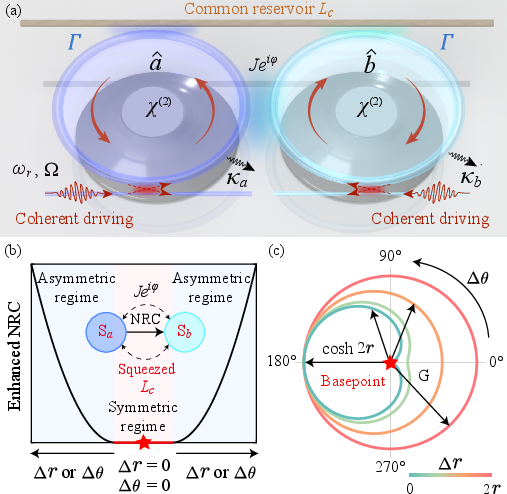
"Enhancing Nonreciprocity through Squeezing-Induced Symmetry Breaking" (2607.00718) develops a general theory for the control of reservoir-engineered nonreciprocal coupling (NRC) in two-mode cavity QED platforms, introducing squeezing-induced symmetry breaking as a principle for exponentially amplifying nonreciprocity. The model comprises two bosonic modes, a and b, coherently coupled as Jeiφ and dissipatively coupled to a common reservoir. Nonreciprocal energy and signal flow emerge via the interplay of coherent and engineered dissipative interactions. Unlike standard magneto-optical mechanisms, this approach leverages dissipative channels for nonreciprocal quantum device concepts.
Figure 1: Schematic of the mode-resolved squeezing-enhanced NRC model, depicting the unitary and dissipative couplings and symmetry breaking between squeezed modes.
The critical insight is that applying quantum squeezing (via parametric amplification with tunable amplitude and phase) to cavity modes enables direct engineering of phase-sensitive gain and symmetry properties—key for NRC enhancement. The effective NRC strength, Jeff, is shown to depend non-trivially on the relative squeezing amplitude and phase between the two modes. The enhancement factor is given by
G=2JJeff=coshracoshrb−eiΔθsinhrasinhrb,
where ra/b and θa/b denote the squeezing amplitude and phase, and Δθ=θa−θb.
Contrary to naive expectations, identical squeezing of both modes does not enhance NRC due to destructive interference; the enhancement is “activated” only when the exchange symmetry between the parameters is broken, e.g., via phase or amplitude mismatch between the squeezing applied to modes a and b. Significant amplification, scaling as b0, is realized for b1 and b2.
Squeezing Control: Reservoir Effects Versus Internal Mode Effects
Squeezing the common reservoir significantly differs from direct mode squeezing: reservoir squeezing does not break exchange symmetry and hence cannot amplify the NRC, although it does induce substantial changes in noise correlation functions and dissipative dynamics. The physics is thus not a simple rescaling of coupling constants; instead, the symmetry structure of the system determines the efficacy and scaling of nonreciprocity enhancement. This insight provides a concrete “design principle” for experimental quantum photonic device engineering; phase-selective mode squeezing relaxes the requirement for strong parametric gain to access robust NRC.
Application to Quantum Batteries
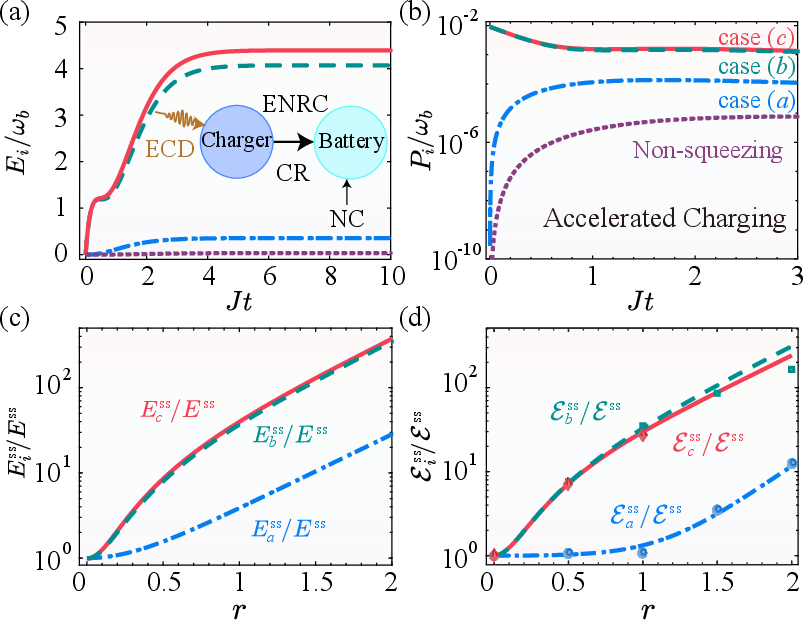
The NRC enhancement mechanism is applied to the framework of quantum batteries—cavity QED subsystems storing quantum work that are energized via nonreciprocal transfer. The model distinguishes three cases: squeezing the charger mode, squeezing the reservoir, and simultaneous squeezing. The quantum battery performance is characterized by stored energy, charging power, and ergotropy.
Figure 2: Temporal and steady-state performance of quantum batteries under various squeezing configurations; exponential improvement in energy storage and charging power manifests under symmetry-broken squeezing.
The results demonstrate exponential enhancement (orders of magnitude over reciprocal cases) in stored energy and charging power when squeezing-induced symmetry breaking is present. The ergotropy, quantifying extractable work, also follows exponential scaling with squeezing strength—a direct consequence of the enhanced nonreciprocal energy flow.
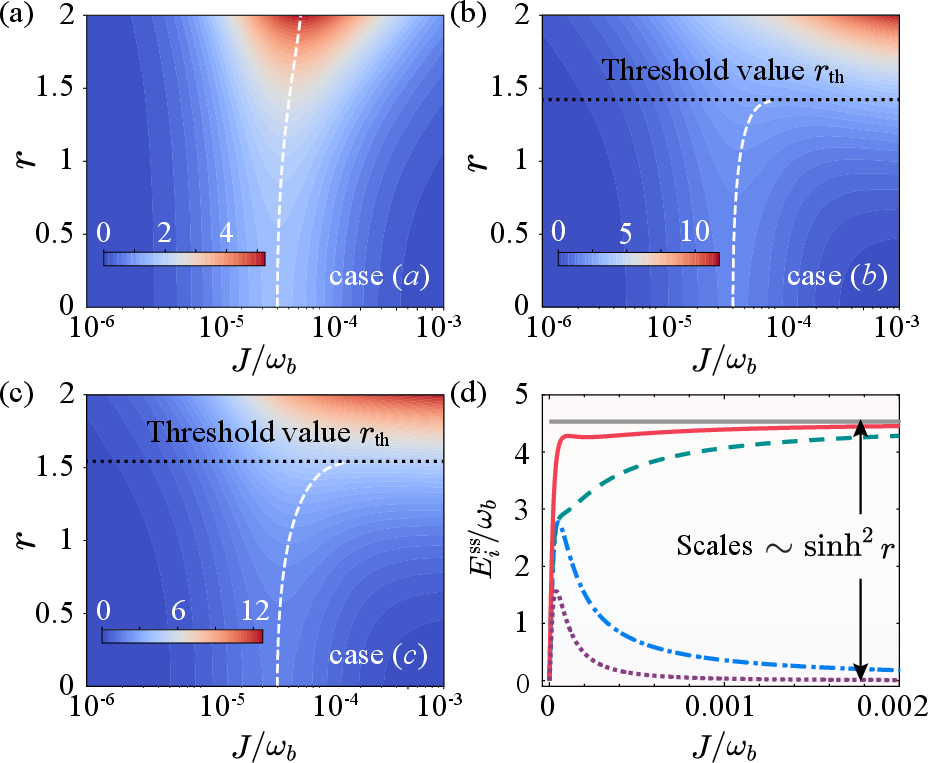
Figure 3: Steady-state battery energy as a function of coupling and squeezing parameters, with optimal matching conditions delineated.
At large squeezing, the stored energy shows a monotonic increase with the squeezing parameter b3 (within the assumed broadband Markovian reservoir regime), while optimal coherent-dissipative coupling rates b4 emerge due to the balance between coherent transport and engineered dissipation. The steady-state values are robust across realistic parameter ranges, with results holding for both strong and weak coupling limits.
Squeezing-Enhanced Optical Isolation
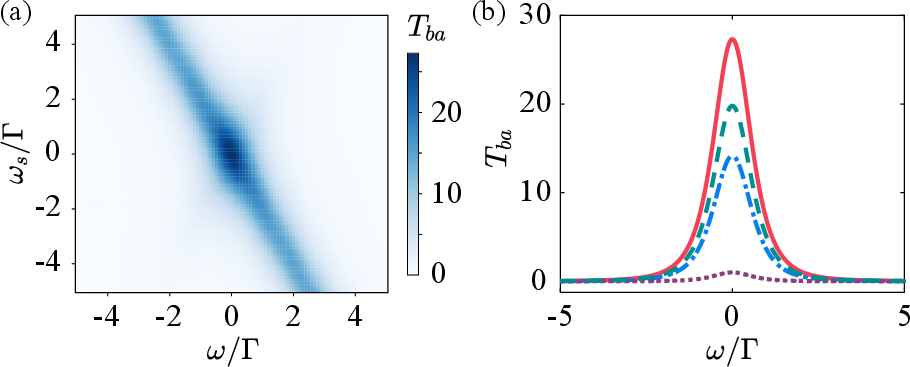
Optical isolation is essential for back-propagation suppression in photonic circuits. The symmetry-controlled squeezing mechanism translates to systematically engineer exponentially amplified unidirectional transmission in isolator configurations. The quantum Langevin formalism reveals that the symmetry-broken squeezing amplifies counter-rotating contributions, enabling dramatic signal gain in the forward direction with vanishing backward transfer.
Figure 4: Transmission coefficient b5 as a function of signal and squeezing parameters, revealing exponential isolation and unidirectionality controlled by squeezing asymmetry.
The entries of the scattering (transmission) coefficient matrix reveal strictly zero transmission in the undesired direction, while the desired direction exhibits a maximum at zero detuning, with a dependence on both the squeezing phase difference and amplitude asymmetry. Explicitly, b6 grows as b7, illustrating the non-linear character of the enhancement.
Practical and Experimental Implications
The results chart a path for leveraging mode-resolved and reservoir squeezing in on-chip quantum photonic platforms. Implementation prospects include high-b8 microring resonators with strong b9 nonlinearity for squeezing, superconducting microwave architectures for tunable coherent and dissipative couplings, and precise phase control for symmetry management. Experimental techniques for reservoir engineering, broadband squeezing injection, and phase-locking are developed to support these regimes. The mechanism extends to generic bosonic systems, with immediate implications for robust quantum battery charging, nonreciprocal signal routing, and dissipative quantum information processing.
Conclusion
Squeezing-induced symmetry breaking establishes a principle for exponential NRC enhancement in system-bath engineered open quantum systems. Mode-resolved, phase-selective squeezing yields strong nonreciprocal response inaccessible in exchange-symmetric or reservoir-only squeezing protocols, consolidating a design rule for nonreciprocal quantum devices. Future research will involve exploring non-Markovian regimes, multi-mode generalizations, and active feedback protocols to further optimize nonreciprocal functionalities and exploit coherent-dissipative interactions for advanced quantum technologies.
“Emergent Mind helps me see which AI papers have caught fire online.”
Philip
Creator, AI Explained on YouTube
Sign up for free to explore the frontiers of research
Discover trending papers, chat with arXiv, and track the latest research shaping the future of science and technology.Discover trending papers, chat with arXiv, and more.