- The paper establishes quantum limits on squeezing by deriving lower bounds on quadrature variances in bosonic networks.
- It employs canonical commutation relations and input-output theory to connect noise budgets with reservoir engineering strategies.
- The work reformulates multipartite entanglement criteria, providing quantitative targets for optimal quantum state preparation.
Quantum Limits on Squeezing: Canonical Constraints and Reservoir Engineering
Introduction
The study titled "Quantum limits on squeezing" (2604.22500) rigorously addresses the quantum constraints governing steady-state squeezing in linear bosonic networks, a class relevant to both fundamental quantum measurement and reservoir-engineered quantum state preparation. By linking canonical commutation relations (CCRs) and input-output theory, the authors derive general lower bounds on the achievable quadrature variances—the so-called “squeezing power”—in dissipative and parametrically driven multimode systems. The framework also reformulates continuous-variable inseparability criteria for multipartite entanglement, with direct applicability to current experimental platforms in opto- and electromechanics.
Commutator Sum Rules and Noise Budgets in Linear Quantum Systems
For an N-mode bosonic Markovian network with external input channels, CCRs enforce “commutator budgets” that directly translate to noise and squeezing constraints. Specifically, in passively linear (number-conserving) systems, the sum rules on commutators manifest as sum rules on the contributions of each input channel to the system's quadrature variances. For independent, quasi-diagonal Markovian dissipation with no unobserved internal losses, the diagonal entries of the commutator transfer matrices Ki satisfy
$\sum_{i}\, (K_i)_{jj} = 1\$
for each mode j. These constraints are agnostic to specific Hamiltonian parametrizations and stem solely from fundamental physical realizability (stability and CCR preservation).
Such formalism generalizes quantum noise constraints beyond traditional amplifier settings—e.g., the Haus-Caves limit [haus_quantum_1962, caves_quantum_1982, caves_quantum_2012-1]—to engineered dissipative platforms wherein the interplay of coherent coupling and dissipation shapes the steady-state properties.
Two-Mode Reservoir Engineering: Minimal Bounds on Squeezing
For the canonical two-mode setup, the effective reservoir-engineered Hamiltonian
H=G+a1†a2†+G−a1†a2+h.c.
can be block-diagonalized into beam-splitter-like dynamics between a mode and an engineered Bogoliubov quasi-mode. When transformed appropriately, this system is rendered passive and reciprocal, and the CCR-induced sum rules become explicit bounds for mode variances.
The paper demonstrates that the normalized sum of minimal quadrature variances
θmin{ΔX1,in2ΔX12(θ)+ΔX2,in2ΔX22(θ)}≥1
cannot be undercut, regardless of interaction strengths, as long as the system is stable and only standard Markovian dissipation is present. In the strong coupling limit, these bounds are saturated.
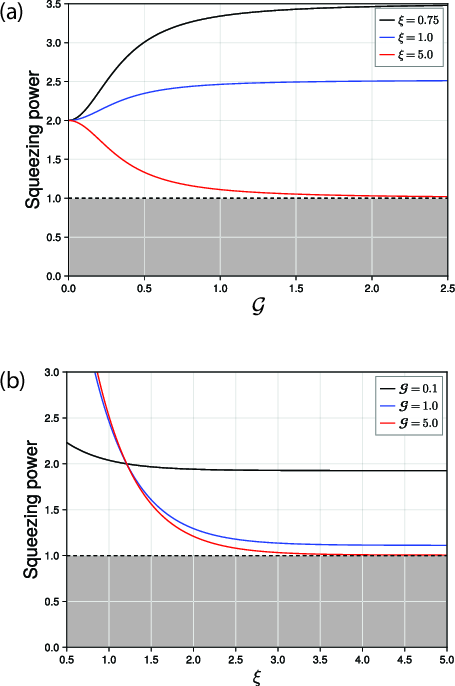
Figure 1: Squeezing power in a purely dissipative two-mode setup as a function of the effective coupling G and the squeezing parameter ξ.
The result is notable for its generality: it is indifferent to details of the reservoir engineering protocol provided the system does not break passivity or inject hidden noise sources. This formalizes the intuition that, in coherent-plus-dissipative protocols, quantum mechanics prohibits simultaneous sub-vacuum squeezing of both modes beyond a collective threshold.
Squeezing Power Modification via Local Parametric Driving
Extending to inclusion of local degenerate parametric terms per mode,
H=G+a1†a2+G−a1a2+η1a12+η2a22+h.c.,
the interplay of driving-induced noise and gain shifts the squeezing power bound.
A generalized lower bound is derived:
ΔX1,in2ΔX12+ΔX2,in2ΔX22≥(γ1+γ2)2−(η1−η2)2(γ1+γ2)2−(η1−η2)(γ1−γ2)
which, upon parameter optimization in the stability region, achieves a minimum at Ki0—asymptotically approaching Ki1 for vanishing damping.
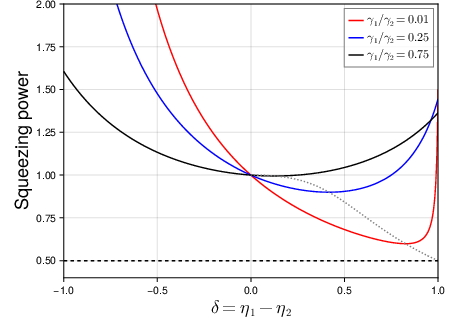
Figure 2: Minimal attainable squeezing power as a function of parametric imbalance Ki2 and damping ratio Ki3.
Hence, the addition of local parametric driving can redistribute the quantum noise budget so that one mode's quadrature is arbitrarily squeezed, with the cost that the other's variance remains bounded from below by half the input value. This reveals a fundamentally distinct limit, not accessible in purely dissipative (passive) scenarios.
For multimode systems engineered to generate and stabilize mechanical entanglement (as in [ockeloen-korppi_stabilized_2018, woolley_two-mode_2014]), the same transfer matrix formalism enables a compact expression of the Duan inseparability criterion. For a symmetric three-mode optomechanical system with two mechanical oscillators coupled via a cavity mode, the canonical collective quadratures Ki4, Ki5 are variances used in the separability inequality
Ki6
The paper expresses this criterion directly in terms of the commutator transfer integral Ki7s and the squeezing parameter Ki8, facilitating the mapping from system parameters (e.g., optical and mechanical bath occupations, dissipation rates, coupling strengths) to the entanglement boundary without full state tomography:
Ki9
Optimization over experimental parameters (such as the effective coupling $\sum_{i}\, (K_i)_{jj} = 1\$0 and squeezing $\sum_{i}\, (K_i)_{jj} = 1\$1) provides a quantitative entanglement boundary on the $\sum_{i}\, (K_i)_{jj} = 1\$2 bath occupation plane.
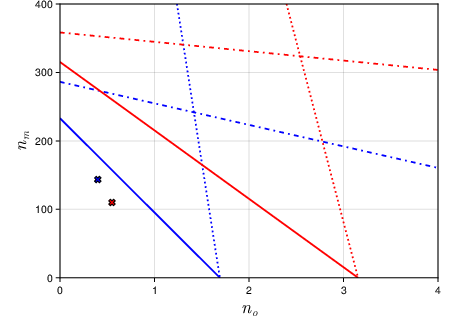
Figure 3: Boundaries between separable and entangled regions for realistic electromechanical experimental configurations, with dependence on effective coupling and squeezing parameter.
The formalism allows direct extraction of the critical optical and mechanical occupations required to violate the separability condition, guiding experimental entanglement optimization strategies.
Implications and Prospective Directions
These results provide a set of fundamental, non-circumventable lower limits on squeezing in engineered linear quantum networks, unifying noise budget and commutator constraints in a model-independent manner. Practically, these bounds inform the design of optimal dissipative or feedback protocols in continuous-variable quantum information processing and macroscopic entanglement generation.
In electromechanical or microwave implementations, they clarify attainable parameters for steady-state squeezing and entanglement at both cryogenic and room temperature scales [pokharel2022coupling], setting quantitative targets for system design. The framework also sharpens the criteria for experimental claims of multimode entanglement, ensuring theoretical rigor.
Future research can generalize these constraints to networks with non-Markovian dissipation, non-Gaussian state preparation, or time-dependent (Floquet) couplings. Additionally, extending to hybrid platforms incorporating spin, superconducting, or photonic degrees of freedom under the same algebraic constraints will further broaden the relevance of these results.
Conclusion
This work systematically characterizes the quantum-limited squeezing power achievable in reservoir-engineered bosonic systems. By elevating commutator-based sum rules to direct noise and entanglement constraints, it delivers a unified, physically realizable framework for analyzing and optimizing quantum state engineering protocols. The identification of nontrivial collective bounds for minimal quadrature variances represents a critical reference for both experiment and theory in continuous-variable quantum technologies.

