- The paper introduces DART, a novel method that leverages weight-space arithmetic to isolate domain-specific adaptation using only a single target demonstration.
- It employs spectral subspace filtering and scaling to denoise update vectors, ensuring robust transfer of vision-language-action policies across varying conditions.
- Experimental results reveal significant performance gains in both simulation and real-world robotics, demonstrating effective adaptation under visual and physical shifts.
Domain Arithmetic: One-Shot VLA Adaptation under Environmental Shifts
Introduction and Motivation
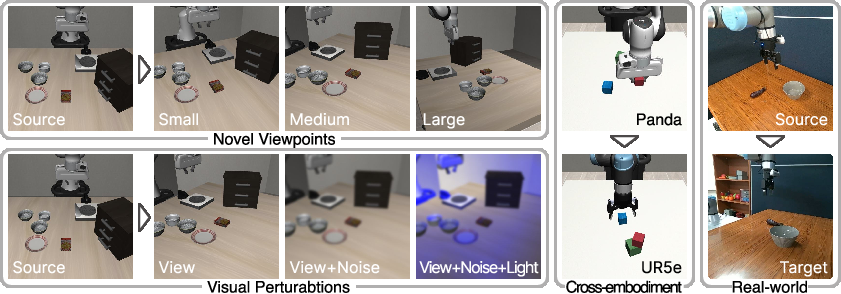
Vision-Language-Action (VLA) models are foundational for enabling robotic systems to interpret and execute language-driven tasks via visual inputs. However, empirical evidence shows that even robust, multi-task VLA policies exhibit severe performance degradation under environmental shifts, including changes in camera viewpoints, sensor setups, or embodiment transfers (e.g., from one robotic platform to another). The principal challenge is that adapting these models to new target domains typically incurs prohibitive data collection costs: existing methods require extensive expert demonstrations for each policy task in the new environment and limited-data adaptation (e.g., one-shot fine-tuning) generally fails to generalize across tasks.
This paper addresses this critical challenge by introducing an analogy-based adaptation method—Domain Arithmetic for One-Shot VLA adaptation (DART)—which leverages weight-space arithmetic and subspace alignment to efficiently transfer domain-specific information using only a single target-domain demonstration.
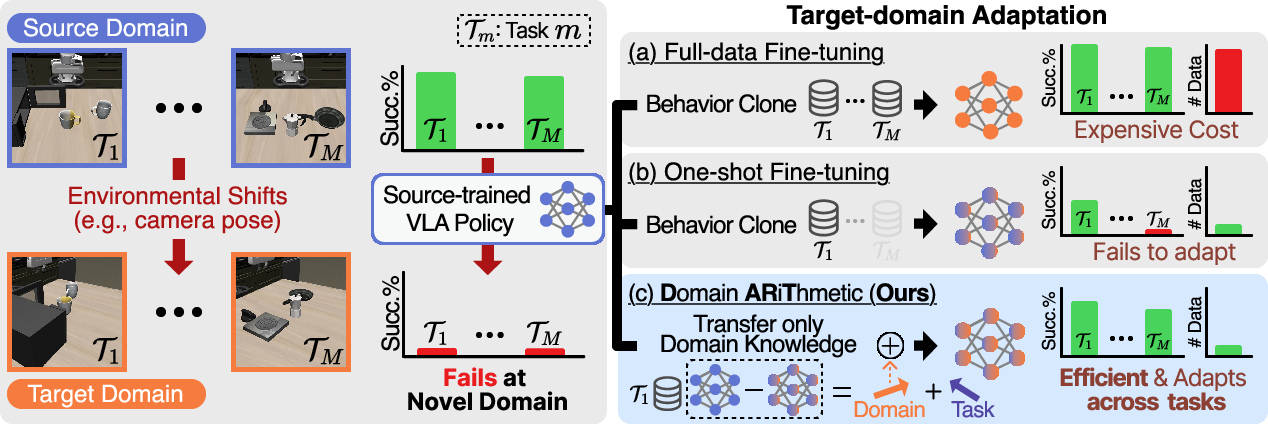
Figure 1: One-shot VLA adaptation under environmental shifts — DART enables adaptation across domains with single demonstration data by extracting domain-specific directions in model parameter space.
Analysis of One-Shot Fine-Tuning and Update Vector Decomposition
Empirical analysis on the LIBERO suite and diverse VLA architectures demonstrates that standard one-shot fine-tuning yields strong adaptation to the target task, but fails to generalize to other tasks due to the adaptation being dominated by task-specific directions. Through subspace similarity measurements using SVD-based alignment metrics, the authors show that parameter updates (update-vectors) decompose into two nearly-orthogonal components: one capturing task-specific features and another encoding domain-specific shifts.
Additive composition experiments confirm that task and domain updates are linearly combinable. Specifically, by averaging update-vectors across tasks (task-prototype) and domains (domain-prototype), the sum of these prototypes closely reconstructs task-domain-specific adaptation vectors, validating the hypothesis of functional disentanglement in the weight space.
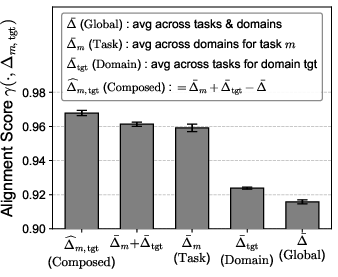
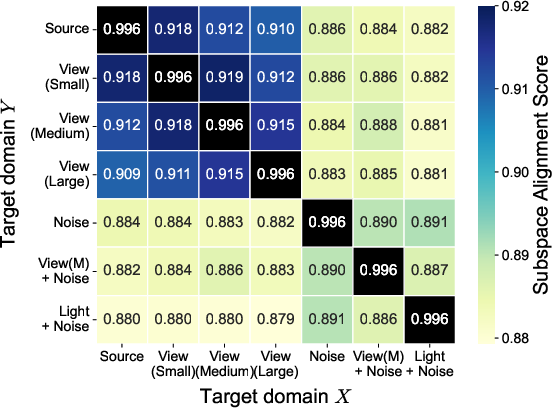
Figure 3: Subspace alignment γ(⋅,Δm,tgt) reveals strong additive structure and alignment between task and domain update prototypes.
DART: Domain Arithmetic for One-Shot Adaptation
Building on the above analysis, DART formulates domain adaptation as an analogy in parameter space: given source (θ0), source fine-tuned (θm,src), and target fine-tuned (θm,tgt) models for a task Tm, DART extracts the domain vector as
δtgt(l)=Δm,tgt(l)−Δm,src(l)
for each layer l, where Δm,⋅(l)=θm,⋅(l)−θ0(l). This operation isolates the component in θm,tgt that is attributable to the domain shift, while removing (via subtraction) the task-specific direction represented in both the source- and target-domain updates.
To further denoise the extraction and prevent the injection of task-irrelevant artifacts, the authors propose two spectral filtering mechanisms:
- Subspace Filtering: Aligns and suppresses basis vectors in the source update-vector that do not strongly align with the target, retaining only the mutually shared subspace directions.
- Subspace Scaling: Down-weights or rejects domain vectors when the subspace alignment metric indicates low similarity, reducing the risk of noise propagation from misaligned updates.
The final adapted model is given by
θ∗=θ0+α⋅δ~tgt
where θ00 is a tunable adaptation strength and θ01 is the subspace-filtered and scaled domain vector.
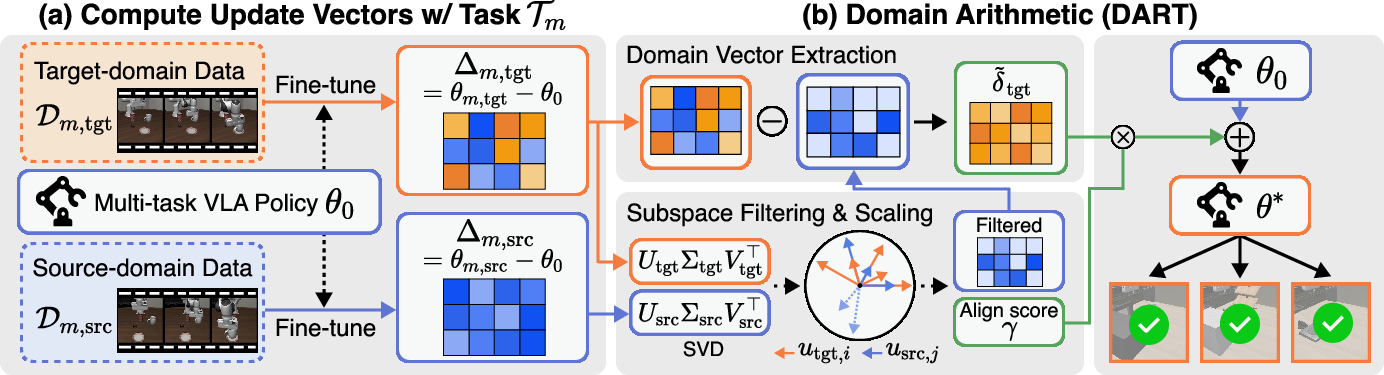
Figure 2: The DART domain adaptation pipeline utilizes a single demonstration from both source and target domains, performing update arithmetic and subspace operations to inject domain-specific knowledge.
Experimental Results
Simulation Benchmarks: Visual and Physical Shifts
DART is evaluated on established simulation benchmarks with diverse visual and physical shifts:
- LIBERO:
- Under viewpoint, lighting, and noise shifts, DART achieves average success improvements up to 24.6 percentage points above one-shot fine-tuning and outperforms prior adaptation baselines (e.g., FLA, RETAIN) across all settings.
- DART demonstrates robust transfer across variations, maintaining composable multi-task behavior with a single demonstration.
- MimicGen (Cross-Embodiment):
Real-World Robotics
In real-world settings, where only a single target domain demonstration per task is available due to cost, DART yields strong performance across all tested manipulation tasks. E.g., on a UR10e robot under severe camera viewpoint shift, DART achieves 81.7% average task success rate, while standard one-shot fine-tuning and parameter-merging baselines plateau at significantly lower rates.
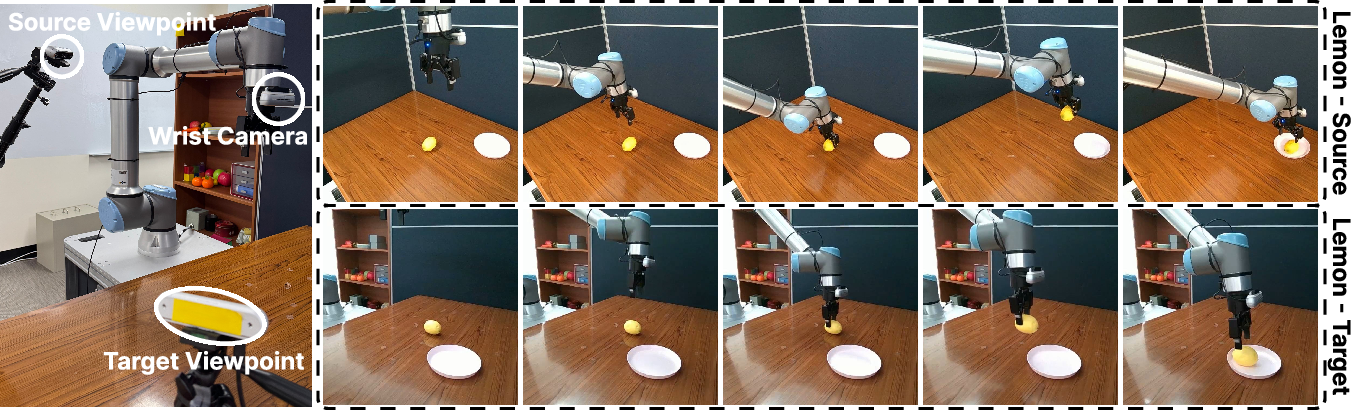
Figure 5: Real-world robot setup and rollouts — DART adapts VLA policies to camera shifts with only a single demonstration under realistic sensor and embodiment conditions.
Ablation and Analysis
Ablation studies confirm that subspace filtering and scaling are both necessary for stable domain vector extraction, especially as update-vectors become increasingly noisy with limited fine-tuning steps. Furthermore, analyses show that merged domain vectors are composable: vectors from different domains can be added to adapt to multiple shifts, and forgetting on the source domain is minimal after adaptation.
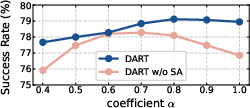
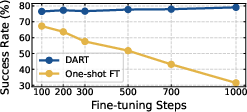
Figure 8: Performance as a function of the scaling coefficient θ02 demonstrates DART’s broad robustness.
Implications and Future Directions
The ability to efficiently adapt VLA models to new environments with only a single demonstration has substantial implications for practical robotics. DART’s insights—most notably, the nearly orthogonal decomposition of task and domain updates—indicate an underlying structure in deep model parameter spaces that is amenable to algebraic manipulation. This abstraction enables rapid adaptation, greater data efficiency, and furthers the generalization potential of VLA models.
Open questions for future work include extracting more precise domain vectors under extreme shifts, exploring hyperparameter-free, per-layer adaptive scaling, and investigating whether similar arithmetic operations extend to reasoning about higher-level factors of variation, such as affordances or interaction intents.
Conclusion
This work introduces DART, a one-shot, analogy-based domain adaptation method for VLA models via weight-space arithmetic and subspace alignment. Comprehensive experimental results demonstrate strong, scalable adaptation across visual and physical domains—both in simulation and on real hardware—using only a single demonstration per target environment. DART reveals additive, disentangled structure in VLA parameter updates and provides a data-minimal, architecture-agnostic framework for practical deployment of vision-language-action agents across novel domains.
(2607.00666)