- The paper demonstrates that SKA-LOW’s spectral range (50–350 MHz) and enhanced sensitivity enable stage-resolved imaging of lightning processes, from initiation to VHF emission.
- It introduces innovative imaging techniques using raw-voltage buffer dumps and near-field TRID methods to capture transient, sub-threshold streamer events.
- The paper highlights that SKA-LOW’s strategic location and technical capabilities can significantly advance our understanding of thunderstorm electrification and plasma dynamics.
Probing Lightning's Physical Processes with SKA-LOW
Introduction
The study provides a comprehensive analysis of the potential of the SKA-LOW array for advancing observational lightning physics. Building on the progress established by radio interferometers such as LOFAR, the authors make a case that SKA-LOW’s combination of unprecedented spectral bandwidth (50–350 MHz), sensitivity, and extensive baselines can resolve unresolved questions about lightning initiation, propagation, and VHF emission mechanisms. The discussion covers the limits of current instrumentation, computational modeling bottlenecks for plasma dynamics, and a detailed breakdown of the new scientific and technical capabilities that SKA-LOW introduces for terrestrial lightning research.
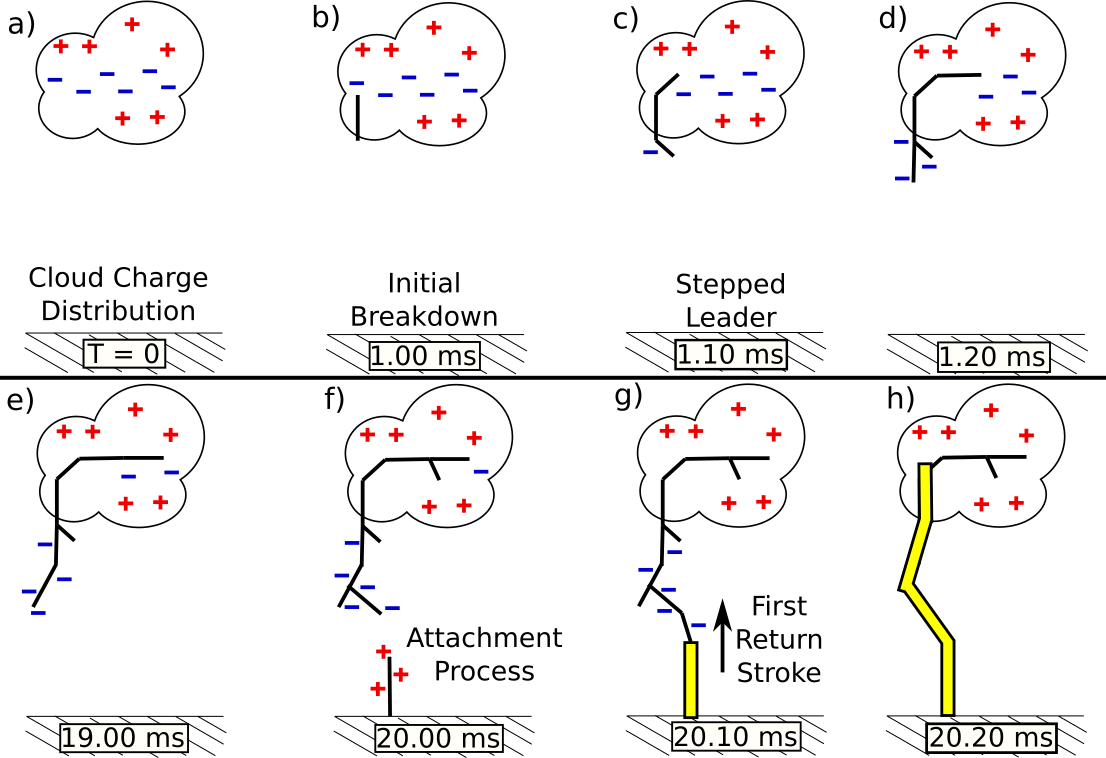
Figure 1: Illustration of principal lightning processes—charge distribution, initiation, leader propagation, ground connection, and return stroke—underpinning the radio emission mechanisms.
Current Status of Lightning Physics and the Role of Radio Arrays
Despite significant interest in the plasma physics community, fundamental aspects of lightning remain poorly understood because of the opacity of thunderclouds, rapid time scales (up to nanoseconds), and the complexity of involved multi-scale plasma dynamics. Key unresolved domains include the details of dielectric breakdown during initiation, multi-scale leader channel formation, and the origin of high-energy VHF and gamma emission bursts. Streamer dynamics—fine-scale SSW ionization waves—play a hypothesized central role but elude direct modeling beyond a handful of filaments, owing to computational constraints.
Radio interferometry, especially high-resolution networks such as LOFAR, revolutionized intracloud lightning imaging, providing meter-scale spatial and nanosecond-scale temporal data. These capabilities permitted the identification of phenomena such as "needles"—negative breakdown episodes on positive leaders—and high-precision mapping of leader and return stroke trajectories.
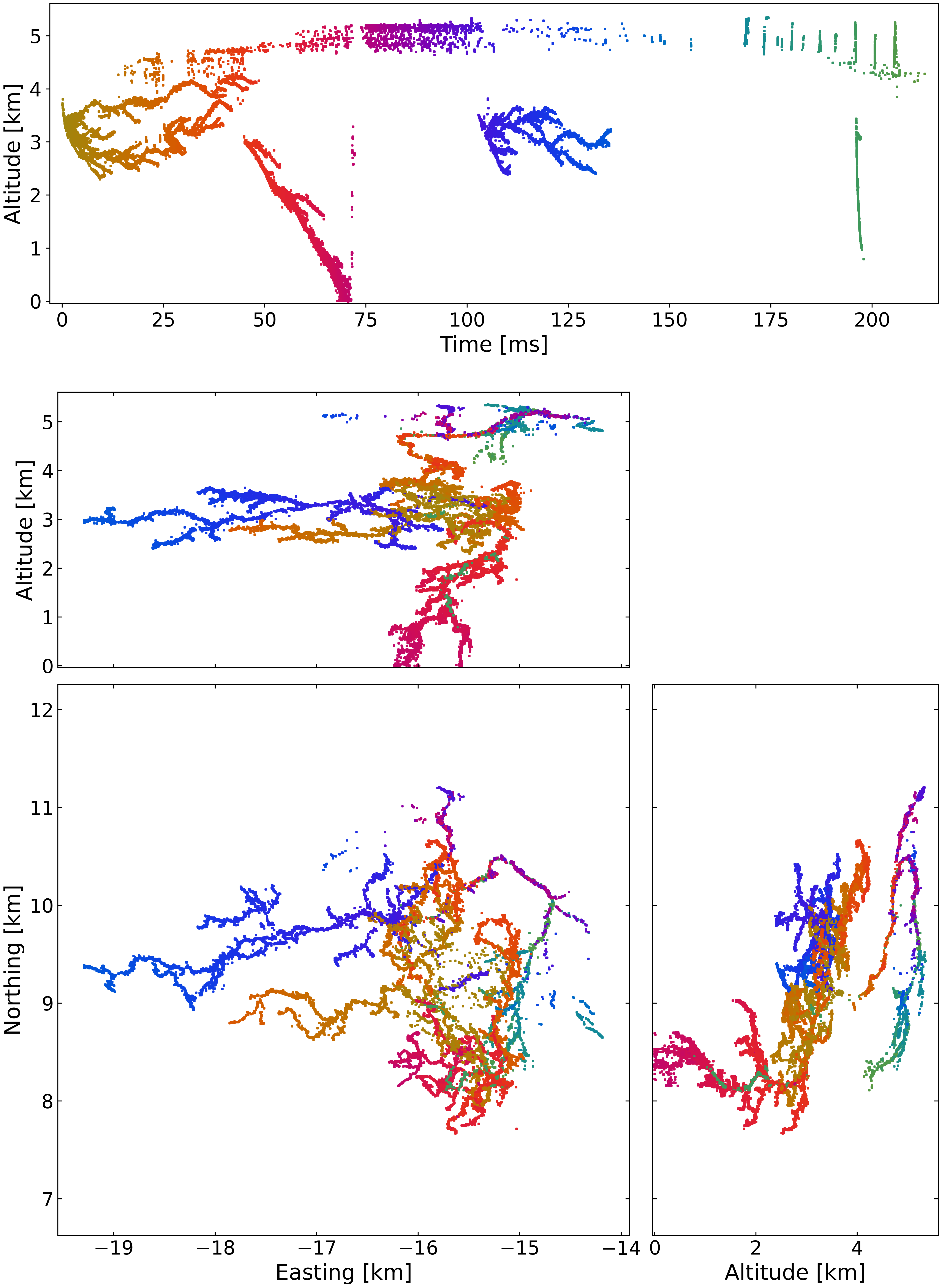
Figure 2: 3D radio interferometric reconstruction of a representative lightning flash observed by LOFAR, displaying source locations and their temporal evolution via VHF emission.
VHF Radio Emission Mechanisms: Models and Open Questions
The dominant mechanism for VHF emission remains debated. Empirical evidence suggests that emission primarily originates from compact streamer discharges at the leader tip, rather than the hot, conductive core itself. Theoretical and simulation work points to three viable mechanisms:
- Exponential Streamer Growth: Early streamer proliferation may radiate lower VHF, but the spectrum should cut off at higher VHF.
- Streamer Collision/Merging: Counter-propagating, oppositely charged streamers, when interacting, produce abrupt current surges capable of broad-band VHF emission.
- Stochastic Photoionization: Rare, high-energy photons introduce rapid, Poissonian fluctuations in streamer evolution, potentially exciting a broad, distinct VHF signature.
However, these models are limited to simulations of only a small number of streamers, while lightning leaders involve millions, implying likely emergent collective phenomena inaccessible to current modeling frameworks.
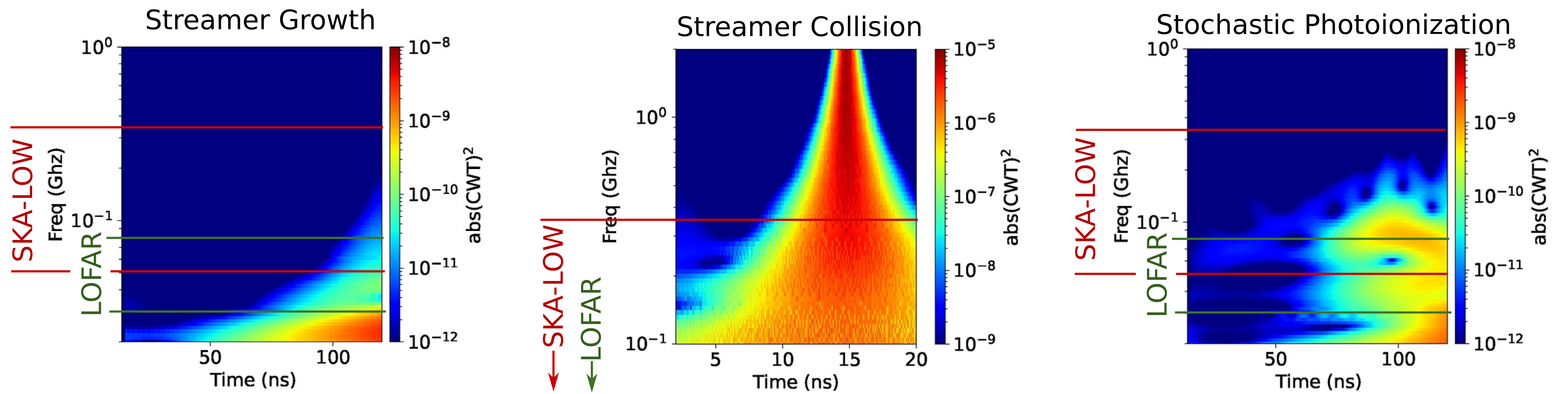
Figure 3: Comparative VHF emission spectra predicted by exponential streamer growth, streamer collision, and stochastic photo-ionization models, highlighting spectral and temporal distinctions. The SKA-LOW and LOFAR frequency bands are indicated for context.
Most lightning observations have focused on 30–100 MHz, leaving higher VHF signatures largely unexplored. Broadband measurements indicate differences in spectral cutoffs for positive versus negative leaders, providing indirect diagnostics of thunderstorm electric field strength and plasma parameters. The SKA-LOW bandwidth and SNR will enable systematic, stage-resolved spectral and spatiotemporal measurements of VHF emission through all lightning phases, constraining or discriminating between competing models. If, for example, streamer collision is found to dominate, this demonstrates large-scale interaction networks among streamers near leader tips.
Imaging Weak Processes: Initiation and Positive Leader Propagation
A major unknown is the initiation of lightning, which not only remains inaccessible to optical and most radio methods but is also exceedingly faint in VHF. LOFAR is capable of imaging late-stage initiation when source power exceeds system noise, but cannot probe the earliest streamers, nor observe failed incipient breakdown events, whose frequency and role remain unknown. The same applies for the VHF-quiet propagation phases of positive leaders—despite a surplus of ionization activity, VHF radiative coupling is either absent or below sensitivity thresholds in all but the rarest cases or under high-propagation speeds. The reasons for these asymmetries between positive and negative leader emission are unresolved but likely relate to subtle plasma kinetics and thunderstorm electrical microenvironment, inaccessible by previous-generation arrays.
SKA-LOW’s sensitivity fundamentally expands the parameter space for these observations: it enables the detection of sub-threshold streamer bursts, provides robust statistics on failed breakdown, and allows the reconstructive imaging of leader structures previously invisible in VHF. This will directly impact our understanding of thunderstorm charge structure, replenishment, and the statistical nature of electrical breakdown in the atmosphere.
Geographical and Climatological Expansion: Studying Energetic Phenomena
LOFAR is limited to low-altitude, low-energy European thunderstorms, restricting the observable range of phenomena. In contrast, SKA-LOW’s siting in Western Australia increases the expected lightning event energy and altitude, penetrating deeper into the parameter space of high-altitude, high-energy flashes, including upward jets, fast breakdown events, and transient luminous events. Fast breakdown, a phenomenon associated with initiation and typified by rapid, intense VHF emission not linked with a hot leader core, has not been observed by LOFAR, potentially due to climatological limitations. High event rates, global charge structure diversity, and the anthropogenic electromagnetic background are all essential factors that SKA-LOW’s location optimally addresses.
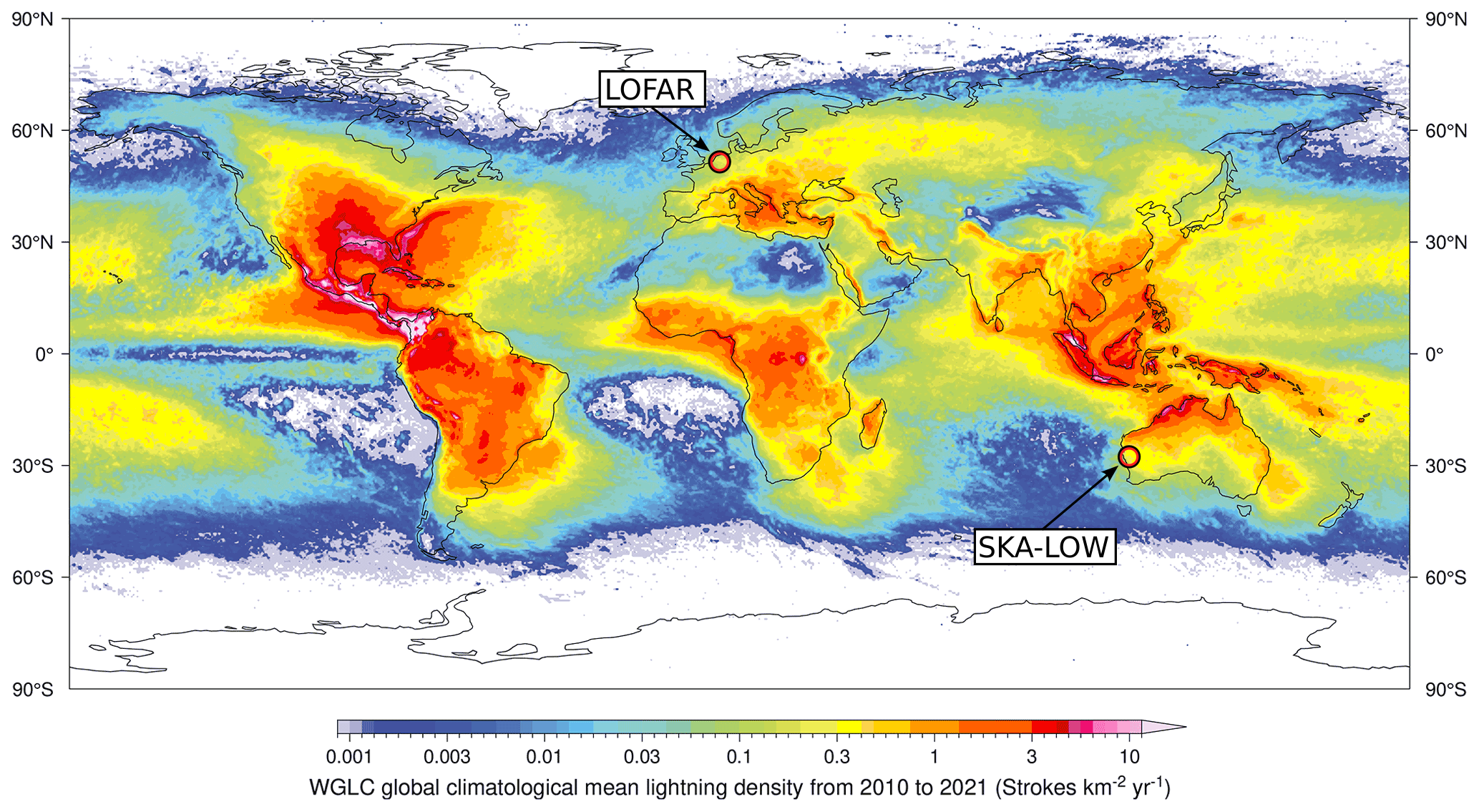
Figure 4: Global lightning flash density showing enhanced activity and more energetic storms at SKA-LOW’s geographical location compared to the Netherlands.
Technical Implementation: Imaging and Triggering
As lightning occurs in the near field and evolves much faster than conventional visibility integration times, SKA-LOW will bypass standard astronomical pipelines. The system will operate by raw-voltage buffer dumps triggered externally or by self-triggering on impulsive events. Post-processing uses the impulsive imager (high-throughput, time-of-arrival analysis) for full-flash imaging, transitioning to a near-field TRID approach for short-leader or initiation event localization, enabling ~10 cm accuracy and full 3D dipole parameter reconstruction. The anticipated increases in sensitivity with future SKA-LOW rollouts (AA*) and longer baselines will particularly benefit the study of the weakest phenomena.
Implications and Future Prospects
SKA-LOW introduces new possibilities for multi-stage, multi-regime lightning physics: identifying the microscopic processes behind VHF emission, elucidating asymmetric channel development, and exposing previously hidden energetic and faint atmospheric electrical events. This paradigm enables direct interfaces between multi-scale computational modeling and empirical spatiotemporal/spectral data, a critical juncture for atmospheric plasma physics.
Practically, these capabilities will impact thunderstorm electrification models, atmospheric chemistry (by quantifying failed and successful breakdowns), and may provide a diagnostic for testing SKA system timing and calibration fidelity. From a theoretical standpoint, the high-resolution and high-SNR dataset will inform the development of improved collective streamer kinetic models and validate emergent hypotheses regarding leader branching, retriggering mechanisms (e.g., dart leaders), and global lightning energetics.
Conclusion
The SKA-LOW array positions itself as a pivotal instrument for resolving foundational uncertainties in lightning physics. By bridging detection sensitivity, spectral range, rapid triggering, and high-resolution imaging, it facilitates direct access to intra-cloud processes, emission mechanisms, failed and successful initiation, and the global variation of lightning. This will advance our understanding far beyond what is possible with existing arrays, catalyzing progress at the interface of observational geophysics, non-equilibrium plasma physics, and atmospheric science.