- The paper demonstrates that quantum-informational observables from Gaussian inflationary fluctuations maintain invariance under Wands' duality, revealing a hidden symmetry in quasi-de Sitter backgrounds.
- It employs a continuous-variable Gaussian formalism to analyze covariance matrices, showing that individual matrix entries differ while the symplectic eigenvalues remain identical across dual backgrounds.
- Numerical and analytical results indicate that standard measures like entanglement entropy, mutual information, and logarithmic negativity are unable to distinguish between dual inflationary histories using local Gaussian probes.
Introduction and Motivation
The paper "Hidden quantum-informatic symmetries of quasi-de Sitter backgrounds" (2607.00636) explores the persistence of degeneracies between quasi-de Sitter inflationary backgrounds, characterized by Wands' duality, within the context of real-space quantum correlations. The research focuses on whether entanglement and related quantum-informational observables between coarse-grained, localized field regions remain sensitive to differences in background cosmological evolution, despite their indistinguishable behavior in traditional configuration space measures (i.e., the Mukhanov-Sasaki power spectrum).
The motivation lies in the intersection of relativistic quantum information theory and early universe cosmology, with the goal of revealing to what extent quantum origins of primordial perturbations may be constrained or revealed by local quantum probes. Specifically, understanding whether quantum informational metrics—entanglement entropy, mutual information, quantum discord, log-negativity—are capable of differentiating between different inflationary histories related by Wands' duality presents a stringent test for the observational distinguishability of quantum features in the inflationary paradigm.
Wands' duality arises when different background inflaton evolutions yield identical linearized dynamics for the Mukhanov-Sasaki variable, vk. In these dual backgrounds—exemplified by slow-roll (SR) and ultra slow-roll (USR) inflation—mode equations, initial vacuum choices, and thus configuration space correlation functions coincide, even though phase-space structure (i.e., momenta conjugate to vk) and curvature observables can differ significantly.
The authors deploy a continuous-variable Gaussian formalism. Two spatially separated, coarse-grained modes are defined using smooth window functions, leading to a bipartite Gaussian quantum state characterized by a real-space covariance matrix γ. This matrix encodes all second-moment correlations: field-field, field-momentum, and momentum-momentum between the two regions.
Quantum-informational measures such as entanglement entropy and mutual information are determined by the symplectic spectrum of γ, i.e., its canonical symplectic eigenvalues, which are invariant under local linear canonical transformations.
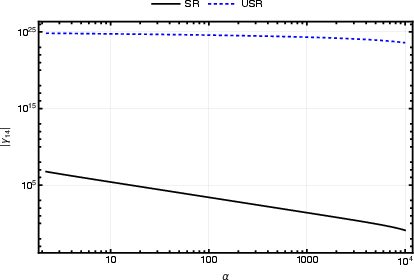
Figure 1: Component ∣γ14∣ of the covariance matrix in SR and USR backgrounds as a function of patch separation; the sign and magnitude of this entry differ, demonstrating covariance matrix non-invariance under Wands duality.
The explicit construction and analysis (as seen in Figure 1) confirm that individual entries of the covariance matrix can differ non-trivially between dual backgrounds. In particular, even sign reversals can occur, indicating that the local bipartite real-space statistics retain memory of the underlying background.
Despite these differences in the covariance matrix, the critical finding of the paper is that the symplectic eigenvalues {σ±}—the fundamental invariants under local, scale-independent canonical transformations—are precisely the same for any Wands-dual pair. This result is initially demonstrated explicitly for the SR/USR pair and then generalized to constant-roll (CR) backgrounds via analytic manipulation involving Hankel functions, ensuring that the argument holds across all backgrounds yielding the same effective mass term in the Mukhanov-Sasaki equation.
Consequently, measures derived from the symplectic spectrum—entanglement entropy, mutual information, quantum discord, logarithmic negativity—cannot distinguish between dual inflationary backgrounds, provided the state is Gaussian and the transformation connecting the backgrounds is local and k-independent.
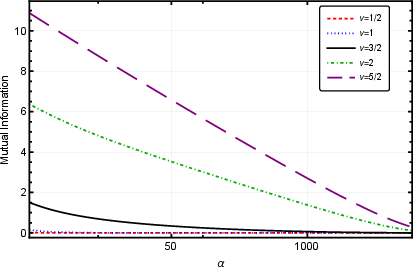
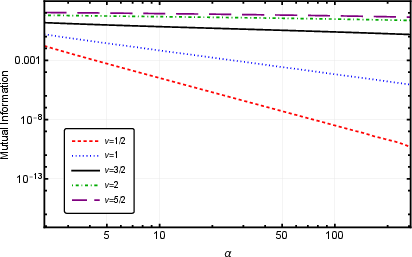
Figure 2: Mutual information between two local modes as a function of their separation, shown for various Wands dual pairs and for both linear and logarithmic scales; the decay with separation and growth with Hankel index ν are evident and identical for each dual realization.
Figure 2 evidences that mutual information decays monotonically with increased separation, and that larger Hankel index ν—corresponding to more rapidly rolling backgrounds—increases overall quantum correlations, but with no distinction between dual pairs with the same ν.
Logarithmic Negativity and the Invariance under Duality
The investigation extends to logarithmic negativity, a rigorous entanglement witness. Even though the partial transpose operation alters the covariance matrix, the minimal symplectic eigenvalue used to compute logarithmic negativity, vk0, remains invariant under the local, vk1-independent symplectic transformations induced by Wands' duality. The result is that, for all examined (and by extension, all) Wands-dual backgrounds, bipartite log-negativity is identical—typically zero for regions separated by superhorizon distances, confirming the absence of detectable real-space entanglement in the regime of interest.
Theoretical Implications
The main conclusion is that in the domain of linearized, Gaussian quantum fluctuations during inflation, the entire symplectic spectrum—the complete set of quantum-informational observables accessible via local, scale-insensitive bipartite probes—manifest a new invariance under Wands duality. This "quantum-informatic symmetry" extends the power spectrum degeneracy of Wands duals into the full informatic content of local Gaussian quantum fields.
Theoretical implications are multi-fold:
- Primordial quantum probes have limited discriminatory power: No local linear Gaussian probe (including future CMB Bell-type cosmological tests) can distinguish between Wands-dual inflationary histories.
- Group-theoretical interpretation: The duality arises because the canonical transformation connecting duals is generated by local, vk2-independent elements of vk3, and thus commutes with all procedures used to construct real-space covariance matrices and their symplectic invariants.
- Window-independence and generality: Results do not depend on the specific coarse-graining filter choice, and generalize trivially to multi-partite settings.
Importantly, this symmetry only applies to the Gaussian sector of linearized perturbations and thus does not contradict observable differences in curvature or power in non-linear regimes; it breaks down as soon as scale-dependent (or nonlinear) canonical transformations are introduced (e.g., in transitions between phases or in the presence of interactions or non-Gaussianities).
Numerical Observations and Strong Claims
A particularly strong numerical result is that for all physically plausible choices of background parameters, smoothing scales, and separations, quantum-informational observables (entanglement entropy, mutual information, log-negativity) are strictly invariant under Wands duality up to computational accuracy. Figure 1 directly visualizes the divergent covariance matrix entries, while Figure 2 confirms the matching mutual information profiles between dual pairs.
The assertion that "all entropic and correlation measures (entanglement entropy, mutual information, quantum discord, and so on) can be expressed in terms of these symplectic invariants" and are thus unable to distinguish dual backgrounds is robustly supported by both analytic derivations and numerical plots.
Prospective Developments and Future Directions
This work suggests several directions for further research:
- Beyond Gaussianity: Incorporating non-Gaussian statistics and exploring the breakdown of quantum-informatic symmetry under nonlinear canonical transformations.
- Transitions and Scale Dependence: Studying scenarios with transitions between inflationary phases, where the vk4-independence of the canonical transformation fails and Wands symmetry is expected to be violated.
- Observational Relevance: Assessing whether quantum-informatic invariance imposes limits on the design of cosmological `quantum tomography' or Bell-type experiments probing inflationary initial states.
- Enhanced signal regimes: Deeper examination if multi-phase or excited-initial-state scenarios might enhance quantum-informational signals or partially lift the duality-induced degeneracy, given practical windowing and finite cosmic variance constraints.
Conclusion
The study reveals a new quantum-informatic symmetry for Gaussian fluctuations in quasi-de Sitter backgrounds: all quantum-informatic measures computed from covariance matrices of locally smeared, spatially separated modes are invariant under Wands' duality. This result extends the reach of configuration-space degeneracy to real-space quantum observables, drastically limiting the ability of Gaussian quantum probes to extract information about the inflationary background. Answers to whether this invariance holds beyond the Gaussian sector, and how it is affected by scale dependence or nonlinear dynamics, are pivotal for future theoretical and observational cosmology.