- The paper introduces pseudo entropy as a new quantum diagnostic that distinguishes cosmological perturbation states via amplitude and phase information.
- It employs analytic expressions for two-mode squeezed states to demonstrate saturation and phase freezing in de Sitter and FLRW settings.
- Findings juxtapose pseudo entropy with entanglement and circuit complexity, highlighting its sensitivity to cosmological dynamics and equation-of-state changes.
Introduction
This paper introduces pseudo entropy S as a quantum information-theoretic diagnostic tailored to cosmological perturbations. Extending the entanglement entropy framework, pseudo entropy quantifies the distinguishability between two quantum states via a transition matrix, thereby acquiring sensitivity to both squeezing amplitude and relative squeezing phase. The paper emphasizes the imaginary component of pseudo entropy—which encodes phase information absent in conventional entanglement entropy, circuit complexity, and Krylov complexity. By analyzing scalar perturbations in de Sitter and FLRW backgrounds across expanding and contracting regimes with varying equation-of-state parameter w and sound speed cs, the authors demonstrate pseudo entropy's utility in tracking cosmological evolution and its relation to other quantum complexity measures.
Pseudo entropy S(TAψ∣φ) generalizes entanglement entropy through the transition matrix Tψ∣φ=⟨φ∣ψ⟩∣ψ⟩⟨φ∣, where ∣ψ⟩ and ∣φ⟩ are distinct quantum states. The reduced transition matrix for subsystem A is obtained by tracing out complementary degrees of freedom. Unlike the von Neumann entropy, pseudo entropy can be complex-valued due to non-Hermiticity, with a physically significant imaginary part Im(S) sensitive to quantum phases.
For two-mode squeezed states (the archetype for cosmological perturbations), the pseudo entropy has a closed analytic form: S(TAψ∣φ)=−log(1−q)−1−qqlogq
where w0 parameterizes squeezing amplitudes and relative phases. The real part measures quantum correlations, while the imaginary part detects relative phase accumulation.
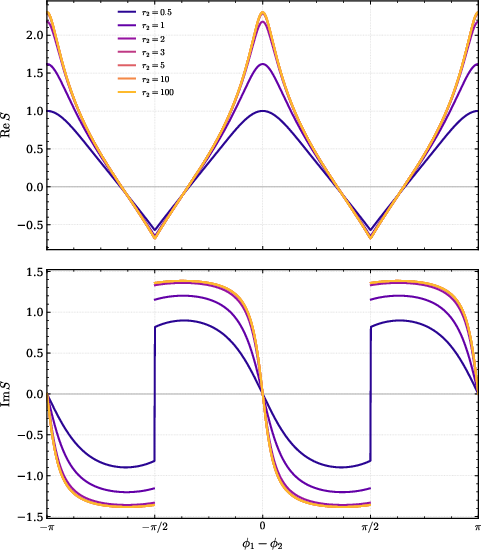
Figure 1: Real and imaginary components of pseudo entropy w1 as a function of w2 for a fixed w3 and growing w4, showing rapid envelope saturation for large squeezing.
Pseudo Entropy Evolution in de Sitter Backgrounds
The pseudo entropy's evolution is analyzed in de Sitter space for different effective sound speeds w5 (with w6). Exact solutions for squeezing parameters reveal that the real part w7 increases post-horizon crossing and eventually saturates, in contrast with entanglement entropy's continuous growth. Saturation is governed by phase freezing; when the squeezing phase ceases to evolve, the distinguishability between initial and final states halts, producing an asymptotic plateau.
Pseudo entropy's imaginary part decays to zero at late times in de Sitter and expanding-accelerating backgrounds, but exhibits observable transient negative dips whose temporal locations are modulated by w8.
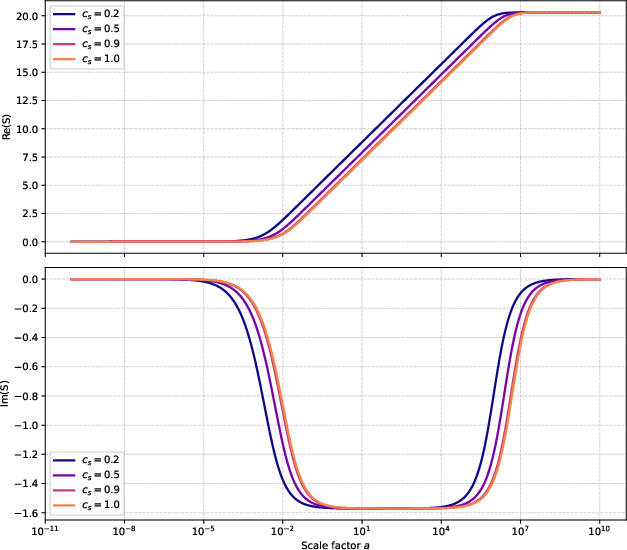
Figure 2: Real and imaginary parts of pseudo entropy vs. scale factor w9 for a fixed reference squeezed state and varying sound speed, highlighting saturation regimes.
Further, the choice of reference state influences late-time saturation. Larger initial squeezing delays cs0 saturation, with the plateau height proportional to the reference amplitude; the imaginary part's transient dip becomes deeper and occurs later for greater initial squeezing.
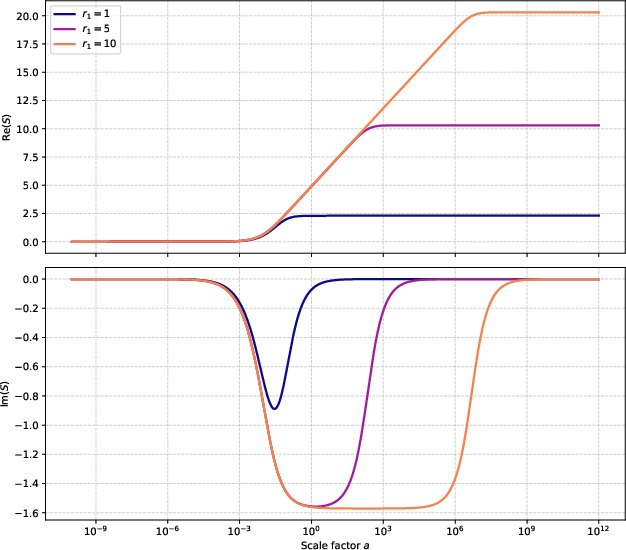
Figure 3: Pseudo entropy vs. scale factor cs1 in de Sitter background, showing sensitivity to initial squeezed state parameters.
Pseudo Entropy Across FLRW Expanding and Contracting Regimes
For FLRW backgrounds, numerical integration of squeezing evolution equations exposes distinct pseudo entropy profiles in expanding-accelerating, expanding-decelerating, contracting-accelerating, and contracting-decelerating settings.
In expanding-accelerating backgrounds (cs2), cs3 grows and saturates post-horizon exit, with the saturation scale determined by cs4. The imaginary part transitions from oscillations to a stable value.
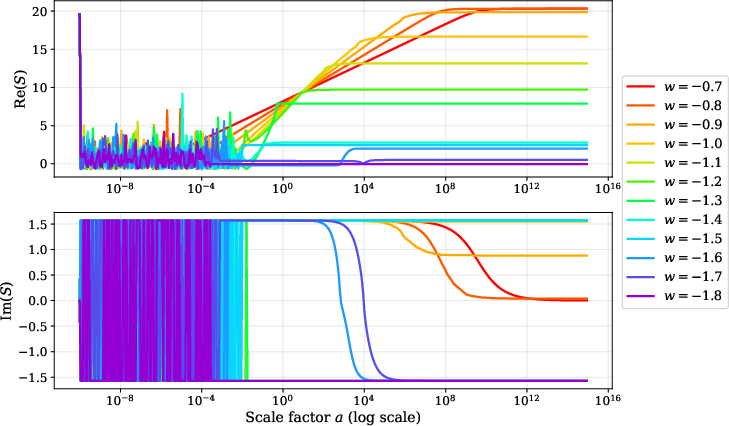
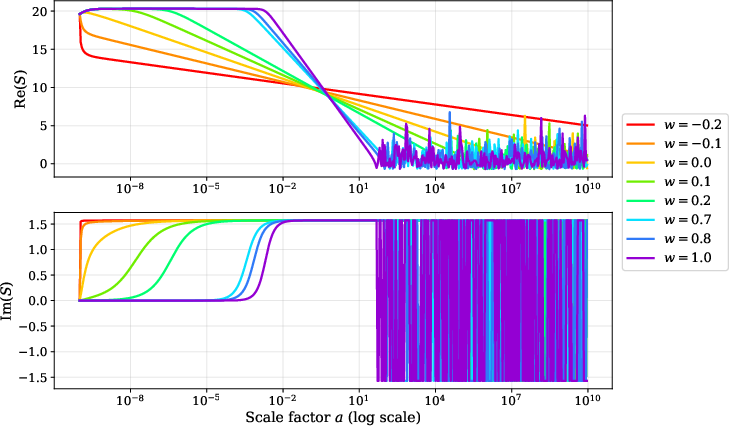
Figure 4: Pseudo entropy in expanding backgrounds, with accelerating and decelerating cases for varying cs5, exhibiting saturation and oscillatory transitions.
In expanding-decelerating scenarios (cs6), modes start super-horizon, yielding constant cs7, followed by sharp oscillations after horizon re-entry as squeezing phase resumes evolution. Contracting backgrounds mirror these features in time-reversed order, with similar dependence on cs8 and mode re-entry.
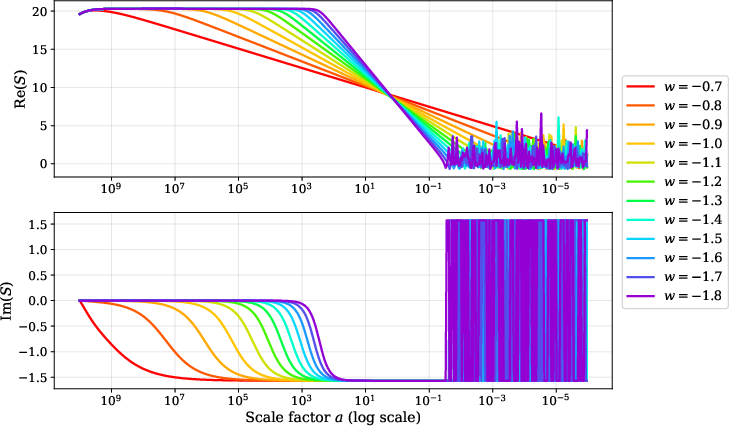
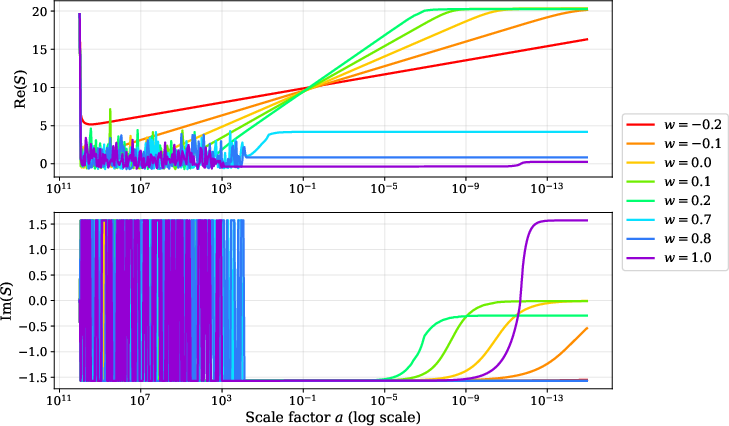
Figure 5: Pseudo entropy in contracting backgrounds, highlighting oscillatory behavior and late-time plateauing with the cs9-axis inverted for contracting evolution.
Comparison with Entanglement Entropy and Complexity Measures
Pseudo entropy captures information distinct from entanglement entropy (which is phase-blind) and Krylov complexity (which is amplitude-dependent). The key differentiator is relative phase sensitivity: pseudo entropy detects the accumulated phase between two cosmological times, whereas Nielsen's geometric circuit complexity depends on the absolute squeezing phase—tied to reference state and circuit definition and subject to ambiguities in the transition regime.
Remarkably, in the unsaturated regime, the growth slope of S(TAψ∣φ)0 with respect to S(TAψ∣φ)1 is universally S(TAψ∣φ)2 times the circuit complexity slope. Explicitly: S(TAψ∣φ)3
with circuit complexity slope S(TAψ∣φ)4.
Pseudo entropy continues to track S(TAψ∣φ)5 post-saturation, whereas circuit complexity saturates, thereby offering greater sensitivity to cosmological equation-of-state transitions.
Implications and Future Directions
Pseudo entropy offers a computationally tractable and physically insightful probe of quantum cosmological dynamics, sensitive to both squeezing amplitude and relative phase. Its imaginary part provides access to information inaccessible by other complexity or entanglement measures.
Theoretically, the paper highlights open questions associated with branch choices for the complex logarithm in Lorentzian spacetimes, and the operational interpretation of the imaginary component. Extensions beyond linear theory—including modes coupled by nonlinearities and interactions between scalar fields—are proposed as future directions. The authors also suggest exploring pseudo entropy in systems that exhibit topological transitions or quantum chaos, and investigating computational complexity definitions for transition matrices in broader quantum settings.
Conclusion
Pseudo entropy encapsulates both amplitude and phase information of cosmological perturbations, yielding real and imaginary components that respond to the equation-of-state parameter, mode history, and reference state. Saturation occurs with phase freezing in accelerating backgrounds, while oscillatory regimes and super-horizon erasure characterize decelerating and contracting cases. Quantitative relations are established between pseudo entropy growth rates and cosmological parameters, and S(TAψ∣φ)6 proves to be a finer diagnostic compared to conventional complexity and entropy metrics. Future research may clarify the operational meaning of the imaginary part, extend the analysis to nonlinear regimes, and leverage pseudo entropy for detecting quantum phase transitions and chaos.

