- The paper's main contribution is a configuration-based framework that classifies superradiant phases and multistability in coupled Dicke lattices.
- It demonstrates that photon hopping and spatial symmetry breakings yield distinct equilibrium and nonequilibrium universality classes with measurable critical exponents.
- The methodology scales to larger lattices, providing predictions for complex spatial orders and offering experimental routes in cavity and circuit QED systems.
Configuration-Based Classification of Superradiant Phases in Dicke Lattices
Introduction
This work develops a configuration-based theoretical framework for understanding superradiant phase transitions (SRPTs) in Dicke lattices, which are fundamental in both quantum optics and nonequilibrium statistical mechanics. Dicke lattice models constitute arrays of coupled cavity QED systems, each containing an ensemble of two-level atoms collectively coupled to a cavity mode, with photon hopping mediating inter-site interactions. The paper presents a unified symmetry-oriented method for classifying the steady-state (dissipative) multistabilities and equilibrium ground-state phases that emerge in finite Dicke lattices, extending the analysis to N=3 through N=6 sites and distinguishing between equilibrium and nonequilibrium universality classes.
Model and Configuration Classification
The considered system consists of N coupled Dicke units on a ring, each modeled by the canonical Dicke Hamiltonian extended with photon hopping and subject to Markovian photon loss. In the decoupled limit (ξ=0), the system exhibits 2N degenerate SR configurations, each characterized by the independent breaking of Z2 parity at every site due to spontaneous symmetry breaking above a critical gc. Upon introducing photon hopping (ξ=0), lattice symmetries reduce the local to a global Z2, with additional cyclic translation symmetries imposing structure on the permitted superradiant configurations.
These symmetry constraints yield a decomposition of the 2N configuration space into equivalence classes, each characterized by distinct spatial patterns of photon occupation. The authors identify these classes explicitly for N=60 to N=61, demonstrating that with increasing N=62, the phase diagram's complexity and the number of distinct superradiant orderings grow rapidly.
Multistability and Nonequilibrium Phase Structure
By employing a mean-field approach in the N=63 limit and linear stability analysis, the authors exhaustively enumerate all dynamically stable steady-state solutions for the open (dissipative) Dicke lattice, focusing primarily on the N=64 case. The resulting phase diagram reveals regions of monostability, bistability, tristability, and—critically for N=65—tetrastability, where all four symmetry-determined superradiant configurations are simultaneously stable for the same choice of control parameters. The analytical construction of the phase boundaries for homogeneous (HSRP), antiferromagnetic (ISRP1), and other inhomogeneous phases (ISRP2, ISRP3) underpins the configuration classification for larger lattices.
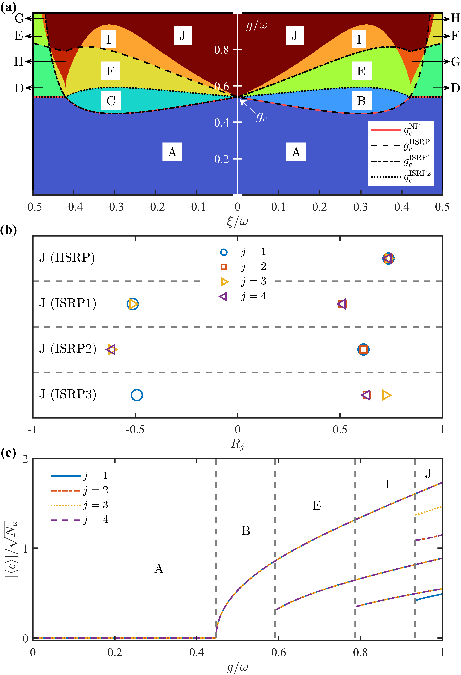
Figure 1: (a) Phase diagram for the open Dicke lattice with N=66; (b) spatial profile of photon order parameters at a representative point; (c) order parameter magnitude as a function of N=67 for N=68.
An important, nontrivial result is the pronounced asymmetry of the phase diagram with the sign of hopping N=69. Positive (negative) N0 preferentially stabilizes the homogeneous (antiferromagnetic) configuration, a consequence of the underlying photonic mode structure and the dependence of critical couplings on N1.
Numerically, the spatially inhomogeneous ISRP3 phase is only accessible by solving the nonlinear steady-state equations, and it exhibits lower symmetry compared to the analytically tractable configurations.
Extension to Larger Lattices
The methodology generalizes to N2 in a straightforward manner, as evidenced by analysis of N3 and N4. Each additional site greatly increases the number of configuration classes, and thus the possible forms of steady-state multistability. This framework thus provides a scalable recipe for enumerating and predicting rich spatial orders in engineered Dicke lattices.
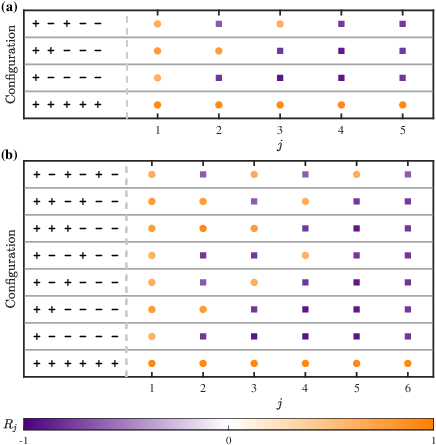
Figure 2: Steady-state superradiant order parameter patterns for (a) N5 and (b) N6 Dicke lattices.
Nonequilibrium Universality Classes
The paper leverages the discrete truncated Wigner approximation (DTWA) to compute quantum fluctuations of the photon number at critical points and thus analyze universality classes of the dissipative phase transitions. For the N7 open Dicke lattice, two distinct universality classes appear—transitions into both HSRP and ISRP1 exhibit critical exponent N8, while the ISRP2 transitions yield N9.
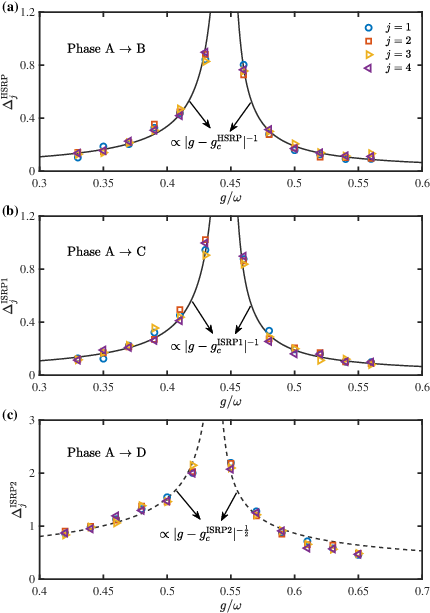
Figure 3: On-site photon fluctuations ξ=00 at transition points, showing distinct scaling laws for HSRP/ISRP1 (ξ=01) and ISRP2 (ξ=02).
This finding underscores that spatial configuration not only distinguishes steady states but can also differentiate nonequilibrium critical phenomena.
Equilibrium Ground State and Universality
The closed Dicke lattice (ξ=03) admits only a single unique ground-state configuration, determined energetically. For ξ=04, the ground state is homogeneous for ξ=05 and antiferromagnetic for ξ=06, with the transition between them being first order. However, the transition from the normal to the superradiant phase is always continuous and characterized by a universal closing of the lowest excitation gap:
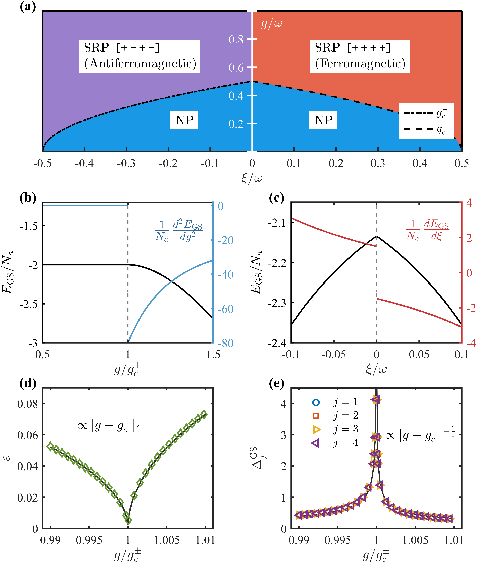
Figure 4: (a) Equilibrium phase diagram for ξ=07; (b) ground-state energy and its derivatives versus ξ=08; (c) ground-state energy and its first derivative versus ξ=09; (d) excitation gap scaling as 2N0 approaches 2N1; (e) ground-state photon fluctuation scaling.
Both types of superradiant ground-state configurations display the same universal scaling at criticality, with critical exponent 2N2, matching that of the single-site Dicke model. This result contrasts sharply with the nonequilibrium case, where different steady-state configurations may belong to distinct universality classes.
Theoretical and Practical Implications
The configuration-based approach delivers an explicit link between spatial symmetry and both equilibrium and nonequilibrium phase structures in engineered quantum systems with long-range photonic interactions. This framework enables prediction and systematic classification of complex multistable steady states in coupled cavity arrays—an experimentally accessible platform in cavity and circuit QED. Potential implications include the controlled engineering of bistable or multistable quantum memories, as well as tailoring phase transition universality via system geometry and photon loss.
The methodology is extensible to larger lattices, open boundary conditions, and more exotic topologies, providing a flexible lens for the study of driven-dissipative many-body quantum phenomena. Further, the demonstrated existence of multiple universality classes within the same microscopic platform, differentiated solely by spatial order, points to new opportunities for quantum simulation and criticality engineering.
Conclusion
This work establishes a rigorous symmetry- and configuration-based framework for understanding multistability and universality in Dicke lattice models. By explicitly delineating the relationship between lattice symmetries, allowed superradiant configurations, and nonequilibrium as well as equilibrium phase structures, it opens new avenues for the controlled realization and manipulation of collective quantum phases and phase transitions in cavity QED and related platforms. The nontrivial finding that dissipative and equilibrium transitions can lead to different universality classes depending on spatial order highlights the rich physics accessible in engineered light-matter lattices.

