- The paper demonstrates that geometric frustration in Dicke lattices induces emergent superradiant phases with unconventional symmetry breaking.
- A generalized Hamiltonian with on-site Dicke interactions and photon hopping reveals critical modes and tunable photonic density waves.
- Analytical and numerical methods link normal phase soft modes to real-space order, enabling predictive control of phase transitions.
Frustration-Induced Superradiant Phases in Periodic Dicke Lattices
Introduction
"Frustrated superradiant phases in one- and two-dimensional lattices" (2606.05278) presents a comprehensive theoretical treatment of coupled Dicke models on periodic lattices, focusing on the interplay between geometric frustration and spontaneous symmetry breaking in quantum many-body photonic systems. The Dicke lattice model studied entails both an extensive spatial thermodynamic limit (the lattice size) and an intrinsic thermodynamic limit borne from strong light-matter coupling at each site. The study systematically elucidates how frustration-driven competitions yield unconventional symmetry-breaking, emergent collective modes, and both commensurate and incommensurate order in one- and two-dimensional arrays.
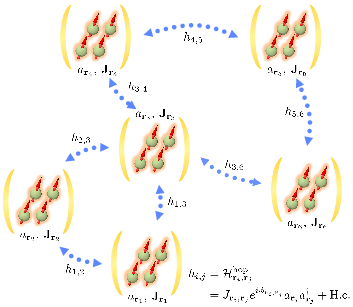
Figure 1: Schematic of the Dicke lattice model with six sites, where each node represents a Dicke system and photon hopping (with spatial phase) connects cavities.
Dicke Lattice Model and Theoretical Framework
The authors consider arrays of Dicke models with photonic hopping terms, incorporating a generalized Hamiltonian with on-site Dicke interactions and inter-site photon tunneling. Each node contains a macroscopic collective spin (representing many two-level systems) and a cavity mode, with the hopping Hamiltonian allowing for both real and complex-valued photon tunneling amplitudes, the latter generating synthetic magnetic flux.
This structural framework enables the realization of both bipartite and non-bipartite (e.g., triangular) lattices, and supports exploration across limits from few to large numbers of sites, emphasizing the coexistence and competition between local (on-site) and global (lattice) order.
Superradiant Phase and Translational Symmetry Breaking
At weak light-matter coupling, the Dicke lattice resides in a normal phase with unbroken symmetry and zero photon condensation. Increasing the local coupling strength λ induces a continuous superradiant phase transition, analogous to the single-site Dicke transition but distinctly affected by lattice geometry and photonic hopping.
One-dimensional chains with positive photon hopping display frustrated antiferromagnetic ordering: for even numbers of sites, the superradiant order parameter alternates sign (Néel-like), breaking translational symmetry by doubling the unit cell. For odd-numbered chains, perfect staggered order is frustrated, resulting in a global, system-size-spanning broken translational symmetry with a delocalized domain wall and an emergent critical mode.
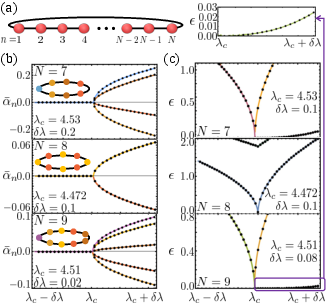
Figure 2: Schematic and numerical results for the simple Dicke chain; odd-length chains cannot achieve perfect Néel order, demonstrating frustration-induced effects.
Emergent Nambu-Goldstone Modes via Frustration
Despite the purely discrete symmetry of the Dicke chain Hamiltonian (Z2), the authors theoretically and numerically demonstrate that the frustrated, odd-length chains exhibit an emergent Nambu-Goldstone (Goldstone-like) mode near the critical point. This gapless collective excitation is associated with the spontaneous breaking of an effectively continuous degeneracy in the thermodynamic limit, with the domain wall delocalized across the system.
The analytical and numerical results reveal that for odd N, the low-energy spectrum possesses a mode whose energy vanishes with an exponent scaling with N, asymptotically becoming gapless as N→∞. This behavior is unattainable in standard Z2 systems, highlighting the qualitative consequences of concurrent geometric frustration and extensive system size.
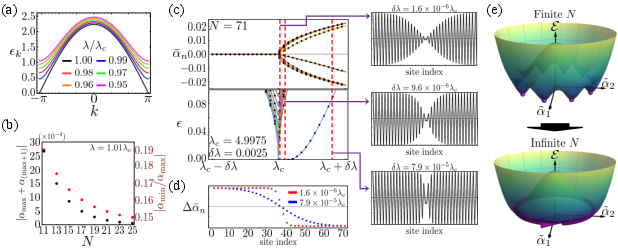
Figure 3: Dispersion relations and order parameter structure for the 1D Dicke chain, showing the emergent soft mode and its evolution with system size.
Broken Periodicity and Photonic Density Waves in 2D Triangular Lattices
Extending the framework to triangular lattices introduces geometric frustration that is not removable by system size—unlike the 1D chain, the triangular unit cell inherently prevents simultaneous minimization of all local coupling terms for antiferromagnetic interactions. Analyzing the normal-phase excitation spectrum, the location of gap closing in momentum space prescribes the reduced periodicity emerging in the ordered phase.
The ground state exhibits a photonic density wave: a three-sublattice structure whose periodicity is distinct from the underlying lattice arrangement, and whose global degeneracy is limited by the frustration within the enlarged unit cell. Excitation spectra computed in the reduced Brillouin zone show robust anomalous critical exponents, with both square-root and linear closure of the gap at the transition.
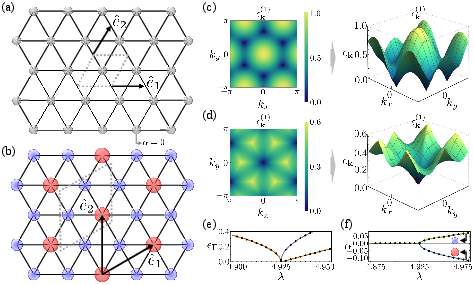
Figure 4: Triangular lattice: (a) Normal phase with minimal unit cell, (b) superradiant phase with an extended three-sublattice unit cell, and associated excitation spectra and order parameters.
Quasiperiodic Superradiant Phases and Magnetic-Flux Control
In ladder and J1-J2 chain geometries, corresponding to quasi-1D lattices, the system generically supports incommensurate photonic density wave order: the critical momentum kc at which the mode condenses is irrational with respect to the lattice vector, suppressing any finite real-space periodicity. Here, complete spontaneous breaking of translational symmetry results in a quasiperiodic spatial profile for the superradiant order.
Moreover, the introduction of synthetic magnetic flux through the Peierls substitution in the hopping amplitudes allows for external tuning between incommensurate and commensurate phases. Select flux values reestablish rational kc and enable commensurate density wave orders with well-defined unit cell sizes, offering systematic control over the broken-symmetry patterns in the superradiant phase.
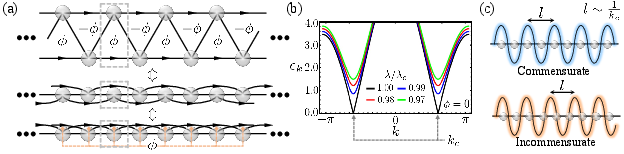
Figure 5: Dicke ladder model: distinct flux values (Peierls phases) select between commensurate and incommensurate photonic density wave order.
Universal Mechanism and Experimental Relevance
A key methodological advance is connecting the symmetry-breaking pattern in the superradiant phase with the critical momentum of the normal phase excitation spectrum. This allows rapid a priori determination of emergent real-space periodicity and simplifies the analysis of frustrated large lattices even for complex geometries.
The correspondence between the Dicke model (large collective spin per site) and the quantum Rabi model (single spin per site with large detuning) extends the theoretical predictions to a broad class of cavity- and circuit-QED arrays, ultracold ions, and other experimental platforms.
Theoretical and Practical Implications
This work provides a detailed map of the ground state manifold and excitation structure for frustrated Dicke lattices. Key results include:
- Anomalous critical exponents and emergent gapless modes in the thermodynamic limit specifically due to geometric frustration.
- Realization of photonic density waves as direct analogs of charge-density waves and phasons in condensed matter, without the need for electronic or phononic interactions.
- External tunability of symmetry-breaking patterns via synthetic magnetic flux, enabling exploration of topological and quasiperiodic phases.
- Theoretical framework relating normal phase soft modes to real-space order, circumvents the need for exhaustive high-dimensional energy minimization and establishes generalizability to more complex and higher-dimensional frustrated systems.
Conclusion
The investigation reveals that Dicke lattice systems with geometric frustration manifest a variety of unconventional superradiant phases characterized by nontrivial spatial order and emergent low-energy collective modes. The results have direct implications for quantum simulation of strongly correlated photonic systems, the study of symmetry-breaking and criticality beyond Landau paradigms, and the controlled engineering of commensurate and incommensurate order in quantum optical and solid-state platforms.
This work provides a roadmap for future exploration of frustration-driven emergent phenomena, higher-order and topological phases, and non-equilibrium many-body dynamics in engineered quantum optical lattices.