- The paper establishes an unconditional exponential separation in memory requirements between classical DFAs and quantum finite automata for the Kochen-Specker Problem using graph invariants.
- It shows that a measure-once QFA can solve KSP with an n+1-dimensional Hilbert space, while classical automata require exponentially more states derived from the graph's chromatic number.
- The proposed method is robust against both depolarizing and coherent noise, paving the way for practical implementations on near-term quantum hardware.
Robust Quantum Memory Advantage from Contextuality
Introduction
This paper rigorously investigates exponential quantum memory advantages for sequential computational tasks derived from the structural properties of quantum contextuality. It targets the long-standing challenge of precisely connecting quantum contextuality—a key resource for non-classicality—to unconditional computational or memory advantages without recourse to conjectures or fragile constructions. Using exclusivity graphs and graph invariants, the paper defines the Kochen-Specker Problem (KSP) as a promise language recognition task and proves an exponential, noise-resilient separation between the classical and quantum memories required to solve it. The separation is shown to follow from the integer gap between the chromatic number and orthogonal rank of exclusivity graphs, a graph-theoretic characterization of what the author terms representational contextuality.
Finite Automata Models and Contextuality
The KSP is addressed in the standard automata-theoretic setting. A classical deterministic finite automaton (DFA) recognizes a formal language with a discrete memory state space whose cardinality defines classical state complexity. In contrast, a quantum finite automaton (QFA) employs a finite-dimensional Hilbert space, transitions via unitary evolution, and measurement—its memory cost is the Hilbert space dimension. The KSP is a two-symbol, constant-length, promise problem: input strings are of length two, with both symbols either identical or connected by an edge in a specified exclusivity graph G.
Key to the memory separation is the following:
- Classical lower bound: Any DFA solving the KSP induces a vertex coloring of G, hence requires at least χ(G) internal states.
- Quantum upper bound: There exists a measure-once QFA that solves KSP using a memory dimension of d=ξ(G)+1, where ξ(G) is the orthogonal rank of G.
This gap reflects a purely structural form of contextuality: representational contextuality, where the graph's chromatic number exceeds its orthogonal rank.
Exclusive Graphs and Quantum Memory Compression
In the exclusivity graph formalism rooted in quantum contextuality studies, each vertex is a measurement outcome, edges correspond to mutual exclusivity, and the graph's invariants determine classical and quantum representability. The orthogonal rank ξ(G) is the minimal Hilbert space dimension for an assignment in which adjacent vertices are assigned orthogonal projectors, reflecting quantum constructibility. The chromatic number χ(G) is the minimal number of ontic states required for a valid non-contextual hidden variable description, corresponding to classical memory.
Exponential Quantum Advantage: Boolean-Orthogonality Graphs
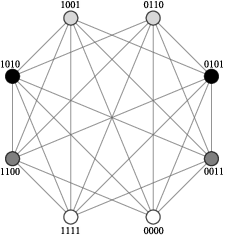
The separation becomes exponential for the family of Boolean-orthogonality graphs G3. These graphs are defined on G4 binary vectors of Hamming weight parity and connect vertices pairwise at Hamming distance G5. The orthogonal rank is G6, while the chromatic number satisfies G7 for some G8 (per the Frankl-Rödl theorem). Thus, G9 while χ(G)0.
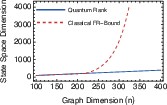
Figure 2: State space dimension scaling for χ(G)1 graphs: quantum memory cost grows linearly, classical chromatic bound grows exponentially.
For the KSP on χ(G)2, the QFA needs only χ(G)3-dimensional quantum memory, unaffected even as the minimum classical state number grows exponentially.
Noise Robustness
Unlike standard QFA algorithms exploiting small-angle unitaries or quantum fingerprinting—whose required error tolerance χ(G)4 shrinks as χ(G)5—the QFA solution for the KSP achieves an χ(G)6 noise threshold. The protocol processes only two input symbols and utilizes discrete Householder reflections, making it robust to both depolarizing and coherent noise.
- Depolarizing robustness: Acceptance gap remains χ(G)7 as long as per-cycle depolarizing rate χ(G)8, independent of χ(G)9.
- Coherent robustness: Systematic angular perturbations up to d=ξ(G)+10 per operation leave a nonzero acceptance gap, again independent of classical memory cost.
This robustness is critical for NISQ implementations and distinguishes the construction from the fragile separation mechanisms in conventional QFAs.
Beyond State-Independent Contextuality
The representational contextuality underlying the memory separation is necessary but not sufficient for statistical state-independent contextuality. There exist graphs where d=ξ(G)+11 but the fractional chromatic number d=ξ(G)+12; such graphs do not exhibit traditional state-independent quantum contextuality (SIC), yet the quantum memory advantage persists due to the vertex-coloring constraint on classical automata.
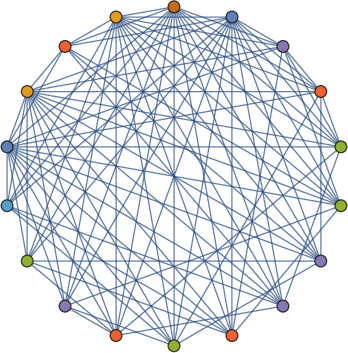
Figure 3: An 18-vertex exclusivity graph with d=ξ(G)+13, d=ξ(G)+14, and d=ξ(G)+15—realizing representational but not statistical contextuality.
Practical and Foundational Implications
The separation witnessed here is unconditional, does not rely on conjectured complexity class separations, and is operative at constant input length, enabling demonstration on near-term quantum hardware. The 60-vertex Waegell-Aravind graph, with d=ξ(G)+16 and d=ξ(G)+17, requires only a 5-level quantum memory for separation—implementable, e.g., on a single ququint platform.
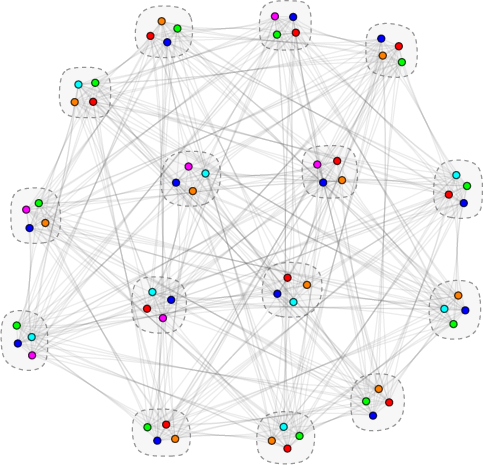
Figure 4: Six-coloring of the 60-ray orthogonality graph derived from the 600-cell, with potential for experimental realization.
The work illustrates that quantum contextuality not only yields violations of classical statistical bounds but also imposes strict operational memory separations for simulating exclusivity relations. This extends beyond quantum theory: any theory respecting the exclusivity structure of the graph faces the same classical memory bottleneck.
Conclusion
This work formalizes and proves an unconditional, exponential separation in memory requirements for solving a specific promise problem—KSP—driven by the structural phenomenon of representational contextuality. The quantum memory protocol ensures robust, scalable advantage, opening avenues for direct experimental realization of memory-bounded quantum supremacy. It establishes that the source of quantum computational power can sometimes be traced not to entanglement or non-locality, but to purely structural properties of contextuality, abstractly encoded in exclusivity graphs. These findings motivate further investigation of contextuality-driven quantum advantage within limited-depth or restricted-memory computational architectures, and the development of practical protocols for experimental demonstration in noisy intermediate-scale quantum systems.