- The paper introduces spectral effective-rank entropy as a novel metric to quantify critic complexity and monitor its dynamic behavior during training.
- It demonstrates that applying spectral-entropy regularization can reduce over-parameterization and bias, with effects varying by algorithm and task.
- The study establishes critic complexity as a complementary diagnostic tool, offering new avenues for controlled intervention in RL model training.
Critic Complexity in Actor-Critic Reinforcement Learning: Measurement and Control
Introduction
This work systematically investigates the role of critic model complexity in actor-critic reinforcement learning (RL), a topic classically neglected in favor of evaluating critics solely by indirect performance proxies such as episodic return, TD error, or loss. The central thesis is that critic complexity—defined here using a spectral effective-rank entropy metric—can be rigorously quantified, its training dynamics monitored, and its value explicitly steered throughout learning, thereby opening new diagnostic and control dimensions for actor-critic RL.
By leveraging algorithms including TD3 and PPO under standard control benchmarks (Pendulum-v1, HalfCheetah-v4, and others), the study provides empirical evidence for the nuanced, context-dependent relationship between critic complexity and learning outcomes. Furthermore, it proposes and evaluates a spectral-entropy regularization technique for direct complexity control.
Spectral Effective-Rank Entropy as a Critic Complexity Metric
The effective-rank entropy is operationalized as follows: Given the singular values of a weight matrix W within the critic, their normalized distribution pi=σi/(∑jσj) yields an entropy H(W)=−∑ipilogpi that quantifies how distributed the energy is across spectral modes. This metric is computationally efficient and interpretable, capturing both under- and over-parameterization within neural critics. Averaging H(W) over critic layers produces an aggregate indicator of network complexity.
Strong justification for this measure, as opposed to alternatives like stable rank or norm-based proxies, lies in its higher correlation with critical RL signals such as return and bias, as found in preliminary and primary experiments.
A key result is that critic effective-rank entropy is a dynamic training quantity exhibiting nontrivial structure over learning trajectories. As training proceeds, complexity typically decreases modestly, but with substantial variability across algorithms, tasks, and hyperparameters. This temporal evolution is visible in both TD3 and PPO across environments.
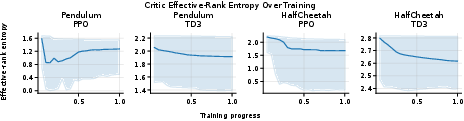
Figure 1: Evolution of critic effective-rank entropy during training on non-controlled Pendulum-v1 and HalfCheetah-v4 runs, displaying modest overall decreases and substantial interquartile variability.
The relationship between final critic entropy and task return is present but non-monotonic. Specifically, lower entropy is generally associated with better performance, but the correlation's magnitude and direction are algorithm- and task-specific.
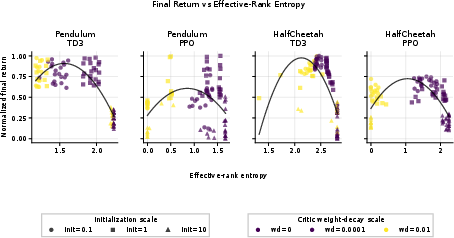
Figure 2: Relationship between final episodic return and critic effective-rank entropy for non-controlled runs on Pendulum-v1 and HalfCheetah-v4. Higher returns trend towards lower entropy, but this relationship is heterogeneous across tasks and algorithms.
Correlation coefficients amplify this finding: For example, in TD3/Pendulum runs, the Spearman correlation between critic entropy and final return is −0.67, while in PPO/Pendulum it is effectively zero. Critic complexity is thus neither universally detrimental nor beneficial; instead, it encodes a nontrivial intermediate regime where both excessive simplicity and unnecessary complexity can harm performance or induce estimation bias.
Spectral-Entropy Regularization for Explicit Complexity Control
To move beyond observation toward intervention, the study introduces a spectral-entropy penalty term in the critic loss. The modified loss is
Ltotal=Lcritic+λentℓ∈C∑H(Wℓ)
where λent controls the strength of regularization and C indexes the critic layers.
This penalty consistently reduces critic rank-entropy in TD3 runs, most notably on the HalfCheetah-v4 and Pendulum-v1 tasks. The strongest joint improvement—in both critic entropy reduction and final return—occurs for TD3/HalfCheetah-v4 at moderate regularization (λent=0.001), while the lowest entropy is attained at higher coefficients ($0.01$), reflecting a typical trade-off between constraint tightness and learning performance.
However, PPO and some other tasks demonstrate minimal changes in entropy and performance under regularization, indicating that the effectiveness of complexity control is highly sensitive to algorithmic context and the underlying critic architecture.
Cross-Task Evaluation and Generalization
When spectral-entropy regularization is tested on new environments (TD3/Walker2d-v4, TD3/Ant-v4), the result is unambiguous in its partiality: while critic entropy reliably decreases, this control does not systematically translate to improved returns or greater bias reduction. In some cases, volatility increases or remains unchanged, and return shifts are statistically negligible. Thus, complexity-control as implemented is not a universally effective performance enhancement but rather a task-contingent tool for shaping critic representation structure.
Theoretical and Practical Implications
This analysis underscores several actionable implications:
- Model Monitoring: Critic spectral entropy provides an orthogonal lens for model diagnostics not obtainable from return curves or loss metrics alone.
- Algorithm-Dependent Control: The utility of complexity regularization is strongly modulated by RL algorithm, environment, and possibly architecture; it cannot, at present, be recommended as a plug-and-play return booster.
- Train-Time Interventions: Spectral measures are differentiable and readily incorporated into standard optimization pipelines, facilitating their use in online critic shaping.
These findings interface with broader explorations of neural generalization, grokking, and complexity control—linking state-of-the-art RL practice with contemporary neural theory on inductive bias and effective dimensionality.
Future Directions
The study motivates several extensions:
- Comprehensive Cross-Algorithm Sweeps: To establish whether regularization effects generalize, large-scale comparisons across RL algorithms and critic parameterizations are warranted.
- Robustness Analysis: Variations in initialization, architecture size, and explicit bias-variance trade-off manipulations may further clarify the scope and limits of spectral complexity control.
- Connection to Representation Learning: Investigating whether lower critic spectral entropy aligns with more semantically meaningful, processable state embeddings offers one route to intersect RL with interpretability research.
Conclusion
The explicit quantification and control of critic complexity in actor-critic RL is both feasible and illuminating. Spectral effective-rank entropy emerges as a tractable, interpretable metric with nontrivial relationships to performance and estimation bias, contingent on algorithm and task. Direct regularization enables principled manipulation of critic representations, though its impact on RL outcomes is heterogeneous and context-specific. These findings suggest that critic complexity should be monitored and considered alongside classical RL metrics, and establish a foundation for more systematic investigations of model-driven RL training dynamics.