- The paper presents a detailed bifurcation and resonance analysis of an ENSO model using a periodically forced delay differential equation, highlighting invariant torus dynamics and phase-locking phenomena.
- It rigorously identifies key bifurcations—including pitchfork, Hopf, saddle-node, and gluing bifurcations—and maps out narrow, non-overlapping resonance (Arnold) tongues in different parameter regimes.
- The study demonstrates that for large delays, a double Dehn twist symmetry governs the repeated resonance structure, offering predictive insights into parameter sensitivity in climate models.
Resonance Structure in a Periodically Forced Delay Differential Equation Model of ENSO
Introduction
This paper performs a rigorous bifurcation and resonance analysis of the periodically forced Suarez–Schopf delay differential equation (DDE) as a conceptual model for El Niño–Southern Oscillation (ENSO) variability. The model captures essential ENSO features through nonlinear delayed feedback subject to periodic external forcing, representing the interaction between ocean-atmosphere delayed responses and the annual solar cycle. The study couples analytical results with extensive numerical bifurcation computations, focusing on invariant torus dynamics, locking phenomena, and resonance tongue organization, thereby elucidating the interplay between periodic forcing and the internal delayed feedback mechanisms.
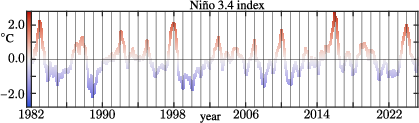
Figure 1: Niño 3.4 index as measured by NOAA, illustrating irregular, phase-locked oscillations typical of ENSO.
Mathematical Model and Dynamical Framework
The base dynamical system studied is the canonical S–S DDE: u′(t)=u(t)−u3(t)−αu(t−τ)+ccos(ωt)
where u(t) is the non-dimensional SST anomaly, α the delayed feedback parameter, τ the delay (representing wave travel time along the Pacific), c the forcing amplitude, and ω the forcing frequency. This parameterization translates oceanographic reasoning (delayed action oscillator, DAO) into a nonlinear DDE with feedback delay and explicit annual forcing.
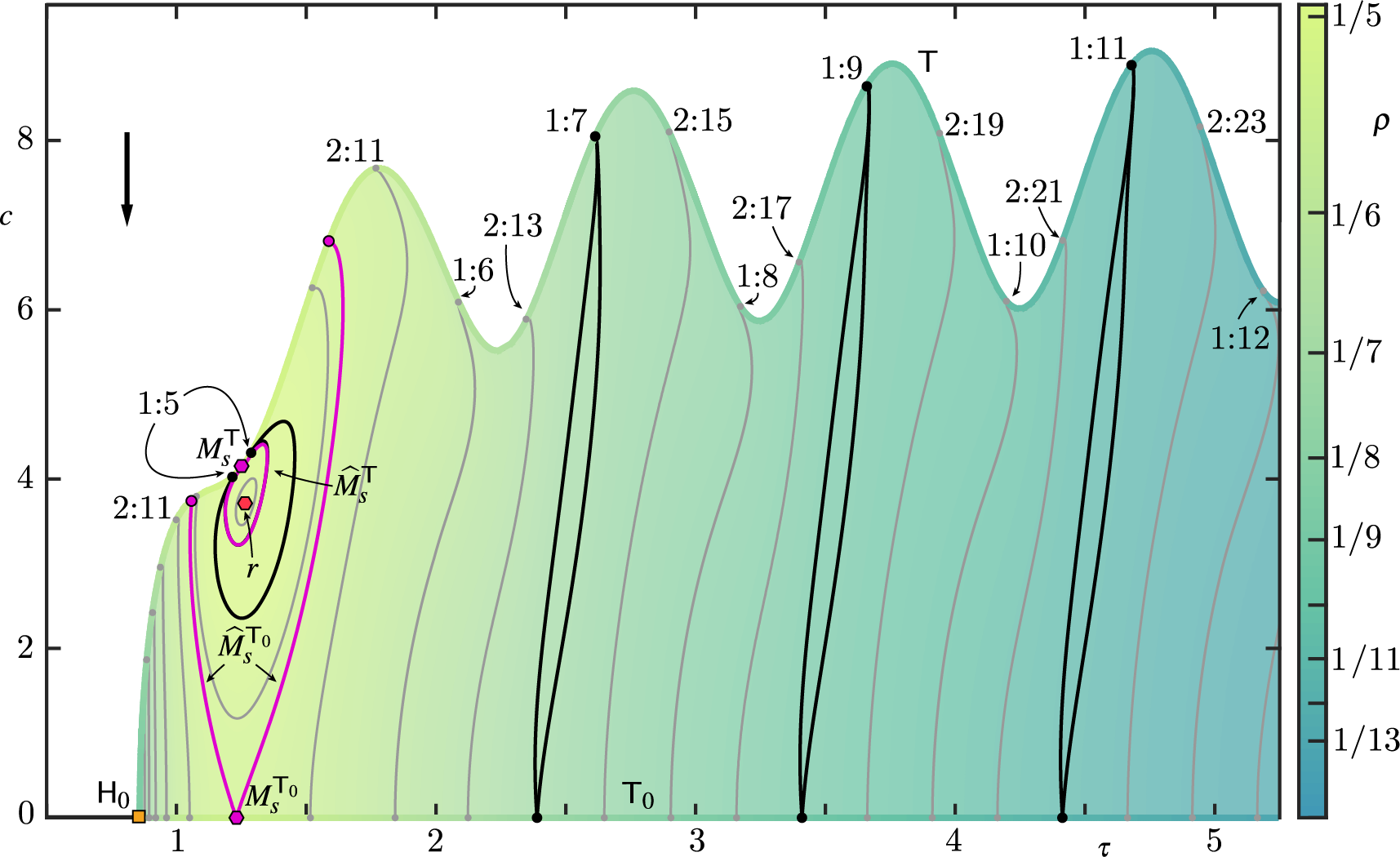
The analysis leverages the infinite-dimensional phase space of DDEs but tracks attractors, bifurcations, and organizing centers using stroboscopic and Poincaré maps, Floquet multipliers, and resonance (Arnold) tongue computations. Special attention is paid to the rotation number ρ as a dynamical invariant encoding the average motion along invariant tori—critical for distinguishing phase-locked resonances from quasiperiodic regimes.
Bifurcation Structure Without Forcing
A thorough linear and numerical bifurcation analysis of the unforced (autonomous) S–S model reveals the codimension-one and codimension-two organizing centers:
- Pitchfork bifurcation for equilibria at α=1.
- Supercritical and subcritical Hopf bifurcations producing stable and unstable periodic orbits, with explicit loci τk(α).
- Saddle-node bifurcations and gluing bifurcations generating and destroying periodic (unstable) orbits and organizing attractor transitions for varying delay and feedback.
- Double-zero (Bogdanov–Takens-like) point at (τ,α)=(1,1) with associated organizing influence.
The result is a complete partitioning of the u(t)0 parameter space into dynamical regimes, each classified by the nature and multiplicity of attractors.
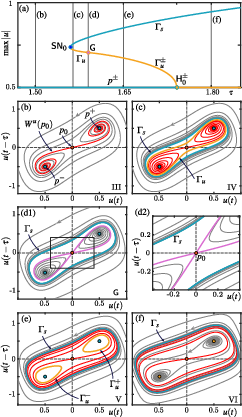
Figure 2: Bifurcation diagram in u(t)1 for u(t)2; shows gluing and saddle-node bifurcations not captured by linear theory.
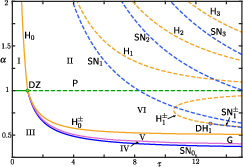
Figure 3: Global bifurcation structure in the u(t)3-plane; regions separated by pitchfork, Hopf, saddle-node, and gluing bifurcation curves.
Periodically Forced System: Dynamics on Invariant Tori
Upon periodic forcing, trajectories no longer reside on periodic orbits but can asymptotically approach two-dimensional invariant tori (for non-locking). The paper extends algorithms for computing the rotation number u(t)4—crucial for classifying the internal dynamics on tori—to infinite-dimensional DDEs, including careful treatment of appropriate projections due to the infinite-dimensionality of history space. The approach ensures correct identification of phase-locked (resonant) versus quasiperiodic behavior.
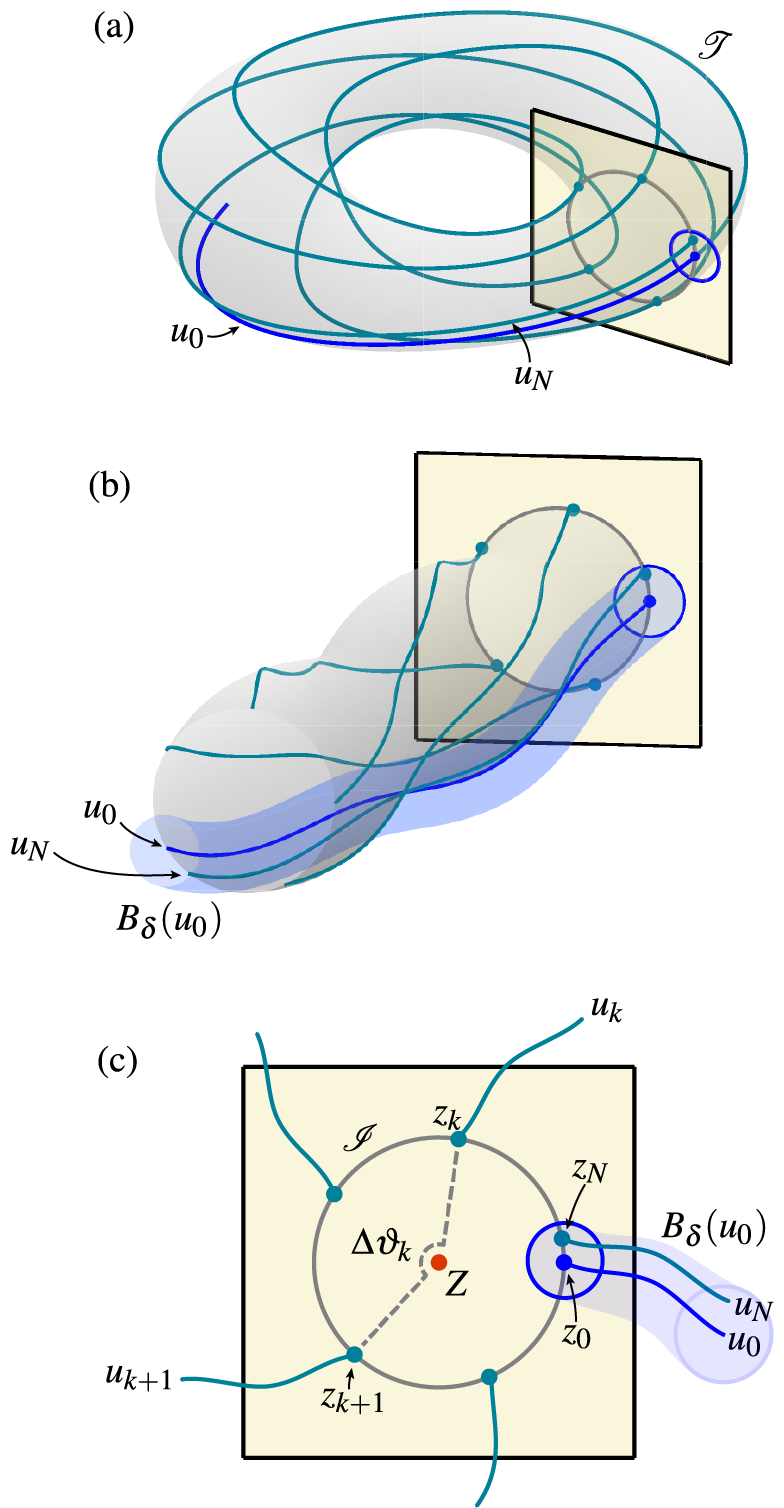
Figure 4: Schematic of rotation number computation on invariant tori for the periodically forced DDE.
Bifurcation and Resonance Structure with Forcing
Case u(t)5 (Monostable Periodic Attractors)
Case α4 (Bistability and Complex Torus Bifurcation Sequences)
- Pitchfork bifurcation of period-one orbits (lifted from equilibria) and double-one torus bifurcation organize more complex parameter space structure.
- Bistability between periodic and torus attractors, with transitions governed by fold (saddle-node) and gluing bifurcations of tori—uncommon in ODE frameworks but natural in DDEs.
- Hysteresis behavior: The system exhibits nontrivial coexistence regions, where attractor selection depends sensitively on initial condition and parameter sweep direction. The sequences of bifurcations (birth, gluing, annihilation of tori) parallel and generalize the autonomous case's scenario.
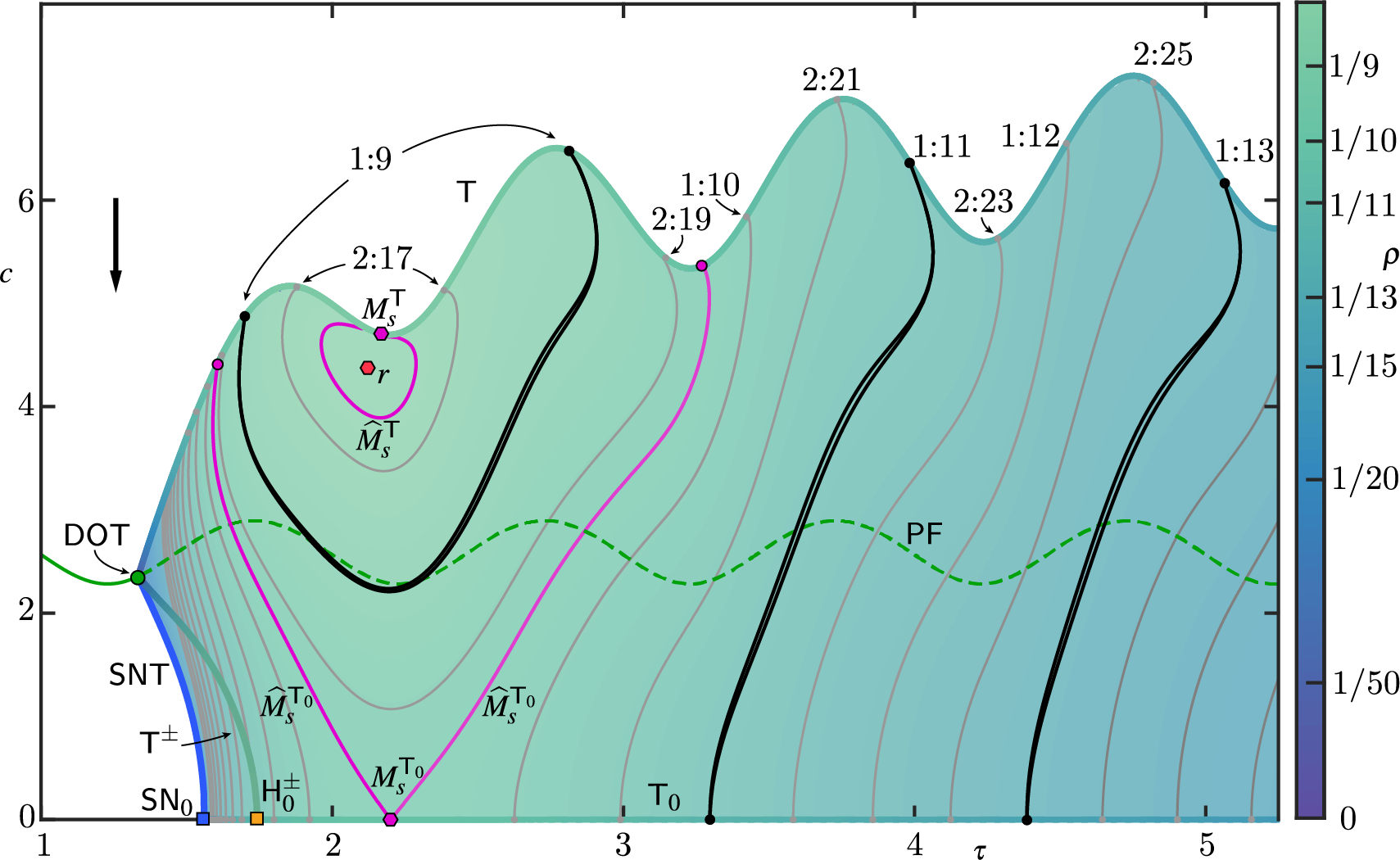
Figure 6: Resonance structure in the α5-plane for α6 with bistability regions and torus-gluing phenomena.
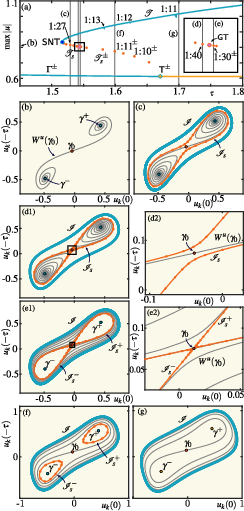
Figure 7: One-parameter bifurcation in α7 for α8 shows the sequence of torus bifurcations, folds, and gluing.
Large-Delay Regime: Dehn Twist Symmetry and Resonance Reappearance
An explicit result is established: for large delay, the structure of rotation numbers and resonance tongues is recursively generated via the map
α9
corresponding to a double Dehn twist in the homology of the torus. This symmetry is proven to organize both rational (locked) and irrational (quasiperiodic) rotation numbers, leading to predictable repetition of resonance structures as τ0.
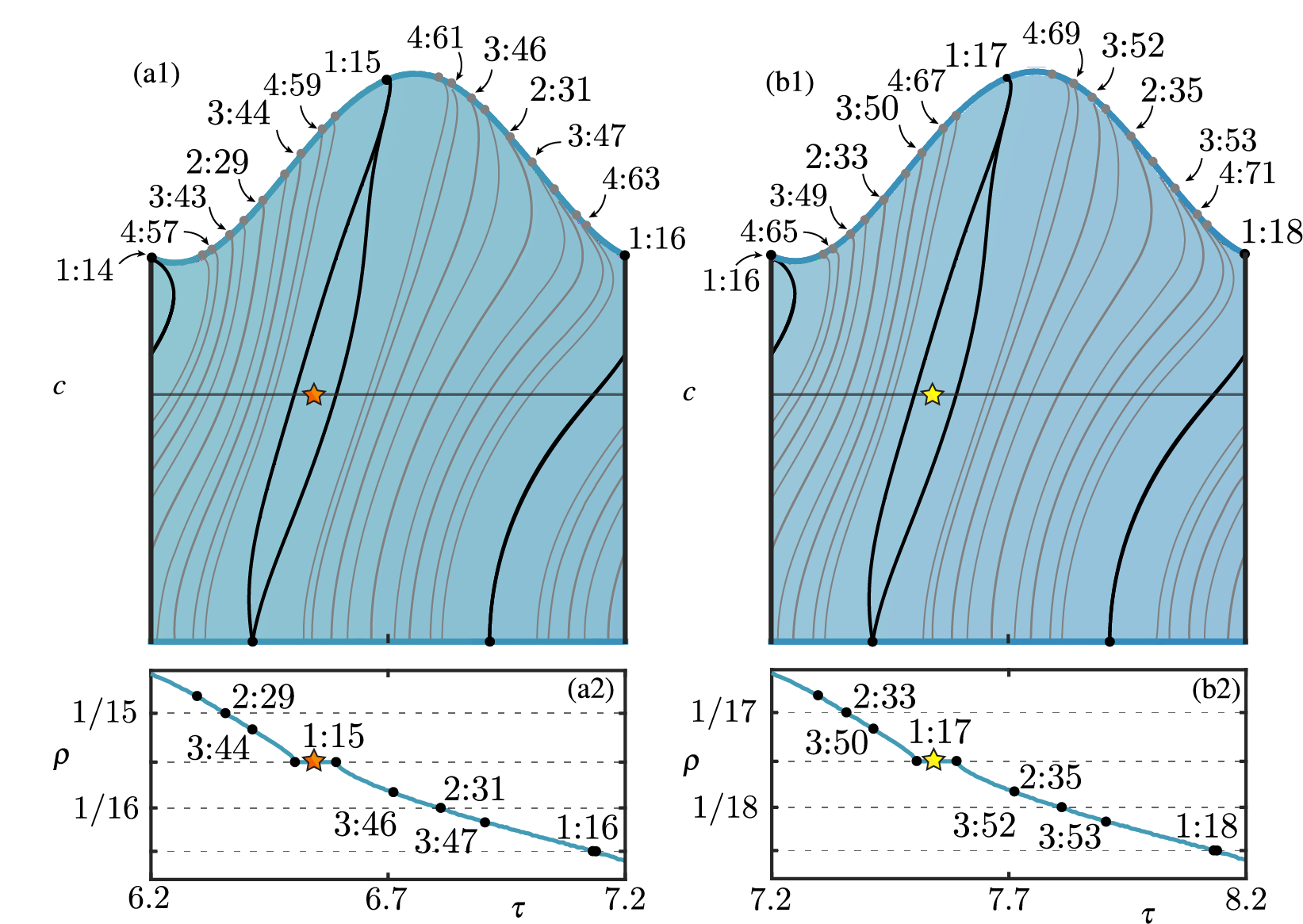
Figure 8: Preservation and recursive generation of resonance structure under τ1, corresponding to a Dehn twist.
Extension to Physically Derived ENSO Models
A forced, physically derived S–S–type DDE (the VoC reduction of Falkena et al.) is also examined. The main resonance structure—non-overlapping Arnold tongues, organization by rotation number critical points, reappearance for large delays—persists, but with increased combinatorial complexity due to further nonlinearities.
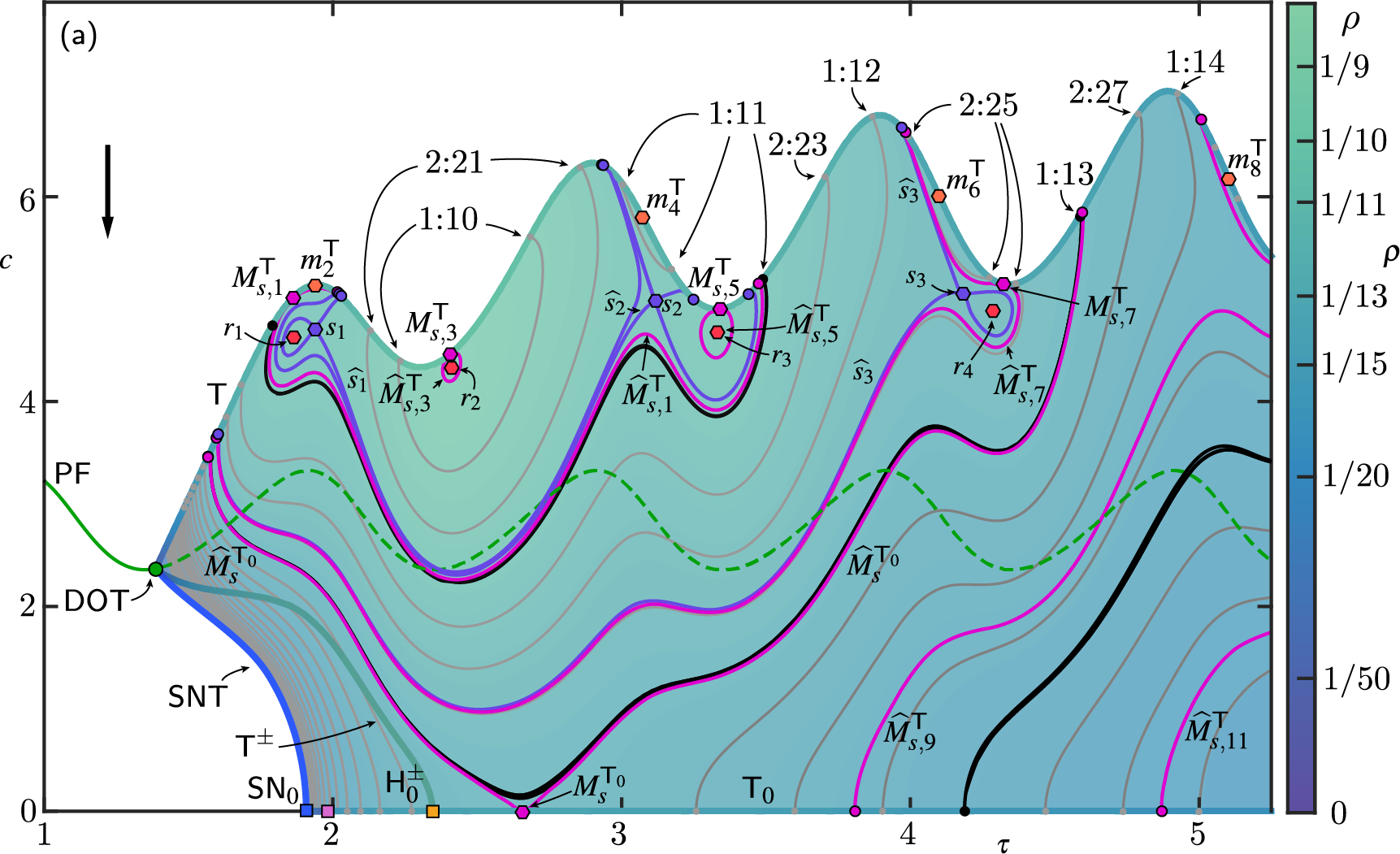
Figure 9: Bifurcation set and rotation number for the physically motivated pfVoC model; interior critical points lead to rich resonance tongue arrangements.
Theoretical and Practical Implications
- Absence of resonance overlap and chaos: For physical parameter regimes and annual forcing, resonance tongues remain thin and separated, precluding robust chaotic attractors.
- Predictable parametric sensitivity: The organizational role of rotation number critical points and resonance tongue roots supports rational design and prediction of ENSO-like regime transitions under parametric modulation (e.g., basinscale climate interventions or climate change).
- Modular layering of bifurcation phenomena: Periodic forcing lifts equilibria and periodic orbits to higher-dimensional attractors (periodic orbits → tori, bifurcations → global tongue rearrangements), providing a universal template for resonance-mediated transitions in delayed systems.
Furthermore, the analysis identifies avenues for future work:
- Role of forcing frequency (τ2): Lowering τ3 produces wider, potentially overlapping resonance tongues, permitting robust chaos (supported by rigorous numerics in other works [ANIKUSHIN2023133653], [Oishi2021]).
- Extension to systems with broken symmetry, distributed or state-dependent delays, or stochastic perturbations: These are key to capturing observed ENSO asymmetries and non-trivial statistics.
Conclusion
The paper delivers a comprehensive mathematical and computational treatment of resonance phenomena in a minimal DDE ENSO model. The results typify the high predictability and structurally organized but highly sensitive dependence of such systems to parameter modulation and periodic forcing. The developed analytical and numerical tools are broadly applicable to other infinite-dimensional periodically forced systems—such as delay-coupled lasers, climate tipping elements, and neural architectures—where understanding the mechanisms of resonance, locking, and their bifurcation organization is increasingly essential for both theory and applications.