- The paper demonstrates that microlensing observations reveal a nearly equal-mass SMBBH system with a total mass of approximately 10^9.5 solar masses in Q J0158-4325.
- The methodology integrates multi-wavelength spectral energy distribution modeling and Bayesian inference to constrain disk parameters and rule out alternative explanations.
- The study predicts distinctive periodic microlensing signatures, including enhanced X-ray variations, which inform upcoming electromagnetic and gravitational wave follow-up research.
Evidence for a Nearly-Equal Mass Supermassive Binary Black Hole in Q J0158-4325 from Periodic Microlensing and SED Modeling
Introduction
Hierarchical structure formation under ΛCDM cosmology mandates frequent galaxy mergers, resulting naturally in supermassive binary black holes (SMBBHs) ensconced within gas-rich nuclei, often embedded in complex circumbinary disk environments. Although the theoretical underpinnings of SMBBH-driven accretion structures are mature, direct observational confirmation remains elusive except in special dynamical regimes. Recent attention has focused on strong-lensing quasars, where microlensing induced by stellar mass objects in the lens galaxy provides unique spatial resolution to probe accretion flows at microarcsecond scales. "An equal mass ratio supermassive binary black holes in Q J0158-4325 with periodic microlensing signature?" (2607.00360) presents a comprehensive analysis of the gravitationally lensed quasar Q J0158-4325, leveraging extensive multi-wavelength monitoring and spectral modeling to diagnose the presence of an SMBBH with nearly equal masses.
Observational Data and Spectral Diagnostics
Q J0158-4325 (z=1.29) exhibits two lensed images with an angular separation of $1.''3$. Long-term optical monitoring revealed persistent ∼173-day periodicity in the flux ratio light curve, which cannot be explained by intrinsic AGN variability or simple microlensing from single or binary stellar lenses. The paper establishes the detailed properties of Q J0158-4325 through a combination of XSHOOTER optical and HST-STIS UV spectra, together with time series data from optical and X-ray telescopes. Careful decomposition of the broad emission line profiles (Mg II, Hα, Hβ) yields virial SMBH mass estimates and extinction corrections.
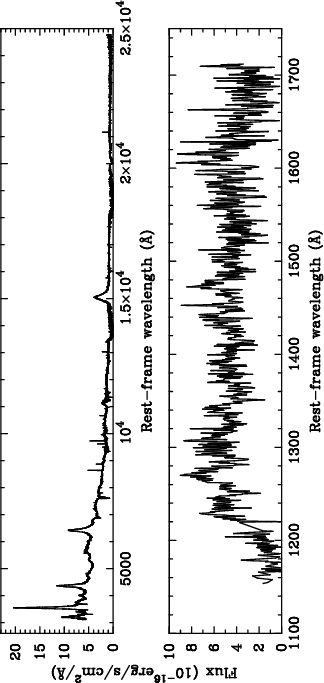
Figure 1: XSHOOTER: Full optical/UV spectrum of Q J0158-4325 for both panels in the observer's frame.
Empirical fitting of the Mg II line and Fe II pseudo-continuum forms the basis for measuring the demagnified 3000 Å luminosity and black hole mass, yielding log(M∙/M⊙)=9.04±0.10.
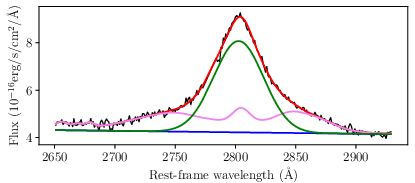
Figure 2: Decomposition of the observed Mg II line into (power-law) continuum, Fe II emission, and broad line components in the XSHOOTER spectrum.
Broad Balmer profiles reinforce both mass estimates and constraints on E(B−V) due to dust.
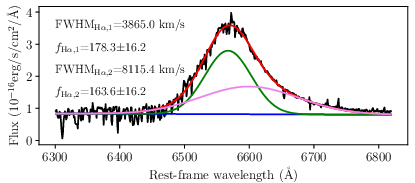
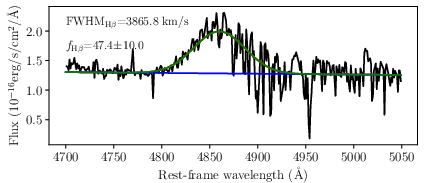
Figure 3: Decomposition of the broad Hα and Hβ emission lines with multiple velocity components.
Triple-Disk SMBBH Model and Microlensing
The authors present a self-consistent model for the surface brightness of a triple-disk SMBBH system: two mini-disks encircling each component BH, fed by a circumbinary disk truncated by the binary’s gravitational torques. Key parameters include total mass, mass ratio (z=1.290), mini-disk truncation radii, Eddington ratios, and binary separation, with an explicit treatment of Roche lobe geometry. Disk emission is modeled as multicolor blackbody, with spectral energy distribution (SED) derived as the sum of all three disks, and the wavelength-dependent surface brightness profiles are convolved with microlensing magnification maps computed using ray-tracing techniques.
The orbital motion of the triple-disk system, on scales of z=1.291, naturally generates periodic microlensing signals as the brightness centroid rotates through regions of high and low magnification. Distinctively, the period of microlensing variability directly links to the binary’s mass ratio: nearly equal-mass systems (z=1.292) produce modulations at half the orbital period, while low-z=1.293 binaries reflect the full orbit.
MCMC Fitting and Bayesian Inference
Bayesian parameter estimation is performed using joint likelihoods from the microlensing light curve and the SED (including both optical and UV). The mass, mass ratio, Eddington ratios, disk structural parameters, and extinction are treated as free parameters. The paper systematically compares multiple physically motivated models, adjusting z=1.294 from 0.1 to 1 and fixing orbital period according to theoretical expectations for each z=1.295 regime.
Comparison of model evidence via Bayes factors decisively excludes single-black-hole disk geometries and low-mass-ratio binaries (z=1.296) once both the UV continuum and microlensing data are considered.
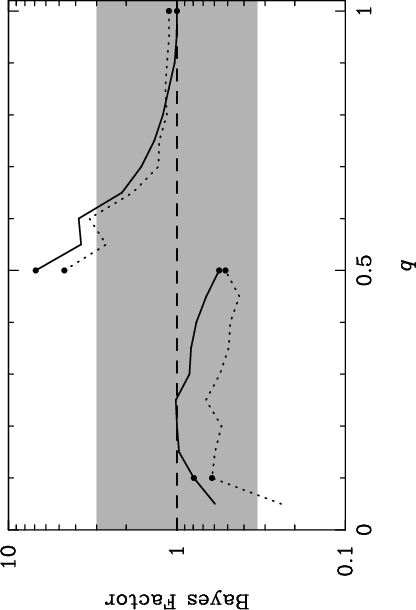
Figure 4: Bayesian model evidence (Bayes factors) for fitting microlensing light curves as a function of mass ratio and disk parameters, highlighting the preference for z=1.297.
Reproduction of Microlensing Light Curves
Simulated microlensing light curves for each SMBBH configuration are compared directly to the 15-year observed flux ratio data. The z=1.298 nearly-equal-mass models robustly recover both the amplitude and the periodic signature, while the single-BH or low-z=1.299 binary models fail to reproduce key features—either yielding the wrong periodic structure or insufficient amplitude.
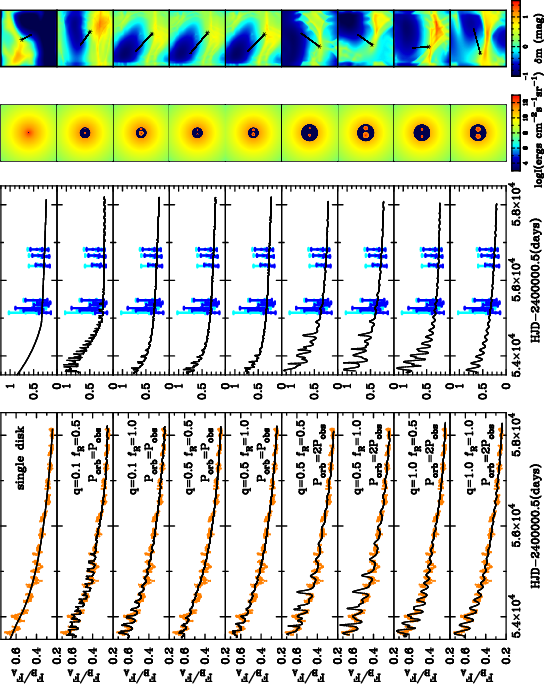
Figure 5: Left: Observed flux ratio (orange points) vs. model predictions (various colored lines) for both optical and X-ray bands; microlensing magnification maps and surface brightness distributions for reference models.
SED Fitting and Constraints from UV/Optical Data
The SEDs of the best-fit SMBBH models are in strong agreement with extinction-corrected, macro-magnification-corrected spectra over the full optical-to-UV baseline. Notably, low-$1.''3$0 binaries and single-disk models systematically over-predict UV flux unless the disk winds are invoked at a level inconsistent with observational constraints, while the triple-disk models with $1.''3$1 precisely match the observed SED.
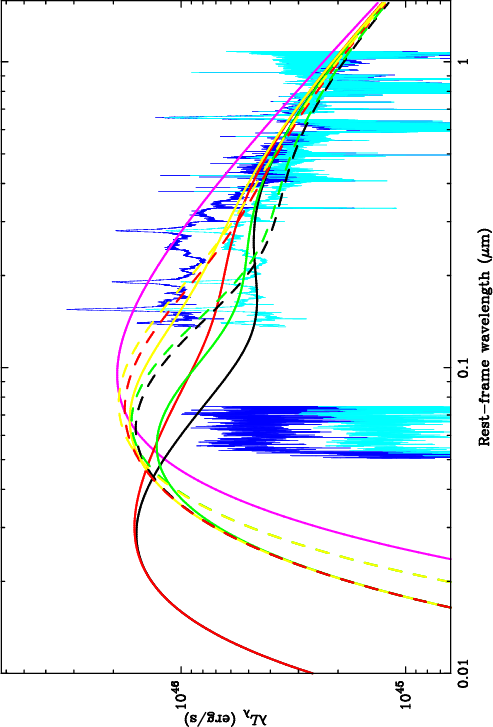
Figure 6: Model SEDs for a grid of ($1.''3$2, $1.''3$3) parameters compared to the observed, extinction-corrected SED.
Joint MCMC posterior samples from optical-only and optical+UV fits reveal degeneracy breaking: UV data reject low-mass-ratio models due to their hotter, more centrally concentrated disks.
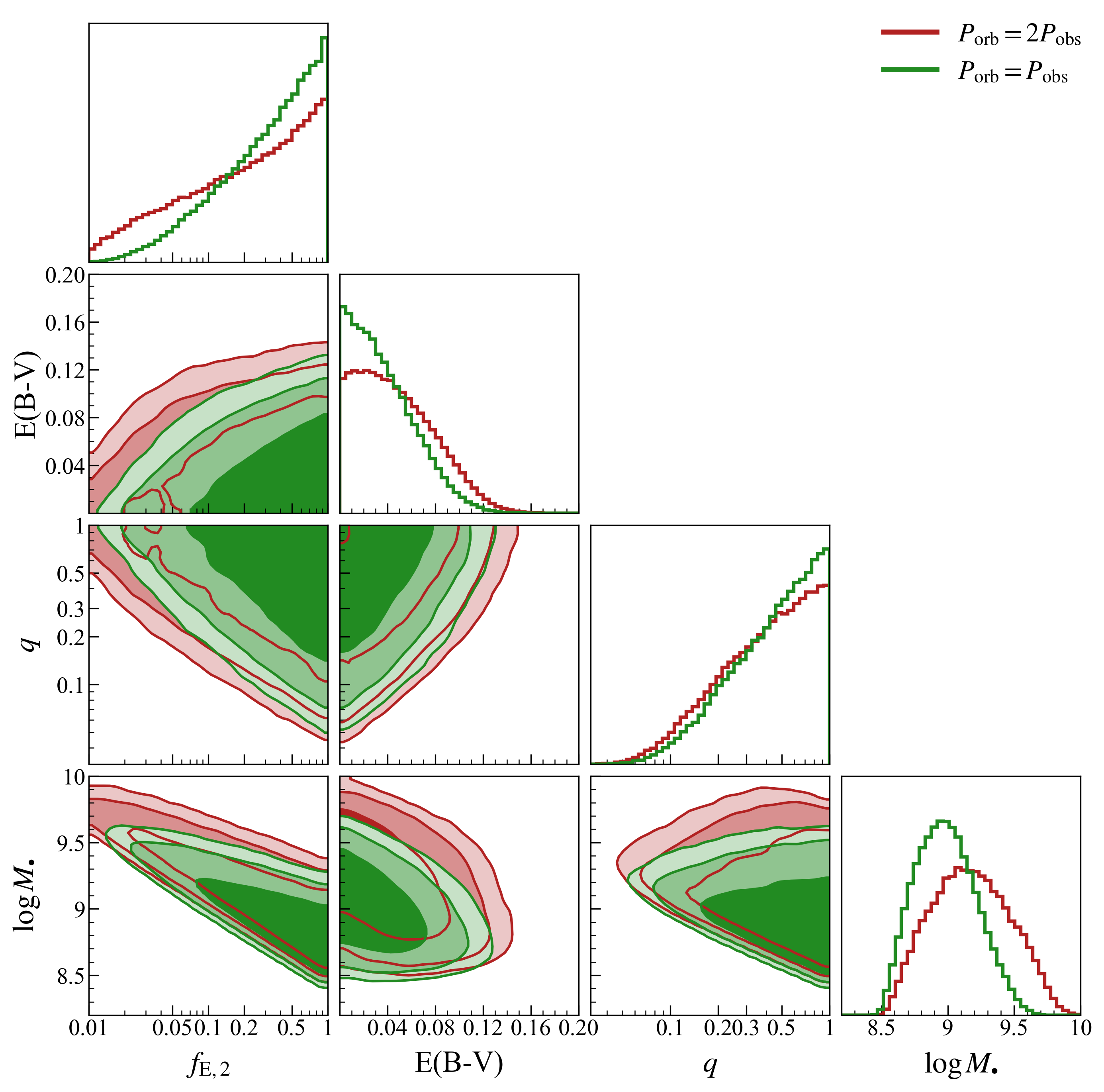
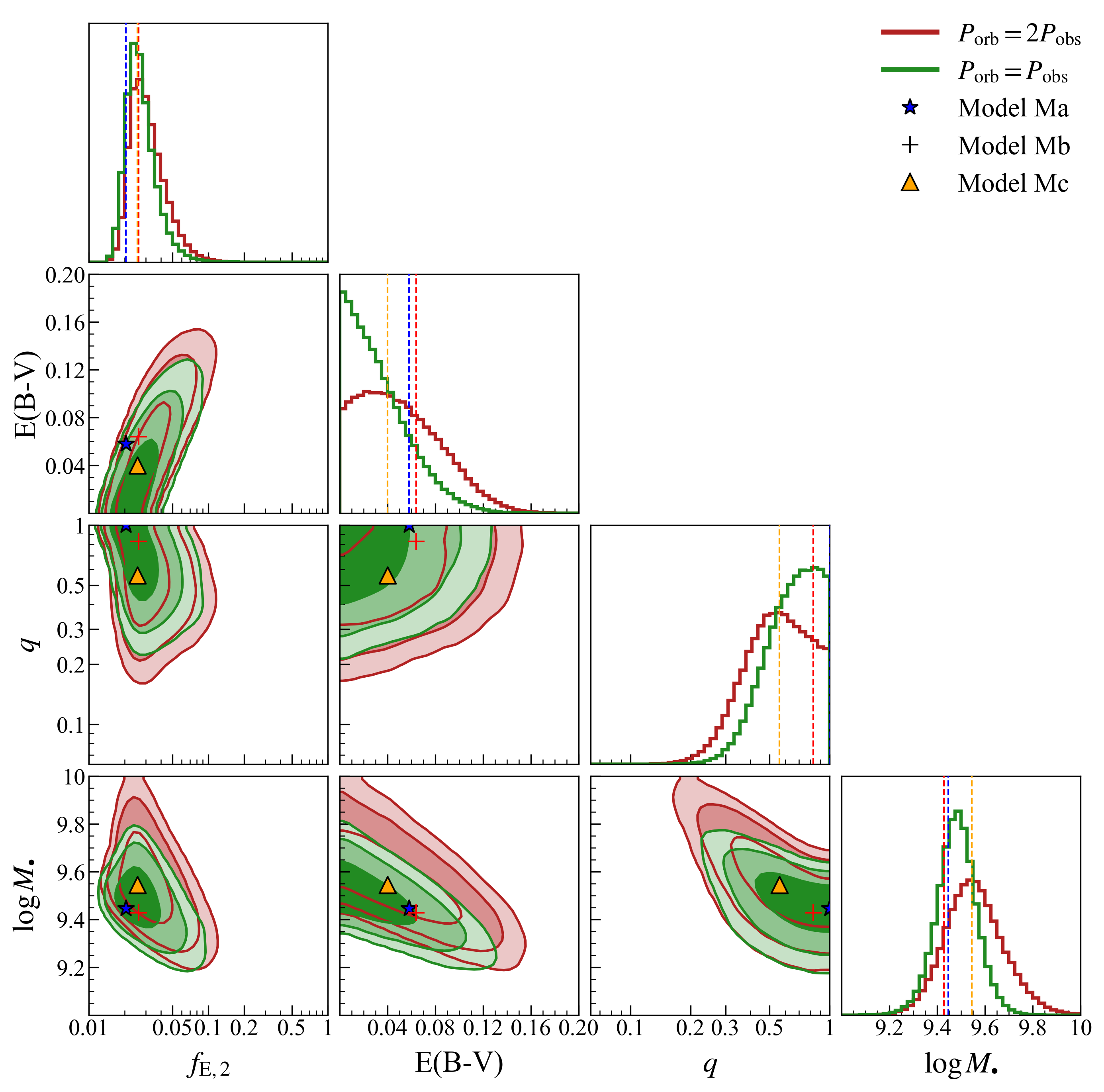
Figure 7: Posterior probability distributions for SMBBH system parameters for models with differing period hypotheses; simultaneous fitting to optical and UV spectra breaks mass ratio degeneracy.
The conclusiveness is also evident in direct model-to-data overlays.
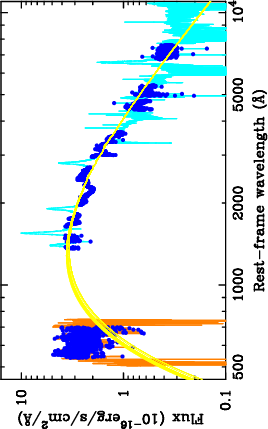
Figure 8: Single-black-hole disk models fail to match the combined optical and UV SED, yielding a poor $1.''3$4.
Optimal Model Selection and Theoretical Implications
The authors identify a model with $1.''3$5 and $1.''3$6 (Ma) that achieves both an excellent SED fit and quantitative agreement with the microlensing periodicity and amplitude. Alternative models with $1.''3$7 (Mb, Mc) fail to recover the characteristic light curve morphology.
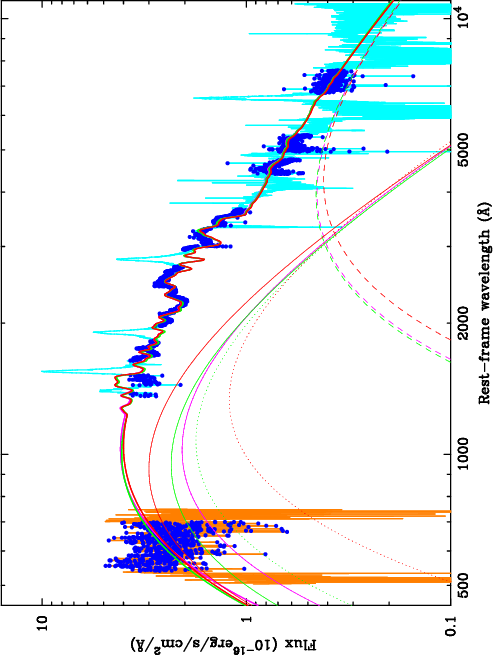
Figure 9: Comparison between observed and predicted spectra for the best-fit ($1.''3$8) SMBBH triple-disk system and alternatives.
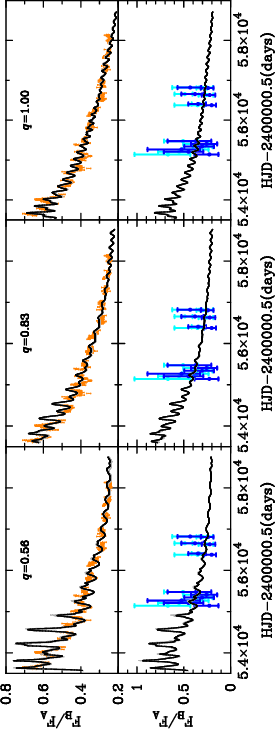
Figure 10: Model-predicted microlensing light curve and observed flux ratios in both optical (high-cadence) and X-ray (lower-cadence) bands. Only the $1.''3$9 model reproduces the periodic signatures robustly.
The predicted SED decomposes into mini-disk and circumbinary-disk contributions, validating the physical consistency between microlensing interpretation and radiative transfer constraints.
X-ray Microlensing and Multi-wavelength Predictions
Microlensing-induced variations are predicted to be even larger in the X-ray band, due to the more compact emission regions. Although current Chandra data are too sparse for definitive phase or amplitude matching, X-ray light curve predictions provide a direct target for future time-domain X-ray campaigns.
(Figure 10, repeated)
Figure 10: Microlensing light curve predictions in X-ray demonstrate anticipated large amplitude events, outpacing those in the optical.
Dynamical Evolution, Disk-Binary Coupling, and Alternative Interpretations
Given the inferred separation (∼0), the SMBBH is predicted to merge via gravitational wave radiation in ∼1 years. Analysis shows disk-binary coupling is physically justified (viscous timescale exceeds GW inspiral time at the inferred ∼2 for canonical viscosity parameters). The examination of alternative explanations—including stochastic AGN variability, binary microlens, and intermediate-mass BHs embedded in the disk—excludes them based on light curve statistics, timescale, and peak morphology.
Practical and Theoretical Implications
The study demonstrates a robust framework to identify and characterize SMBBHs in lensed quasars by combining multi-wavelength microlensing and SED analysis. This methodology will be especially impactful with imminent wide-field surveys (e.g., LSST), which will deliver high-cadence, multi-band light curves for thousands of strongly lensed AGNs. The findings highlight the extreme rareness of detecting a source in a brief pre-merger phase, but also the possibility of accumulating a sample of less extreme SMBBHs at wider separations with greater occurrence rates.
Future progress is anticipated from high-cadence X-ray monitoring, time-resolved spectroscopic campaigns, and integration with gravitational wave observatories (e.g., LISA). For lower mass/later-stage binaries, EM+GW multi-messenger studies will become feasible.
Conclusion
This work provides compelling evidence that Q J0158-4325 harbors an SMBBH with a nearly equal mass ratio, a total mass of ∼3, and a separation of ∼4, tightly constrained by joint microlensing and spectral modeling. The approach demonstrates that combining periodic microlensing signatures with broadband SED fitting can eliminate most alternative scenarios and deliver robust constraints on sub-parsec scale SMBH binaries in lensed quasars. The results underline the urgent need for multi-wavelength, high-cadence monitoring campaigns and open new prospects for EM and GW joint studies in AGN astrophysics.