- The paper demonstrates that periodic microlensing fluctuations in multiwavelength light curves reveal the orbital dynamics and unique triple-disk accretion structures of SMBBH systems.
- It employs relativistic thin-disk modeling and ray-shooting simulations to quantify wavelength-dependent variability, constraining key parameters like mass ratio and separation.
- The findings underscore that high-cadence, multi-band observations can effectively identify subparsec SMBBH candidates in lensed quasars, guiding future detection strategies.
Multiwavelength Microlensing Signatures of Macrolensed Supermassive Binary Black Holes
Introduction
The hierarchical ΛCDM paradigm predicts a significant population of supermassive binary black holes (SMBBHs) in galactic centers, particularly after gas-rich galaxy mergers. Gas dynamics in these systems generically yield a circumbinary disk feeding two mini-disks, setting up a triple-disk accretion geometry. These configurations imprint unique multiwavelength signatures in both spectral energy distribution (SED) and gravitational lensing observables, notably in lensed quasars. The paper systematically studies the orbital-phase-dependent microlensing signatures generated by subparsec SMBBH systems embedded in this triple-disk structure, focusing on how different physical parameters (e.g., mass ratio, accretion rate, and separation) modulate the microlensing-induced variability in the optical, UV, and X-ray bands.
Physical Model and Methodology
The adopted model incorporates a standard relativistic thin-disk prescription (with blackbody radiation) for the circumbinary disk and the two mini-disks encircling each black hole. The disks are truncated at radii set by the Roche lobe (as a proxy for tidal truncation), while the X-ray emitting region is assumed to be a compact corona (<20rg). The relative configurations of the disks, the dynamical timescales, and the location and geometry of emission regions are explicitly computed for a suite of SMBBH parameters.
Microlensing magnification maps are generated via optimized ray-shooting over realistic lensing mass and shear configurations, using parameters directly applicable to existing strongly lensed quasar systems (e.g., Q J0158-4325). The surface brightness maps at each wavelength and orbital phase are convolved with these magnification maps to predict light curves for prescribed trajectories and temporal baselines.
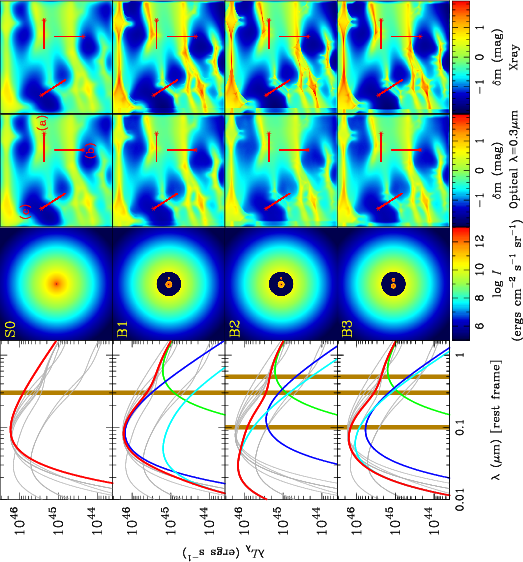
Figure 1: SEDs, optical brightness distributions, and convolved magnification maps for S0, B1, B2, B3; illustrating the impact of disk structure and mass ratio on observed multiplicity and lensing geometry.
Multiwavelength SEDs and Disk Morphologies
The SEDs of the triple-disk SMBBH systems are marked by a characteristic deficit (notch) in the optical/UV regime, corresponding to the central cavity created by the secondary SMBH and the diminished emission around the mini-disk truncation radii. The position of this deficit is sensitive to the binary separation, and its depth/shape is modulated further by the mass ratio and component accretion rates. These effects are closely reproduced in the surface brightness maps and their quantitative half-light radii (see Table 2 in the original document).
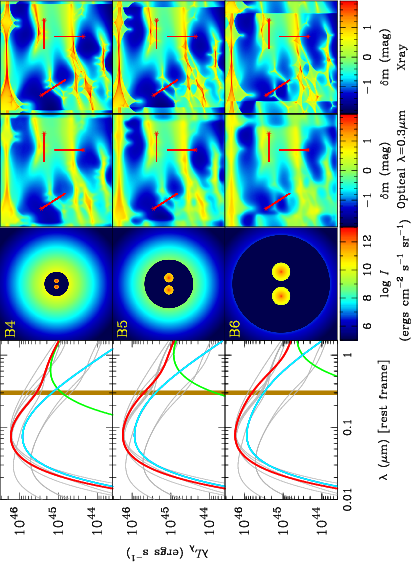
Figure 2: SEDs and magnification maps for B4, B5, B6, demonstrating how increasing separation leads to larger disk sizes and evolves the location of the SED flux deficits.
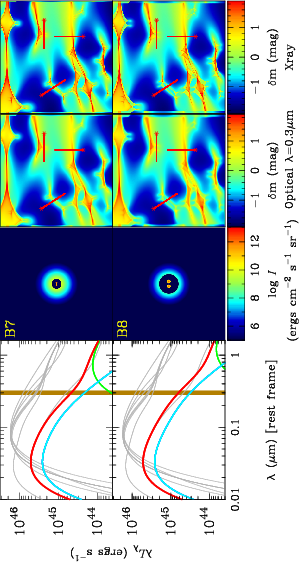
Figure 3: SEDs and magnification maps for B7, B8, highlighting the implications of lower total SMBH mass and more compact accretion emission regions.
Microlensing Light Curves and Periodic Modulations
Microlensing maps derived for the full triple-disk structure, when convolved with evolving surface brightness, yield light curves with both long-term caustic crossing events and superposed periodic oscillations. Key findings:
- Periodicity: The periodicity of the microlensing fluctuations is set mainly by the orbital dynamics. For equal-mass binaries (q≈1), the period is Porb/2, reflecting alternate caustic crossings by the two mini-disks. For small mass ratio (q≪1), the dominant period maps directly to Porb, governed by the secondary's caustic crossings.
- Wavelength Dependence: The amplitude of periodic microlensing is much larger in the X-ray (and extreme UV) bands than in the optical, due to more compact emission regions (smaller half-light radii). All bands share the same phase and period, but their amplitudes scale inversely with the emission region size.
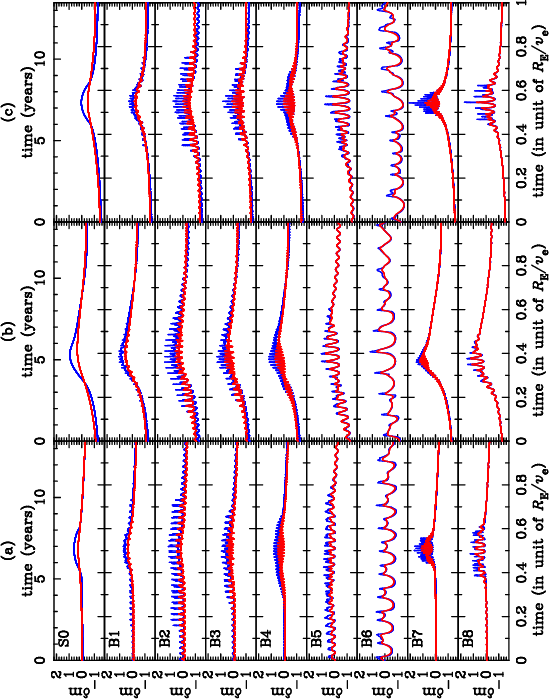
Figure 4: Simulated optical and X-ray microlensing light curves for a range of SMBBH models and trajectories, with gray/white stripes marking intrinsic orbital periods; prominent periodic structures are highlighted.
The fine structure of the light curves is closely linked to the mass ratio, disk sizes, and the locus of the source trajectory with respect to the caustic network. Model variations produce distinguishable behavior: e.g., "double-horned" peaks arise in equal-mass systems, and low-q cases yield single periodic peaks in the presence of a dominant secondary mini-disk.
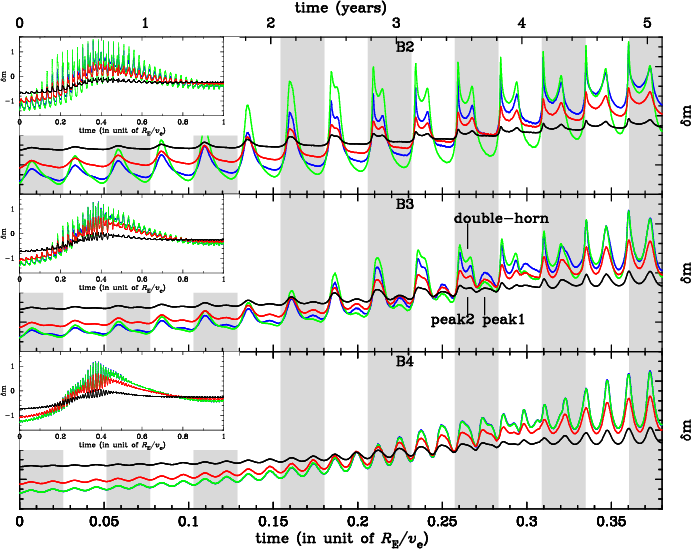
Figure 5: Multi-band (X-ray, UV, optical) light curves for B2, B3, B4; peak widths and amplitudes diminish with increasing emission region size, while orbital periodicity is retained across all bands.
Constraints and Parameter Degeneracies
The light curves' details constrain the spatial distribution of emitting regions and the orbital geometry, but substantial degeneracies hinder unique determination of all system parameters from microlensing alone. In particular, microlensing phase, period, peak amplitudes, and the relative spacing of features provide constraints on mass ratio and separation, but black hole masses and Eddington ratios require complementary SED modeling. The presence of cavity streams (gas channels feeding mini-disks) can broaden light curves and decrease peak amplitudes—however, the predicted periodicity persists robustly even when streams are luminous, provided their spatial extent is moderate.
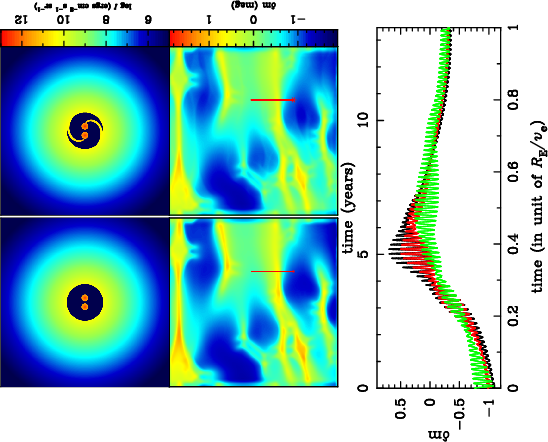
Figure 6: Effect of adding luminous gas streams between circumbinary and mini-disks; stream emission broadens and lowers the light curve amplitude, while periodic microlensing oscillations due to disk orbital motion remain detectable.
Implications for Detection and Future Prospects
These results imply that high-cadence, multiwavelength photometric monitoring of lensed quasars—such as that anticipated with LSST and follow-ups—can directly probe the presence of SMBBH systems if periodic oscillations superimposed on caustic-crossing microlensing events are observed.
Detection rates are limited by the short residence times at subparsec separations (104–105 yr), implying that only $10$–<20rg0 macroscopically lensed SMBBH AGN candidates may exist within future wide-field samples, with only a subset accessible to microlensing periodicity studies. However, the disk-size vs. wavelength relations—specifically, a deficit at characteristic optical/UV bands, modulated in time by SMBBH orbital motion—offer a less stringent means to identify wider binaries.
Combining SEDs, multi-epoch lensing light curves, and multi-band data thus becomes essential for breaking parameter degeneracies and robustly characterizing SMBBH systems. Such joint analyses provide an independent probe of sub-parsec SMBH binaries, complementary to electromagnetic periodicity searches and forthcoming gravitational wave detections.
Conclusion
This work demonstrates that microlensing-induced periodic modulations in multiwavelength light curves, caused by the orbital motion and unique accretion disk structure of macrolensed SMBBHs, are sensitive diagnostics of SMBBH presence, accretion geometry, and disk parameters. The observational program leveraging these results should combine high-cadence multi-band monitoring and SED modeling, providing a sharp tool for the detection and characterization of the subparsec binary black hole population. Future advances in simulation of radiation hydrodynamics and more precise reverberation mapping will further sharpen these constraints.