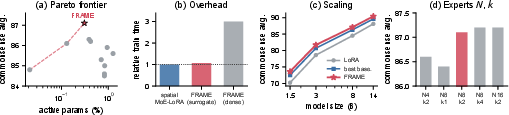
- The paper introduces a novel PEFT paradigm that employs learnable fractional-Fourier orders per expert to span adaptive spatial-spectral domains.
- It achieves state-of-the-art accuracy gains with minimal parameter overhead and computational cost across diverse benchmarks.
- Empirical and theoretical insights reveal that dynamic domain adaptation reduces interference and enhances multi-task composability.
FRAME: Learning the Adaptation Domain with a Mixture of Fractional-Fourier Experts
Introduction and Motivation
FRAME introduces a novel parameter-efficient fine-tuning (PEFT) paradigm that generalizes the prevailing spatial (LoRA) and spectral (Fourier) domains used for low-rank adaptation in frozen pre-trained models. Rather than fixing the adaptation domain, FRAME parameterizes it as a learnable fractional-Fourier transform order per expert within a mixture-of-experts (MoE) adapter, allowing adapters to span a continuous spatial-to-spectral spectrum. This approach addresses the empirical observation that the optimal adaptation domain is not universal; it varies by task, model layer, and sometimes input token type. Experimental analysis demonstrates that sweeping the fractional-Fourier order for LoRA-style adapters yields optimal validation accuracy at task-specific intermediate orders rather than at the conventional endpoints.
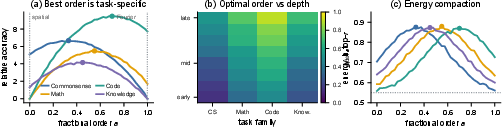
Figure 1: Optimal adaptation domains depend on task and layer, with intermediate fractional-Fourier orders improving energy compaction and accuracy relative to fixed spatial or spectral domains.
Model Architecture
FRAME extends standard MoE-LoRA by equipping each expert with a learnable fractional-Fourier order ai∈[0,1], interpolating between the spatial domain (a=0) and the Fourier domain (a=1). The adaptation update for each expert is constructed as BiAiRe[Fai], where Fai is the discrete fractional-Fourier transform of order ai. Token-specific routing activates the top-k experts per token, and updates are performed in the corresponding expert's learned domain.
Efficient computation is achieved using a chirp–FFT surrogate for the fractional transform, incurring only O(dlogd) compute per active expert—comparable to other MoE-PEFT methods. Critically, each expert's order is trained via a separate optimizer with a smaller learning rate to maintain training stability.
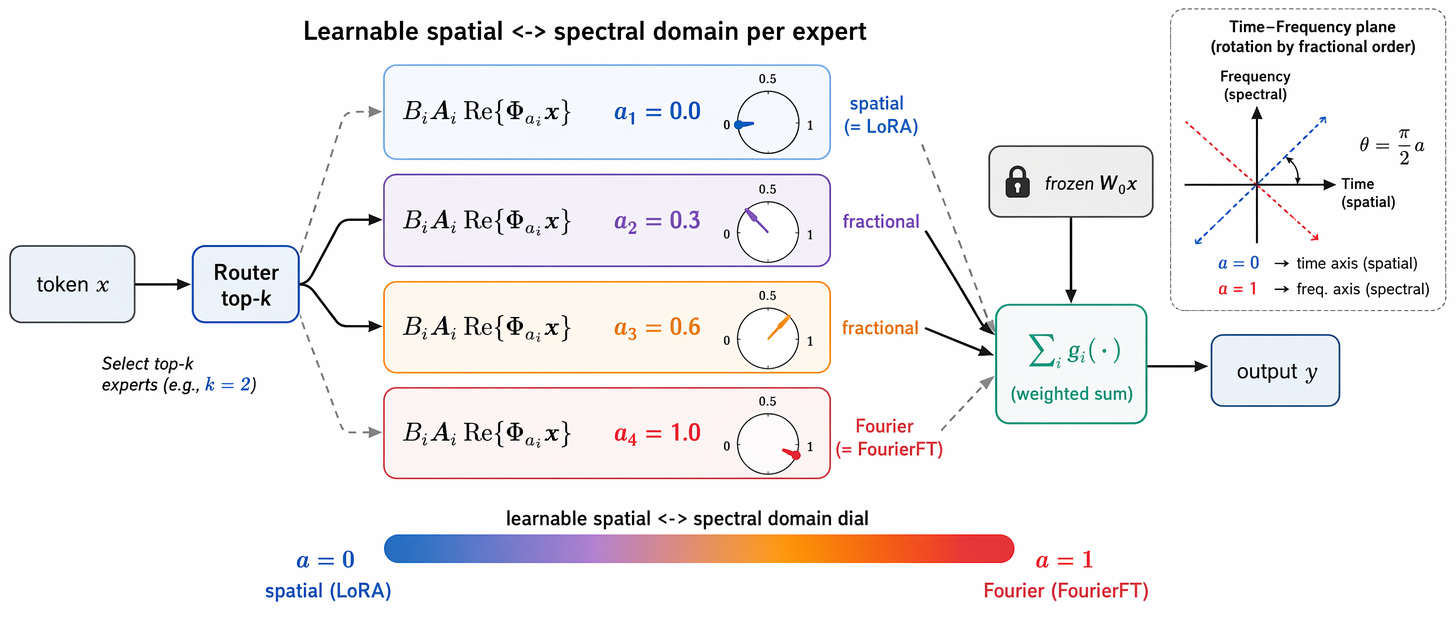
Figure 2: FRAME architecture—token routing to top-k experts, each imposing low-rank updates in its own learned fractional-Fourier domain (ai).
Theoretical Properties
FRAME rigorously generalizes both LoRA and spectral adapters: it contains spatial and Fourier MoE-LoRA as strict special cases. The mutual incoherence between experts at well-separated fractional orders provably decorrelates their updates, reducing parameter interference and improving multi-task composability. These theoretical claims are formalized:
- Strict generalization: For any LoRA or spectral expert, a corresponding FRAME expert exists that reproduces its update. Frame's hypothesis class strictly contains both baselines for N≥2 experts.
- Bounded grad stability: Gradients for learnable orders are provably stable, preventing destabilization due to rapid domain change.
- Decorrelation: Expected coherence of updates across experts falls monotonically with order spacing, so domain diversity achieves low-interference specialization.
- Faithful, cheap transform: The fractional transform surrogate closely approximates the true transform with negligible computational cost.
Empirical Results
FRAME sets new state-of-the-art results on a comprehensive suite of benchmarks spanning commonsense, mathematical reasoning, code generation, and knowledge tasks across LLaMA-3.1-8B and Qwen2.5-7B (and other backbone scales). Key findings:
Mechanistic Insights
Ablation studies reveal that both per-expert learnable orders and grouped load balancing are crucial: fixing the adaptation domain to spatial, spectral, or a static intermediate grid consistently degrades performance. In contrast, per-expert learnable orders induce structured, interpretable specialization across tasks, layers, and even token types:
- Layer specialization: Early transformer layers favor spatial domains; deeper layers migrate towards more spectral orders.
- Token specialization: Numerals, function words, and content words are differentially routed to different domains, evidence for learned token-dependent domain adaptation.
- Expert decorrelation: As predicted theoretically, inter-expert coherence declines with order spacing, boosting overall specialization and adaptability.
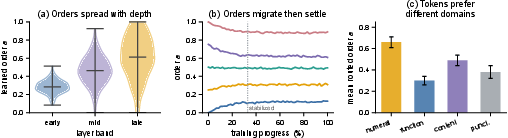
Figure 4: Learned orders spread across the spatial–spectral continuum, specialize by layer depth, and adapt dynamically over the course of training.
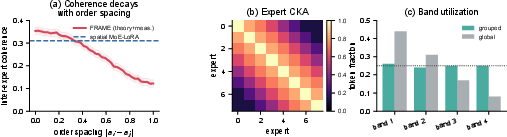
Figure 5: Inter-expert coherence drops with increasing order spacing, demonstrating effective expert decorrelation through domain diversity. Grouped balancing maintains domain utilization.
Implications and Future Developments
The principal implication is that adaptation domain itself is a critical, learnable axis for model specialization, composition, and interference reduction in PEFT. FRAME's design enables fine-grained, parameter-efficient control over how information is encoded and adapted, promising greater robustness and utility for multi-task or continual learning, adapter merging, and potentially other components beyond adapters (e.g., in full fine-tuning or attention mechanisms). The empirical and theoretical results underscore the advantage of trainable, non-Euclidean domains for parameter-efficient transfer.
Future work may extend this paradigm to richer, possibly per-axis or multi-dimensional domain parameterizations (e.g., anisotropic or wavelet-style transforms), or combine learnable projections with additional methods for expert decorrelation and modularity. Applying FRAME-style adaptation domains to complex merging, continual learning, or hierarchical adaptation scenarios are particularly promising avenues.
Conclusion
FRAME reframes the adaptation domain in parameter-efficient fine-tuning as a learnable, per-expert attribute rather than a fixed prior. By letting experts operate at arbitrary fractional-Fourier orders, it generalizes and subsumes spatial and spectral PEFT approaches, producing higher-capacity, better-specialized, and less-interfering adaptation at negligible added computational cost. FRAME’s results strongly suggest that the adaptation domain should become a first-class hyperparameter in the development of future PEFT, multi-task, and model composition methodologies.