- The paper introduces a differentiable spectral envelope loss that accurately recovers cyclical and seasonal patterns in relational time series generation.
- It employs a recurrent adversarial framework conditioned on static parent attributes to outperform existing models with lower spectral divergence metrics.
- Empirical evaluations on synthetic and real-world datasets validate its performance, offering advances for privacy-preserving analytics and process simulation.
Seq. RC-TGAN: Frequency-Domain Conditional Generation of Relational Time Series
Introduction and Motivation
Relational databases with temporal dynamics are a cornerstone of enterprise data infrastructure, yet current synthetic data generation techniques fall short in modeling the joint spatio-temporal dependencies across static parent attributes and child time series, particularly in the categorical setting. The paper "Sequential RC-TGAN: Generating Relational Time Series with Spectral Envelope Loss" (2606.31904) addresses these deficits by proposing Seq. RC-TGAN, a recurrent adversarial framework that explicitly incorporates frequency-domain information—quantified by the spectral envelope—into the learning objective.
Traditional approaches (e.g., SDV, transformer-based models, tabular diffusion) treat temporal dependencies as secondary effects, and one-hot encodings for categories fail to capture underlying periodicity or cyclic structure. Seq. RC-TGAN introduces a differentiable spectral envelope loss, enabling end-to-end optimization for the preservation of cyclical and seasonal patterns in both categorical and continuous-domain time series in relational databases. This is a critical advance for synthetic time series generation in practice, where such features are typical (retail events, promotions, system states, etc.).
Architecture and Spectral Envelope Loss
Seq. RC-TGAN extends the Row Conditional TGAN paradigm to sequential generation, modeling the conditional distribution
P(u1,…,uT∣w)
where w represents parent attributes and (u1,...,uT) is the dynamic child sequence.
The generator is a recurrent neural network (RNN) conditioned at every step on the static parent vector, with output decoded to attribute values. The discriminator assesses the global coherence of the generated sequence against real samples, considering the parent context.
To address the categorical periodicity blind spot of one-hot encodings, the framework introduces a novel spectral envelope loss, computed as the mean L2 distance between the batch-averaged spectral envelopes of real and synthetic data. The spectral envelope is defined as the maximum possible fraction of variance at each frequency after optimal scaling of category indicators, and is derived via a generalized eigenvalue problem over the spectral density and variance matrices estimated from mini-batch one-hot representations.
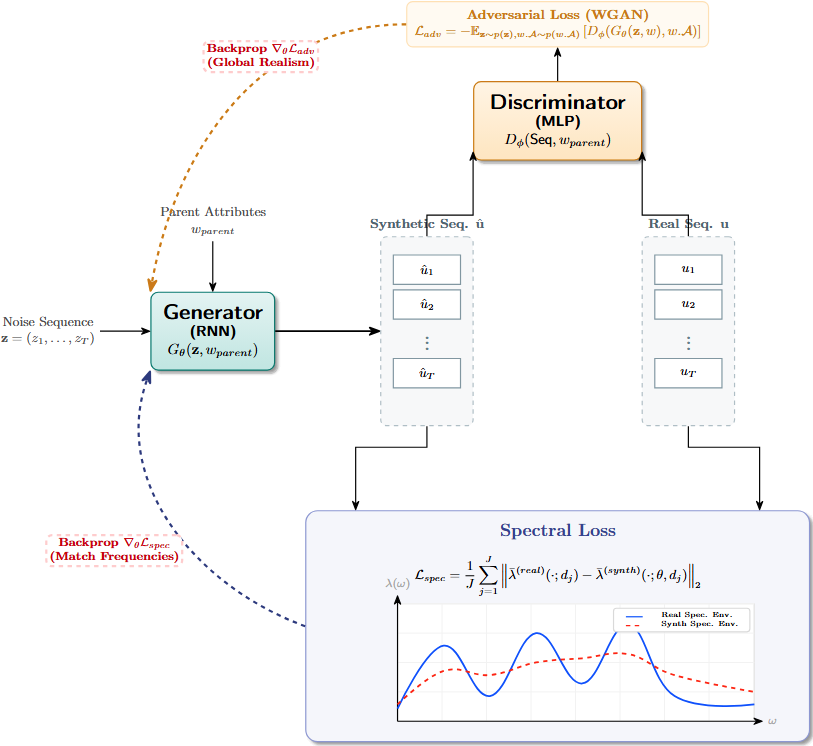
Figure 1: Architecture of Sequential RC-TGAN, illustrating sequence generation conditioned on parent attributes, with dual adversarial and spectral envelope loss optimization.
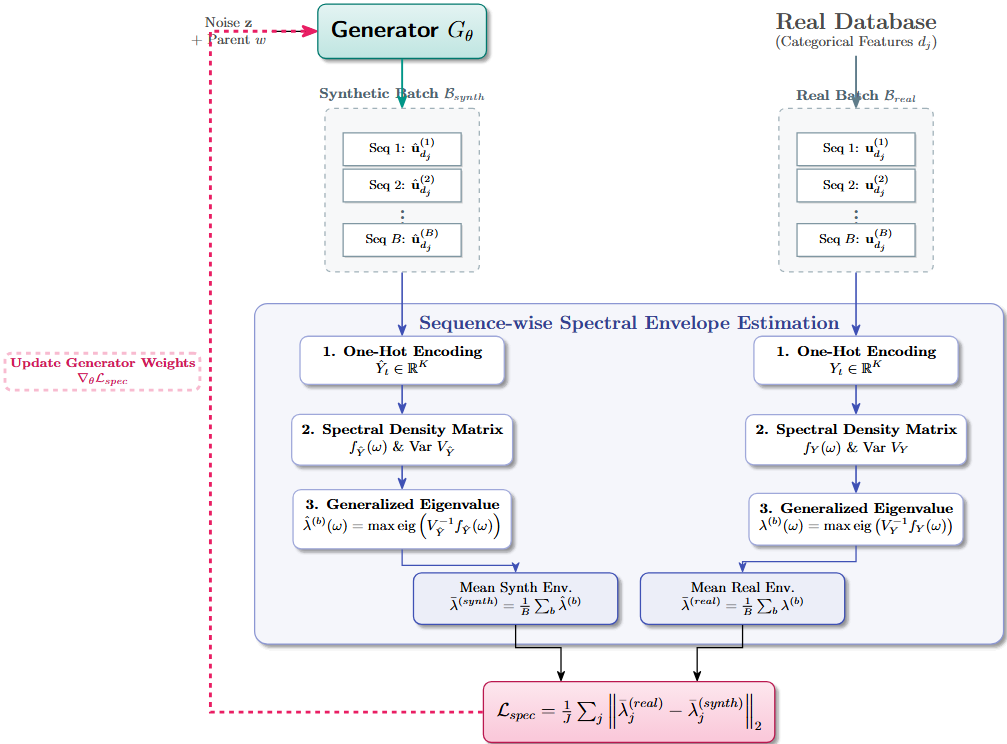
Figure 2: End-to-end spectral envelope loss pipeline. Real and synthetic categorical sequences are encoded, spectral envelopes are computed by solving the generalized eigenproblem, and the generator receives continuous frequency-domain gradients.
For continuous features, sequence values are discretized via a Variational Gaussian Mixture Model (VGM), allowing categorical envelope computation. A scalar offset encodes intra-mode variation, preserving time-domain variance.
Theoretical Framework: Spectral Envelope for Categorical Sequences
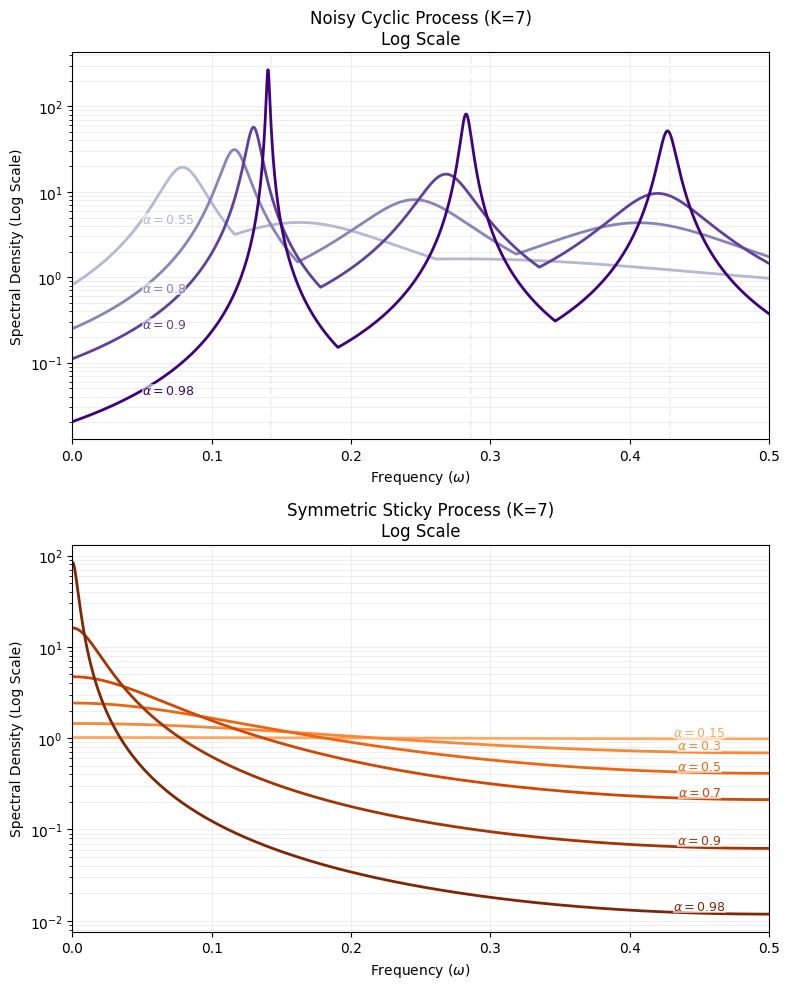
The paper formalizes the space of spectral envelopes as a subset of continuous/square-integrable functions over the frequency torus [−1/2,1/2], with well-defined L1 and L2 bounds. The envelope for a stationary categorical Markov process with transition matrix P is precisely characterized when P is circulant, allowing analytical determination of the exact expected envelope (and thus frequency content) as a "gold standard" for benchmark simulations.
Specifically, for processes like the Noisy Cyclic Process (NCP) and Symmetric Sticky Process (SSP), the envelope reveals:
Experimental Design and Evaluation Metrics
The evaluation protocol leverages Bayesian hierarchical simulation of relational databases, with each parent entity parameterizing a child chain with exactly known spectral envelope. This enables precise quantification of the generator's ability to reconstruct target frequency signatures.
Two frequency-domain divergence metrics are introduced:
- Spectral Density Divergence (SDD) for continuous features, computed as a divergence (e.g., KL) between normalized average spectral densities,
- Spectral Envelope Divergence (SED) for categorical attributes, given by normalized w1 distance between mean real/synthetic envelopes.
These metrics directly measure the model's ability to recover higher-order temporal structure and latent periodicities unobserved by time-domain statistics alone.
Empirical Results and Ablation
Simulated Benchmarks: On synthetic datasets governed by NCP and SSP processes (with state space sizes w2), Seq. RC-TGAN achieves significantly lower SEDs compared to SDV, ClavaDDPM, DoppelGANger, and TimeGAN. This reflects accurate recovery of cyclical and persistence phenomena in categorical series, passing both the strict harmonic location and spectral purity criteria.
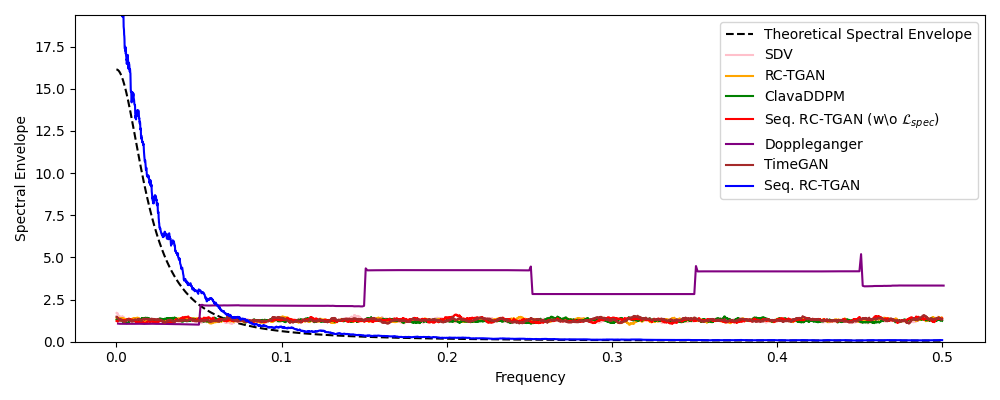
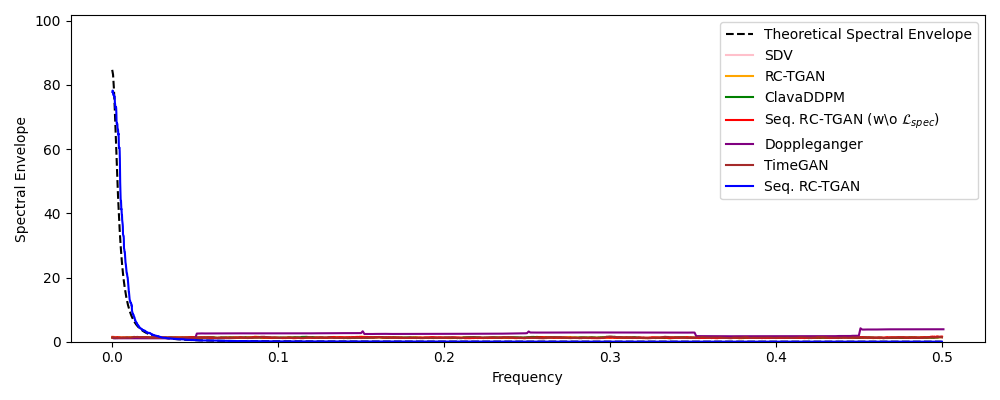
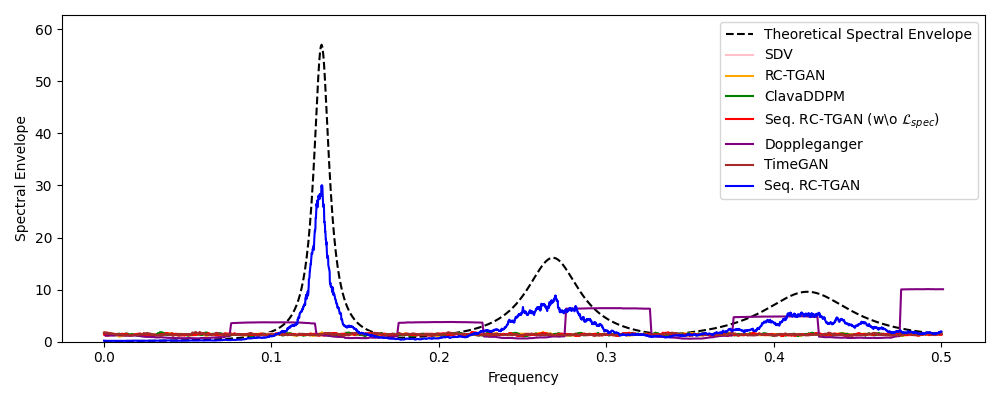
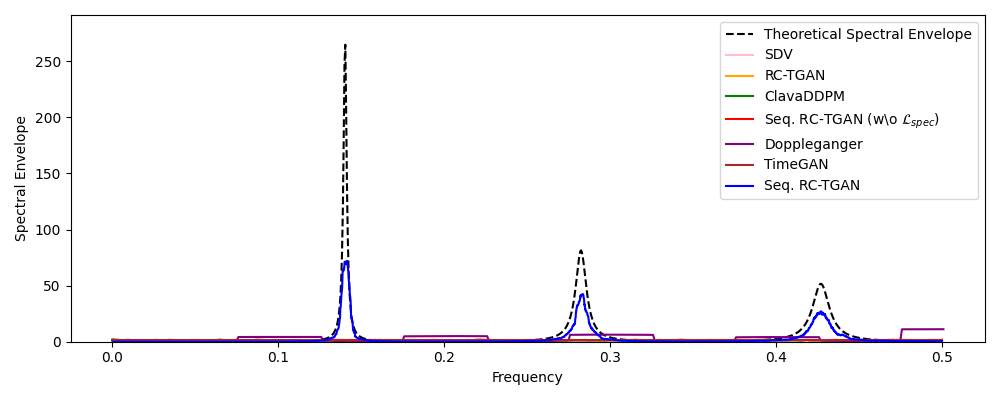
Figure 4: Seq. RC-TGAN recovers the spectral envelope of Symmetric Sticky with w3, while baselines fail to match amplitude and localization.
Real-World Databases (Rossmann, Walmart): On retail store and fuel price datasets, Seq. RC-TGAN yields the lowest SED and, for continuous columns, the lowest SDD, outperforming competitive time-series GANs and static relational generative models. Time-domain metrics (MSE ACF) are misleading in the presence of flat predictions; only models integrating frequency-domain constraints (i.e., Seq. RC-TGAN) faithfully reproduce hidden seasonal or periodic structure.
Ablation results underline:
- The necessity of the spectral envelope loss for categorical periodicity. Recurrent adversarial models without spectral loss behave similarly to static baselines for these features.
- Discretization-based adaptation for continuous columns is essential; simple power spectral density matching is less effective.
- MSE (ACF) can favor trivial flat predictions but does not reflect preservation of periodicities.
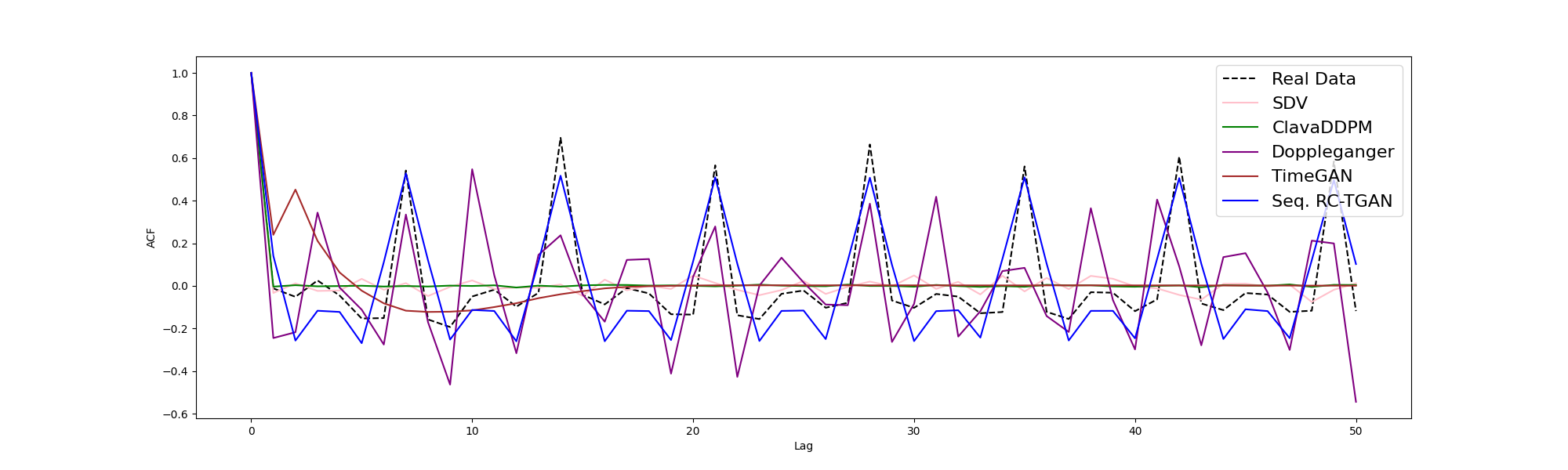
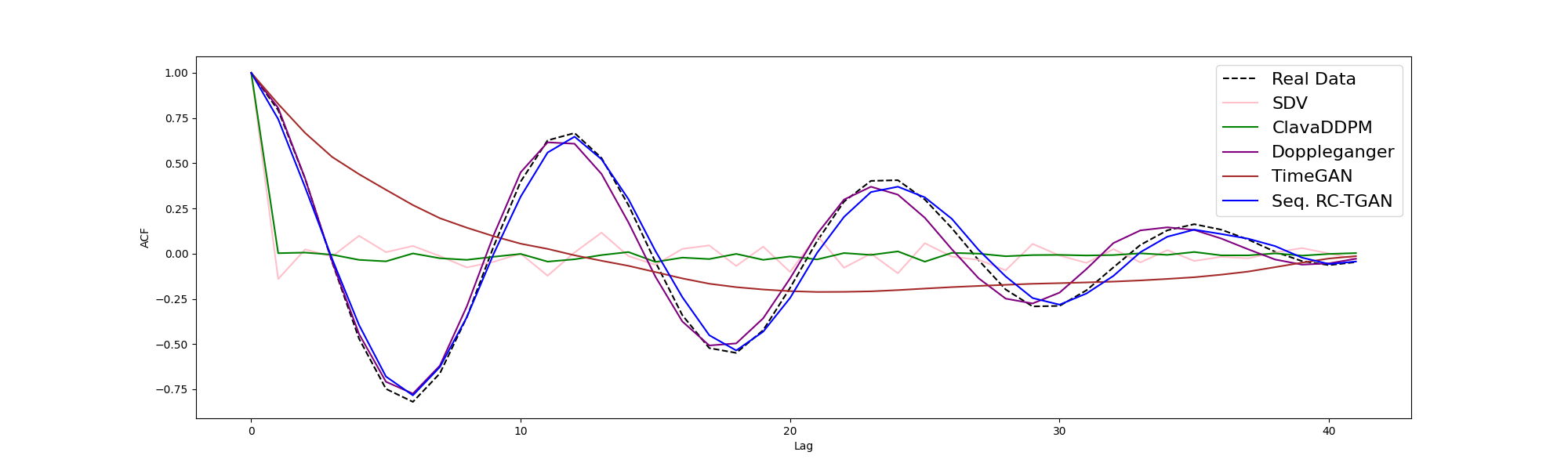
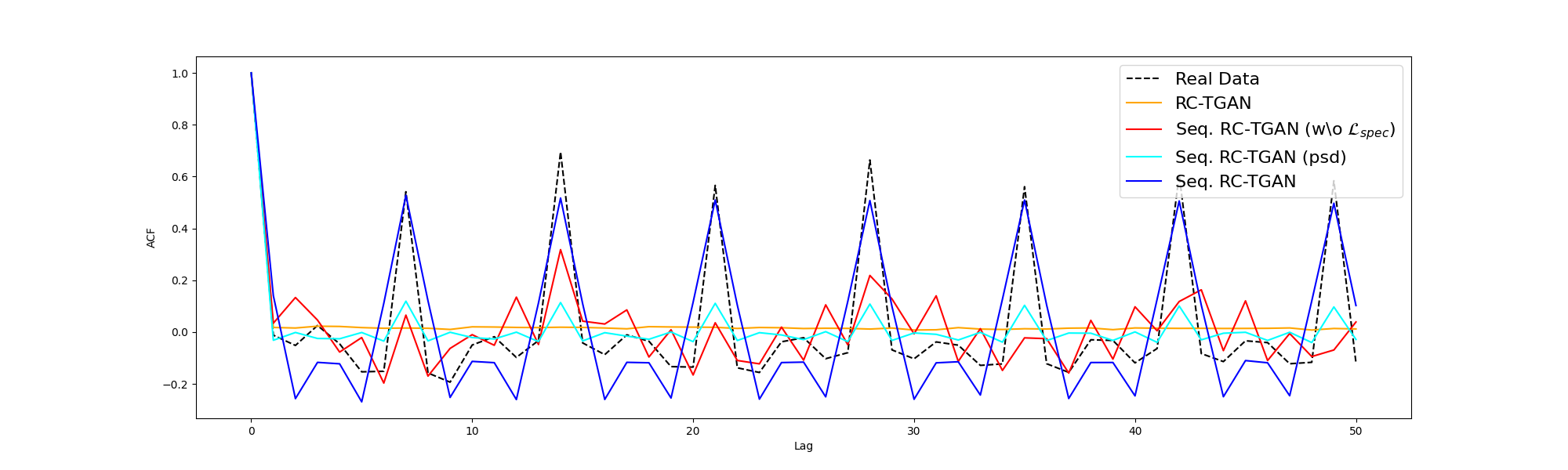
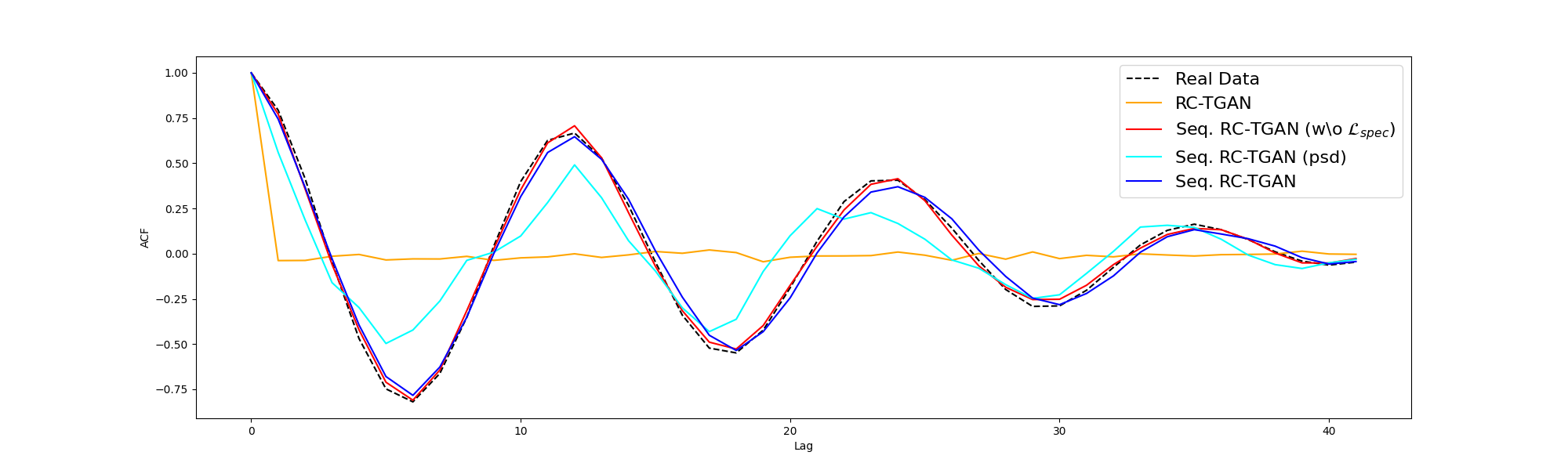
Figure 5: Rossmann Store Sales—autocorrelation (ACF): only Seq. RC-TGAN reproduces the periodic peaks consistent with observed sales cycles; static and unregularized recurrent models underfit.
Implications and Future Directions
This work demonstrates that frequency-domain regularization, specifically via spectral envelope theory, is essential for categorical time series modeling in relational synthetic data systems. The inclusion of a differentiable spectral envelope loss enables direct propagation of periodicity constraints through neural architectures, resolving orthogonality and cyclicity blindness present in alternative GAN and diffusion-based approaches.
Practically, this framework enables the generation of synthetic relational time series data with control over latent seasonality, cycles, and inertia—beneficial for privacy-preserving analytics, watermarking, fairness auditing, and process simulation. Theoretically, the rigorous benchmark/evaluation protocol based on ground-truth envelopes of parametric Markov processes sets a new baseline for generative model assessment in this domain.
Future research should explore:
- Extension to multi-modal or hierarchical spectral loss formulations for complex event sequences.
- Adaptation of diffusion or transformer-based generative paradigms to frequency-aligned objectives.
- Integration with downstream task metrics that depend explicitly on periodic feature fidelity.
- Broader application to graph-structured and multi-relational temporal domains.
Conclusion
Seq. RC-TGAN introduces a robust, theoretically-grounded methodology for sequential conditional generation in relational databases by leveraging spectral envelope loss. This approach consistently outperforms state-of-the-art generative models on both categorical and continuous time series, directly addressing the longstanding blind spot of frequency domain structure in tabular synthetic data generation. The mathematical rigor of the evaluation pipeline, coupled with practical performance, marks a substantive advancement in the field.