- The paper demonstrates that parallel reservoir architectures achieve higher accuracy in raw audio classification by preserving multi-scale temporal features without preprocessing.
- It compares shallow, sequential, and parallel RC models, showing that while shallow models are efficient, sequential models suffer from signal degradation unless adjusted.
- The study highlights the potential for energy-efficient, scalable audio processing on neuromorphic and edge platforms, paving the way for future adaptive stabilization strategies.
Direct Raw Audio Signal Processing via Reservoir Computing: 'Feature-Free' Architectures
Introduction
The paper "Direct Raw Audio Signal Processing via Reservoir Computing: An Investigation into 'Feature-Free' Architectures" (2606.21335) presents a comprehensive evaluation of Reservoir Computing (RC) for end-to-end audio classification without relying on traditional handcrafted feature extraction. The study addresses computational inefficiencies and intellectual bottlenecks inherent in audio pipelines employing Mel-Frequency Cepstral Coefficients (MFCCs) by proposing and analyzing several RC architectures—shallow, sequential, and parallel deep Reservoirs—for direct processing and classification of raw acoustic signals. The work is positioned at the intersection of neuromorphic computing and scalable, low-power signal processing, with a primary emphasis on feature-free, time-domain audio tasks.
Motivation and Background
Reservoir Computing, originating from Recurrent Neural Network theory, leverages a fixed, high-dimensional non-linear dynamical system (the "Reservoir") to project temporal data for efficient processing. Unlike RNNs, RC does not require backpropagation within the Reservoir, sidestepping vanishing gradients and reducing computational cost. Traditional audio classification pipelines depend on features like MFCCs, which introduce preprocessing bottlenecks and require domain expertise for configuration. End-to-end approaches based on deep CNNs have demonstrated performance parity with feature-based models but at the expense of large model sizes and significant training resources. The paper addresses whether lightweight reservoir architectures, with only the readout layer trained, can learn discriminative features from raw audio, thus eliminating pre-processing and facilitating rapid, energy-efficient deployment.
Shallow Reservoir Architectures
The shallow RC baseline processes moderately decimated raw audio, using empirical windowing and non-linear peak-to-peak envelope extraction to reduce dimensionality while maintaining temporal fidelity.
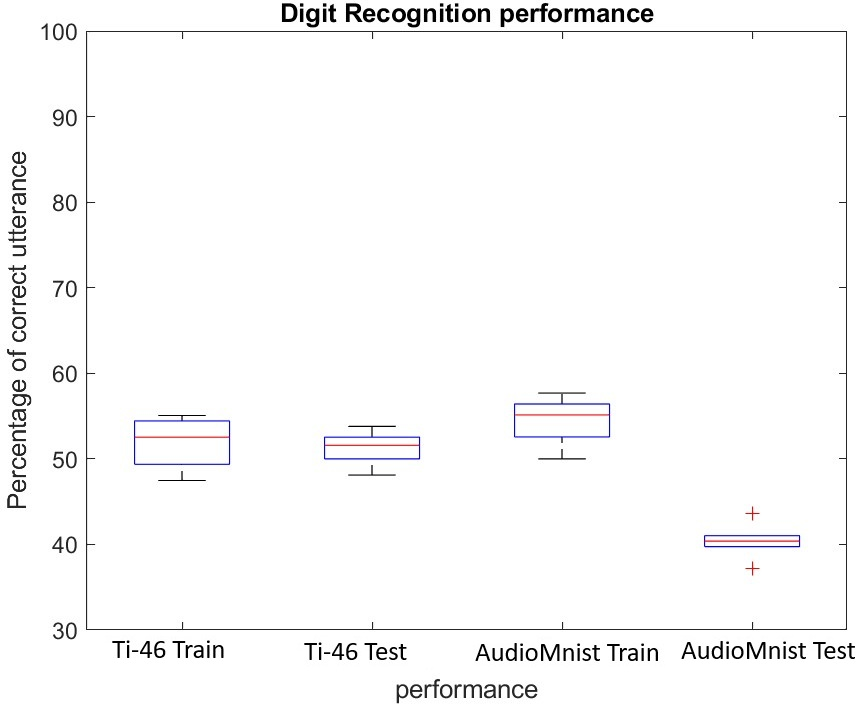
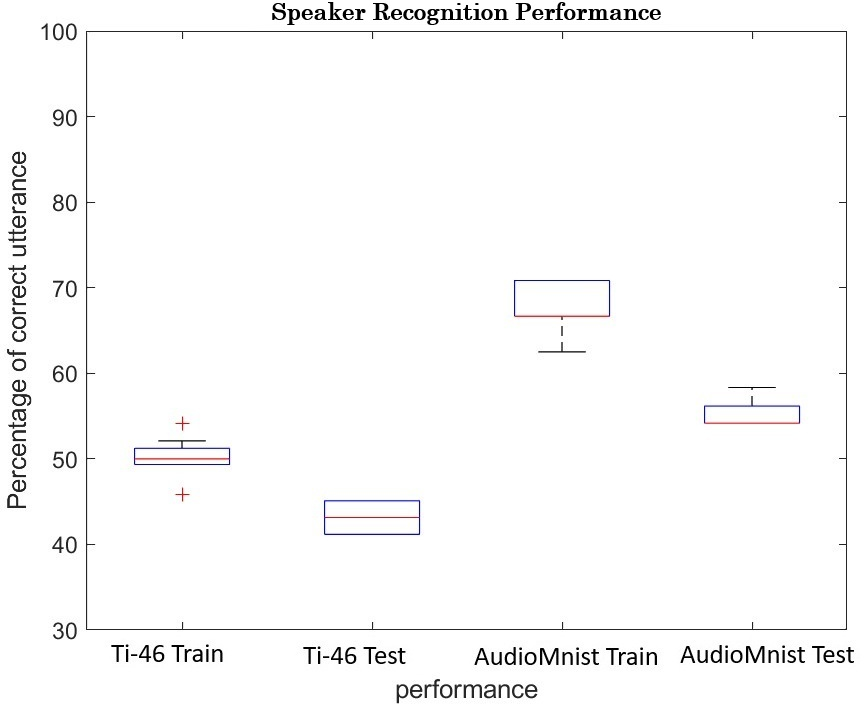
Figure 1: Digit and speaker recognition using "feature-free" audio processing using shallow Reservoir.
This architecture demonstrates the feasibility of direct audio classification, achieving significant accuracy on digit and speaker recognition tasks. However, the configuration is limited by its fixed timescale and absence of explicit frequency decomposition, leading to suboptimal separation for multi-class scenarios and limited ability to capture fine spectral nuances critical for robust speech recognition.
Sequential Deep Reservoir Architectures
The sequential (series-connected) Deep RC framework stacks multiple Reservoirs, where the subsequent layer receives the hidden states—rather than direct input—of the previous Reservoir. The architecture increases memory and abstraction capacity but introduces critical trade-offs.
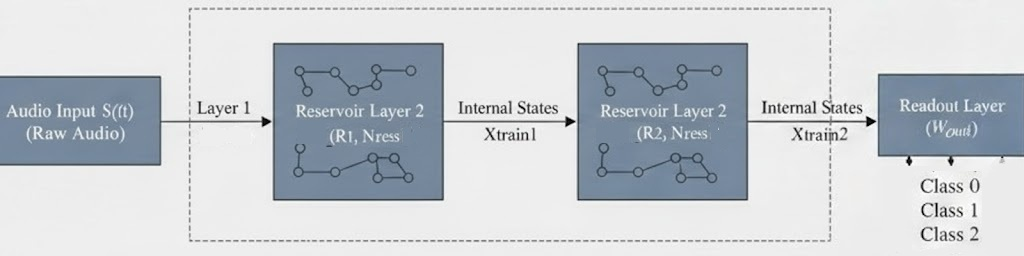
Figure 2: Deep Series "Feature-free" Audio signal processing.
Performance metrics indicate that sequential stacking does not consistently outperform shallow models—primarily due to signal degradation ("washing") when internal states lose frequency-specific information before further processing.
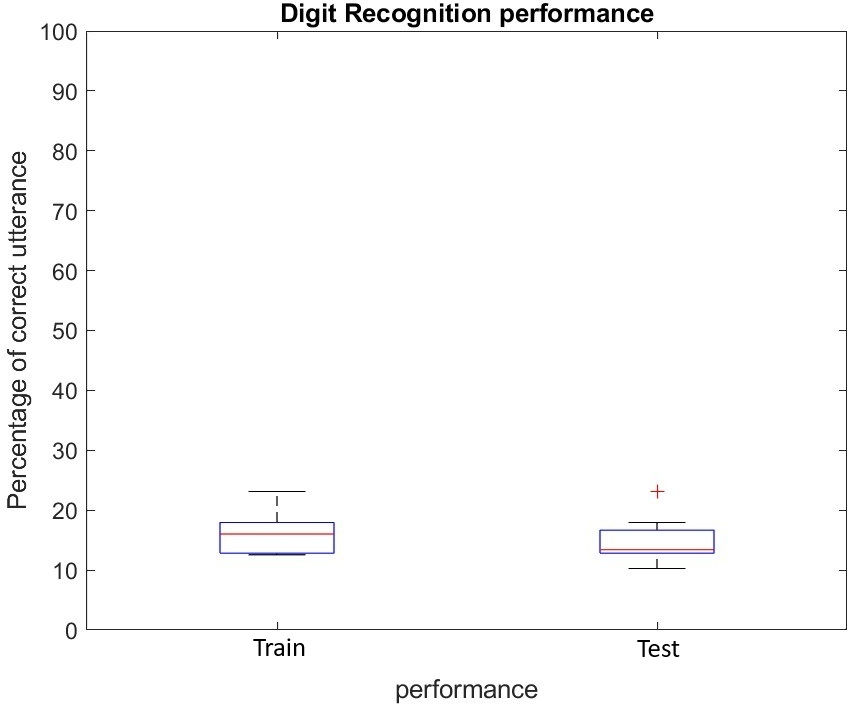
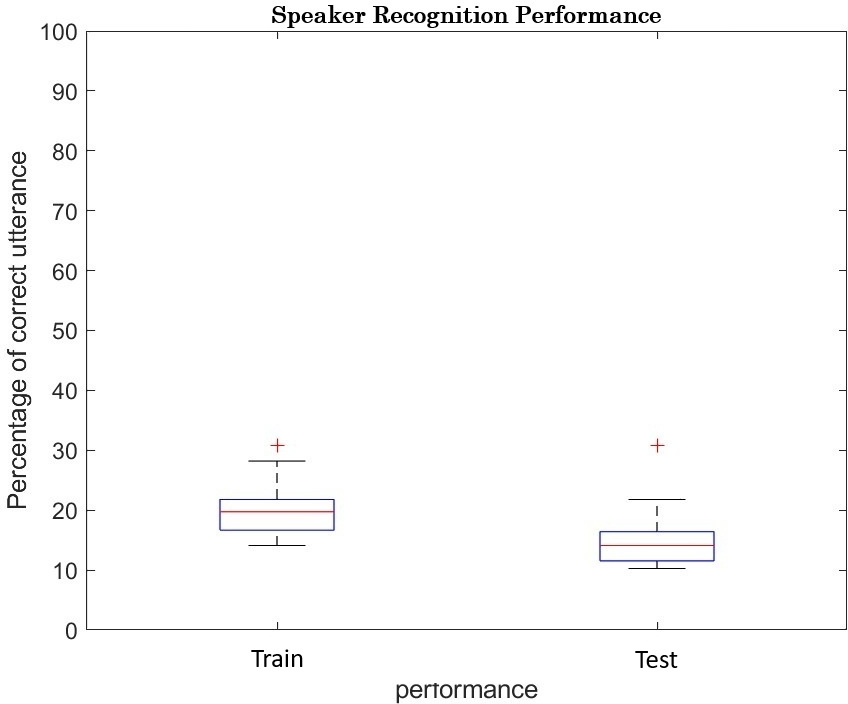
Figure 3: Performance of series deep Reservoir used for "feature-free" audio processing.
When MFCCs are used instead of raw audio, sequential deep Reservoirs yield superior discrimination. However, using MFCCs reintroduces the preprocessing bottleneck the feature-free architecture intends to eliminate.
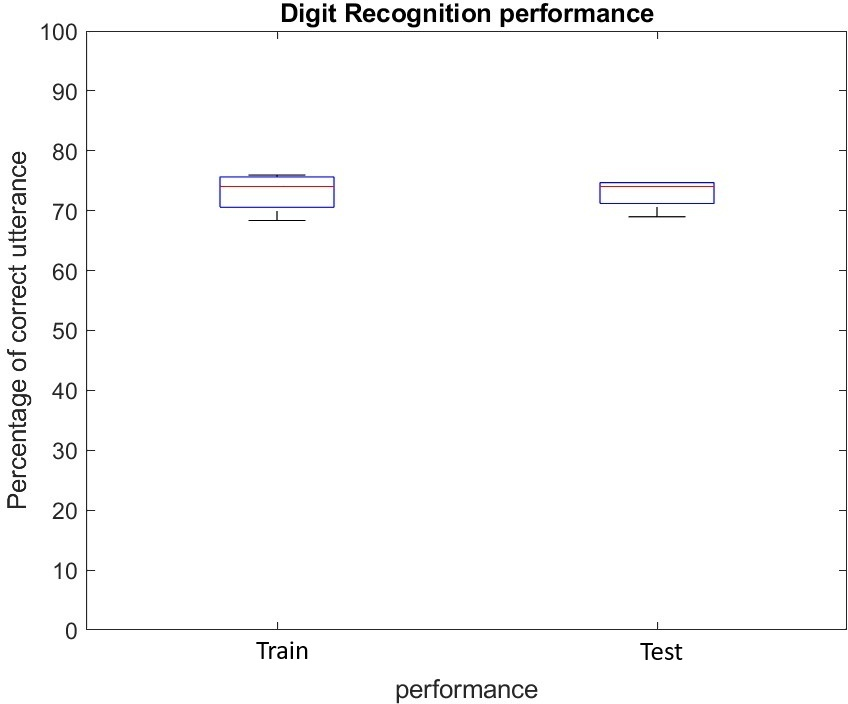
Figure 4: Performance of Deep series RC with MFCC as input.
A partial mitigation strategy, feeding a copy of the raw input alongside the hidden states, improves performance but does not surpass shallow MFCC-fed baselines.
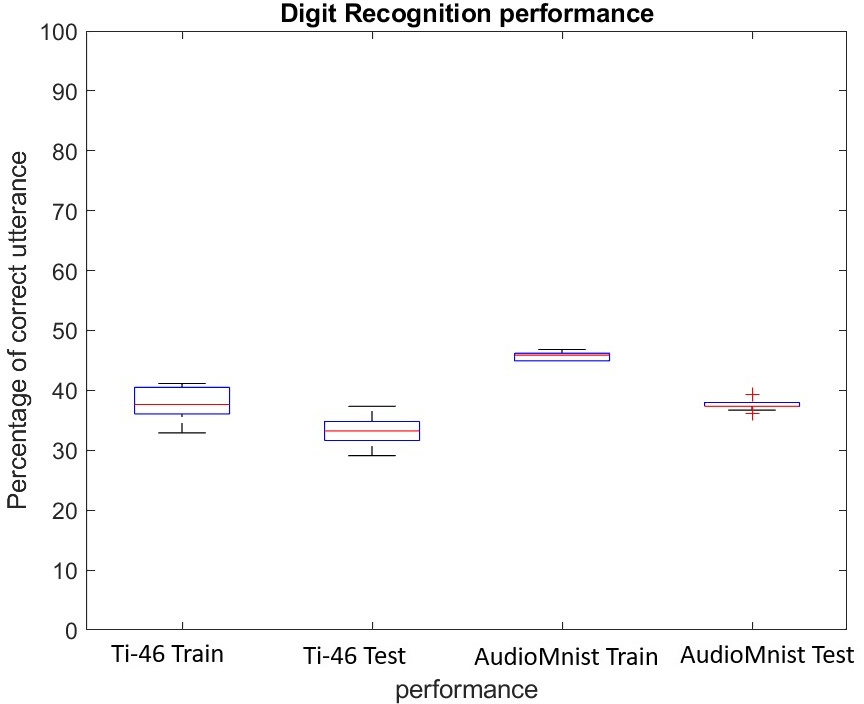
Figure 5: Output of Series Deep "feature-free" with second layer receiving a copy of Input.
The findings underscore limitations of serial stacking for "feature-free" processing: signal integrity is compromised unless original input is propagated across layers, and hyperparameter sensitivities (leak rate, spectral radius) must be finely controlled to avoid catastrophic loss of crucial cues.
Parallel "Feature-Free" Reservoir Architectures
The parallel RC topology diverges from serial abstraction, enabling each Reservoir to process the original raw audio simultaneously. Differentiated leak rates among Reservoirs optimize multi-scale temporal integration: slow leak captures global, speaker-specific identity; fast leak preserves short-term phonemic texture. Random initialization and parameter diversity ensure feature heterogeneity and robustness.
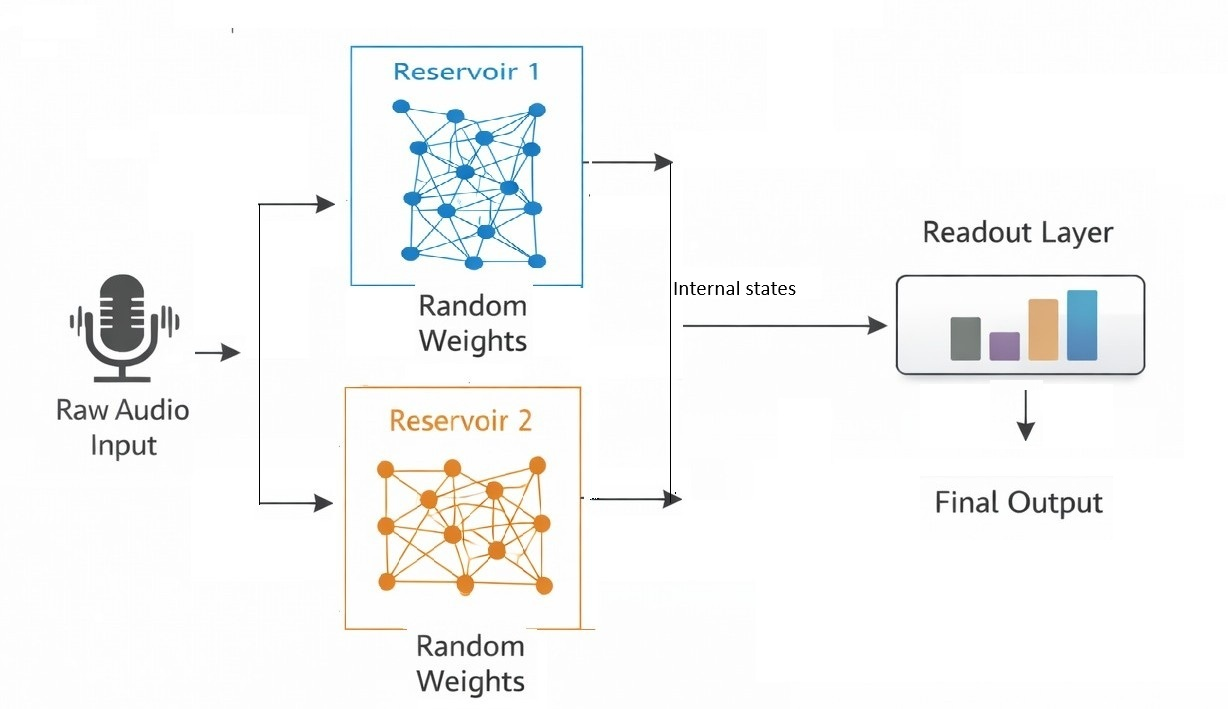
Figure 6: Parallel "feature-free" architecture.
Each branch independently maintains signal integrity and develops complementary abstractions, effectively bypassing the loss of information seen in series architectures. The concatenated state representation presented to the readout layer achieves high linear separability with minimal preprocessing and parameter count.
Implementation challenges include dimensionality scaling with increased node count, enforcement of diversity to avoid redundant state vectors, and normalization to ensure balanced readout integration. Despite these, the parallel approach consistently outperforms both shallow and serial RC models.
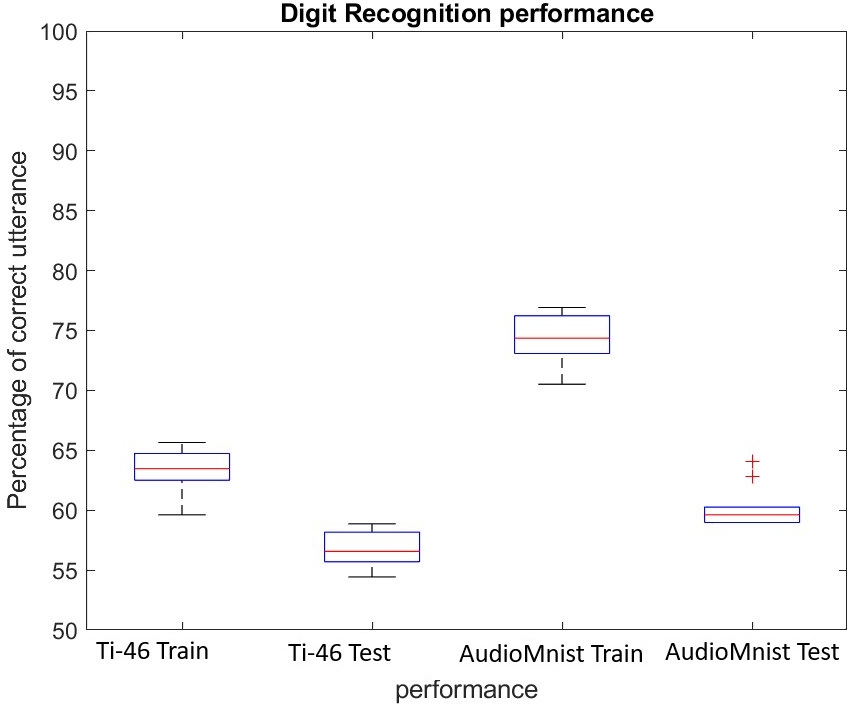
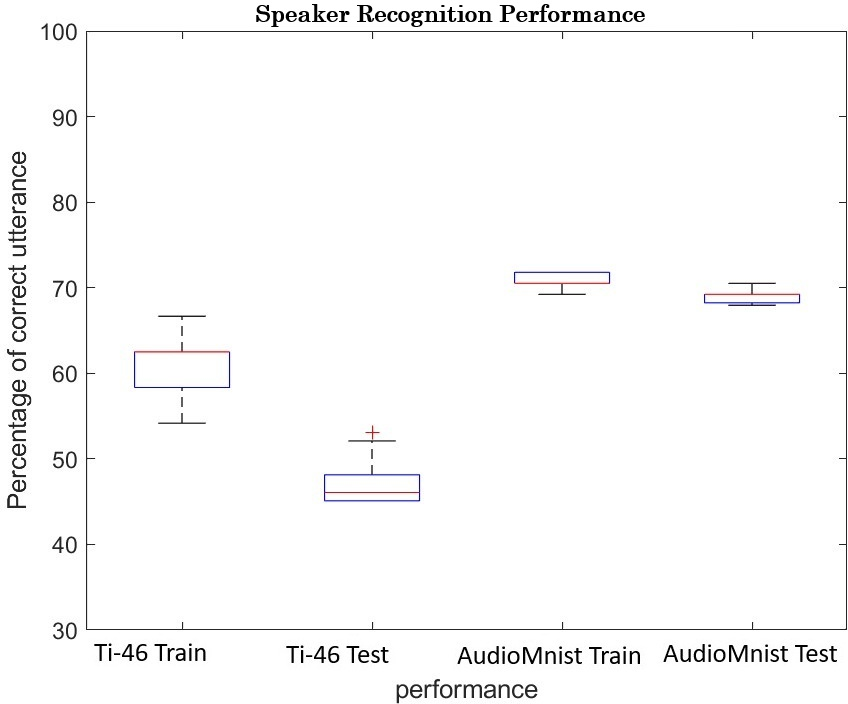
Figure 7: Digit and speaker recognition using deep "feature-free" parallel audio processing using Reservoir.
Notably, parallel RC models show improved test accuracy across both digit and speaker classification tasks (58.86% and 53.14% for Ti-46 test sets, respectively), compared to shallow baselines (53.79% and 41.18%) with low random guess baselines of 10%. This demonstrates significant discriminative capacity without feature extraction.
Discussion
The architectural evolution reveals that shallow RC models, while computationally efficient, lack sufficient multi-scale representation for complex audio tasks. Sequential deep RCs, despite increased depth, suffer from irreversible signal loss unless direct input propagation is maintained. Parallel architectures overcome these constraints, achieving robust, multi-resolution abstraction and state-space richness. The feature-free paradigm substantially reduces preprocessing costs and model complexity, rendering PFRC architectures ideal for neuromorphic and edge hardware.
Persistent challenges include model instability from weight initialization and hyperparameter drift, and sensitivity to dimensionality reduction strategies impacting Reservoir effectiveness. The approach enables time-domain processing with minimal overhead, but theoretical questions remain about optimal state encoding, convergence properties, and generalized applicability to other sensor modalities or environmental variabilities.
Implications and Future Directions
Practically, the PFRC framework establishes a scalable, energy-efficient pathway for autonomous audio processing directly from raw signals, bypassing conventional feature engineering and enabling rapid deployment for embedded and low-power platforms. Theoretically, it highlights RC's utility as a generalized high-dimensional projective processor, capable of multi-resolution abstraction in time-domain tasks. Future directions include stabilization protocols for hyperparameter robustness, adaptive dimensionality reduction matching signal information density, and expansion to diverse modalities with heterogeneous input encoding.
Conclusion
The paper substantiates that parallel feature-free Reservoir Computing architectures deliver superior signal processing performance on raw audio tasks, outperforming both shallow and sequential RC baselines at reduced model complexity. By eliminating feature extraction and enabling robust high-dimensional projection and classification directly from time-domain waveforms, PFRC paves the way for efficient, scalable, and deployable audio processing systems. Further optimization of RC dynamics, adaptive input handling, and stabilization strategies are critical steps toward establishing PFRC as a standard for autonomous low-power signal pipelines.