- The paper introduces RAISE, a framework that integrates LLM-based heuristic evolution with an inner adversarial search to combat distribution shifts.
- RAISE employs a bi-level evolutionary process that significantly reduces waste ratios in online combinatorial optimization tasks compared to classical methods.
- Experimental results across bin packing, job shop scheduling, and vehicle routing confirm its scalability, improved robustness, and reduced LLM inference costs.
RAISE: LLM-Based Automated Heuristic Design with Robust Adversary Instance Search
Motivation and Problem Statement
Automated Heuristic Design (AHD) powered by LLMs has made significant progress in synthesizing high-quality heuristic algorithms for combinatorial optimization, leveraging LLMs as evolutionary operators. However, such approaches are critically limited by their dependence on a fixed nominal training distribution. Heuristics optimized only for this set are prone to catastrophic degradation when deployed under moderate distributional shifts, as commonly encountered in real-world operations. Prior attempts to address robustness, such as portfolio construction or meta-optimization, still require explicit multi-distribution training, which is not always practical and fails to guarantee robustness against unseen or hard-to-anticipate shifts.
The RAISE (Robust Adversary Instance Search) framework addresses this gap by reframing robust heuristic discovery as a constrained adversarial minimax optimization problem. Specifically, RAISE couples an LLM-driven outer loop for heuristic evolution with an LLM-free inner adversarial instance search, which efficiently identifies worst-case instances from a principled ε-ball uncertainty set around the nominal distribution.
RAISE Framework Architecture
RAISE is structured as a bi-level evolutionary process. The outer loop utilizes LLM operators to generate and refine heuristic candidates, while the inner loop performs adversarial search to discover hard instances for evaluation:
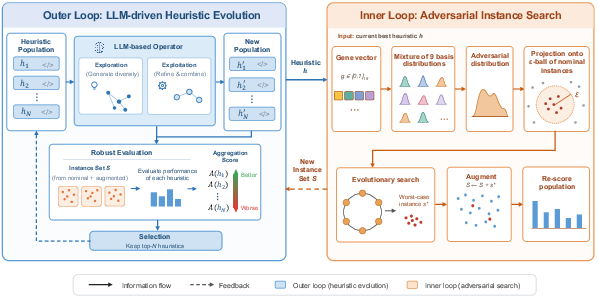
Figure 1: RAISE framework overview with LLM-driven outer evolutionary loop for heuristic design and LLM-free inner adversarial instance search within an ε-ball uncertainty set.
Formally, RAISE optimizes: h∗=arghmaxs′∈Bε(S)mineval(h,s′),
where Bε(S) defines a constraint set of instances within ε distance of the nominal training set. The inner adversarial search employs a basis-distribution parameterization together with boundary projection to efficiently scan the feasible space and surface instances that maximize heuristic failure, without incurring extensive LLM inference cost.
During each training cycle:
- A population of heuristics is evolved via LLM-based operators on the current adversarial instance set.
- Every τ generations, the inner loop exposes the current population to newly discovered worst-case instances within the uncertainty set.
- The adversarial instance is added to the evaluation set, and all heuristics are re-scored, ensuring continuous selective pressure toward robustness.
The ε-ball radius controls the trade-off: as ε→0, RAISE reduces to standard AHD; as ε increases, the search converges to worst-case performance optimization, providing explicit robustness guarantees within the specified uncertainty set.
Experimental Evaluation
Comprehensive experiments were conducted on three canonical online combinatorial optimization domains:
- Online Bin Packing (OBP)
- Online Job Shop Scheduling (OJSP)
- Online Vehicle Routing (OVRP)
Each task spanned five distinct test distributions (Uniform, Normal, Lognormal, Exponential, Triangular) and multiple problem scales, totaling 95 test datasets.
Numerical results in OBP are highlighted in Figure 2 and strongly support the robustness claims:
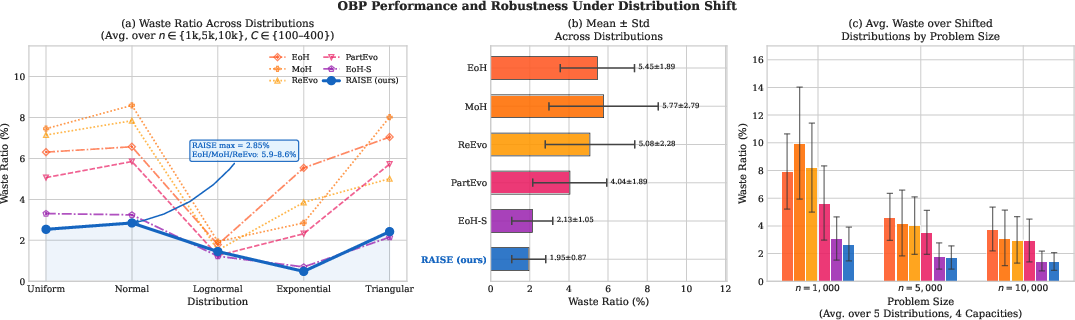
Figure 2: OBP waste ratio (lower is better) across five distributions, average over 60 datasets, and by size; RAISE consistently achieves superior OOD robustness compared to all LLM-based and classical baselines.
Key findings:
- Catastrophic shift failure of vanilla LLM-based AHD: Methods such as EoH and ReEvo yield waste ratios of 5.2−6.5% on OOD distributions (Uniform, Normal), far exceeding classical BestFit (ε0), with up to ε1 degradation.
- OOD robustness of RAISE: For ε2, RAISE achieves an average shifted waste ratio of ε3, outperforming EoH-S (portfolio-based robustness) trained on far larger and more diverse training sets. On Exponential, RAISE achieves ε4 versus EoH's ε5.
- Consistency across scales: RAISE leads or matches the best performance on 8/12 scale configurations. Differences grow with problem scale, supporting the effectiveness of adversarial instance search.
- Transfer to other domains: In OJSP and OVRP, RAISE maintains state-of-the-art results on normalized makespan and route length ratio, consistently outperforming or matching all learned and classical baselines under distribution shift.
Adversarial Search Dynamics and Ablation Results
Analysis of the convergence trajectory confirms that the inner adversarial loop drives the population toward genuinely robust heuristics, avoiding overfitting to the nominal set:
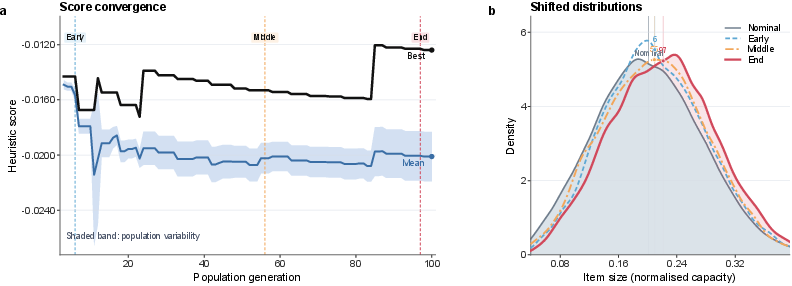
Figure 3: Left—Population score evolution across generations showing adaptation to increasingly adversarial evaluation contexts. Right—Distribution parameters of discovered adversarial instances shift systematically away from nominal.
Ablation studies demonstrate the necessity of each RAISE component:
- Removal of the ε6-ball constraint yields heuristics that overfit to extremes and generalize poorly, with ε7 to ε8 higher average waste.
- Elimination of basis-distribution parameterization restricts the diversity of adversarial instances, severely degrading OOD performance.
- Omission of inner adversarial search reduces the method to vanilla AHD and restores catastrophic OOD failure.
- Boundary projection (ε9-mapping) is essential: its ablation causes upwards of h∗=arghmaxs′∈Bε(S)mineval(h,s′),0 performance loss on certain distributions.
Theoretical and Practical Implications
RAISE formalizes robust AHD as a constrained minimax problem within an instance-level uncertainty set, leveraging a decoupled LLM-free mechanism for adversarial evaluation. This architecture provides several advances:
- Elimination of dependence on predefined distribution sets or portfolios, which may be unrepresentative or unattainable in realistic settings.
- Sub-linear increase in computational cost: the robust inner loop is LLM-free, representing a negligible API budget share compared to multi-instance re-training or portfolio evaluation.
- Scalability to broader classes of shift phenomena, provided an appropriate distance metric can be defined over instance space.
RAISE demonstrates that principled robustness can be operationalized over black-box, non-differentiable heuristic programs by combining evolutionary search with derivative-free inner adversarial optimization. This decoupling is critical for extending robust AHD beyond settings where explicit distribution coverage or gradient-based adversarial training is feasible.
Future Directions
Future work should extend RAISE to model multi-dimensional, correlated, or hierarchical distributional shifts; adapt the framework to offline and mixed-setting combinatorial optimization; and generalize the uncertainty model beyond simple h∗=arghmaxs′∈Bε(S)mineval(h,s′),1-ball constraints, potentially leveraging optimal-transport or kernel-based set definitions. Additional research is warranted on convergence analysis, inner loop acceleration, and transfer to broader program synthesis tasks in operations and machine learning.
Conclusion
RAISE provides a general and practical framework for robust LLM-based Automated Heuristic Design. By integrating efficient, constrained adversarial search into the LLM evolutionary loop, RAISE achieves consistent and substantial improvements in OOD reliability—across multiple tasks, distributions, and scales—while operating within realistic LLM usage budgets. This work establishes the feasibility and necessity of explicit robustness mechanisms for data-driven heuristic synthesis and provides a foundation for further advances in safe, reliable, and generalizable machine programming.