- The paper establishes an isomorphism between Z_d-equivariant Rabinowitz Floer homology of Legendrian lifts and the quantum homology ring of monotone Lagrangians.
- It employs monotonicity and Maslov index bounds to achieve compactness without Liouville fillings, enabling explicit computations in key examples.
- The work provides new obstructions to exact Lagrangian fillings and bridges RFH with wrapped Fukaya categories, deepening insights into symplectic topology.
Rabinowitz Floer Homology for Legendrian Submanifolds in Prequantization Bundles: A Technical Overview
Introduction and Motivation
This paper develops a detailed Floer-theoretic framework relating the topology and quantum invariants of monotone Lagrangian submanifolds L in symplectic manifolds (Σ,ω) to the Rabinowitz Floer homology (RFH) of their Legendrian lifts L in prequantization bundles Y→Σ. Central results are structural isomorphisms connecting Zd-equivariant RFH of L with the quantum homology ring of L, with implications for the existence of fillings, quantum ring structures, and vanishing results under geometric and topological constraints.
Geometric Setup and RFH Construction
Let (Σ,ω) be a closed integral symplectic manifold and Y→Σ its prequantization bundle, determined by an Euler class. A closed, connected, monotone Lagrangian L⊂Σ with minimal Maslov number (Σ,ω)0 admits a Legendrian lift (Σ,ω)1 under a covering condition (holonomy finite image (Σ,ω)2). The Legendrian (Σ,ω)3 inherits a relative (Σ,ω)4-structure from (Σ,ω)5, furnishing integral orientation data necessary for coherent index and sign conventions in Floer-theoretic constructions.
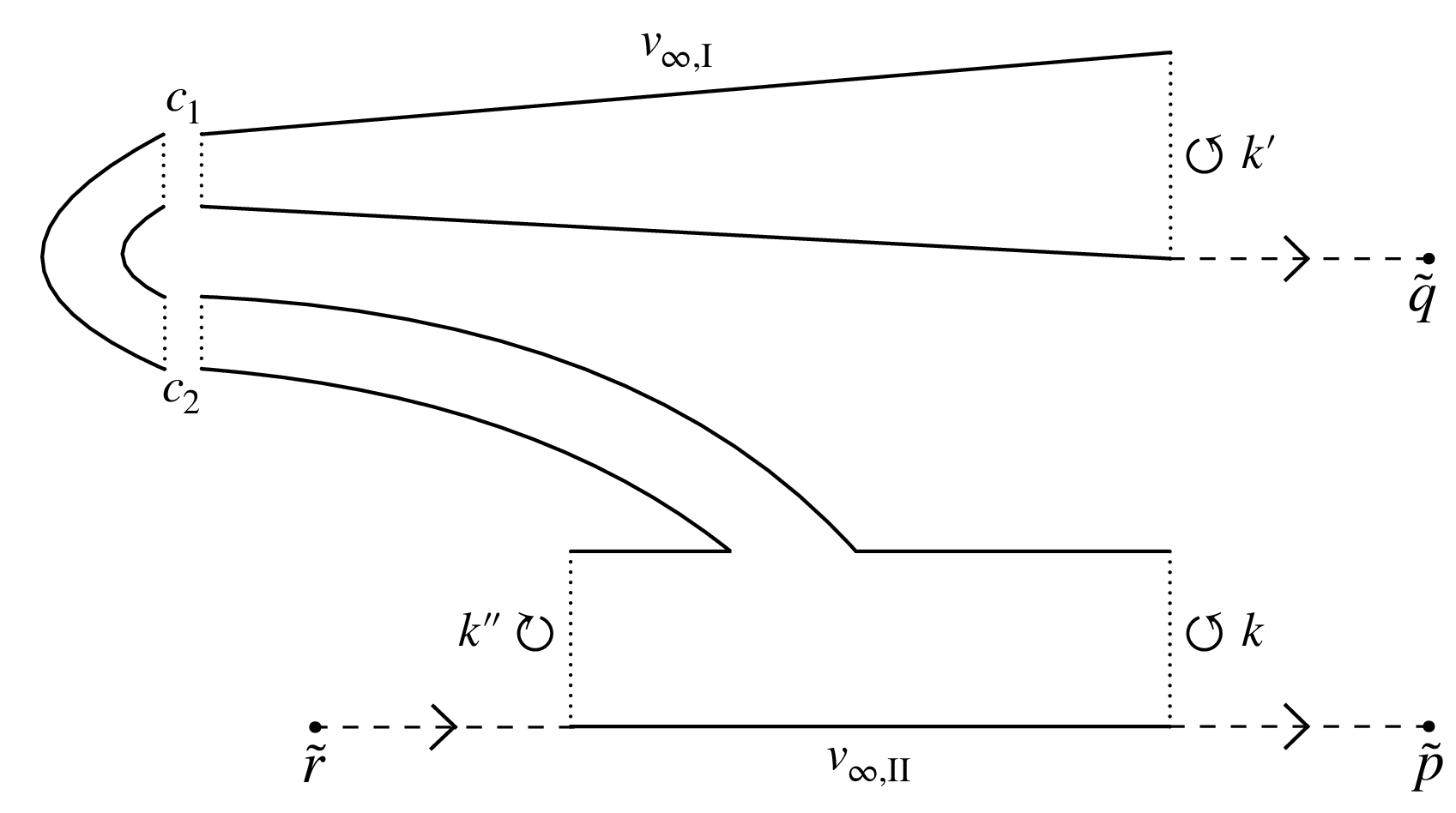
Rabinowitz Floer homology (Σ,ω)6 is defined using contractible generalized Reeb chords and a boundary operator counting Floer strips in the symplectization. Notably, the approach does not rely on the existence of Liouville or Lagrangian fillings—compactness and well-definedness are achieved via the Maslov index bounds. The framework also extends to (Σ,ω)7-equivariant settings, encoding deck transformations from the covering (Σ,ω)8.
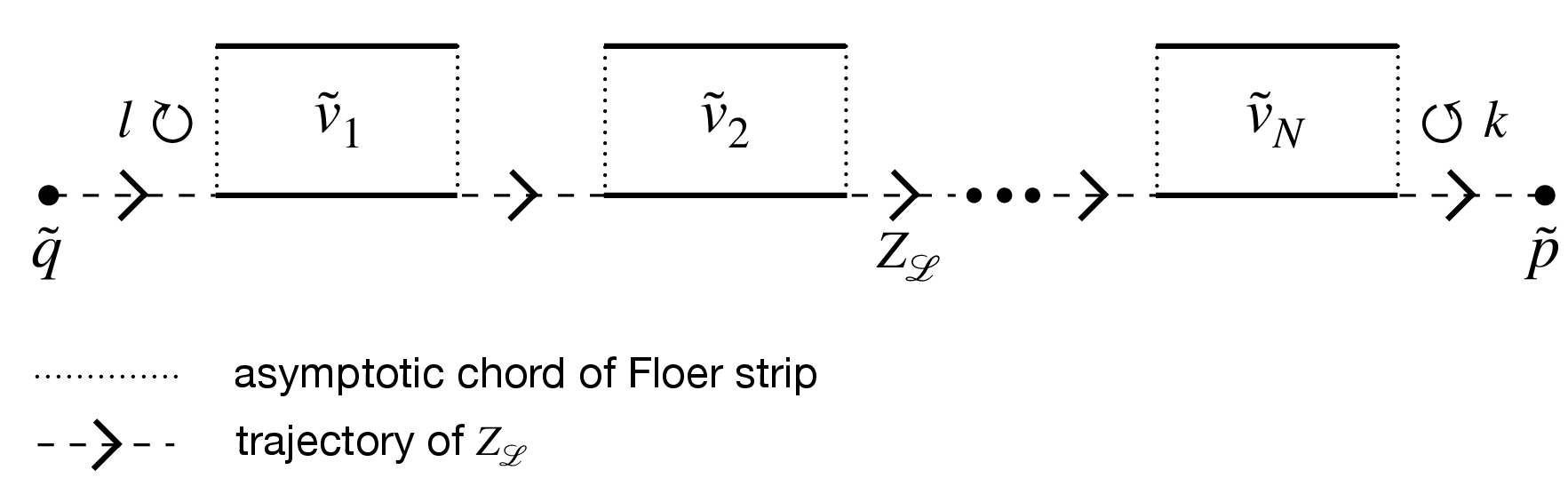
Figure 1: An element of (Σ,ω)9 representing a Floer trajectory structure connecting critical points as chain-level generators in the RFH complex.
Main Results: Isomorphisms and Ring Structures
The core technical achievement is an isomorphism between L0-modules: L1
where L2 denotes the quantum homology (or cohomology, via Poincaré duality) of L3, with the L4-action reflecting equivariant covers. For L5, this isomorphism lifts to the level of quantum rings, providing a Floer-theoretic categorification of quantum products in Lagrangian quantum cohomology via counting of SFT-broken holomorphic curves.
Explicit computational instances—such as Lagrangian spheres in quadrics and two-step flag manifolds—demonstrate the effective computability and structural interpretation of the quantum homology ring via RFH.
Computations and Examples
Two primary classes of examples highlight the utility:
Quantum Invertibility, Vanishing, and Obstruction Results
If Y→Σ2 is invertible in the quantum cohomology ring Y→Σ3, stringent torsion and vanishing constraints emerge for Y→Σ4. The isomorphism Y→Σ5, together with transfer/projection maps induced by covering data, implies that vanishing or torsion phenomena in RFH directly translate to quantum invariants. In particular, this framework gives new obstructions to "simple" exact Lagrangian fillings and generalizes known vanishing results in the presence of polarized symplectic divisors and disjointness from Lagrangian traces.
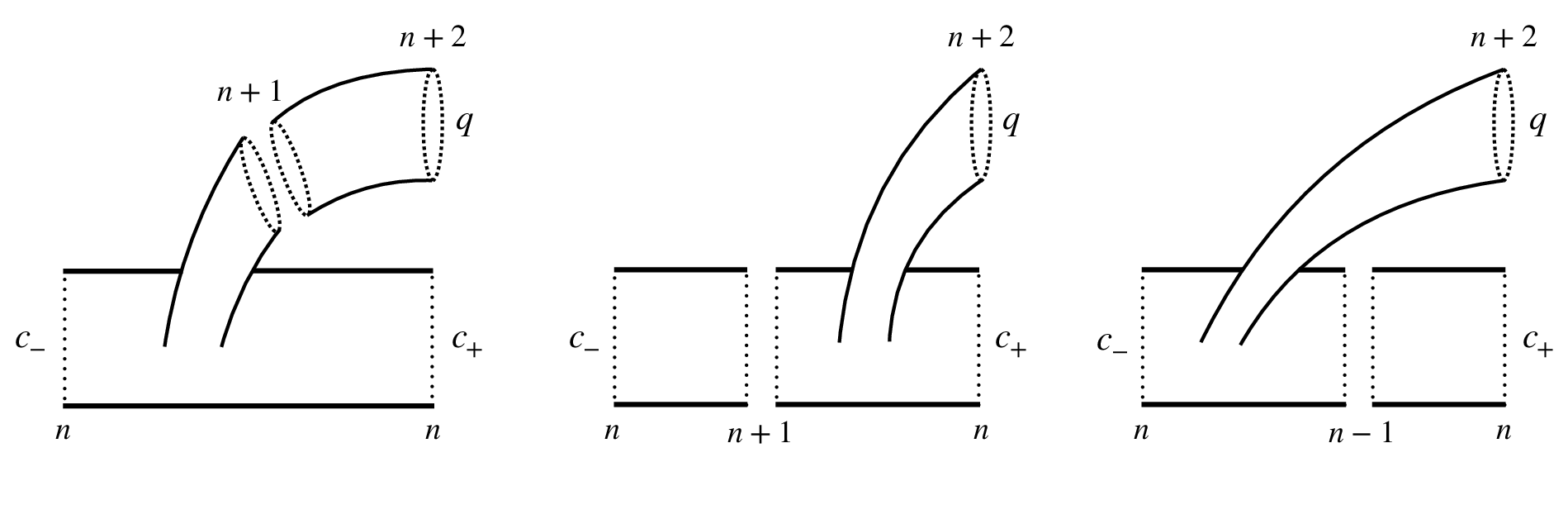
Figure 3: Possible configurations of broken curves at the boundary of moduli spaces, illustrating bubbling phenomena relevant to transversality and compactness.
Nonvanishing RFH classes enforce strong intersection properties under Legendrian isotopies and contactomorphism-induced perturbations, generalizing leafwise intersection principles and quantitative intersection results from the literature. The construction connects to recent advances identifying Lagrangian cocores as wrapped Fukaya generators and relates to corresponding augmentations and potential theory computations.
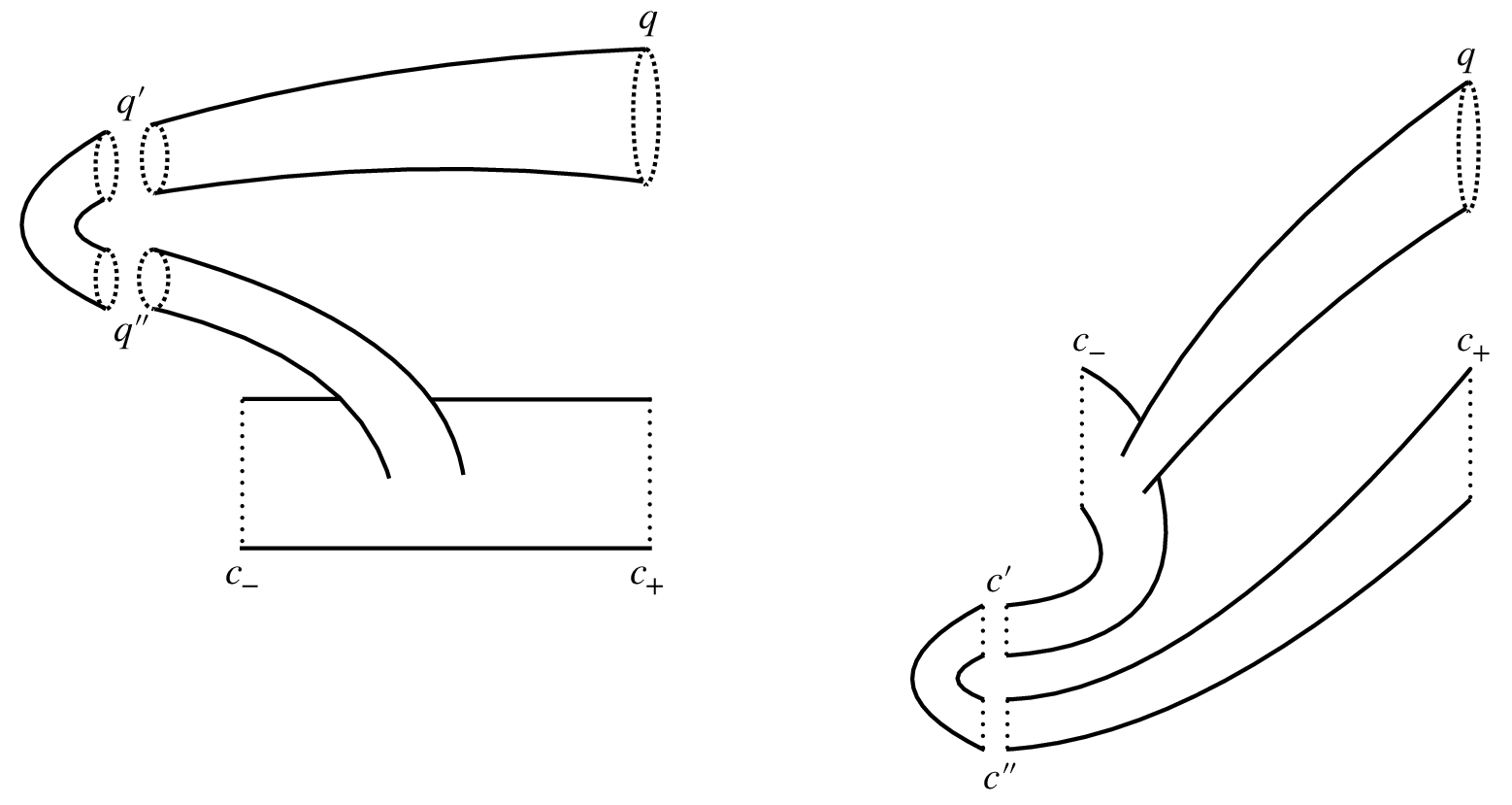
Figure 4: SFT-broken and Floer-broken curve configurations in the boundary of RFH moduli spaces, encoding algebraic relations and compatibility with product structures.
Extensions: Fillings, Reductions, and Localization
When compatible (topologically simple) Liouville or exact Lagrangian fillings exist, weaker Maslov index hypotheses suffice, and RFH calculations factor through wrapped Floer theory via Viterbo transfer maps. The paper clarifies the relation between augmented, localized, and reduced RFH and Y→Σ6, leading to precise algebraic control in terms of ring localizations and spectral sequence arguments.
Technical Innovations
- Chain-level geometric correspondences are established between moduli spaces of holomorphic disks in Y→Σ7 and RFH trajectories in Y→Σ8, systematically upgrading Morse-theoretic and pearl complex techniques.
- Transversality without fillings is achieved using monotonicity and thorough index estimates, allowing computation in the absence of global symplectic convexity.
- Equivariance and coverings are handled with care, with explicit computations of deck action-induced effects on Floer-theoretic invariants.
Implications and Future Directions
The construction establishes a robust bridge between Rabinowitz Floer theory and Lagrangian quantum topology in prequantization geometries, enabling refined computations of quantum rings from Floer-theoretic data and clarifying the connection to the existence, uniqueness, and obstructions of exact fillings.
The results suggest further development in two main directions:
- Study of RFH and quantum homology relations for non-monotone (e.g., weakly exact or broader monotonicity class) Lagrangians, perhaps with local system or boundary condition twists.
- Investigation of the full structure of the isomorphism at the level of Frobenius algebras, and its compatibility with wrapped Fukaya categories, augmentations, and potential mirrors.
Conclusion
This technical advancement provides a comprehensive and explicit analytic-to-algebraic correspondence, illuminating the interplay between symplectic topology, quantum geometry, and Floer-theoretic invariants for Legendrian lifts in prequantization spaces. The results have strong representation-theoretic, geometric, and categorical implications, enabling powerful new computational and conceptual approaches across Hamiltonian and Lagrangian Floer theories.