- The paper introduces a dual-field continuous representation that integrates SDF and UDF to jointly optimize B-rep geometry and topology.
- It leverages a Perceiver-style VAE backbone to fuse multi-modal point cloud features for both reverse engineering and generative modeling tasks.
- Empirical results on the ABC CAD dataset show improved reconstruction validity and fidelity, especially for complex shapes.
DualBrep: A Dual-Field Continuous Representation for B-rep Modelling
Boundary representation (B-rep) is the dominant representation for CAD due to its ability to provide analytical precision and parametric editing capabilities. However, the intrinsic structure of B-rep—coupling continuous parametric geometry and discrete topological graphs—poses serious obstacles for gradient-based deep learning methods. State-of-the-art approaches using direct graph predictions, tokenization, or sequential modeling encounter issues related to non-differentiability, combinatorial search space explosion, and validation failures, particularly as model complexity rises. This severely limits the viability of robust B-rep learning for tasks such as reverse engineering and generative modeling.
DualBrep proposes a paradigm shift: rather than handling hybrid discrete-continuous primitives, it translates the entire B-rep model into a pair of continuous fields defined over Euclidean space. The global geometry is captured by a signed distance function (SDF), while implicit volumetric topology is encoded using an unsigned distance field (UDF) representing the generalized Voronoi diagram (GVD) of surface elements. This dual-field reformulation allows both geometry and topology to be optimized jointly within a unified, differentiable, and resolution-agnostic latent space.
Dual-Field Representation and VAE Backbone
The key innovation of DualBrep lies in its dual continuous representation:
- Geometry Field (SDF): Encodes the global, watertight surface by storing the signed distance to the object's boundary.
- Topology Field (GVD/UDF): Induces a volumetric partitioning such that proximity to the "medial sheet" (the GVD) denotes where B-rep surface identity changes, and thus where edges and face boundaries exist.
By mapping B-rep models entirely into the continuous domain, and then compressing both fields into a shared latent space via a Perceiver-style VAE, the architecture supports both deterministic (reverse engineering) and generative tasks with a common backbone. This design eliminates the need for primitive-specific detection, variable-length graph tokenization, or explicit adjacency prediction.
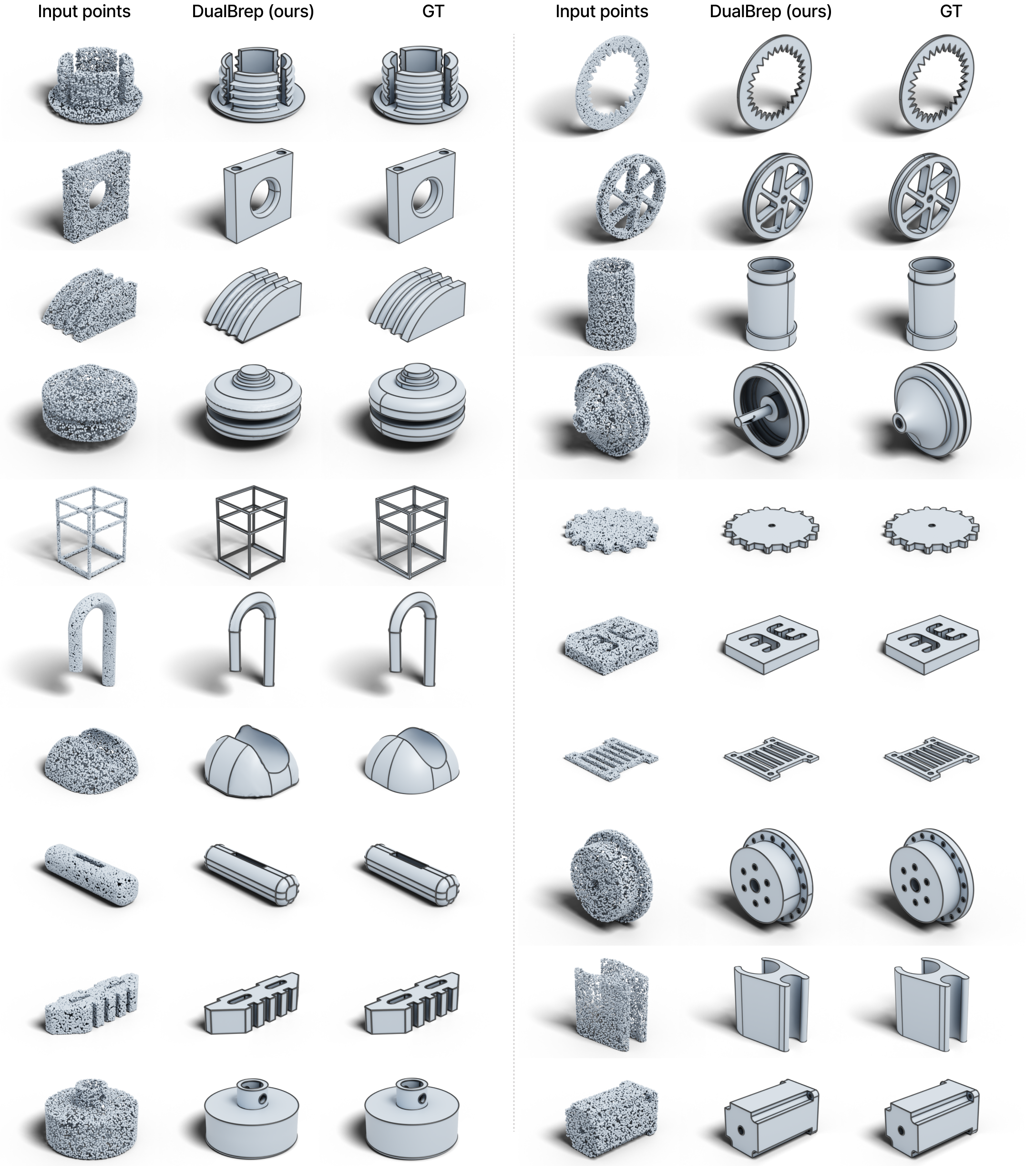
Figure 1: Point-cloud-to-B-rep reconstruction gallery. Diverse CAD reverse engineering results from DualBrep\textsubscript{recon}, preserving fine structure and editability.
The encoder incorporates multi-modal features from surface, edge, and Voronoi point clouds, and fuses them with cross-attention into a compact stochastic latent, while the decoder regresses both SDF and UDF values at arbitrary query locations. For reverse engineering tasks from point clouds, the VAE is used in a deterministic configuration utilizing only surface inputs.
Learned Rebuilding: From Continuous Fields to Explicit B-rep
After decoding the dual fields, a neural rebuilder processes a segmented mesh (recovered from the SDF using Marching Cubes and partitioned using the UDF) and fits parametric UV grids, predicts adjacency matrices, and regresses trim curves in UV space. Surface parameterization and edge reconstruction are performed in canonicalized patch-wise representations, yielding both prismatic and free-form B-rep surfaces.
This reconstruction strategy results in high geometric and topological fidelity, as grid-based trim curve prediction in the surface's UV domain ensures edge and boundary consistency.
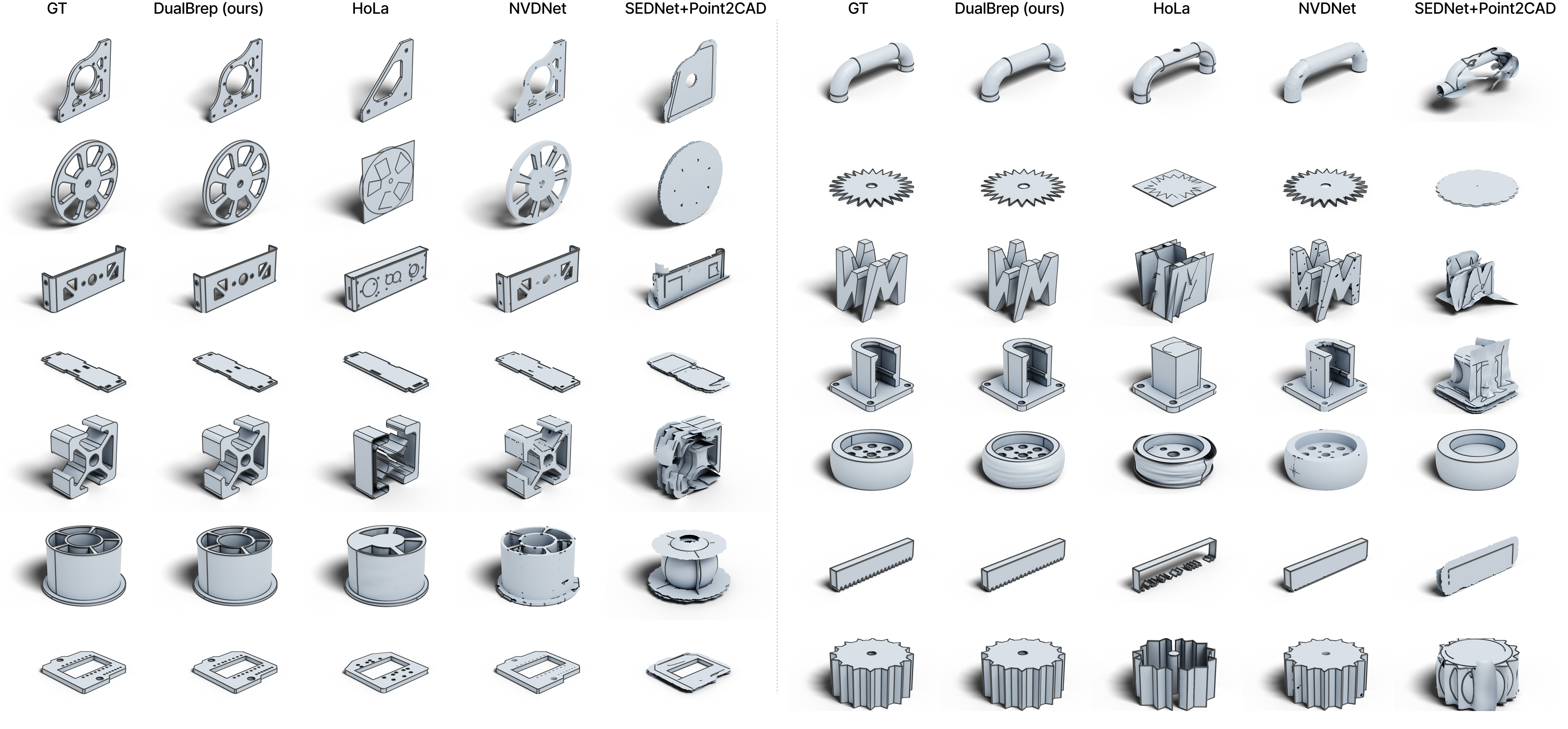
Figure 2: Qualitative comparison on point-cloud-to-B-rep reconstruction. DualBrep shows clear improvement in surface segmentation and topological validity over competing methods.
Latent Flow Matching and Conditional Generation
For generative modeling, DualBrep employs a latent flow-matching model—a DiT-style diffusion transformer operating over the shared latent space—supporting conditioning on geometric modalities such as point clouds or images. Geometry and topology are sampled jointly from a single latent code, addressing the issue of error accumulation that plagues sequential and autoregressive B-rep predictors. During inference, decoded continuous fields are robustly segmented before explicit B-rep reconstruction occurs.
Conditional generation enables both geometric completion and imagination tasks that extend beyond deterministic reverse engineering.
Empirical Evaluation
Quantitative and qualitative evaluations are conducted on the ABC CAD dataset, filtered for consistent face/edge counts and geometric diversity. DualBrep demonstrates strong numerical results, outperforming SEDNet+Point2CAD, NVDNet, and HoLa-BRep in almost all core metrics:
- Surface-level Chamfer distances and primitive F1-scores are either best or near-best.
- Validity rate for reconstructed B-reps achieves 76.34%, substantially higher than NVDNet's reparameterized 12% and HoLa-BRep's 73.98%.
- Robustness to shape complexity: Validity and F1-score remain stable as the number of faces increases, in contrast to the rapid degeneration observed in traditional methods.
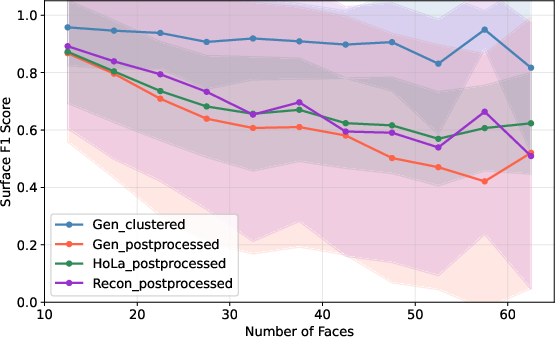
Figure 3: Surface F1-score versus shape complexity across pipeline stages. Continuous field segmentations maintain accuracy with increasing complexity, with reconstruction bottlenecks traced to the final rebuilding step.
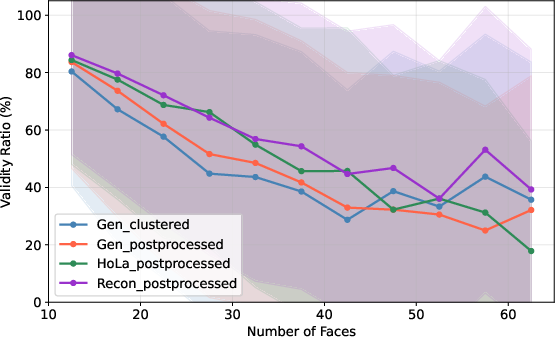
Figure 4: B-rep validity rate vs. shape complexity. Validity remains robust up to high face counts, but discrete rebuilding can cause sharp drops when thin features are not preserved.
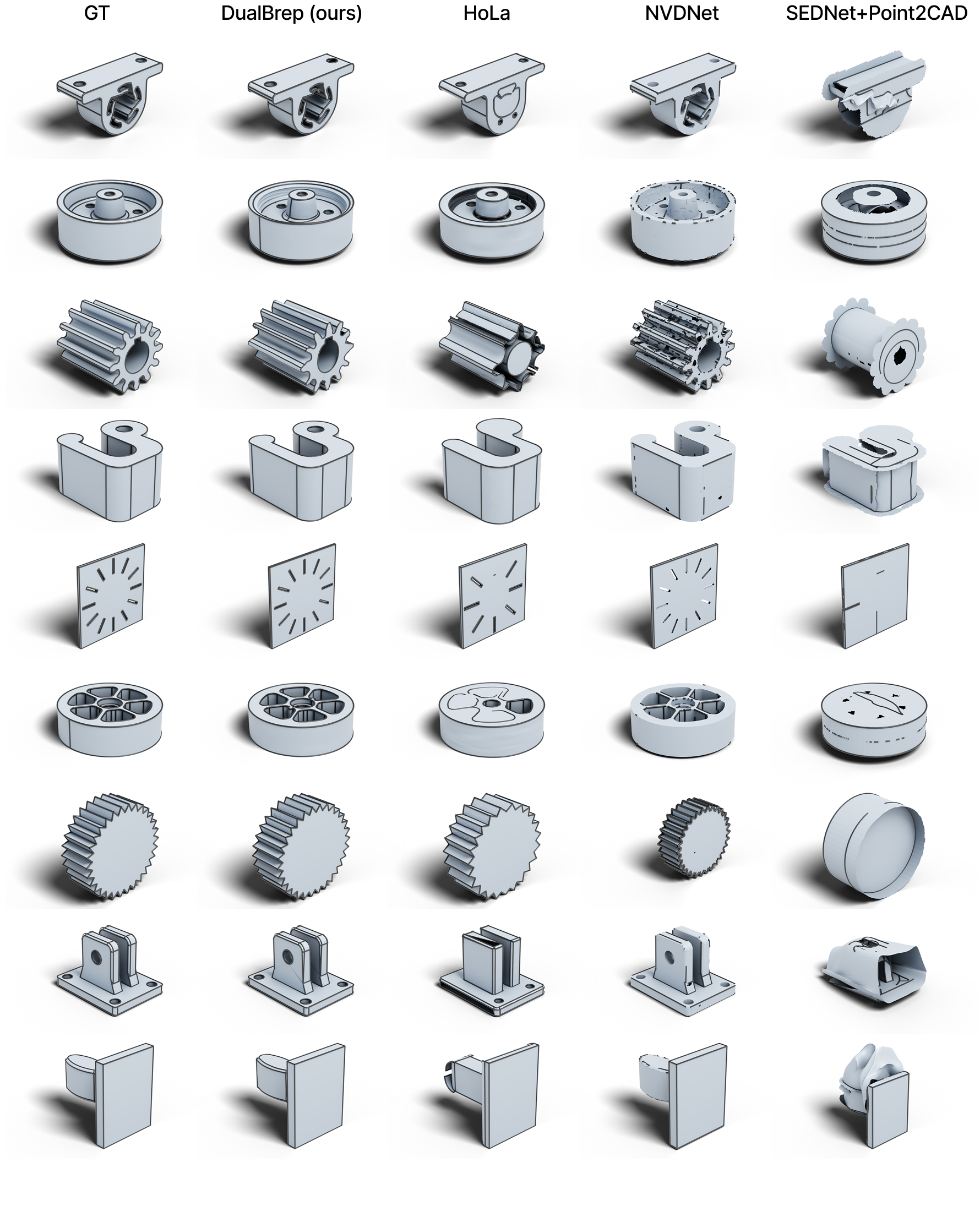
Figure 5: Additional comparison on deterministic reverse engineering from DualBrep\textsubscript{recon}. Finer details and global consistency are preserved relative to benchmarks.
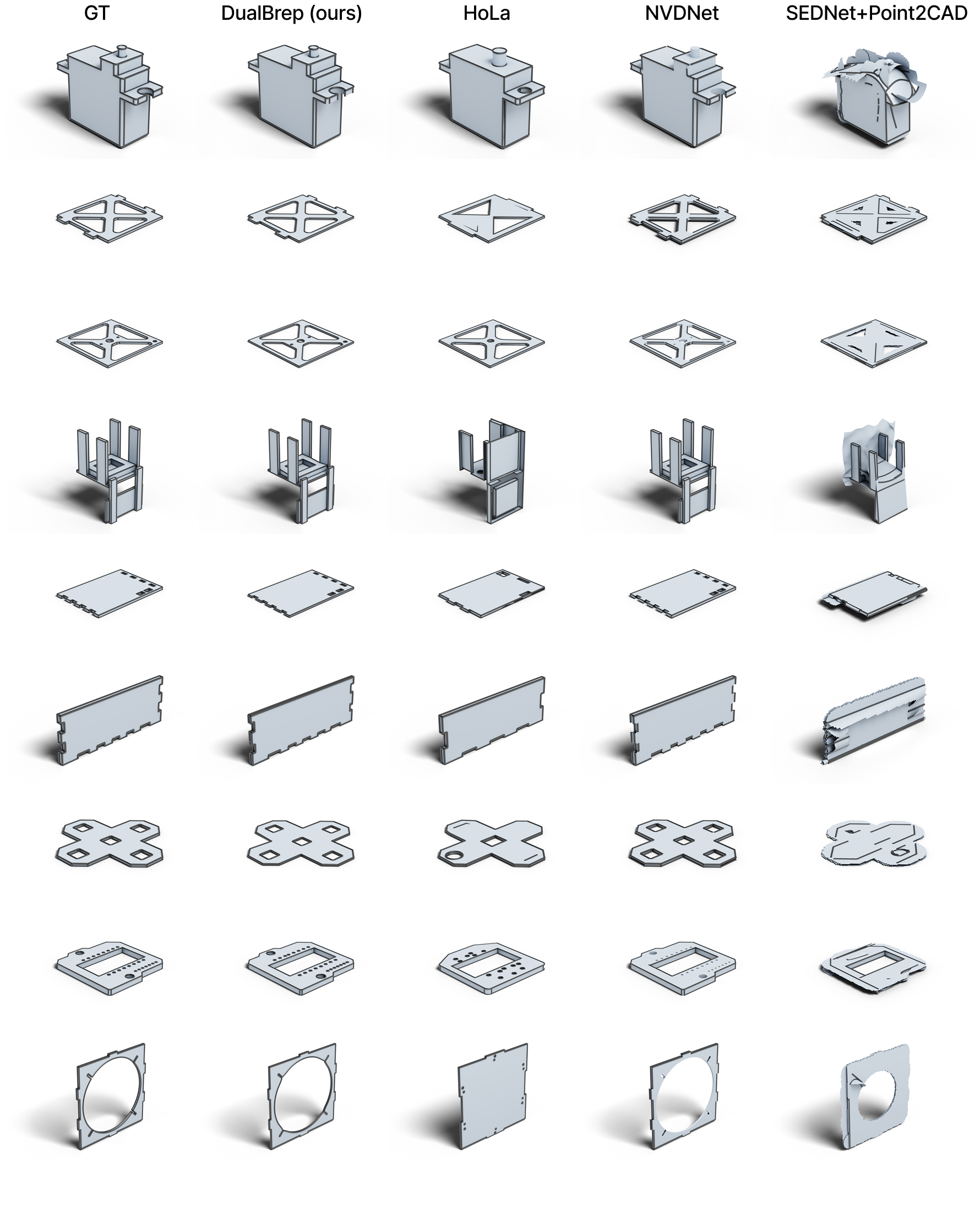
Figure 6: Additional comparison on deterministic reverse engineering from DualBrep\textsubscript{recon}, showing further qualitative improvement.
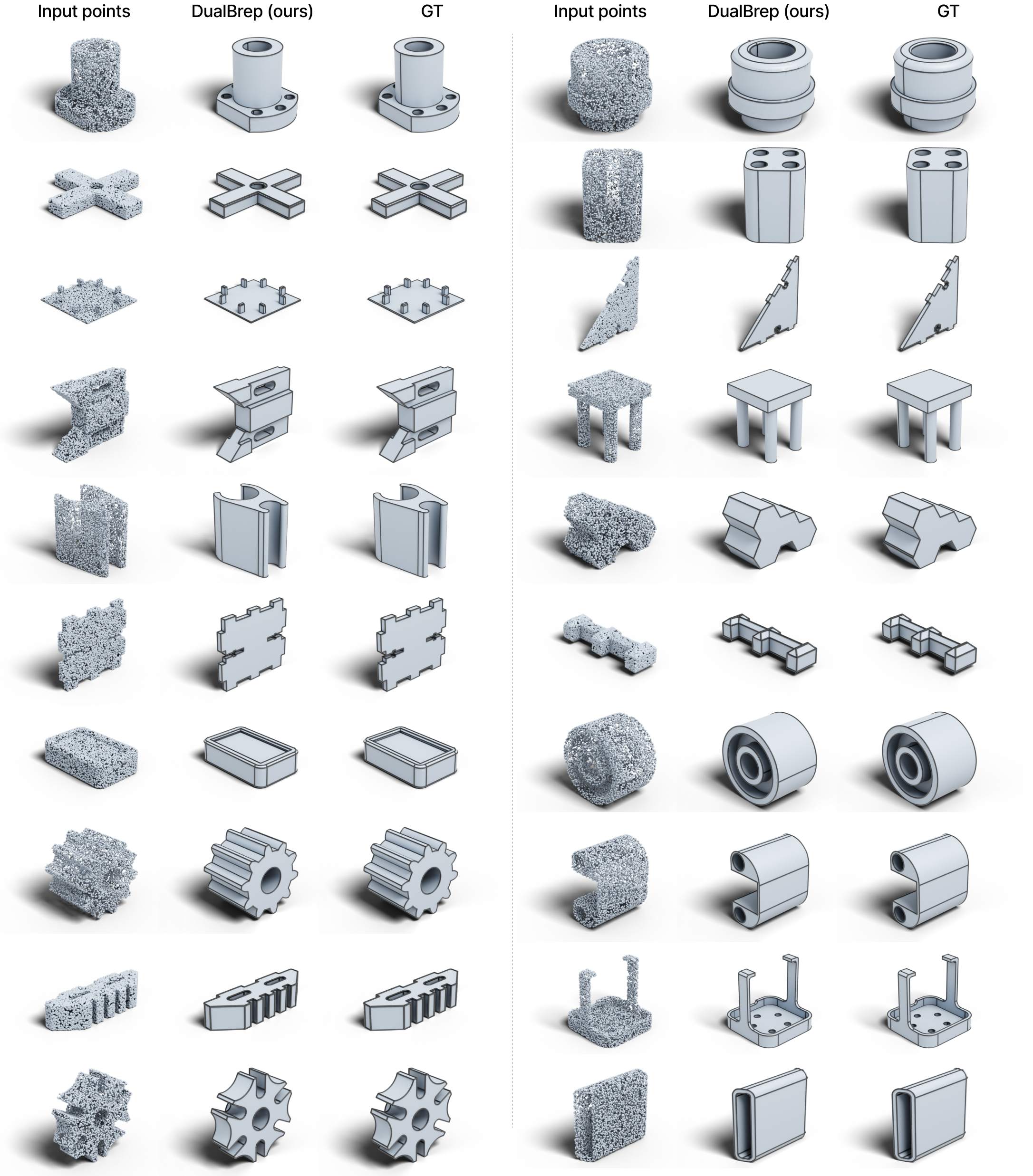
Figure 7: Additional deterministic reverse engineering reconstructions, including highly segmented and intricate structures.
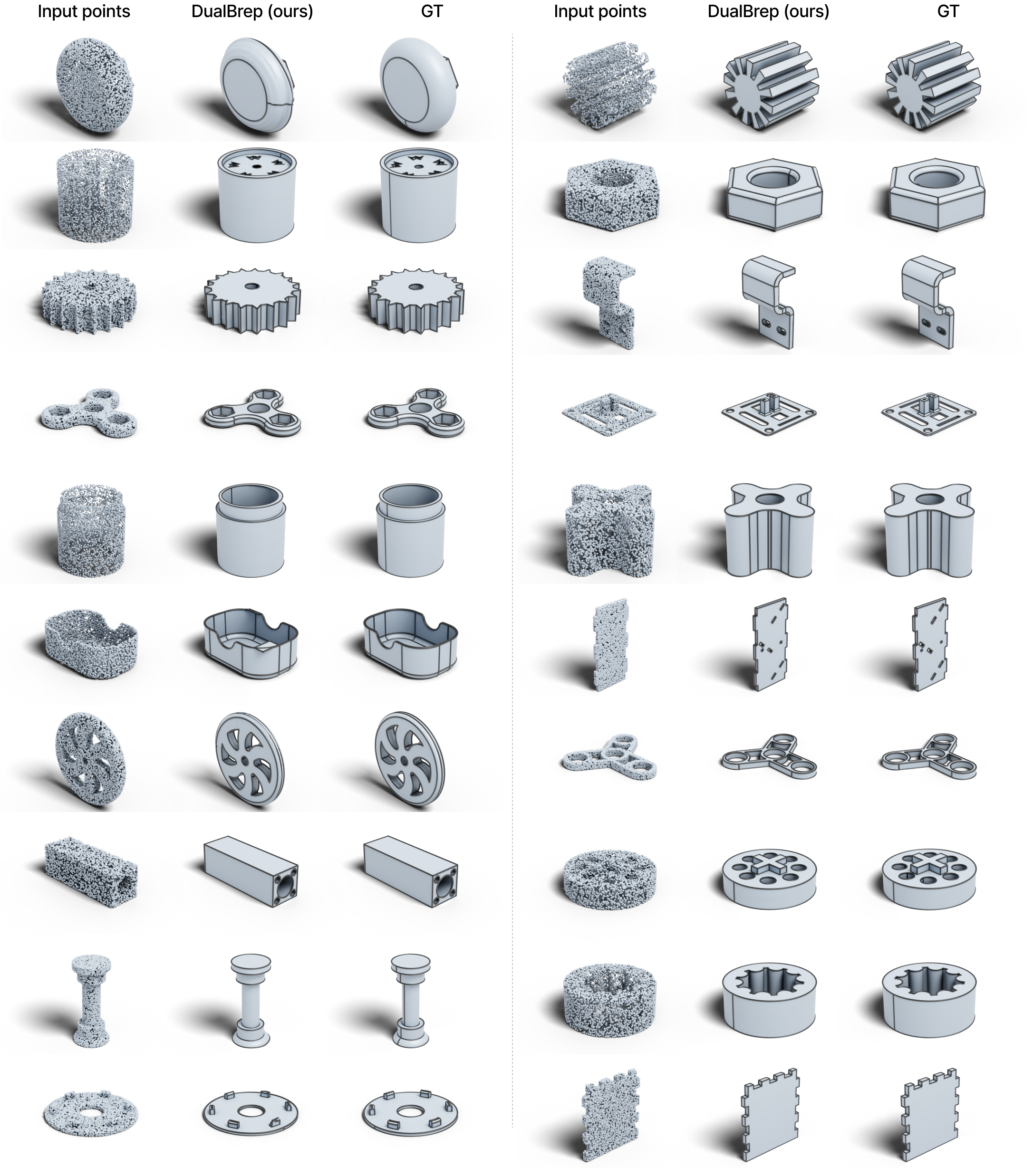
Figure 8: More results on deterministic reverse engineering, reinforcing scalability to diversified CAD model classes.
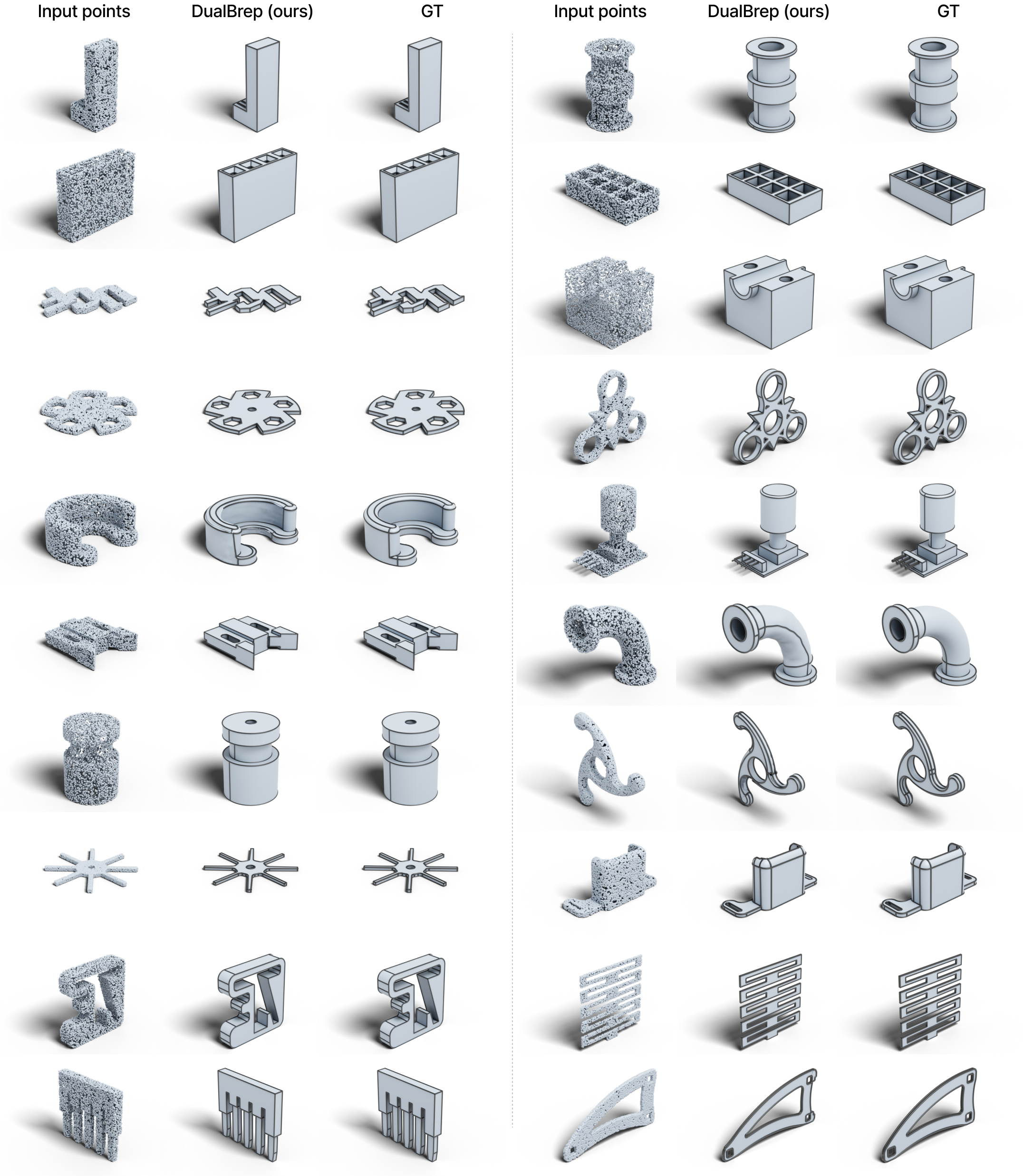
Figure 9: Expanded reconstruction gallery, illustrating robustness to shape variability and thin-walled features.
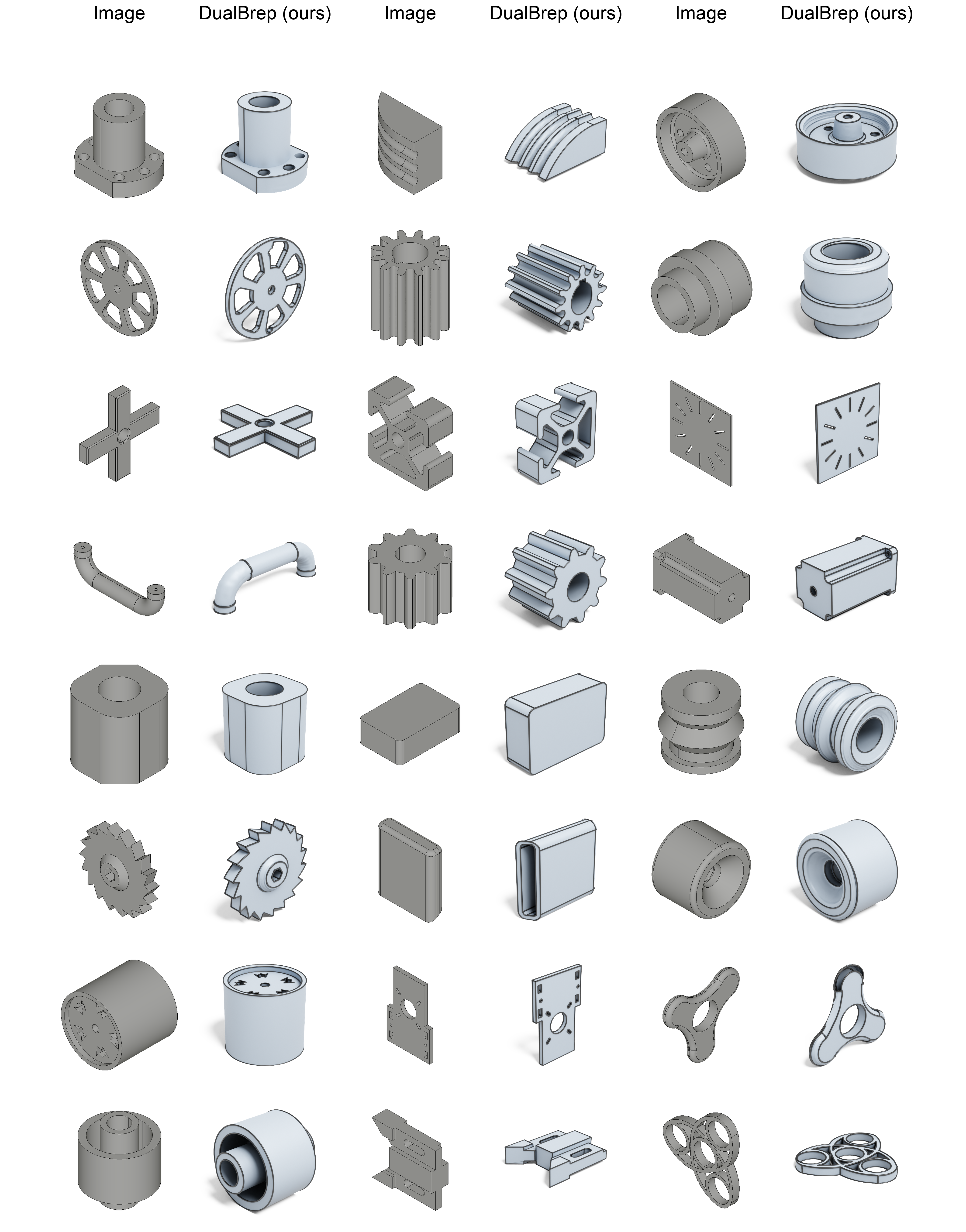
Figure 10: Conditional B-rep generation from single-view images via DualBrep\textsubscript{gen}; plausible topology and geometry inference in occluded regions.
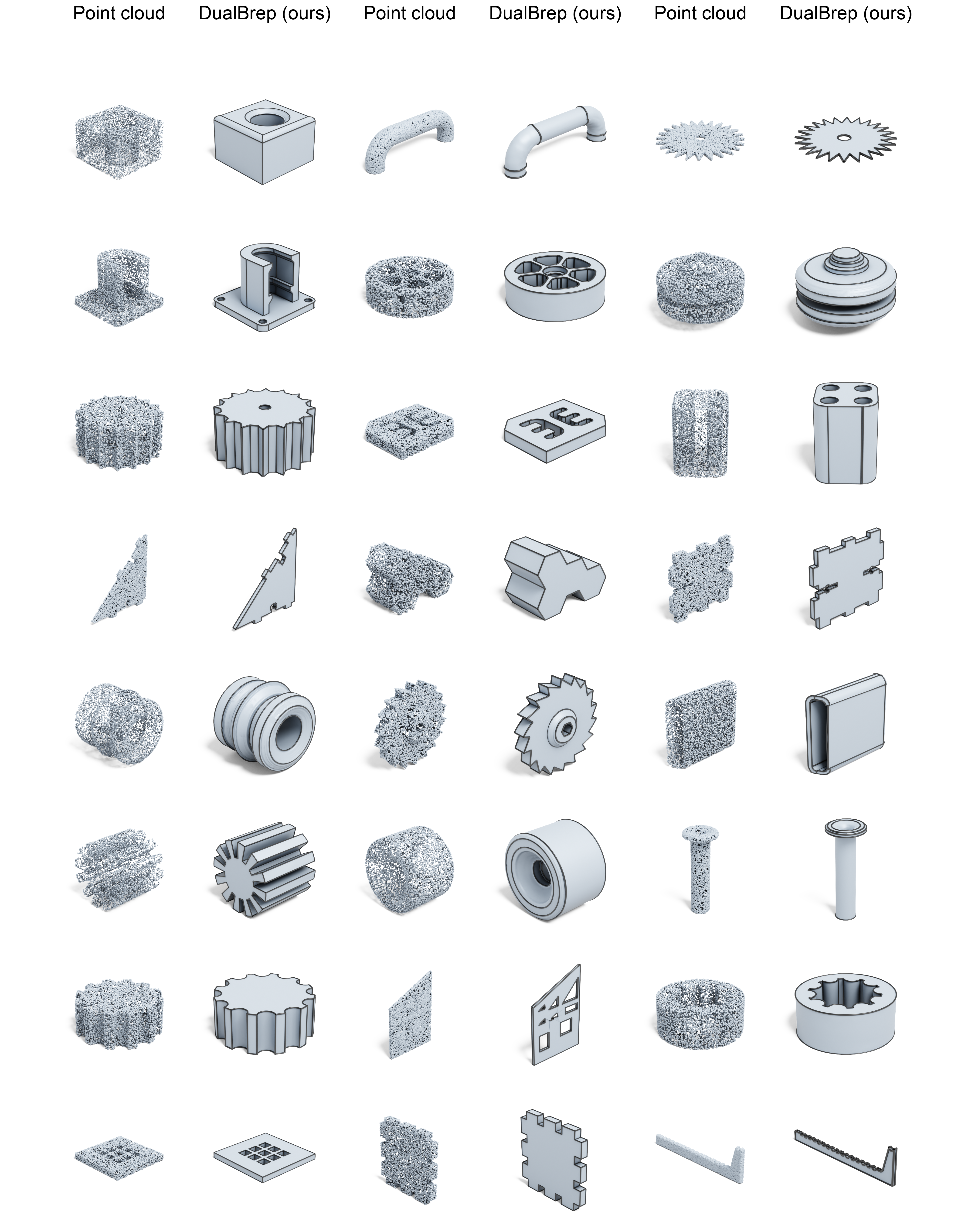
Figure 11: Conditional generation results from point clouds, demonstrating cross-modal generativity and structural coherence.
Analysis, Limitations, and Future Directions
The main bottleneck identified in the pipeline is not in segmentation accuracy, but in the conversion from continuous segmentations to discrete, closed B-rep assemblies. Small segmentation errors are overly penalized due to the watertightness requirement of CAD solids, resulting in disproportionate drops in validity rate. This fragility suggests that further work on robust, perhaps iterative, B-rep rebuilding and hybrid explicit-implicit patch representations is essential.
Despite this, the continuous backbone offers avenues for integrating physical simulation and optimization more readily than discrete B-rep graph predictions. It is straightforward to envision joint training involving functional, manufacturability, or simulation objectives in the latent space.
On the generative side, the method inherits the scaling trends of large neural field models, offering a potential path toward scalable, editable, and conditionalized CAD generation.
Conclusion
DualBrep introduces a unified, dual-field continuous representation for B-rep modeling. By encoding geometry and topology as coupled distance fields and operating in a shared latent space, it enables more tractable and scalable learning, robust reverse engineering, and flexible generative modeling of CAD solids. Strong numerical results, especially in validity and fidelity for complex shapes, demonstrate the viability of the approach. The principal challenges remain in lossless discrete reconstruction; further developments in neural rebuilding and hybrid representations are expected to further increase both engineering applicability and theoretical generality.