- The paper introduces a novel Transformer-based model that autoregressively generates B-Reps by unifying topology and geometry tokenization.
- It employs a breadth-first traversal of the face adjacency graph to ensure precise, watertight representations of complex geometries.
- The model outperforms prior approaches by improving generation speed and achieving over 50% validity on models with up to 100 faces.
AutoBrep: Autoregressive B-Rep Generation with Unified Topology and Geometry
Introduction
The paper introduces AutoBrep, a Transformer-based model designed for autoregressive generation of Boundary Representations (B-Reps) in Computer-Aided Design (CAD). B-Reps are integral to precise 3D modeling, yet generating them with exact geometry and watertight topologies remains a challenge. AutoBrep directly addresses this by employing a unified tokenization scheme that dynamically encodes both geometric primitives and topological relationships into discrete tokens, facilitating improved generation quality and speed while maintaining scalability to complex geometries.
Model Architecture and Features
AutoBrep utilizes a Transformer model that processes sequences of discrete tokens representing B-Rep faces, edges, and their adjacency (Figure 1). This framework synthesizes B-Reps through a sequence of tokens, which are generated based on a breadth-first traversal (BFT) of the face adjacency graph. This method contrasts with previous iterative or multi-stage approaches by combining geometric and topological data into a single autoregressive sequence.
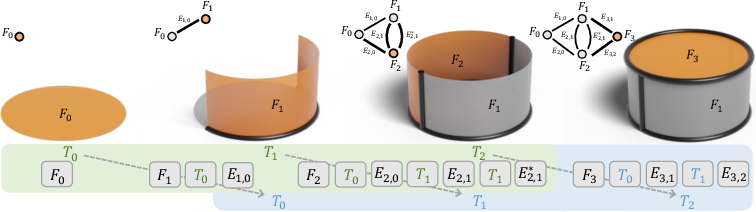
Figure 1: Sequence ordering follows a breadth-first traversal (BFT) of the B-Rep face adjacency graph.
The model distinguishes itself with a local topological reference system. By assigning dynamic tokens within a local context corresponding to the traversal level, AutoBrep efficiently manages vertex-face-edge relationships without relying on global coordinate ordering. This local context is crucial for maintaining watertightness and enhancing model performance, as shown in experiments where global referencing decreases quality metrics significantly.
Results and Evaluation
Experiments conducted using the extensive ABC dataset demonstrate that AutoBrep exceeds prior models like BrepGen and Holistic Latent (HoLa) representations, particularly in terms of generation speed and validity of complex solids. Quantitative metrics like Coverage (COV), Minimum Matching Distance (MMD), and Jensen-Shannon Divergence (JSD) validate its superior alignment with real-world data.
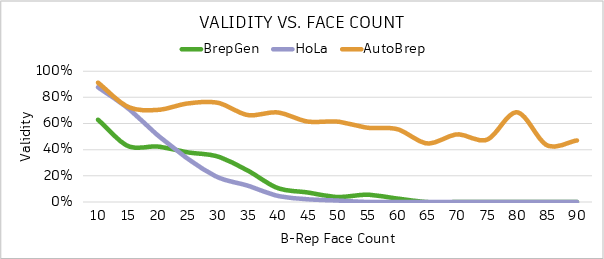
Figure 2: Validity of generated B-Reps as a function of the face count.
Results indicate that AutoBrep maintains over 50% validity for models with up to 100 faces, compared to much lower rates for other models as complexity increases. The use of a holistic Transformer model, alongside a novel tokenization approach, promotes both efficiency and robustness against error accumulation, typical in multi-stage generation pipelines.
Autocompletion Capabilities
Beyond unconditional generation, AutoBrep supports B-Rep autocompletion by seamlessly integrating specific user-provided constraints. This feature addresses scenarios where partial assemblies require completion within specific geometric bounds, which is pivotal for practical CAD applications in manufacturing and design.
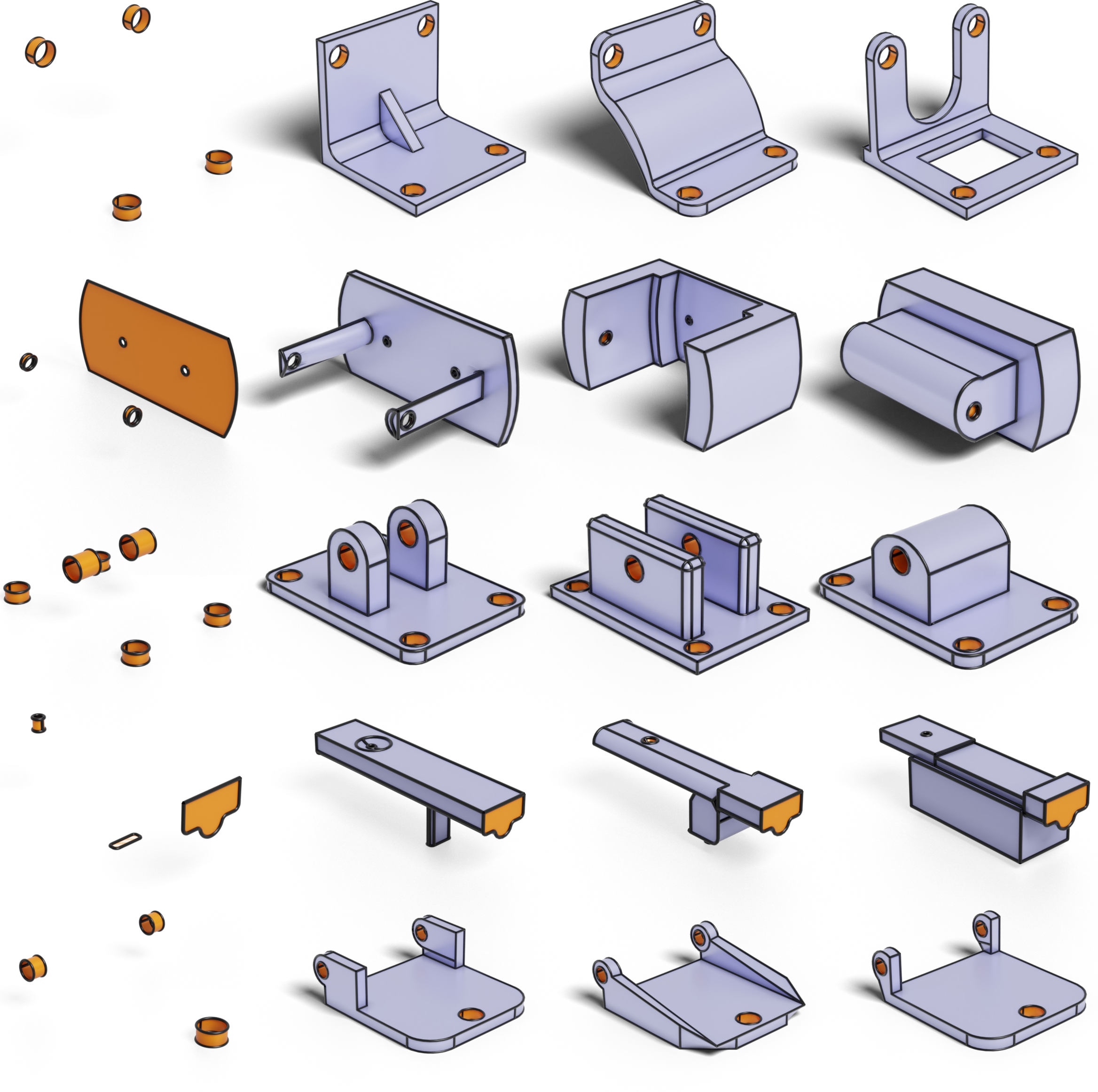
Figure 3: Autocompletions from faces representing the assembly interfaces (orange).
The model's unified token framework allows for exact preservation of user-provided geometry and ensures watertight completions, significantly enhancing user control and practical utility in assembly-driven workflows.
Conclusion
AutoBrep represents a significant advancement in CAD modeling, providing a scalable, efficient solution for generating complex B-Rep geometry. Through its unified topology and geometry tokenization, the model not only surpasses existing benchmarks in quality and validity but also introduces practical tools for controlled autocompletion. Future work will likely explore enhanced robustness against intricate geometries and extend the model's adaptability to broader CAD applications, including parametric and procedural design tasks.