- The paper introduces a novel cumulant-based quantum relative Rényi functional that extends traditional quantum divergences by incorporating the cumulant-generating function of the quantum relative surprisal.
- It employs a path-integral-like expansion and extensive numerical simulations to demonstrate data-processing behavior under commutativity-preserving channels.
- The analysis establishes key analytic properties, offers a quantification of relative quantumness, and paves the way for future research in quantum resource theories.
Cumulant-Based Quantum Relative Rényi Functional: A Technical Examination
Overview and Motivation
The paper introduces a novel quantum divergence measure—the cumulant-based quantum relative Rényi functional (Cu-Q relative Rényi functional, SαQ)—extending classical and quantum information theory by grounding the generalization of Rényi divergence on the cumulant-generating function of the quantum relative surprisal operator. In contrast to the conventional Petz and sandwiched quantum Rényi divergences, which are rooted in operator-algebraic and operational justifications, this cumulant-centric approach is statistically motivated and admits a formal path-integral-like expansion.
The central analytic construct is SαQ(ρ∥σ), defined for α>1 under the support constraint supp(ρ)⊆supp(σ), with a regularized extension to arbitrary α=1, facilitating rigorous treatment in physically relevant, potentially non-full-rank cases. The paper establishes the functional's core analytic properties and explores its behavior under data processing, especially in the context of commutativity-preserving (CoP) quantum channels, supported by extensive numerical simulations.
Construction and Cumulant-Generating Structure
The cumulant-based quantum relative Rényi functional is defined as
SαQ(ρ∥σ):=α−11lnTr[ρe(α−1)(lnρ−lnσ)]
for α>1 and appropriately supported ρ, σ.
Unlike Petz’s or sandwiched definitions, this approach is directly built from the cumulant-generating functional of the quantum relative surprisal operator ΔΞ=lnρ−lnσ. The cumulant expansion reveals the first term as the Umegaki quantum relative entropy, SαQ(ρ∥σ)0, with higher terms corresponding to quantum cumulants such as variance and skewness:
SαQ(ρ∥σ)1
Key structural attributes:
- Reduces to the Umegaki relative entropy as SαQ(ρ∥σ)2.
- Recovers the classical Rényi divergence in the commutative limit.
- Encodes all cumulants of the quantum relative surprisal, providing a bridge from classical statistical mechanics to quantum statistical inference.
Path-Integral Representation
A defining feature of SαQ(ρ∥σ)3 is its path-integral-like representation in Hilbert space, derived via a Lie–Trotter product expansion of the operator exponential. This expansion delivers a sum over discrete trajectories in the eigenbases of SαQ(ρ∥σ)4 and SαQ(ρ∥σ)5, with weights informed by overlaps, transition probabilities, and accumulated phases:
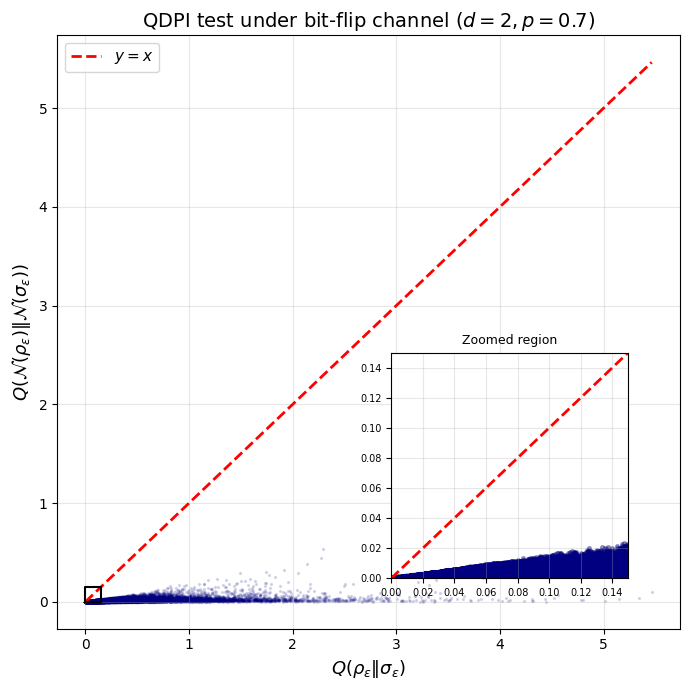
Figure 1: Scatter plot of SαQ(ρ∥σ)6 versus SαQ(ρ∥σ)7 for the qubit bit-flip channel with SαQ(ρ∥σ)8, demonstrating strict adherence to the conjectured data-processing bound; the inset magnifies the near-equality region.
The representation reveals a geometric phase-like term and quantifies non-commutativity explicitly; in the commutative case, only classical trajectories survive, collapsing the representation to a direct sum.
A comprehensive analytical investigation confirms that SαQ(ρ∥σ)9 possesses the following properties:
- Positivity: α>10 for α>11.
- Normalization: α>12.
- Unitary Invariance: The functional is invariant under joint unitary conjugations of α>13 and α>14.
- Additivity: For tensor product states, α>15.
- Continuity: The functional is continuous over full-rank pairs and under regularization.
- Monotonicity in α>16: α>17 is monotonically non-decreasing for α>18.
A regularization procedure establishes well-posedness for all α>19 and all density matrices, allowing analysis of boundary cases (notably supp(ρ)⊆supp(σ)0).
Relative Quantumness: Order-Zero Behavior and Commutativity
Specializing the functional to supp(ρ)⊆supp(σ)1, the paper defines a relative quantumness measure:
supp(ρ)⊆supp(σ)2
This measure satisfies:
- supp(ρ)⊆supp(σ)3 iff supp(ρ)⊆supp(σ)4.
- supp(ρ)⊆supp(σ)5 iff supp(ρ)⊆supp(σ)6.
Thus, supp(ρ)⊆supp(σ)7 is exactly sensitive to pairwise non-commutativity between quantum states, establishing a necessary and sufficient indicator for quantum structure lacking in purely classical distributions.
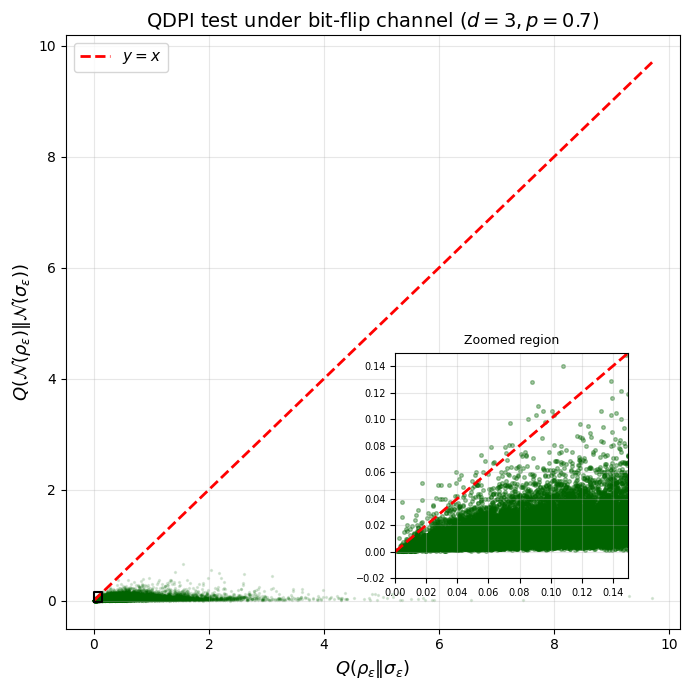
Figure 2: Scatter plot for the qutrit generalized bit-flip channel at supp(ρ)⊆supp(σ)8, demonstrating violations above the conjectured QDPI threshold due to absence of the CoP property in this channel class.
Data-Processing Inequality and CoP Channels: Theoretical and Numerical Analysis
The quantum data-processing inequality (QDPI) for the functional under general CPTP maps is unresolved; however, strong numerical evidence is presented for monotonicity under commutativity-preserving (CoP) channels:
- For any CoP map supp(ρ)⊆supp(σ)9 and all α=10, α=11.
- The conjecture is supported by extensive Monte Carlo simulations over qubit and qutrit state pairs for a variety of physically relevant (CoP) channels including depolarizing, semi-classical, and isotropic channels.
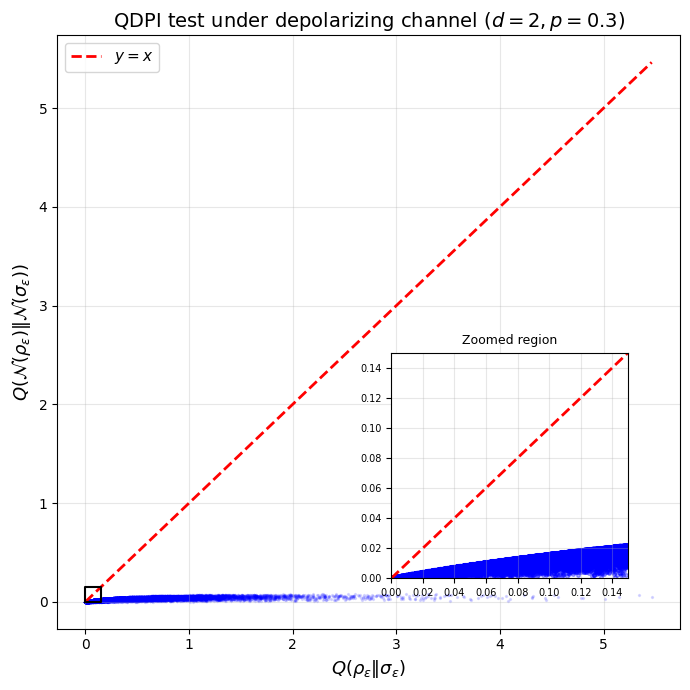
Figure 3: Scatter plot for the qubit depolarizing channel at α=12: all points fall below the equality line, in complete agreement with the CoP-QDPI conjecture.
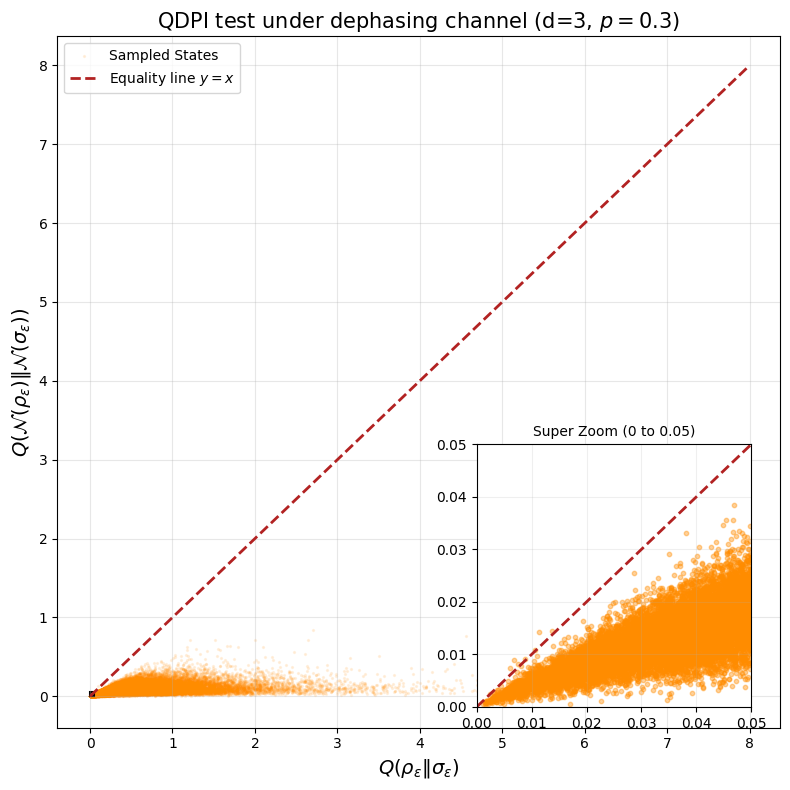
Figure 4: Qutrit dephasing channel, α=13: while most points are monotone, a small fraction of violations are observed (inset), consistent with the absence of CoP structure in higher dimensions for this channel.
Channels not satisfying the CoP property (such as generalized bit-flip and dephasing channels in dimension α=14) do exhibit QDPI violations, which are explicitly captured in the numerical analysis.
Implications and Future Directions
This cumulant-based framework extends the landscape of quantum divergences in several ways:
- Offers a path-integral and cumulant-based interpretation beyond algebraic operator approaches.
- Derives a quantifier of relative quantumness operationally tied to commutativity.
- Numerically isolates the structural role of CoP channels for the data-processing principle, suggesting a structural foundation for monotonicity in the quantum regime.
Potential future research directions include:
- Analytic resolution of QDPI for α=15 under arbitrary CPTP maps.
- Extension of the cumulant-based formalism to other quantum resource theories (coherence, thermodynamics, etc.).
- Development of operational tasks or protocols (e.g., discrimination, hypothesis testing) where higher-order cumulants captured by α=16 provide a quantifiable advantage.
Conclusion
The cumulant-based quantum relative Rényi functional broadens the class of quantum divergences with a construction fundamentally rooted in the statistical structure of the quantum relative surprisal. It is equipped with a robust set of analytic properties and a deep interrelation with commutativity and quantum data processing. The operational content relating higher cumulants to quantum distinguishability, the explicit path-integral structure, and the emergent theory of relative quantumness all signal avenues for further exploration in quantum information science.