- The paper introduces quantum relative-α entropy as a novel divergence that generalizes classical measures while ensuring additivity under tensor products and unitary invariance.
- It establishes a nonlinear convexity structure and identifies conditions where the data-processing inequality does not hold, revealing key operational limitations.
- The study demonstrates a classical-quantum correspondence via Nussbaum-Szkoła distributions, providing a robust geometric framework for quantum distinguishability.
Quantum Relative-α-Entropies: Structural and Geometric Extensions of Quantum Divergences
Introduction
The manuscript "Quantum Relative-alpha-Entropies: A Structural and Geometric Perspective" (2604.06908) analyses and extends the landscape of quantum information divergences, with emphasis on structural aspects not captured by conventional frameworks such as quantum f-divergences and R\'enyi-type divergences. It introduces the quantum relative-α-entropy, formulates its properties, and establishes links to both classical information theory and quantum statistical geometry via the Nussbaum-Szko{\l}a distributions.
Quantum Relative-α-Entropy: Definition, Properties, and Distinctions
The paper proposes the quantum relative-α-entropy, Sα(ρ∥σ), parameterized by α>0, α=1, as: Sα(ρ∥σ)=1−ααlogTr(ρσα−1)−1−α1logTr(ρα)+logTr(σα)
for supp(ρ)⊆supp(σ). Notably, this divergence recovers Umegaki's relative entropy in the limit α→1.
The divergence exhibits several essential properties:
- Additivity under tensor products: f0.
- Unitary invariance: f1.
- Non-negativity and distinguishability: f2, with equality iff f3.
- Invariance under independent rescaling: f4 for positive f5.
The functional form is multiplicative-rather-than-linear, contrasting sharply with both R\'enyi and f6-divergence families: it fails joint convexity in standard sense, but supports a nonlinear convexity structure under multiplicative mixing of density matrices, which is formalized for mutually commuting operators.
Behavior with respect to f7 is highly non-monotonic (Figure 1). Across studied cases, f8 may increase, decrease, or oscillate, dependent on the spectral structure and geometry of f9 and α0.
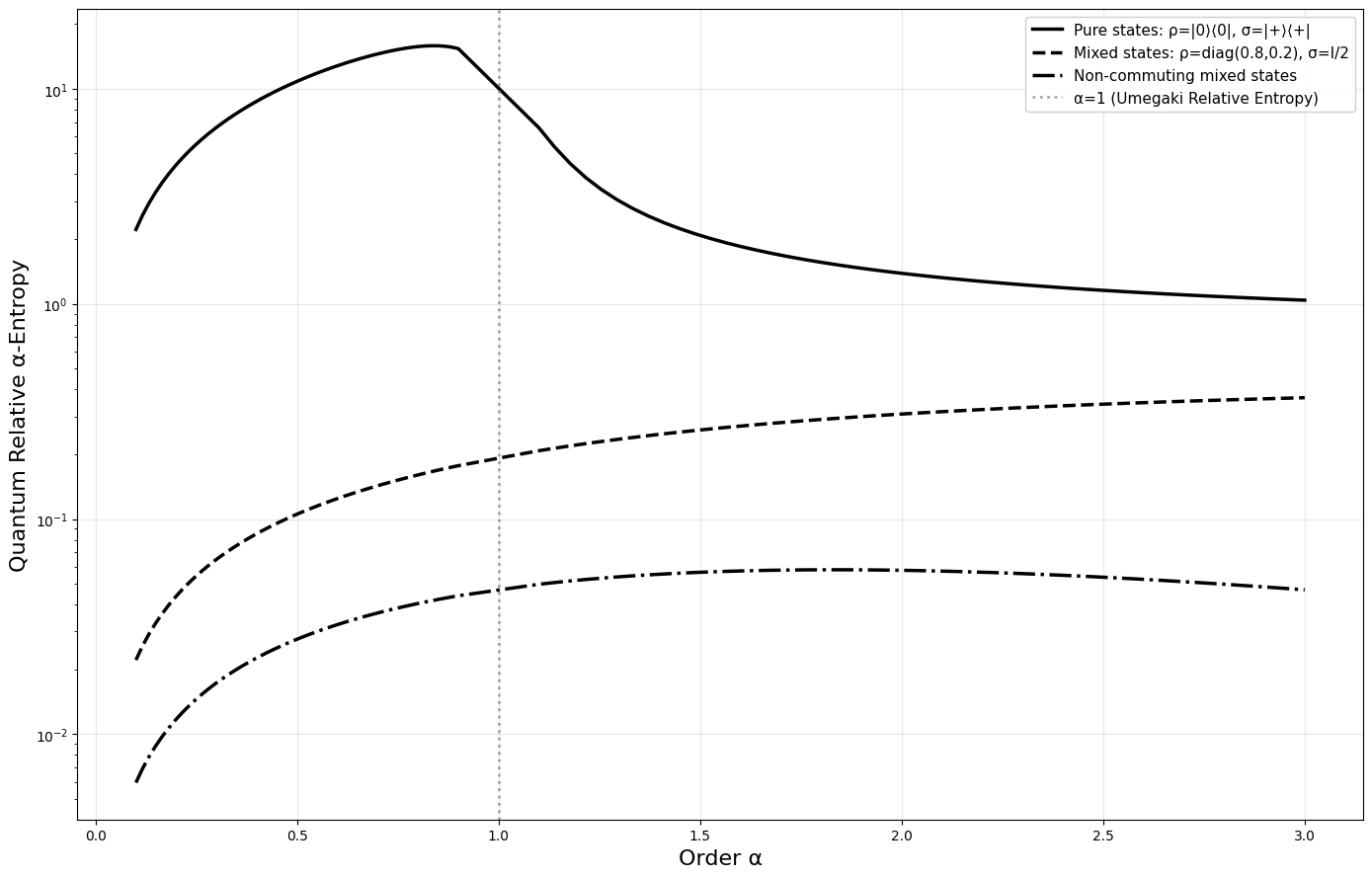
Figure 1: The Quantum Relative α1-Entropy as a function of its order for three different sets of quantum states.
Generalized Convexity and Relation to R\'enyi Entropy
The authors introduce a generalized convex set of density operators, where convex combinations are replaced by multiplicative interpolations. Within this set, nonlinear convexity inequalities are established for quantum relative-α2-entropy, and analogous results apply to Petz-R\'enyi divergences for α3, complementing classical convexity for α4.
Specifically, for α5 commuting density matrices and α6,
α7
for α8; the inequality is reversed for α9.
This nonlinear convexity property is not captured by standard frameworks and provides structural insight into tensor-product additivity and operator geometry.
Structural Comparisons: Monotonicity, Data Processing, and Limiting Cases
Quantum relative-α0-entropy does not obey monotonicity in its second argument, nor does it universally satisfy the data-processing inequality—contradicting structural behaviors of sandwiched R\'enyi divergences, Petz-R\'enyi, and Umegaki's divergence. Explicit examples show that the data-processing inequality can be violated for some quantum channels and values of α1.
The limiting case α2 does not coincide with the min-relative entropy except for maximally mixed α3, highlighting structural differences from Petz-R\'enyi. Connections to fidelity are elucidated for α4 and commuting states: α5
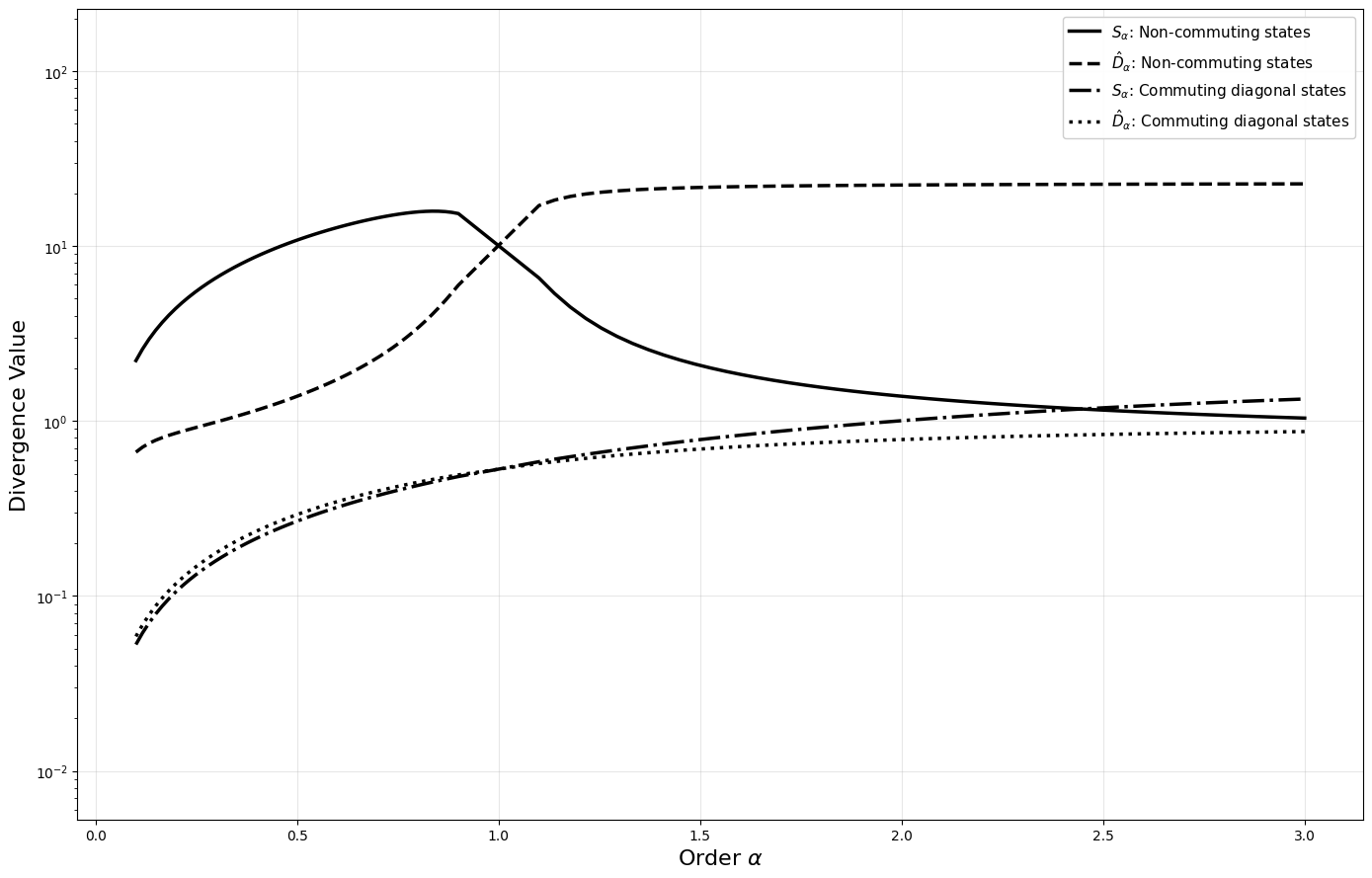
Figure 2: The Quantum Relative α6-Entropy vs Petz-R\'enyi-α7-Relative Entropy as functions of α8.
Classical-Quantum Correspondence via Nussbaum-Szko{\l}a Distributions
A fundamental result is the exact correspondence between quantum relative-α9-entropy and classical relative-α0-entropy, mediated by Nussbaum-Szko{\l}a distributions constructed from spectral decompositions: α1
where α2 and α3.
This establishes that quantum distinguishability admits an exact classical analogue based on measurement statistics—even in noncommuting cases—validating the geometric interpretation and operational utility of α4.
Quantum Density Power Divergence: Log-Free Generalization
The paper also presents a quantum version of the classical density power divergence: α5
This Bregman-type divergence retains nonnegativity and unitary invariance but fails tensor-product additivity and scaling invariance. Its structural properties diverge from α6 due to the absence of the logarithmic transformation, underscoring the role of logarithmic mapping in quantum divergence theory.
Implications and Perspectives
The quantum relative-α7-entropy provides a robust geometric framework, emphasizing spectral overlap and coherence structure, unifying classical and quantum distinguishability via Nussbaum-Szko{\l}a statistics. Its structural deviation from α8-divergence and R\'enyi-type families opens new directions in quantum statistical inference, quantum hypothesis testing, and information geometry.
The lack of universal data-processing inequality and nonstandard convexity suggest that applications may require careful reinterpretation—particularly in settings sensitive to channel monotonicity and operational meaning.
Potential future research may involve:
- Extensions to infinite-dimensional Hilbert spaces
- Reformulation of data-processing inequalities within nonlinear convexity frameworks
- Application to quantum machine learning, robust parameter estimation, and quantum communication
- Exploration of variants and generalizations based on alternative operator functions or convexity schemes
Conclusion
The paper establishes quantum relative-α9-entropy as a structurally novel generalization of quantum divergences, bridging geometric and operational aspects previously uncaptured by existing frameworks. By connecting classical and quantum perspectives and introducing nonlinear convexity structures, it enriches the conceptual toolkit for quantum information theorists and paves new avenues for both theoretical inquiry and practical algorithm design in quantum statistics and learning (2604.06908).