- The paper presents JWST medium-resolution IR spectroscopy of SN 2022acko, directly tracing molecule formation in the nebular phase and revealing asymmetrical ejecta.
- It employs dual-epoch observations (at +259 and +368 days) to model CO production, clumpiness, and evaluate low dust condensation efficiency.
- Findings highlight stratified elemental velocities and a bipolar ejecta geometry indicating a neutron star natal kick in a low-mass Type II supernova.
Introduction
The paper presents a comprehensive analysis of SN 2022acko, the first Type II supernova (SN II) to be followed through the nebular phase with JWST's medium-resolution near-infrared (NIR) and mid-infrared (MIR) spectroscopy (2606.31176). The unique dataset enables direct investigation of molecule formation, ejecta structure, and chemistry in a low-mass SN II environment. The work leverages ground-based and JWST NIR/MIR observations at +259 and +368 days post-explosion, providing insight into element distributions, velocity structures, molecular yields, and the physical conditions affecting molecule and dust synthesis in core-collapse SNe.
Observational Overview and SED Evolution
Two epochs of JWST spectra, supplemented by ground-based NIR data, span 1–27 μm, enabling full SED construction and line identification for both atomic and molecular species. The evolution from +50 d to +368 d shows notable cooling and continuum decline, with prominent H lines present throughout, and a late emergence of intermediate-mass element (IME), iron-group element (IGE), and CO molecular features.
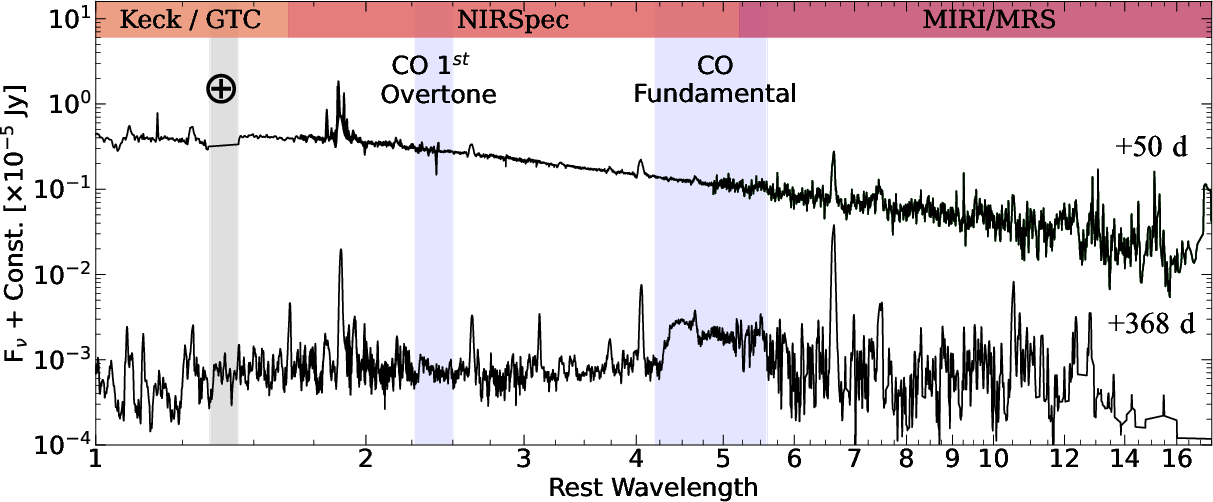
Figure 1: The 1–16 μm SED of SN 2022acko at ≈ +50 d and +368 d shows the dominance of hydrogen emission lines and the emergence of IME, IGE, and CO features at late times.
SN 2022acko lacks any significant MIR continuum excess commonly attributed to newly formed dust, in contrast with other SNe II, indicative of suppressed dust formation or slower dust condensation timescales.
Line Identifications and Ejecta Chemistry
Systematic spectral line identification reveals persistent hydrogen emission (Paschen, Brackett, Pfund, and Humphreys series), strong He I, and a suite of IME and IGE transitions in both NIR and MIR regions. The MIR regime’s sensitivity, especially using MIRI/MRS, uniquely allows isolation of weak forbidden lines from Ar, Ne, Fe, Co, and Ni. Notably, multiple ionic stages are observed, reflecting complex, stratified ionization and excitation structure.
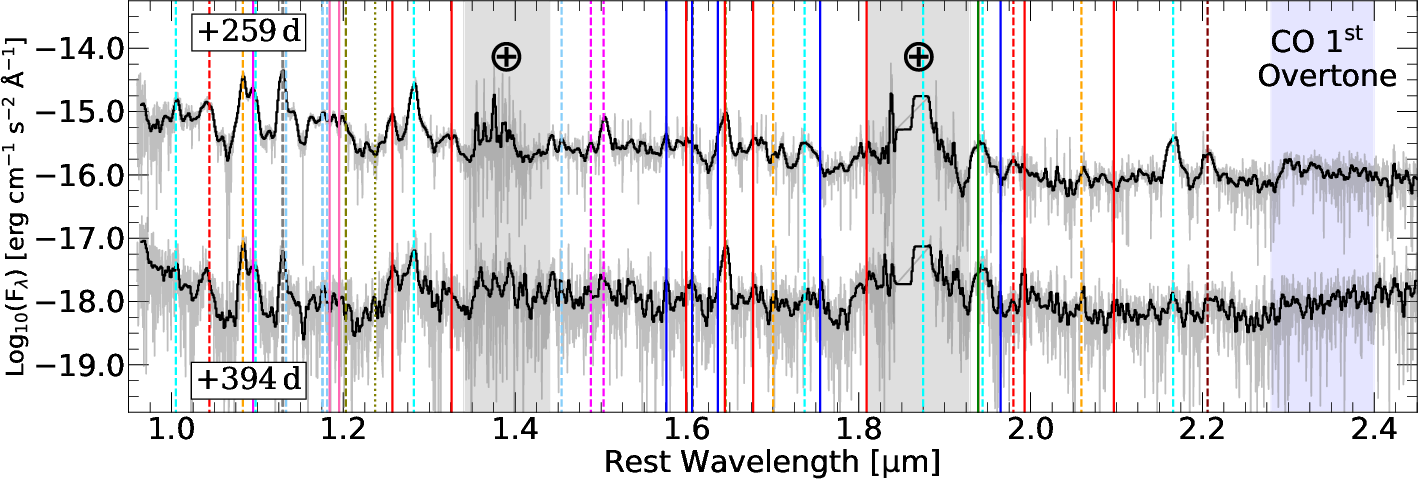
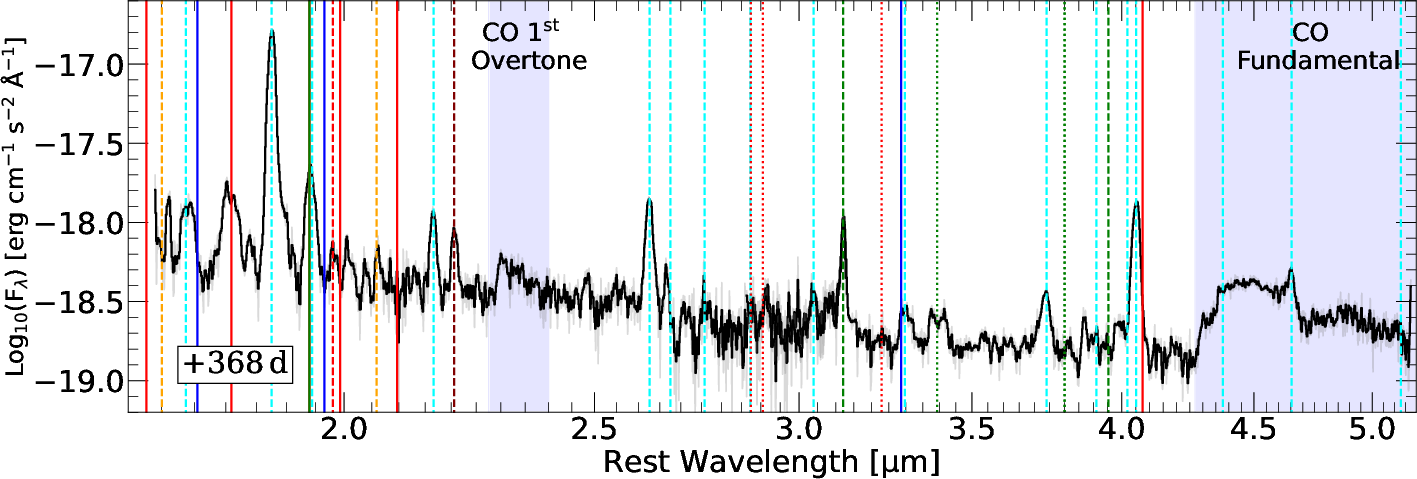
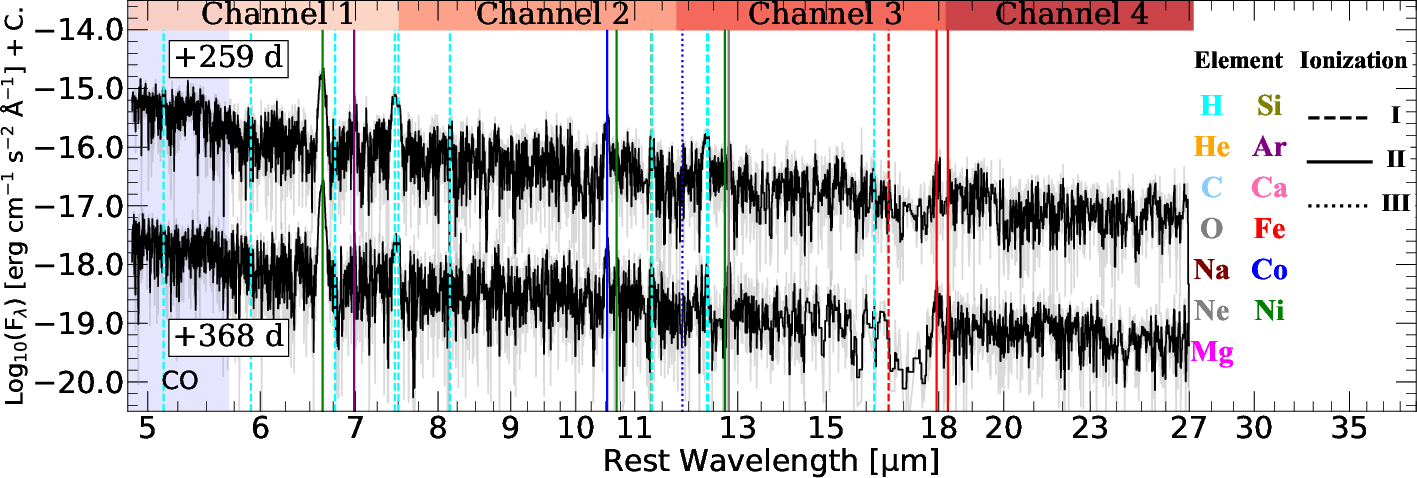
Figure 2: Line identifications for Keck/NIRES, JWST/NIRSpec, and MIRI/MRS spectra, demonstrating the broad chemical inventory and emission mechanisms in the nebular phase.
Comparative Infrared Spectroscopy
The NIRSpec +368 d spectrum of SN 2022acko is compared to SN 1987A, SN 2023ixf, and SN 2024ggi. The H emission features are consistently narrower than in other SNe II. The CO features, both first overtone (~2.3 μm) and fundamental band (~4.4 μm), are weaker and more centrally concentrated than in SN 2024ggi or SN 1987A.
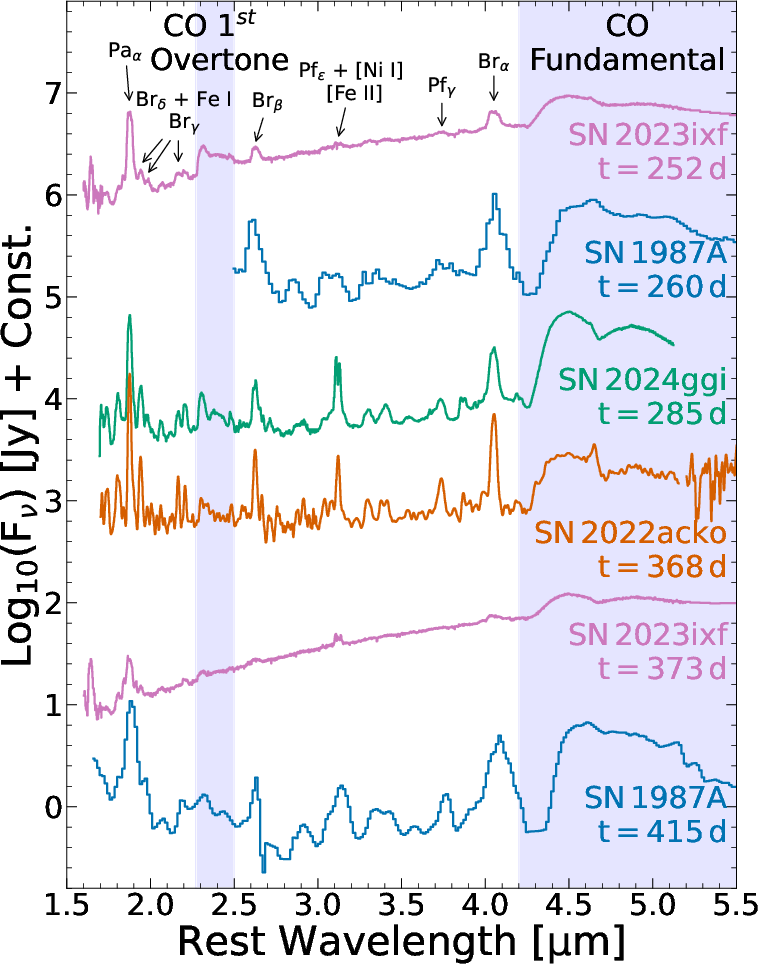
Figure 3: The NIRSpec observation of SN 2022acko at day +368 contrasted with late-phase NIR observations of SN 1987A, highlighting narrower CO and H features.
In the MIR, prominent forbidden Ni II lines dominate over Ar II, distinguishing SN 2022acko from more massive, dust-producing SNe II, where MIR excess and broader features denote active dust production.
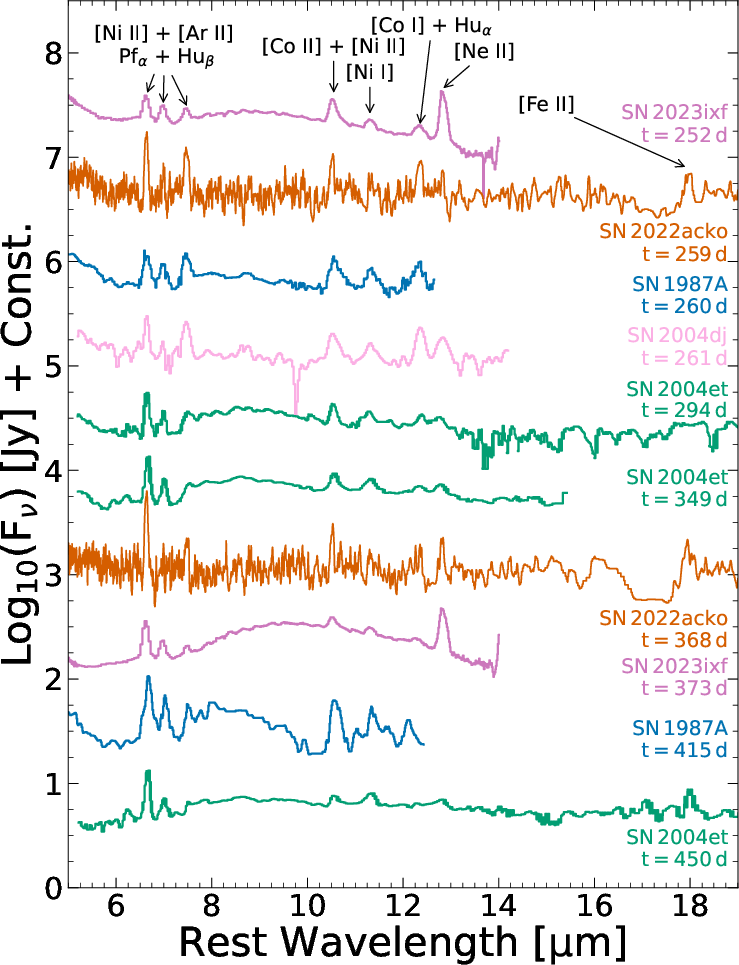
Figure 4: MIR comparison among several SNe II, where SN 2022acko shows narrower lines and absence of MIR continuum excess—evidence for suppressed dust formation.
Velocity Structure and Ejecta Geometry
Gaussian fitting of forbidden-line profiles reveals crucial differences in velocity distributions among elements. IME emission is offset by ≈+300 km/s, IGEs are closer to systemic (≈+100 km/s), and H shows minimal offset, all with relatively narrow FWHM values. The data imply a stratified, highly aspherical ejecta structure, incompatible with spherically symmetric models.
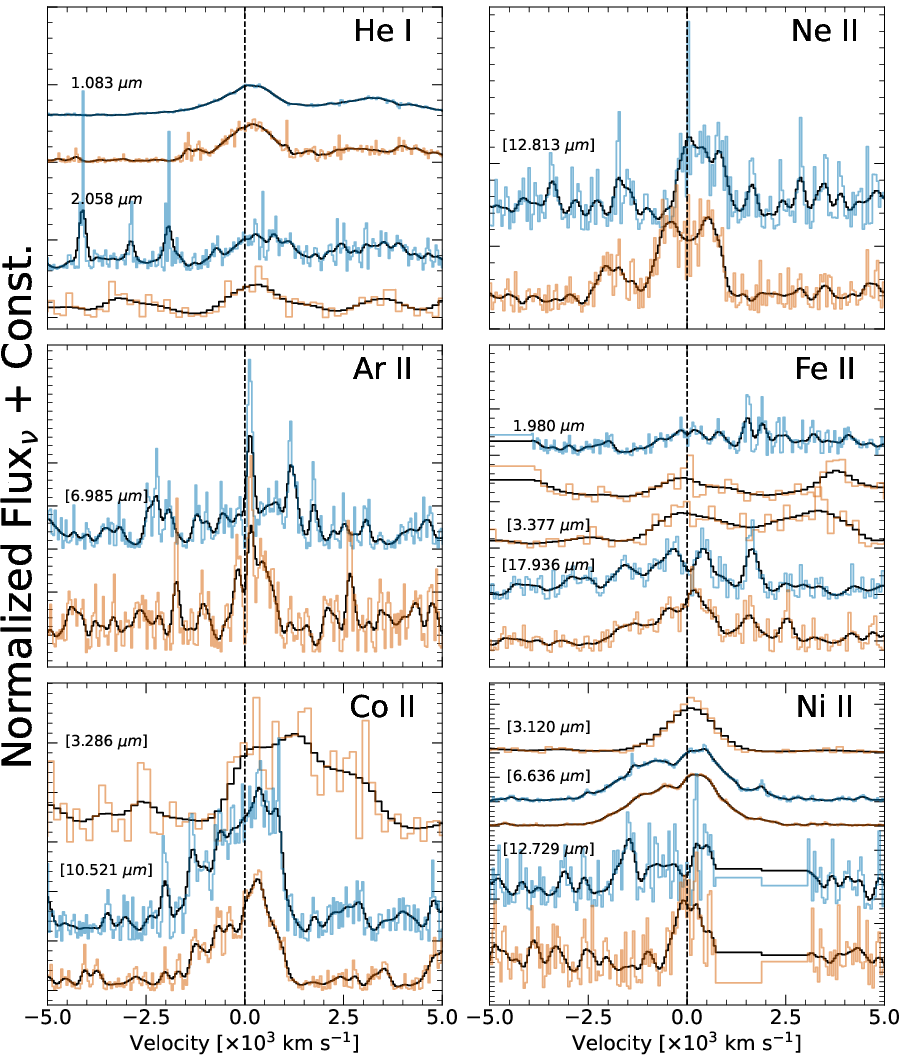
Figure 5: Evolution of emission line velocities for He, Ne, Ar, Fe, Co, and Ni; consistent line shifts and width trends between +259 d and +368 d indicate geometry and mixing effects.
This systematic velocity offset is interpreted as the signature of a natal kick imparted to a neutron star remnant by asymmetric mass ejection.
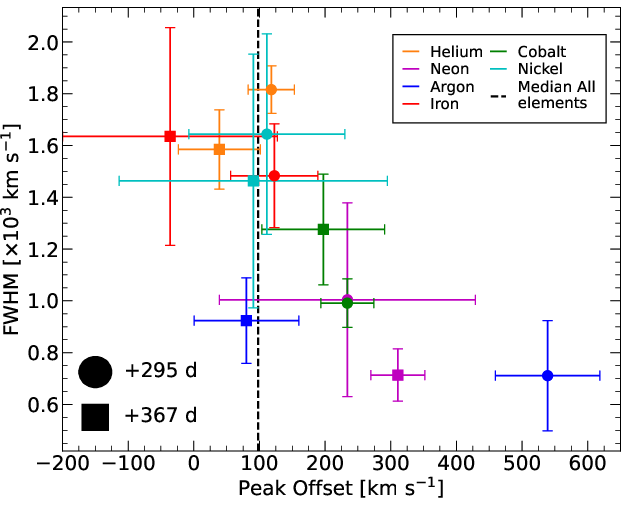
Figure 6: FWHM versus peak velocity offset for strong NIR/MIR lines; clear separation and systematic offsets between IME and IGE layers argue for a bipolar/aspherical ejecta geometry.
Comparison of H lines with other SNe II at similar post-explosion epochs shows that SN 2022acko’s H envelopes are significantly slower and maintain sharp line cores, further indicating low dust opacity and minimal dust formation.
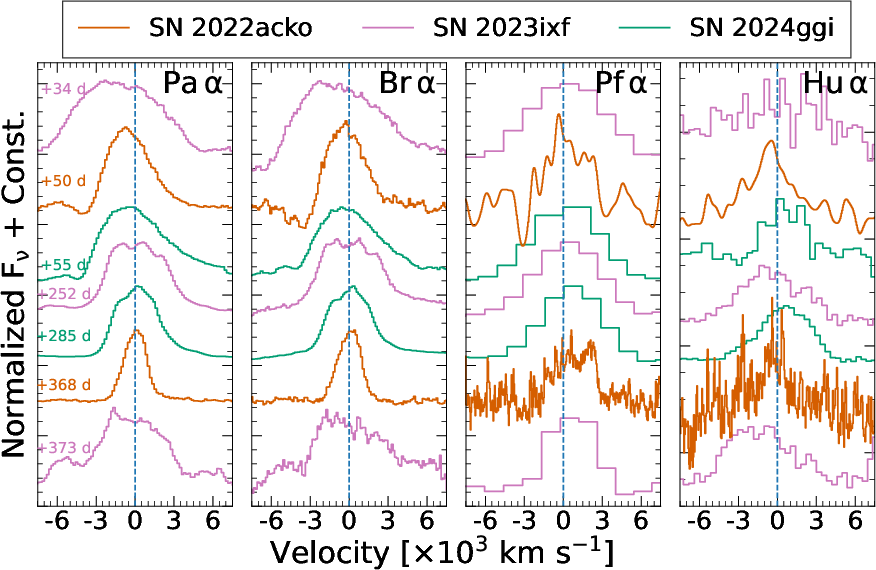
Figure 7: H line profiles for SN 2022acko, SN 2023ixf, and SN 2024ggi; SN 2022acko exhibits the sharpest, narrowest emission features and lacks the dust-attenuated shoulders seen in other SNe II.
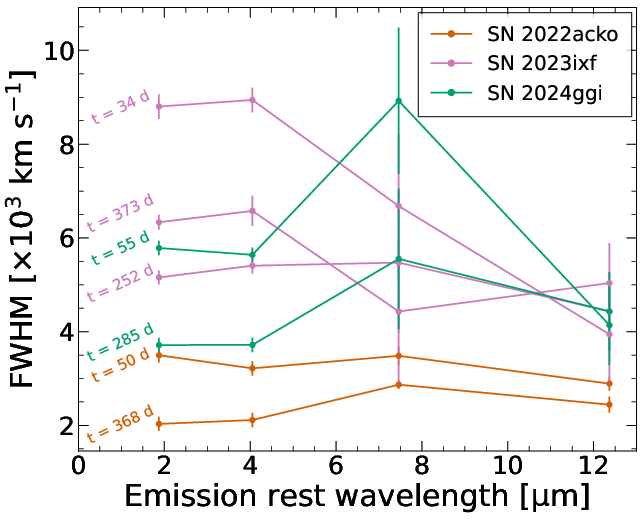
Figure 8: FWHM evolution of strong hydrogen lines; SN 2022acko retains the lowest velocities, consistent with a low-energy, low-mass explosion framework.
Molecular CO Production and Clumping
Both CO first overtone and fundamental bands are modeled using the seven-parameter MOFAT framework, allowing constraints on temperature, velocity extent, clumpiness, and total CO mass. The fundamental band demands a clumped, highly prolate CO zone to reproduce the observed band profiles at +368 d. The derived CO mass increases from 1.55×10⁻⁴ M⊙ (+259 d) to 2.47×10⁻⁴ M⊙ (+368 d), about an order of magnitude less than comparably aged, higher-mass SNe II (e.g., SN 2024ggi).
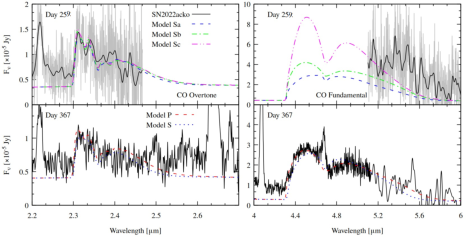
Figure 9: MOFAT modeling of CO band emission—clumped (prolate) and spherically symmetric models overlaid against observed spectra at two epochs.
Temperature structure analysis shows the CO-forming region is both cooler and more centrally confined than in higher-mass SNe II, corresponding to a ZAMS progenitor mass of ~8 M⊙. Clump size and distribution match those inferred for other SNe II, supporting the hypothesis that Rayleigh-Taylor and/or neutrino-driven instabilities shape the molecular emission regions.
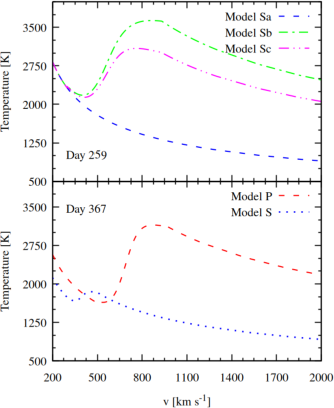
Figure 10: Temperature structures from MOFAT models with and without clumping, illustrating strong sensitivity of CO emission to physical conditions across the ejecta.
No SiO or dust signatures are detected; the lack of an 8.1 μm SiO band and MIR continuum excess further argues that molecule formation (CO) proceeds without efficient dust condensation on observed timescales.
Ejecta Asymmetry, Instabilities, and Remnant Properties
Velocity and spatial distribution analyses indicate substantial asymmetry. The authors argue for a bipolar wind or outflow, likely powered by fallback accretion onto the central compact remnant, which drives IGEs along the rotation axis while IMEs are displaced perpendicularly. The preservation of a symmetric H/He envelope and offset IME/IGE velocities provides geometric constraints that align with multi-dimensional core-collapse simulations.
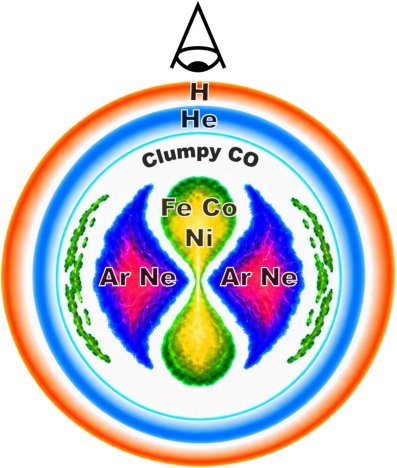
Figure 11: Schematic of required progenitor/explosion geometry; a bipolar structure that leaves the H/He shell largely unaffected while IMEs and IGEs are spatially separated and offset in velocity.
The systematic ~+100 km/s offset of all nebular lines, after correcting for peculiar velocity, is interpreted as a recoil signature (“natal kick”) for a neutron star formed in the explosion—consistent with expectations from momentum conservation in asymmetric supernovae.
Theoretical and Practical Implications
These findings demonstrate that low-luminosity, low-mass SNe II can form molecules but do so far less efficiently than higher mass, energetically richer SNe II. The relatively low CO yield and lack of dust features mean that such systems contribute modestly to early dust production in galaxies and likely require longer timescales for dust condensation, if it occurs at all. Clumpiness and small-scale structures in the molecule-forming ejecta are now directly constrained, offering a calibration point for multidimensional explosion models (Mera et al., 20 Apr 2026).
Bulk ejecta velocity offsets can serve as indirect signatures for compact remnant kinematics (neutron star kicks), and the extent/velocity of the CO zone can be adopted as a proxy for progenitor mass stratification.
Conclusion
JWST observations of SN 2022acko in the nebular phase provide the first high-resolution IR baseline for molecule formation in a low-mass, low-energy SN II explosion. SN 2022acko displays:
- Slower, narrower ejecta velocities and minimal dust formation compared to other SN II archetypes
- Weak, yet growing, clumped CO emission without SiO or dust signatures by +368 d
- Strong geometrical asymmetries and systematic velocity offsets interpreted as a bipolar ejecta structure and a neutron star recoil signature
This event establishes that low-mass SNe II are inefficient early universe molecule/dust factories and confirms that ejecta morphology, clumping, and progenitor mass critically influence IR emission diagnostics. Future JWST programs surveying a broader range of low-luminosity core-collapse SN remnants will further refine our understanding of their contribution to galactic chemical and dust evolution.

