- The paper introduces a new centre-normalised Newman-Unti gauge that simplifies the stability analysis using r^p energy methods for curvature.
- It leverages a decoupled hierarchy via the tensorial Teukolsky equation to control curvature components and obtain sharp decay bounds.
- The approach handles weakly decaying initial data and streamlines nonlinear stability proofs compared to earlier vector field methods.
Stability of Minkowski Spacetime in the Centre-Normalised Newman–Unti Gauge
Introduction and Context
The nonlinear stability problem for asymptotically flat spacetimes governed by the Einstein vacuum equations has been a central pursuit in mathematical general relativity since the late 20th century. This work, "Stability of the Minkowski spacetime in Newman-Unti gauge" (2606.31090), develops a new approach to proving small-data global stability of the Minkowski solution using a centre-normalised outgoing null-geodesic (Newman–Unti) gauge. Contrasting with previous results—such as those of Christodoulou–Klainerman (CK), Lindblad–Rodnianski (LR), and recent rp-method treatments—this proof leverages the structural simplicity of the Einstein equations in this null geodesic framework and extends the utility of rp-estimates to the tensorial Teukolsky equation satisfied by certain Weyl curvature components.
The formulation achieves several advances:
- It controls the Einstein dynamics with initial data that decay only weakly to flat space, including the sharpest known regime except for exterior endpoint cases.
- It covers the full spectrum from weak decay to strong data supporting Bondi–Sachs peeling.
- It streamlines the proof by exploiting a diagonal hierarchy: wave equation estimates for the Weyl component αAB, followed by transport equations for all further geometric quantities.
The implications are both practical—giving optimised control for a large class of initial data—and theoretical, illuminating the null structure's resilience to coordinate divergences and the interplay between gauge choice and asymptotics.
Geometric Framework: The Centre-Normalised Newman–Unti Gauge
The Newman–Unti gauge is based on a double-null foliation: u labels outgoing null hypersurfaces with r affinely parametrising null geodesics. What distinguishes this work is strict centre-normalisation along a timelike geodesic Γ, designating it as the “spacetime axis.” Thus, for each u, the hypersurface Hu is the future null cone emanating from Γ at proper time u. The metric in coordinates rp0 is then:
rp1
This prescription preserves both principal null directions and their geodesic properties, but crucially, global problems are reduced to analysis on a single null foliation adapted to the geometry.
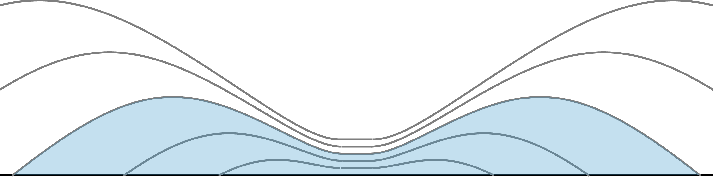
Figure 1: Level sets of rp2 and the region rp3 for the blowup structure of the axis incorporated into the centre-normalised coordinate system.
This coordinate system features metric components that may diverge from their Minkowski values as rp4 (e.g., rp5), but, as shown in the analysis, these divergences do not impact the perturbative control due to smallness and decay in rp6.
Proof Strategy: Decoupled Hierarchy via the Teukolsky Equation
The pivotal insight is to control the geometry through two intertwined mechanisms:
- Wave Equation for rp7: The leading curvature component rp8 satisfies a tensorial Teukolsky-type wave equation with principal part decoupled from lower-order terms. The authors apply the rp9-method of Dafermos–Rodnianski, multiplying the equation against weighted derivatives and integrating to extract global energy and Morawetz-type bounds. The key point is that degeneracies and coordinate divergences—and apparent loss of regularity—are compensated by αAB0-decay and perturbativity.
- Transport Hierarchy for All Other Quantities: Once αAB1 is controlled, all other curvature components, connection coefficients, and metric components are reconstructed—via transport or elliptic equations along the outgoing cones αAB2—from regular initial data specified on the centre axis. Every commutator or nonlinearity introduces gains in αAB3 that, together with decay, allow absorption of error terms.
(Figure 1) is crucial for visualising the stratification of spacetime into regions with different norm weights and for localising the Sobolev-type estimates near the centre and null infinity.
Main Theorems and Sharp Decay Bounds
The main theorem (see Theorem 1 in the paper) states that for asymptotically flat, small data in the centre-of-mass frame, the maximal globally hyperbolic Cauchy development is globally smooth and future complete, covered by the centre-normalised Newman–Unti chart. More importantly, for all such data, the curvature components obey quantitative decay bounds:
αAB4
with similar bounds for αAB5, αAB6, αAB7, and αAB8. For stronger data classes, they obtain “almost sharp Bondi–Sachs peeling,” i.e., all but the highest Weyl component decaying as fast as αAB9 along future null infinity.
These rates are not merely estimates—they are proved to be optimal up to the endpoint (i.e., for decay exponents except the limiting case), matching or exceeding all previously known rates in non-characteristic settings.
Regularity and Behaviour near the Centre
A substantial technical challenge is norm control near u0, where the vector fields and curvature components naturally degenerate. The authors resolve this by formulating all estimates on a blow-up of the axis and showing that under the established bounds, the metric and its derivatives are sufficiently controlled in Sobolev norms to guarantee smoothness by means of classical local well-posedness theorems. The ability to switch between weighted norms in physical and background (Minkowski) geometry, even in the nonlinear setting, is key here.
Hierarchical Regularity, Commutator, and Product Estimates
The analysis keeps careful track of the hierarchy of regularity: different geometric quantities are estimated with different numbers of derivatives, as dictated by their appearance in the null structure and Bianchi equations. For example, to avoid derivative loss in top-order estimates, the authors leverage elliptic estimates on the spheres u1 and use hierarchy-consistent commutation.
A battery of technical lemmas, such as Lemma~\ref{lem:elliptic} and Theorem~\ref{thm:main.Teukolsky}, establish commutator controls, weighted Sobolev product estimates, and dual (test function) norm equivalence. All estimates are compatible with the asymptotic weights required for decay through both u2 and u3.
Comparison with Previous Work
Table 1 in the paper systematically places this approach among previous stability proofs:
| Paper |
Initial Surface |
Gauge/Scheme |
Decay Exponent (u4) |
Dynamical Estimates |
| Friedrich (1986) |
Hyperboloidal |
Conformal |
u5 |
Local-in-time conformal energies |
| Christodoulou–Klainerman |
Spacelike |
Maximal/Null |
u6 |
Classical vector field (vf) estimates (Bianchi) |
| Lindblad–Rodnianski |
Spacelike |
Harmonic |
u7 |
vf estimates for metric components |
| Bieri |
Spacelike |
Maximal/Null |
u8 |
vf estimates (Bianchi) |
| [This paper] |
Spacelike |
Null foliation |
u9 |
r0 estimates for Teukolsky (curvature) |
The main distinction is that prior geometric approaches often required dual foliation frameworks (null plus maximal or hyperboloidal) and vector field multipliers adapted to Minkowski symmetries. This framework achieves full control with a single null foliation, no spacelike maximal slicing, and no construction of approximate Killing fields—streamlining both the analysis and the propagation of decay.
Implications and Future Directions
Practical Consequences:
- The methods in this gauge facilitate optimal decay control for large classes of data, underpinning future studies in gravitational radiation, and suggest a promising foundation for direct Cauchy problem-to-infinity analyses.
- The displayed effectiveness for weak decay settings broadens the admissible data, making the analysis robust for scattering theory and numerical applications.
- Insights into peeling and late-time tails (i.e., quantitative Price’s law-like behaviour) can inform both the structure of asymptotic data and the design of numerical relativity codes compatible with outgoing null coordinates.
Theoretical Directions:
- The streamlined, hierarchical structure of the equations suggests a route to sharply formulated strong field extensions (e.g., exterior stability, full nonlinear scattering), and adapts neatly to coupled matter systems.
- The control over the divergence of the metric in coordinates opens possibilities for new geometric gauge choices in global analyses.
- The conjectured generic local decay rate (r1) for curvature (beyond Bondi–Sachs peeling) is left as an open problem, potentially approachable by further extensions of the Luk–Oh module.
Conclusion
This work demonstrates that the centre-normalised Newman–Unti gauge, previously appearing mainly in the physics literature and in analyses of gravitational radiation, is not only compatible with but optimally suited for global stability proofs for the Einstein vacuum equations. The r2-energy method for the Teukolsky equation, when combined with transport and elliptic hierarchies, provides a robust paradigm for geometric control and propagation of regularity and decay. The results offer a new vantage on the interplay between coordinate choices and nonlinear stability, setting the stage for further progress in both mathematical and physical analysis of isolated gravitating systems.