- The paper establishes that small asymptotically flat perturbations with decay s > 1 yield globally complete Minkowski spacetimes, while the s = 1 threshold fails to ensure global stability.
- It employs maximal-null foliations, r^p–weighted energy estimates, and wave coordinate methods to control curvature decay and ensure asymptotic flatness.
- The analysis highlights the tension between weak decay regimes and nonlinear stability, emphasizing the need for higher regularity at the critical s = 1 threshold.
Stability Theory of Minkowski Spacetime: Techniques, Thresholds, and Implications
Introduction and Historical Context
The nonlinear stability of Minkowski spacetime for Einstein's vacuum equations constitutes a cornerstone achievement in mathematical relativity. This topic revolves around whether small perturbations of the canonical Minkowski initial data yield globally regular, geodesically complete, asymptotically flat solutions to the Einstein equations, or if such perturbations can lead to singularities or qualitatively distinct dynamics.
The field was initiated by the seminal work of Christodoulou and Klainerman, who proved the global nonlinear stability of Minkowski spacetime under strong regularity and decay assumptions. Their maximal foliation and Bel-Robinson tensor based analysis combined geometric insight with advanced energy estimates and commutation vectorfields—foundational to subsequent breakthroughs and refinements.
Subsequent investigations, including Bieri's relaxation of regularity constraints, null foliation exterior proofs by Klainerman-Nicolo, and wave-coordinate approaches by Lindblad-Rodnianski, expanded the regime of stability and introduced analytical flexibility, including consideration of weak null structures and microlocal methods. Moreover, recent works probe minimal decay regimes and borderline decay, identifying sharp thresholds for global stability and highlighting delicate nonlinear phenomena.
Geometric Structure and Energy Framework
A fundamental geometric ingredient is the choice of foliation, which organizes spacetime into hypersurfaces compatible with both the initial data and the asymptotic structure. Maximal foliations enforce trk=0, simplifying constraint equations and energy identities. In the Christodoulou-Klainerman scheme, a global maximal time function is complemented by an optical function u solving the eikonal equation, giving rise to double (maximal-null) foliations—a pivotal apparatus for tracking curvature decay and dispersive effects along null directions.
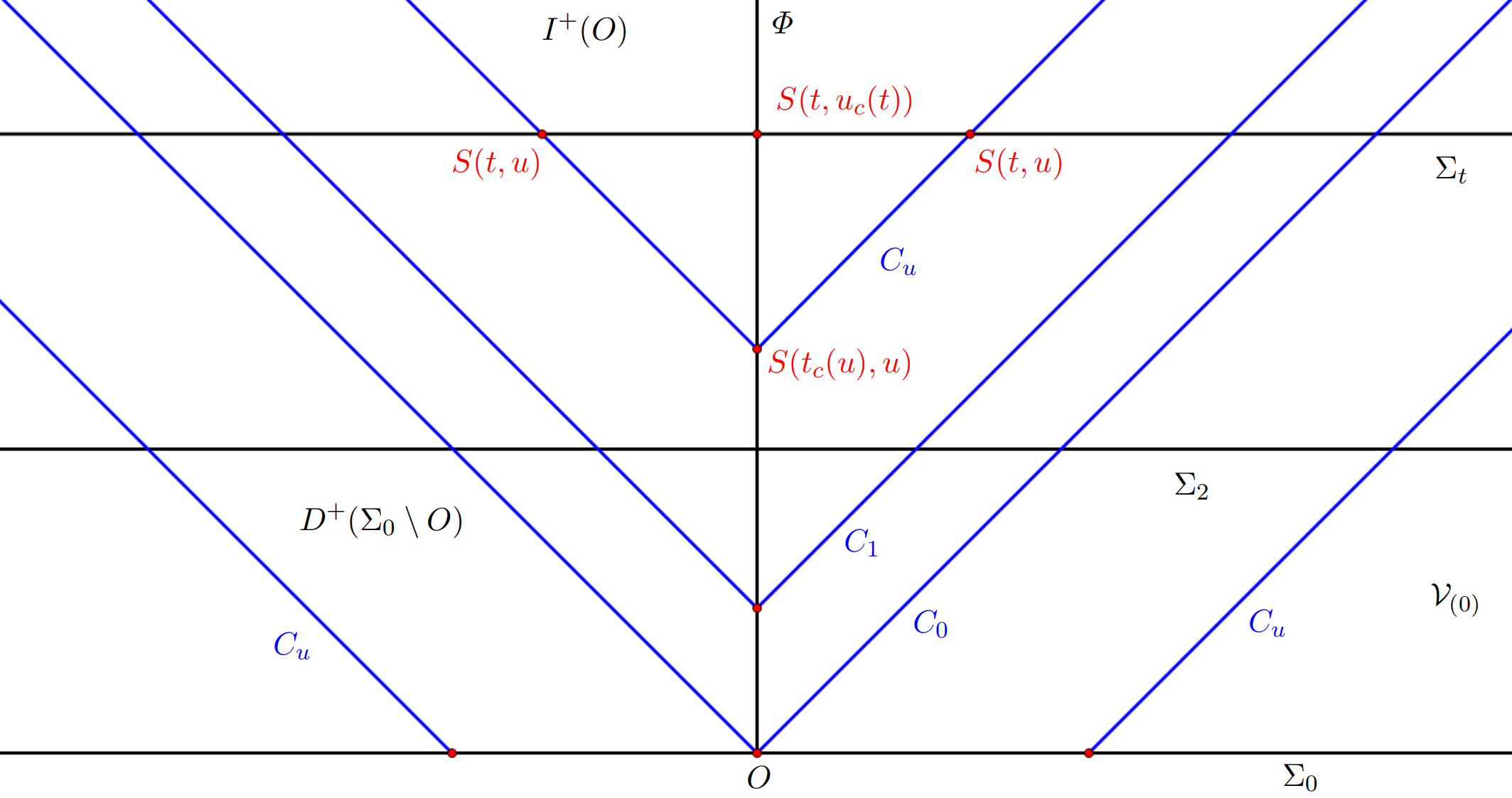
Figure 1: Maximal-null foliation of the spacetime M, illustrating the geometric decomposition and the joint role of maximal and null hypersurfaces.
Curvature analysis leverages null decompositions of the Weyl tensor, with each component encoded in distinct propagation and decay behavior. The Bel-Robinson tensor acts as a positive, divergence-free energy-momentum tensor for the gravitational field, yielding coercive energy densities and facilitating higher-order estimates through strategic contraction with timelike and null vectorfields. The use of the conformal Morawetz vectorfield K0—a conformal Killing field in Minkowski—enables weighted spacetime energy estimates tailored to the peeling hierarchy.
Bootstrapping proceeds by assuming control on weighted energy fluxes (notably rp–weighted fluxes), establishing improved decay, and closing nonlinear estimates. The construction of the optical function from a last slice in the original proof is replaced in minimal decay regimes by axis-based forward constructions, better aligned with weak decay.
Asymptotic Flatness and Threshold Phenomena
The stability framework is calibrated by a hierarchy of asymptotic flatness, specified via weighted asymptotics for the metric and second fundamental form. The decay parameter s quantifies the rate at which data approach Minkowski at spatial infinity, with the regularity parameter q accounting for differentiability.
The Christodoulou-Klainerman setting employs (4,3)–asymptotically flat maximal data, ensuring finiteness of ADM energy, momentum, and angular momentum. Bieri and subsequent works push to weaker decay (s=2 or s∈(1,2]), where these global quantities may diverge, revealing inherent tension between asymptotic structure and physical interpretation.
Notably, the paper demonstrates global nonlinear stability under minimal decay (u0), establishing that arbitrarily small asymptotically flat data above this threshold produce globally complete spacetimes. However, at the critical threshold u1, global stability fails with current methods: nonlinear error terms become non-integrable, and only exterior stability (in the domain of dependence of an outgoing null cone) can be secured, requiring higher regularity in the initial data.
Analytical Techniques: Wave Coordinates and u2–Weighted Estimates
Wave coordinate formulations recast Einstein's equations as quasilinear wave systems, enabling the application of small-data global existence machinery. The classical null condition is not met; instead, Lindblad-Rodnianski identify a weak null structure, in which the most slowly decaying components interact benignly, averting uncontrolled growth.
The u3–weighted energy method, introduced by Dafermos-Rodnianski and developed in this context by Shen, captures decay along null directions without full vectorfield commutation. Abstract weighted divergence identities for tensor pairs under the Bianchi equations isolate bulk spacetime control, exposing how decay rates cascade according to curvature component hierarchy. This method is critical in achieving stability with minimal decay, but yields only subcritical decay at the borderline threshold, necessitating incoming transport equations for optimal rates in the exterior region.
Elliptic estimates on maximal hypersurfaces provide crucial recovery of decay and control for the second fundamental form u4, bridging geometric and analytic approaches.
Results and Claims
The paper proves the following strong results:
- Global stability of Minkowski spacetime under minimal decay (u5) for u6–asymptotically flat initial data: The development is unique, smooth, geodesically complete, and globally asymptotically flat ([Shen23]).
- Exterior stability with borderline decay (u7, u8–asymptotically flat initial data): Unique development exists in the exterior of an outgoing null cone, with double null foliation and quantitative control of geometric and curvature quantities ([Shen24]).
- At u9, global nonlinear stability remains open; nonlinear effects may accumulate and cause qualitatively novel dynamics, including trapped surfaces or singularities.
These claims are substantiated by careful bootstrapping, vectorfield energy estimates, incorporation of elliptic theory, and meticulous analysis of nonlinear spacetime integrability.
Implications and Future Directions
Practically, these outcomes sharpen the criteria for interpreting isolated systems in general relativity—highlighting that strong decay at infinity is necessary for finite conserved quantities and global regularity. Theoretically, the minimal decay threshold delineates the boundary between dispersive, stabilizing dynamics and regimes where nonlinear instability and singularity formation may occur.
Resolution of the borderline case M0 is a pressing open problem, with known techniques—vectorfield method, M1–weighted estimates, elliptic theory—not sufficient for a global argument. A deeper understanding of nonlinear structure in the Einstein equations, perhaps exploiting new rigidity or dispersive mechanisms, is required.
Future developments may pivot on refined analytic tools, geometric rigidity results, or possibly new approaches to nonlinear integrability at the critical threshold. More broadly, this line of research is essential in constraining the global evolution of spacetimes, informing both physical predictions and mathematical foundations.
Conclusion
This survey provides a rigorous synthesis of stability theory for Minkowski spacetime, elucidating the geometric, analytic, and threshold mechanisms underlying known results. The interplay between null structure, energy hierarchies, and asymptotic flatness is articulated, and the delineation between minimal and borderline decay regimes is clarified. The implications are substantial for both relativity theory and nonlinear PDE analysis, guiding future inquiries into gravitational dynamics and the formation of singularities.