- The paper introduces an asymptotic bootstrap method that proves exponential convergence for computing moment sequences in Hermitian matrix models.
- It reformulates moment recurrences in terms of ratio sequences, bypassing positivity constraints and enabling high-precision computations in complex regimes.
- The approach effectively analyzes phase transitions and eigenvalue densities in matrix models, bridging numerical orthogonal polynomial methods with analytic techniques.
Asymptotic Bootstrap Methods for Hermitian Matrix Models: Theory, Algorithms, and Phase Structure
Introduction
The paper "An asymptotic bootstrap method and its applications to Hermitian matrix models" (2606.30895) introduces and rigorously analyzes an asymptotic bootstrap framework for evaluating moments of distributions associated with Hermitian matrix models. The context is the computation of normalized integrals of the form an=∫−∞∞xne−V(x)dx, with V(x) an even-degree polynomial (possibly with complex coefficients). This class of integrals occurs pervasively in quantum field theory, random matrix theory, and statistical mechanics, where numerical and analytic determination of moment sequences underpins the solution of diverse physical models.
A central contribution is the development and proof of convergence of an asymptotic bootstrap methodology, permitting computational bypass of positivity constraints in regimes dominated by the sign problem. The authors delineate the precise cone in coupling-constant space wherein their recursive, ratio-based method converges asymptotically exponentially fast, and they exploit this tool to analyze phase transitions and eigenvalue densities in Hermitian matrix models via the construction of associated orthogonal polynomials.
Bootstrap Framework and Positivity Constraints
The paper begins by recapitulating the moment problem for measures defined by polynomial potentials, emphasizing normalization and the necessity of even-degree leading terms for convergence. Standard bootstrap approaches leverage the positivity of the measure, encoded in the Hankel matrix of moments Mjk=aj+k, leading to semidefinite programming (SDP) formulations that exploit the condition M⪰0. Recursive relationships among moments are derived via integration by parts, resulting in high-order recurrence equations relating an.
However, the authors highlight the computational limitations of SDP bootstrap for large truncation orders k~, noting severe ill-conditioning and the exponential decay of the smallest eigenvalue of Mk~. This motivates the search for alternative schemes capable of leveraging asymptotic information for both improved efficiency and extension to complex couplings.
Asymptotic Bootstrap Approach
Key innovation arises in the analysis of large-moment asymptotics. The recursive structure is reformulated in terms of the ratios rs=bs+1/bs (with bs=a2s for even potentials), which grow polynomially rather than factorially. By analyzing minors of the Hankel matrix, monotonicity properties of the ratio sequence are deduced in the positivity regime, and the recursion can be mapped to a nonlinear difference equation in rs.
For the quartic case (V(x)0), this reduces to a two-term recurrence for the ratios, whose asymptotic solutions correspond to roots of a quadratic polynomial, yielding tight inclusions for V(x)1 bounded by V(x)2 and closely approximated by their mean V(x)3.
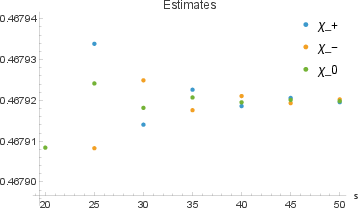
Figure 1: Asymptotic bootstrap method solution for Bessel ratio as a function of truncation order V(x)4, compared to the exact analytic result.
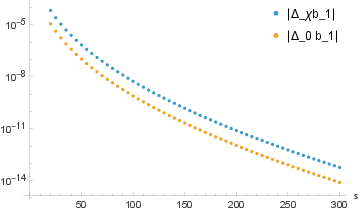
Figure 2: Intrinsic errors of the bootstrap estimates for the Bessel case, confirming exponential error decay with increasing V(x)5.
The general even-potential case with degree V(x)6 is addressed by formulating the recurrence in terms of an V(x)7-dimensional system, where convergence and contraction properties are governed by the spectrum of the associated Jacobian evaluated at the asymptotic root. The result is that convergence is achieved when the leading subdominant coupling V(x)8 satisfies V(x)9, i.e., within a complex wedge symmetric about the real axis.
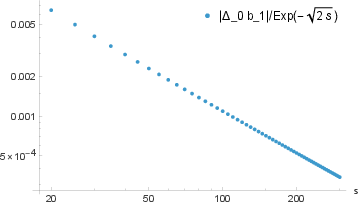
Figure 3: Empirically observed exponential decay of error in the asymptotic method, matching theoretical prediction.
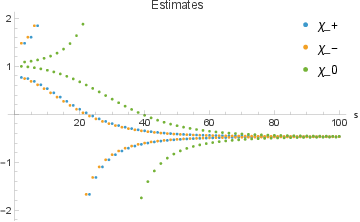
Figure 4: Demonstration of solution tracking for the asymptotic bootstrap method applied to the Bessel ratio, validating high-precision agreement.
Notably, positivity is not required for the method to function—a striking feature enabling application to complex-sign regimes with oscillatory integrals ("sign problem"). In these regions, the method converges where the asymptotic expansion of the ratio recursion exhibits expansion in all directions, as quantified by the eigenvalues of the limiting Jacobian.
Application to Hermitian Matrix Models and Phase Transitions
The practical utility of the approach is demonstrated on Hermitian one-matrix models, standardly written as integrals over Hermitian matrices with measure Mjk=aj+k0. Observables and the spectral density are reduced to moment calculations via the method of orthogonal polynomials, whose coefficients are constructed from the computed moment sequence.
The authors address the numerical challenges inherent in this construction, arising from the poor conditioning of the Hankel matrix and the large cancellations among coefficients of high-degree polynomials. To circumvent numerical instability, extremely high-precision arithmetic is used.
A central focus is the determination of the "one-cut/two-cut" phase transition in matrix models with sextic potentials,
Mjk=aj+k1
as Mjk=aj+k2 is tuned. Computational results display the transition in eigenvalue density, matched to spectral curve predictions from large Mjk=aj+k3 analysis, bridging finite-Mjk=aj+k4 orthogonal polynomial calculations with asymptotic analytic methods.
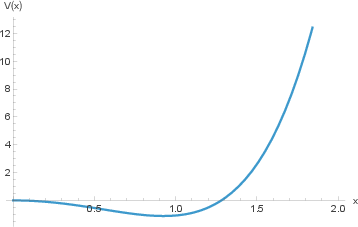
Figure 5: Potential Mjk=aj+k5 with shallow double-well structure, relevant for observing one-cut/two-cut transitions.
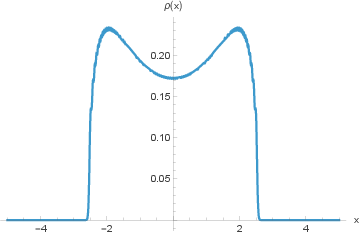
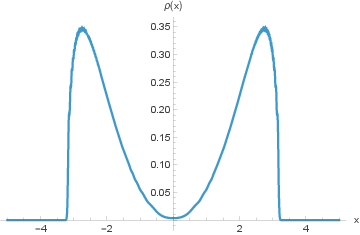
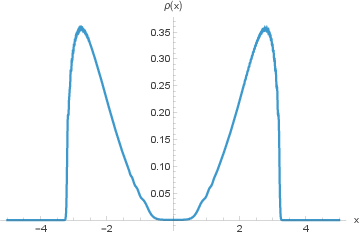
Figure 6: Eigenvalue densities for different values of Mjk=aj+k6 showing one-cut, critical, and two-cut regimes at Mjk=aj+k7.
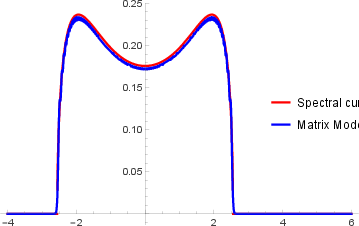
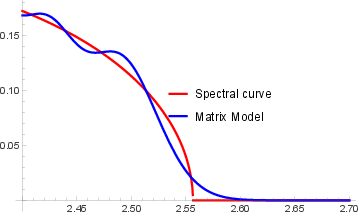
Figure 7: High-precision comparison of finite-Mjk=aj+k8 eigenvalue density using orthogonal polynomials (numerical) with the spectral curve (analytic) in the one-cut regime.
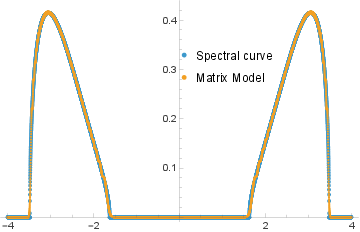
Figure 8: Comparison of eigenvalue density in the two-cut regime: agreement between spectral curve and orthogonal polynomial construction.
The asymptotic bootstrap method demonstrates high computational efficiency relative to both conventional numerical integration and SDP bootstrap, especially at very large truncation order where traditional methods contend with matrix conditioning and floating-point instability. The error in the initial moments or ratios is shown to be suppressed exponentially in the recursion depth Mjk=aj+k9, consistent with the analytically derived rate M⪰00 in the allowed convergence wedge.
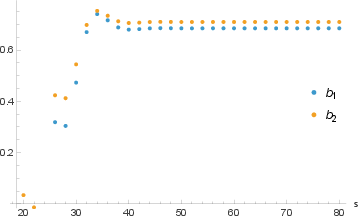
Figure 9: Asymptotic bootstrap convergence in the sextic case, showing rapid agreement with high-precision integral calculations.
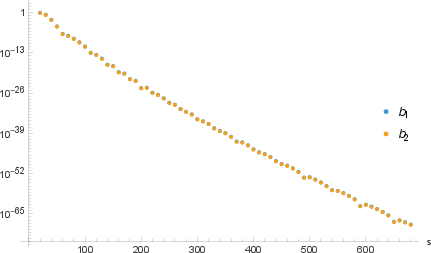
Figure 10: Error decay for the sextic potential, confirming exponential suppression and indicating practical efficiency.
Theoretical and Practical Implications
The asymptotic bootstrap not only provides a rigorous proof of exponential convergence for moment recursion methods in a well-defined region of coupling space but also enables practical computation in the presence of sign problems (complex couplings) that foil positivity-dependent algorithms. This has broad implications for quantum field theory computations, especially in regimes amenable to saddle-point/resurgent methods, and for random matrix analysis beyond unitary or Hermitian ensembles with real action.
The framework exposes deep connections between recursion asymptotics, analytic continuation, and spectral phase structure, motivating further investigation into its extension to quantum-mechanical bootstrap problems, spectral theory of non-Hermitian operators, and the analysis of non-perturbative effects (e.g., Stokes phenomena, resurgence, and instantons).
Conclusion
The paper delivers an authoritative advancement in the landscape of bootstrap techniques for analyzing Hermitian matrix models and associated moment problems. By formalizing and mathematically establishing the scope of an asymptotically exact, positivity-independent bootstrap, it enables rigorous, high-precision, and computationally expedient investigation of models characterized by oscillatory, complex, or sign-ambiguous measures. The method provides a seamless bridge from analytic theory to practical computation, especially in probing phase structures and critical behavior in matrix models, and suggests promising avenues for deeper study into complex extension and resurgence phenomena in random matrix theory and quantum mechanics.

