One-Step Gradient Delay is Not a Barrier for Large-Scale Asynchronous Pipeline Parallel LLM Pretraining
Abstract: Modern large-scale LLM pretraining benefits from utilizing Pipeline Parallelism; however, synchronous implementations leave GPUs idle during pipeline bubbles, wasting computational resources. Asynchronous Pipeline Parallelism eliminates these bubbles, maximizing throughput at the cost of gradient staleness. Among asynchronous schedules, PipeDream-2BW is particularly appealing: unlike the original PipeDream schedule, it ensures a constant one-step gradient delay regardless of pipeline depth. However, its adoption remains limited due to the common belief that optimizing under staleness is fundamentally unstable. In this work, we challenge this assumption, demonstrating that degradation under one-step delay depends strongly on optimizer choice rather than being an intrinsic limitation. We provide the first comprehensive empirical analysis showing that while AdamW, the predominant optimizer at the time when PipeDream-2BW was introduced, indeed suffers from severe degradation, recent methods like Muon exhibit strong robustness under a one-step delay. We introduce an optimizer-agnostic Error Feedback-inspired correction to further mitigate delay effects. We provide supporting theoretical analysis demonstrating convergence for Muon with and without this correction. Extensive evaluation on models up to 10B parameters confirms that our strategies bridge the performance gap with synchronous training, highlighting the practical potential of asynchronous pipeline parallelism at scale.
Paper Prompts
Sign up for free to create and run prompts on this paper using GPT-5.
Top Community Prompts
Explain it Like I'm 14
What this paper is about (big picture)
Training today’s huge LLMs is like running a very long assembly line across many GPUs. In a common setup called “pipeline parallelism,” different parts of the model live on different GPUs, and data flows through them like products on a conveyor belt. In the usual “synchronous” setup, some GPUs have to wait at certain times—these empty wait times are called “pipeline bubbles,” and they waste a lot of compute.
This paper shows that switching to an “asynchronous” setup—where GPUs don’t wait—can keep the assembly line full and fast. The catch with async is that updates are made using slightly old information (a one-step delay). Many people assumed this would make training unstable. The authors test that assumption and find that, with the right optimizer and a small fix, one-step delay is not a problem—even for very large models.
What questions the authors asked
- Does using slightly old gradients (one training step old) actually break training for LLMs?
- Is instability under delay a fundamental problem, or does it depend on which optimizer you use?
- Can we add a simple correction to make async training behave more like the synchronous version?
- Will these ideas still work for very big models (billions of parameters) trained on huge amounts of data?
How they studied it (in everyday terms)
Think of training as steering a car toward a destination using a GPS that tells you which way to turn (the “gradient”). In synchronous training, you always use the freshest directions. In asynchronous training, you’re sometimes using directions from one turn ago. That sounds risky, but it might be fine if your steering system is good at smoothing and averaging.
Here’s what they did:
- They compared different “steering systems” (optimizers), like AdamW and Muon, first on smaller models (135M and 360M parameters) to see how they behave when the directions are one step old.
- They looked at which knobs matter most—like how much “momentum” the optimizer uses. Momentum is like not reacting too sharply to every little bump in the road; it smooths your steering.
- They tried simple tricks to reduce the harm from delay, like starting training in synchronous mode or switching back to synchronous at the end. They also tested a small fix inspired by “Error Feedback,” which basically tries to correct for the missed “fresh” update from the previous step.
- After finding a good recipe, they scaled up to big Mixture-of-Experts (MoE) models with 2B and 10B total parameters and trained them on up to 200 billion tokens to see if the approach holds at large scale.
- They used a scheduling method called PipeDream-2BW, which ensures the delay is always exactly one step for all parts of the model. That consistency matters a lot.
What they found and why it matters
Here are the key findings:
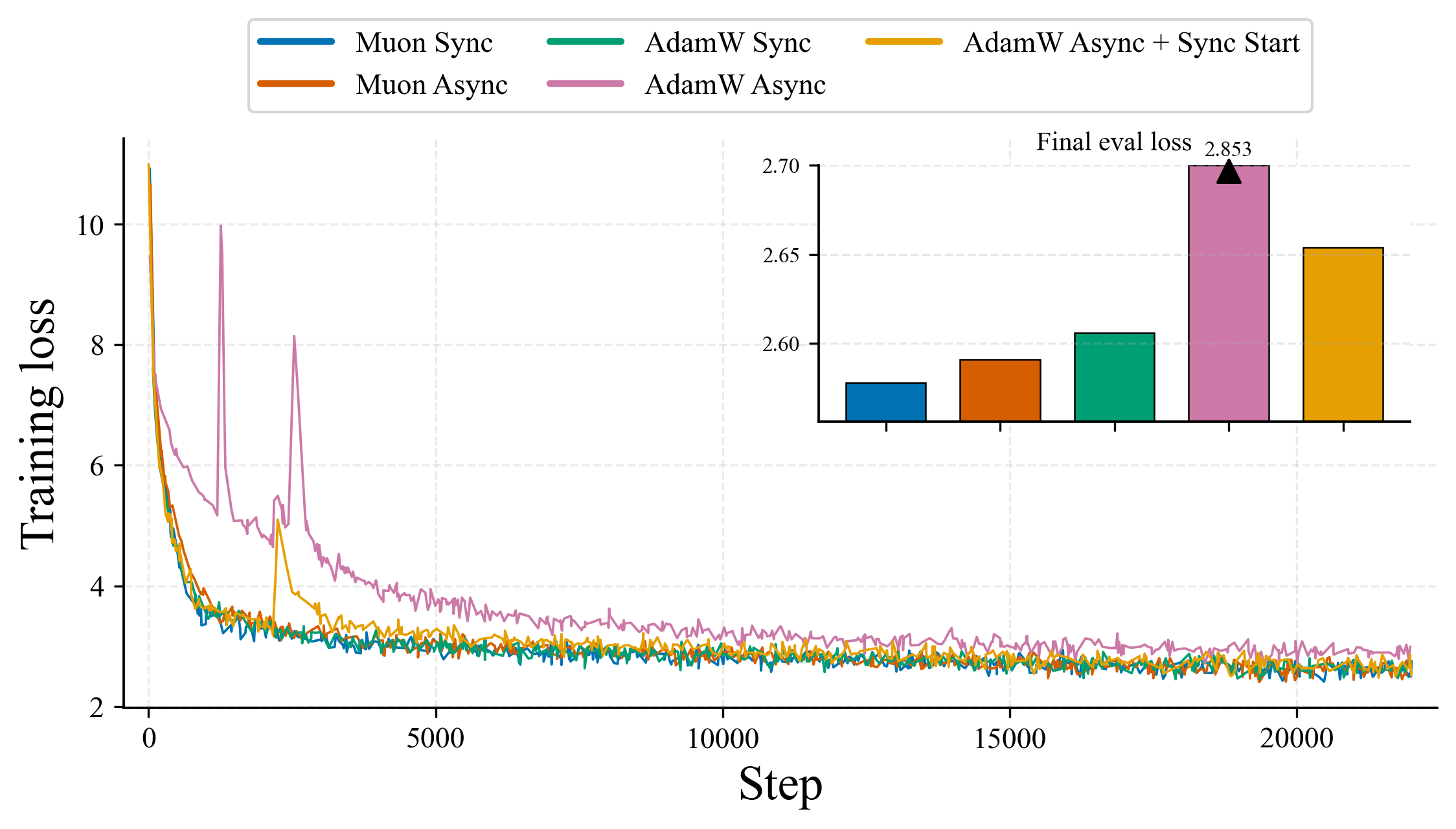
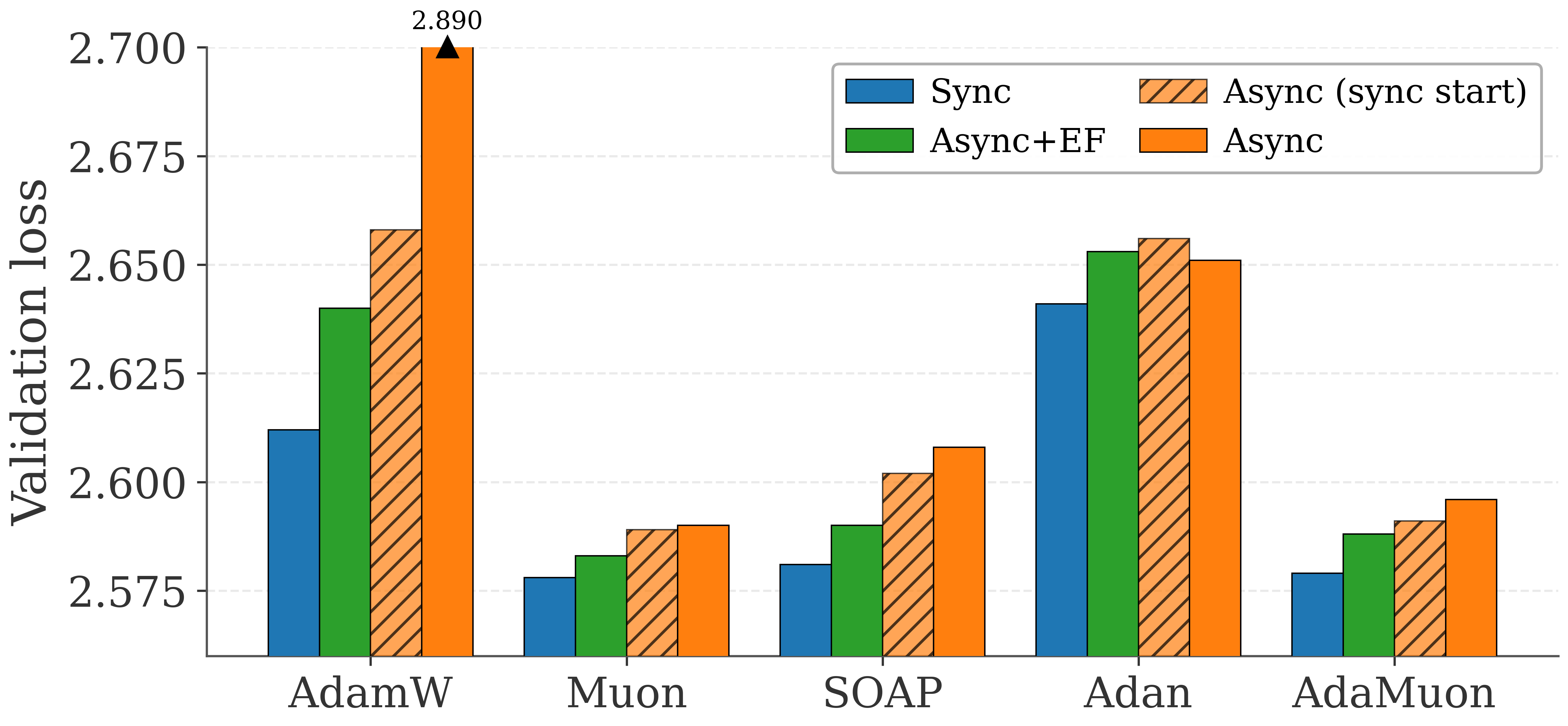
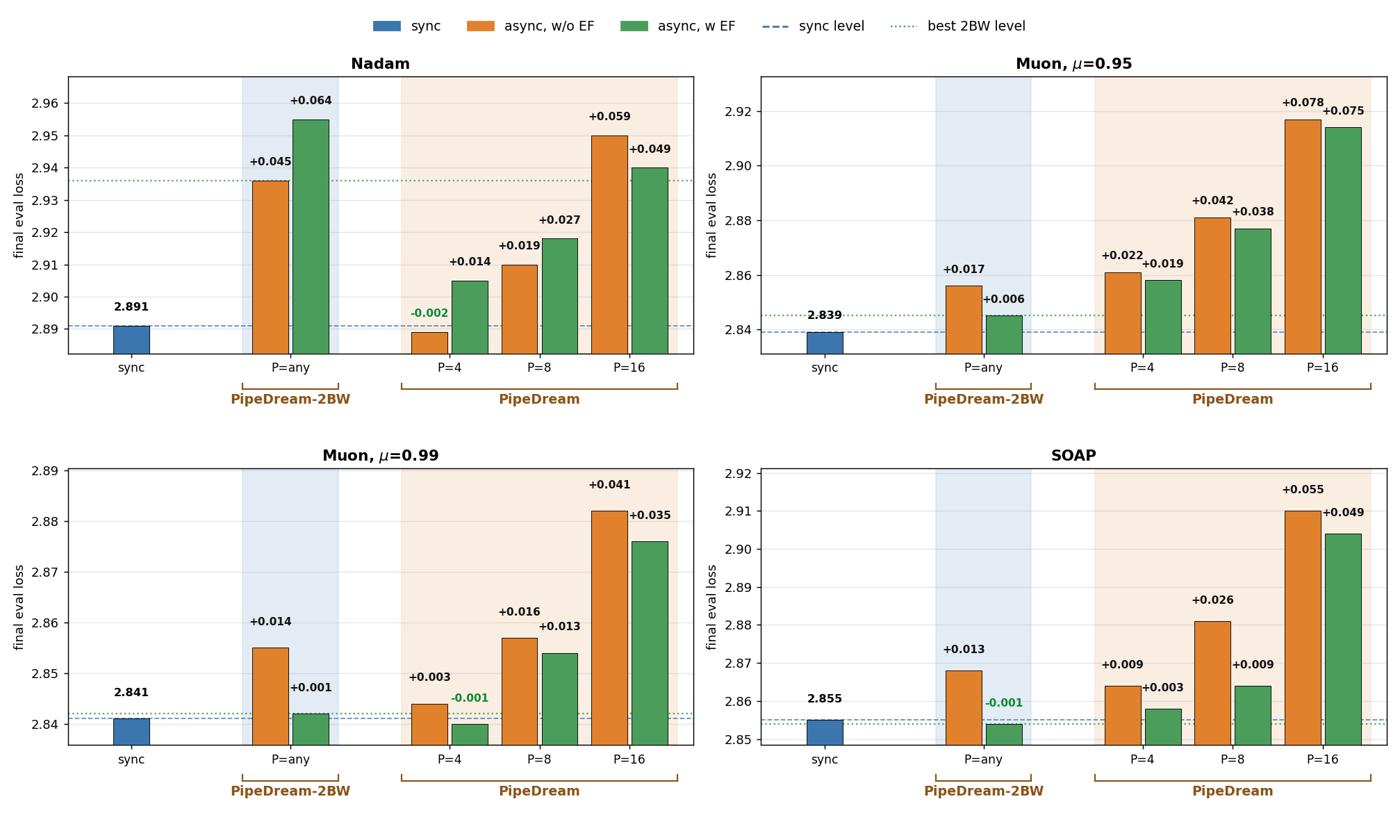
- The optimizer matters a lot. AdamW, a very common optimizer, performs poorly with one-step delay. It loses a lot of quality. But newer optimizers like Muon (and some others, like Adan, Lion, SOAP) handle the delay much better.
- Momentum helps. Across many optimizers, higher momentum makes delayed training more stable and closer to synchronous results. In simple terms, it smooths out the jitter introduced by using slightly old information.
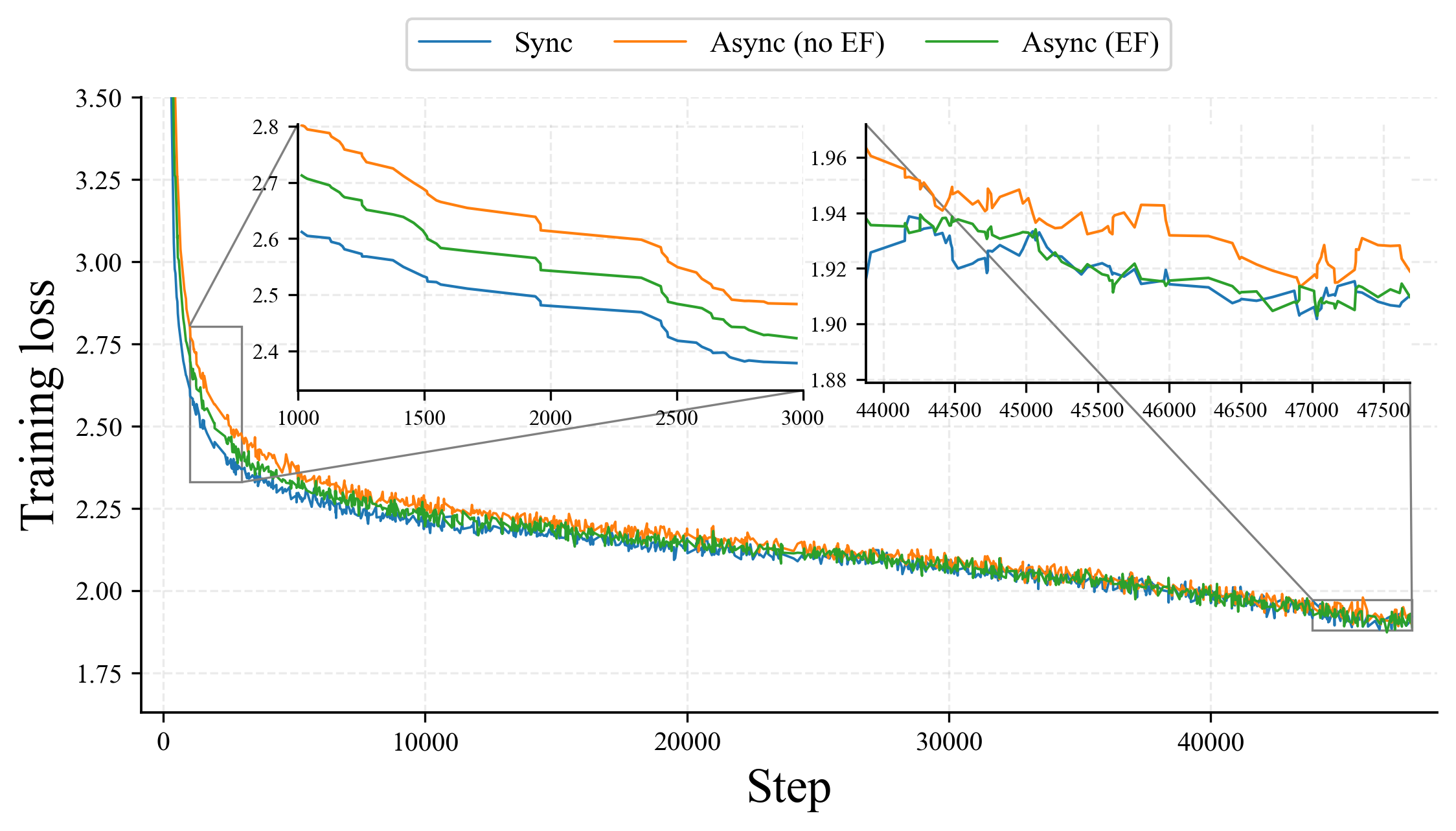
- A tiny fix helps more. The “Error Feedback”-style correction adjusts the current step to compensate for the missed “fresh” update from the previous step. In plain language: if you realize the turn you made last step wasn’t as accurate as it could have been, you nudge the current turn to make up for it. This cut the gap between async and sync by about half (or more) for many optimizers.
- Constant delay beats variable delay. Using a schedule that gives the same one-step delay everywhere (PipeDream-2BW) works much better than schedules where some parts are more delayed than others.
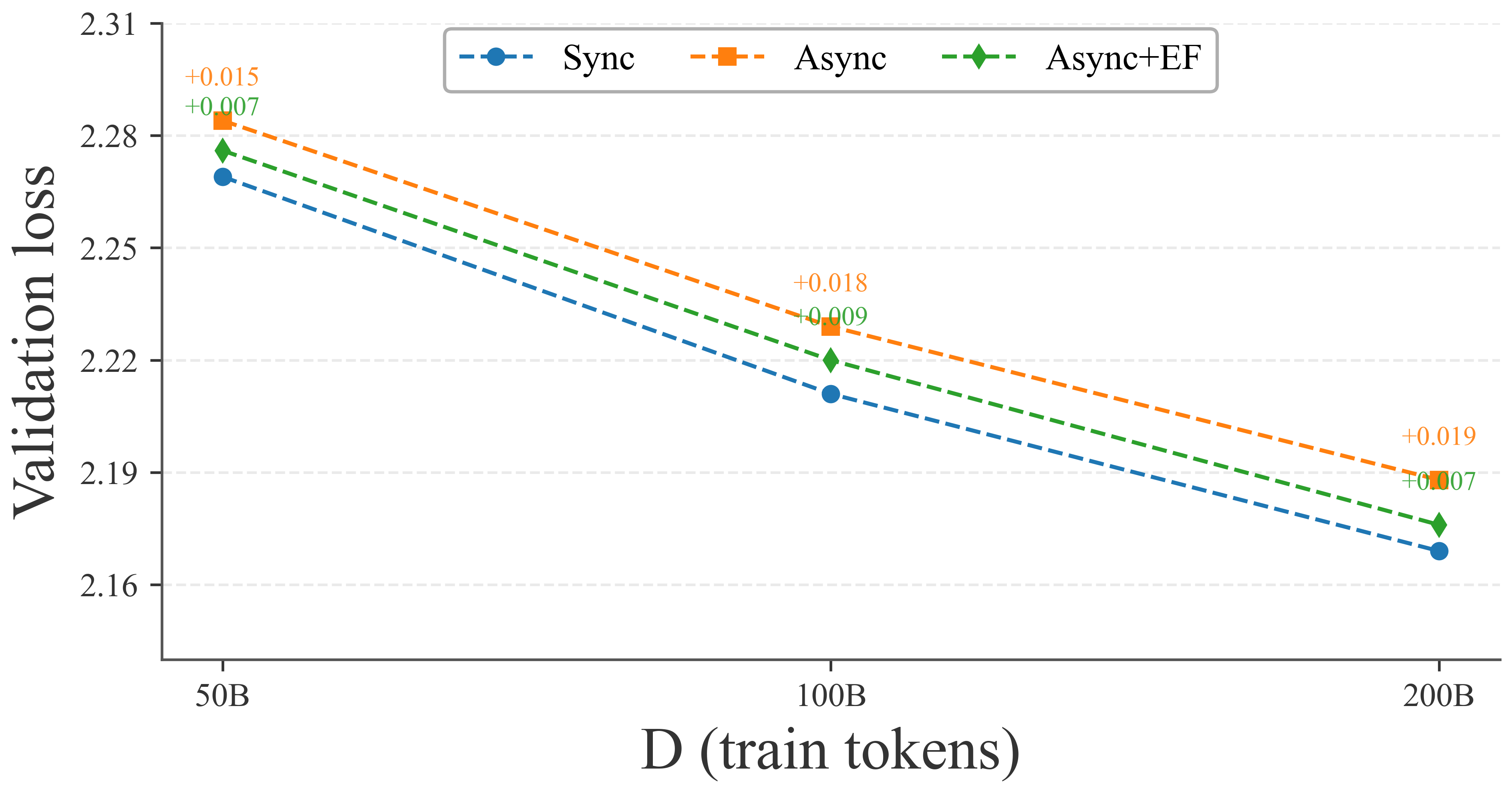
- It works at scale. On a 10B-parameter MoE model trained on 200B tokens, asynchronous pipeline training with the Error Feedback correction matched the final quality of synchronous training—using the same hyperparameters. That’s a big deal: you get the speed/utilization benefits without paying a quality cost.
- There’s theory, too. The authors also provide mathematical analysis showing that Muon still converges even with the one-step delay (and with the correction), backing up the experiments.
Why this is important
- Faster training without quality loss: Asynchronous pipelines remove the “idle time” in the assembly line, making better use of GPUs. That can cut costs and reduce training time for large models.
- Practical guidance: The results suggest that “one-step delay” isn’t a deal-breaker. If you use a robust optimizer (like Muon) and optionally the small Error Feedback correction, you can train large models stably and get the same quality as with synchronous training.
- Better scalability: As models and datasets grow, avoiding wasted compute becomes critical. This work shows a path to scale efficiently without sacrificing performance.
A quick summary in one sentence
By picking the right optimizer (Muon) and adding a simple correction (Error Feedback), the authors show that training LLMs with a one-step delay in updates can be just as good as traditional training—while running faster by keeping all GPUs busy.
Knowledge Gaps
Knowledge gaps, limitations, and open questions
Below is a concise list of what remains missing, uncertain, or unexplored in the paper, structured to guide future research.
Theory and algorithmic understanding
- Extend convergence analysis beyond one-step delay to multi-step and variable delays, and quantify how rates degrade with delay for LMO/Muon and other optimizer families (Adam-like, quasi-hyperbolic, adaptive-sign).
- Provide nonconvex guarantees aligned with LLM training (beyond star-convexity and smoothness), and clarify how constants (e.g., , variance bounds) map to real transformer layers and mixed-precision numerics.
- Analyze the precise mechanism linking momentum to staleness robustness (currently hypothesized); derive conditions under which increasing momentum improves or harms delayed optimization.
- Establish when Error Feedback (EF) helps or hurts, including:
- Sufficient conditions for improvement with EF in adaptive and non-adaptive optimizers.
- Adaptive or learnable scaling of the EF correction (beyond fixed ).
- EF extensions to and to variable, per-layer, or per-stage delays.
- Characterize optimizer-state handling under delay (e.g., EMA, second moments, preconditioners) to avoid instabilities at sync↔async switch points and to ensure consistency across pipeline stages.
Schedules, systems, and scaling
- Validate end-to-end wall-clock speedups and hardware efficiency of PipeDream-2BW and EF on large multi-node clusters, including:
- Actual pipeline bubble elimination vs. theoretical estimates.
- Compute/communication overlap, kernel efficiency, activation checkpointing, and optimizer-state bandwidth.
- Study robustness of “one-step delay” in real systems with stragglers, stage imbalance, network jitter, and dynamic micro-batch timing (which may induce variable, non-uniform delays).
- Compare PipeDream-2BW with alternative constant-delay schedules (e.g., WPipe) under heterogeneous hardware, varying pipeline depths, and MoE load-balancing variability; report quality, throughput, and memory trade-offs.
- Evaluate interactions with other parallelism modes (DP/TP/EP, ZeRO/FSDP) and with optimizer state sharding—does EF or delay introduce bottlenecks or synchronization hazards?
- Examine failure/recovery semantics (checkpointing, restart) under asynchronous schedules with EF, including determinism and reproducibility.
Empirical scope and generalization
- Assess generality across data distributions and tasks:
- Datasets beyond FineWeb-Edu (e.g., multilingual, code-heavy, web mixtures, instruction tuning).
- Transfer to supervised fine-tuning, RLHF, and continued pretraining.
- Broader downstream evaluations (beyond the appendix claim), with task-by-task reporting.
- Test broader architectural coverage:
- Larger dense models (>10B), encoder–decoder models, different normalization/activation schemes, and non-Transformer backbones.
- MoE configurations (varying expert counts, top-k routing, gate noise) and their interaction with delay and EF.
- Explore mixed-precision/quantized training (bf16/fp8), quantized optimizer states, and numerical stability of Muon’s Newton–Schulz preconditioner under delay.
Optimization and hyperparameters
- Develop principled batch-size selection for async regimes balancing throughput and convergence, rather than reusing synchronous near-optimal batch sizes.
- Investigate learning-rate schedules beyond cosine (e.g., warm restarts, adaptive schedules) and momentum schedules tailored for delayed updates.
- Study gradient clipping and weight decay at larger scales and across datasets; check if their “small effect” conclusion holds beyond the tested regimes.
- Evaluate whether EF enables higher stable learning rates or reduced warmup without quality loss, translating into faster convergence.
Mitigation strategies and alternatives
- Design and benchmark alternatives to EF that remain optimizer-agnostic yet stabilize delayed training, such as:
- Prediction/extrapolation of parameters (look-ahead in parameter space).
- Per-layer delay-aware damping or adaptive step-size modulation.
- Basis-rotation strategies (as suggested by SOAP and concurrent AdamW-rotation work) generalized to other optimizers.
- Revisit gradient-level corrections (e.g., DC-ASGD/Taylor terms) with better scaling or normalization to avoid vanishing or exploding corrections in LLM regimes.
Practical considerations and limitations
- Quantify memory overheads of EF and weight stashing across much larger models (≥70B), including interaction with activation checkpointing and optimizer sharding.
- Provide open-source reference implementations integrated with mainstream frameworks (Megatron-LM, DeepSpeed, FSDP) to validate reproducibility and ease of adoption.
- Clarify early-training lag and sharp spikes at sync→async transitions; propose robust transition protocols (e.g., staged or smoothed switches).
- Analyze training dynamics beyond loss (e.g., sharpness, norm growth, calibration, generalization) under staleness and EF.
- Investigate how non-i.i.d. per-stage delays and data order differences in async pipelines affect gradient noise scale and generalization.
Practical Applications
Immediate Applications
The following applications can be deployed now by practitioners to improve training efficiency and stability in large-scale LLM pretraining and related workloads.
- Large-scale LLM pretraining efficiency upgrade (Software/AI, Cloud, Energy)
- Use case: Replace synchronous pipeline parallelism with asynchronous pipeline parallelism (Async PP) using a constant one-step delay (PipeDream-2BW or WPipe), switch optimizer to Muon, and enable the update-level Error Feedback (EF) correction to eliminate pipeline bubbles while matching synchronous quality.
- Tools/workflows: Integrate PipeDream-2BW (or WPipe) into DeepSpeed/Megatron-LM/PyTorch PP; adopt Muon as the default optimizer; enable EF at the optimizer-update level (store and reuse u(t−1) and u(t−2)); set micro-batches so M ≥ P − 1 to guarantee uniform 1-step staleness; increase momentum (e.g., Muon μ≈0.95); optionally reduce batch size slightly if needed; avoid AdamW for async or add EF to mitigate.
- Impact: Higher GPU utilization and throughput; reduced idle time and training cost; lower energy consumption and carbon footprint without sacrificing model quality (demonstrated up to 10B MoE with 200B tokens).
- Assumptions/dependencies: Training framework supports pipeline partitioning and PipeDream-2BW/WPipe; Muon implementation available; EF adds one extra model-sized buffer; high-speed interconnects to fully realize throughput gains; tuned momentum and learning rate near known optima; results validated on FineWeb-Edu and MoE/dense LLMs (generalization to all tasks should be verified).
- MoE-specific pretraining acceleration (Software/AI)
- Use case: Apply Async PP + Muon + EF to Mixture-of-Experts models where compute-to-communication ratio is low; remove pipeline bubbles that hurt synchronous PP utilization.
- Tools/workflows: Combine expert parallelism with Async PP using PipeDream-2BW; adopt Muon defaults and EF; ensure stage balance and sufficient micro-batch count.
- Impact: Significant schedule-level speedups, especially in MoE-heavy stacks; maintains convergence and quality at scale.
- Assumptions/dependencies: Effective stage partitioning to avoid load imbalance; interconnect bandwidth sufficient; micro-batch scheduling tuned.
- Training platform and MLOps templates (Software/AI, Cloud)
- Use case: Provide “Async PP + Muon + EF” training recipes as default templates in internal training platforms and cloud ML services.
- Tools/workflows: Prebuilt YAML/JSON configs for common frameworks; auto-selection of PipeDream-2BW/WPipe; EF plugin; momentum-aware hyperparameter presets; dashboards monitoring staleness and utilization; automated checks enforcing M ≥ P − 1.
- Impact: Faster onboarding to efficient, stable async training; standardized, reproducible pipelines.
- Assumptions/dependencies: Platform hooks for pipeline scheduling and optimizer plugins; logging and monitoring infrastructure.
- Staleness-aware hyperparameter tuning (Software/AI, Academia)
- Use case: Update hyperparameter search to jointly consider staleness (one-step delay), with emphasis on momentum and batch size; de-prioritize AdamW for Async PP, or use EF if AdamW is required for legacy reasons.
- Tools/workflows: Tune momentum upward; maintain warmup and learning rate in stable ranges; use EF to recover 50–70% of the sync-async gap for many optimizers; avoid synchronous-start/cooldown transitions unless necessary (limited and unstable gains).
- Impact: Stable convergence with small or zero quality gap vs synchronous; increased reproducibility under async.
- Assumptions/dependencies: Hyperparameter search infra; validation that task/model-specific optima remain near reported best practices.
- Cost and energy optimization for training budgets (Finance, Energy, Cloud operations)
- Use case: Recalculate training budgets and schedules assuming higher utilization from Async PP; reflect savings in cost and energy forecasts.
- Tools/workflows: Update capacity planning, carbon accounting, and utilization KPIs; prefer async-capable clusters for large-scale runs.
- Impact: Reduced spend per token and lower carbon intensity for pretraining.
- Assumptions/dependencies: Accurate measurement of bubble elimination benefits in the target cluster; ability to schedule sufficient micro-batches.
- Academic labs scaling up on limited budgets (Academia, Education)
- Use case: Adopt Async PP + Muon + EF to train larger models within fixed grants or limited compute quotas; avoid AdamW degradation.
- Tools/workflows: Open-source implementations of PipeDream-2BW/WPipe with EF; adopt momentum-focused hyperparameters; validate on smaller runs before scale-up.
- Impact: Better model sizes/quality per dollar; more accessible large-model research.
- Assumptions/dependencies: Availability of compatible open-source libraries; limited but adequate interconnects; careful replication of recipes.
- Federated/parameter-server style training with small staleness (Software/AI)
- Use case: Borrow momentum and EF insights to improve stability where one-step or short-delay stale gradients occur (e.g., bounded-latency settings).
- Tools/workflows: Apply update-level EF rather than gradient-level EF (paper finds gradient-level EF unstable); tune momentum upwards.
- Impact: Increased robustness to staleness in bounded-delay systems.
- Assumptions/dependencies: Delays remain short and relatively uniform; ability to modify optimizer update rules.
Long-Term Applications
These applications require further research, scaling, engineering, or ecosystem changes before broad adoption.
- Trillion-parameter LLM training with async robustness (Software/AI, Cloud, Energy)
- Use case: Extend one-step delay methods to much larger models and longer horizons (trillion tokens+), maintaining convergence and quality with strong utilization gains.
- Tools/workflows: Hybrid parallelism stacks (tensor + expert + async pipeline + ZeRO/FSDP), dynamic stage balancing, automated EF coefficient scheduling, and staleness-aware learning rate schedules.
- Assumptions/dependencies: Validation at longer horizons and larger scales; better scheduling to handle load imbalance and variable sequence lengths; sustained high-bandwidth interconnects.
- New optimizers designed for delayed gradients (Software/AI, Academia)
- Use case: Develop optimizers with intrinsic robustness to staleness (e.g., LMO variants, adaptive momentum scheduling, basis-rotated adaptivity) that outperform current methods under delay.
- Tools/workflows: Theoretical analyses extending convergence results beyond Muon to richer settings (non-uniform/multi-step delays), automated detection of staleness-induced noise and adaptive mitigation.
- Assumptions/dependencies: Benchmarks and standardized async training suites; reproducible multi-delay datasets and pipelines.
- Generalization to multi-step and variable-delay schedules (Software/AI)
- Use case: Robust training under more complex async schedules with non-uniform delays (e.g., dynamic pipelines, transient stragglers).
- Tools/workflows: Delay-aware EF variants, state correction, and scheduler-level policies that bound or normalize delay; intelligent micro-batch orchestration; runtime staleness monitors.
- Assumptions/dependencies: Instrumentation to observe per-stage delays; empirical study of stability vs delay distributions; potential hardware co-design.
- Cross-domain foundation model training (Healthcare, Vision/Multimodal, Robotics, Finance)
- Use case: Apply Async PP + robust optimizers + EF to non-text foundation models (e.g., multimodal, medical imaging, time-series, robot policies) that rely on pipeline parallelism for depth/width.
- Tools/workflows: Domain-specific data pipelines and loss regimes; tailored momentum and clipping; EF validation in each domain.
- Assumptions/dependencies: Differences in gradient noise and curvature across domains may require adapted hyperparameters; regulatory constraints in sensitive sectors (healthcare/finance).
- Asynchronous training standards and energy-aware policies (Policy, Cloud, Energy)
- Use case: Incorporate async training into compute-efficiency benchmarks and carbon reporting frameworks; promote procurement and funding policies that reward utilization and energy efficiency.
- Tools/workflows: Standard metrics for pipeline bubbles, async utilization, and quality equivalence; guidance on reporting staleness controls (e.g., EF usage).
- Assumptions/dependencies: Broad consensus on measures and validation protocols; transparency from training providers.
- Tooling and ecosystem maturation (Software/AI, Cloud)
- Use case: Stable open-source libraries offering WPipe/PipeDream-2BW as first-class schedulers with EF modules; auto-stage partitioning; memory managers for weight stashing and EF buffers; static analyzers that enforce M ≥ P − 1.
- Tools/workflows: IDE integrations, CI checks for async configs, dashboards that visualize sync-async gap proxies and momentum health.
- Assumptions/dependencies: Community contributions and maintenance; cross-framework support (PyTorch, JAX, TPU/accelerators).
- Data-center schedulers and cluster economics (Cloud, Finance, Energy)
- Use case: Carbon- and cost-aware scheduling that prefers async-capable jobs for better throughput; new pricing models reflecting higher utilization.
- Tools/workflows: Cluster schedulers that detect bubble-prone runs and recommend async PP; incentive structures for users adopting async recipes.
- Assumptions/dependencies: Accurate telemetry of utilization; user acceptance and reliability guarantees.
- Decentralized/edge and continual learning with bounded staleness (Software/AI, Robotics, IoT)
- Use case: Extend EF-based and momentum-centric approaches to asynchronous continual/streaming learning where small delays are unavoidable.
- Tools/workflows: Delay-aware updates on-device; light EF buffers; energy-efficient momentum tuning.
- Assumptions/dependencies: Hardware constraints, limited memory/bandwidth, and intermittent connectivity; careful stability analysis.
- Training-time governance and compliance (Policy, Enterprise IT)
- Use case: Incorporate async training practices into governance frameworks (cost and energy audits, reproducibility requirements).
- Tools/workflows: Compliance checklists for async PP configurations; reproducibility playbooks documenting optimizer choices and EF settings.
- Assumptions/dependencies: Sector-specific standards; auditor familiarity with async training techniques.
Key Dependencies and Assumptions Across Applications
- Uniform one-step delay requires M ≥ P − 1 micro-batches and a constant-delay scheduler (PipeDream-2BW or WPipe).
- Muon (or similarly robust optimizers) is preferred under one-step delay; AdamW degrades substantially unless mitigated by EF or configuration changes.
- Update-level Error Feedback is effective and memory-cheap (one extra model-sized buffer); gradient-level EF was unstable in experiments.
- Momentum is a primary lever for robustness; batch size interacts with staleness and may need small reductions relative to synchronous optima.
- Results demonstrated up to 10B MoE with 200B tokens (FineWeb-Edu); verify generalization to other datasets, modalities, and ultra-long horizons.
- Throughput benefits depend on stage balance, interconnect bandwidth/latency, and overall system efficiency.
- Some mitigation strategies (synchronous start/cooldown, Taylor-based delay compensation) gave limited or negative returns in evaluations.
Glossary
- AdamW: An Adam optimizer variant with decoupled weight decay commonly used for LLM pretraining. "AdamW degrades substantially under one-step delay, even with a synchronous start, whereas Muon achieves a much smaller final sync-async gap."
- Adan: An adaptive optimizer that integrates Nesterov momentum and variance rectification. "Among these methods, Adan achieves the smallest sync-async gap"
- AdaMuon: A Muon family optimizer that adds adaptive features to Muon’s update rule. "In particular, Muon, Adan, NorMuon, AdaMuon, SOAP, and Lion keep the final loss gap within $0.03$ across both model sizes."
- Asynchronous Pipeline Parallelism (Async PP): Pipeline-parallel training without global synchronization, removing idle “bubbles” at the cost of using stale gradients. "Asynchronous Pipeline Parallelism eliminates these bubbles, maximizing throughput at the cost of gradient staleness."
- Cosine learning-rate schedule: A learning-rate schedule that follows a cosine decay pattern over training. "a cosine learning-rate schedule decaying to $0.1$ of the peak value"
- DC-ASGD (Delay-Compensated ASGD): An asynchronous optimization method that applies a Taylor-style correction to compensate for stale gradients. "Finally, we test Delay-Compensated ASGD (DC-ASGD)"
- Error Feedback: A technique that accumulates and feeds back past update errors to correct for communication or staleness-induced inaccuracies. "We introduce an optimizer-agnostic Error Feedback-inspired correction to further mitigate delay effects."
- Exponential Moving Average (EMA): A smoothing technique that maintains a decayed running average of gradients or updates. "Formally, this corresponds to the coefficient in the Exponential Moving Average (EMA) update: ."
- Forward–backward consistency: The requirement that forward and backward passes use consistent parameters for correctness in pipeline schedules. "Moreover, preserving forward-backward consistency requires weight stashing"
- Gated Delta Net: A neural network component that introduces gated residual/delta pathways for improved expressivity or efficiency. "with Gated Delta Net layers"
- Gradient clipping: A stabilization technique that caps gradient norms to prevent exploding updates. "gradient clipping at $1.0$"
- Gradient staleness: The condition where gradients are computed or applied with delayed (stale) model parameters. "maximizing throughput at the cost of gradient staleness."
- Linear Minimization Oracle (LMO): An oracle that returns a direction minimizing a linearization of the objective over a feasible set, used in projection-free methods. "We provide the first theoretical convergence analysis of Linear Minimization Oracle (LMO) algorithms under gradient delay"
- Lion: An optimizer that uses sign-based momentum for efficient large-scale training. "Muon, Adan, NorMuon, AdaMuon, SOAP, and Lion keep the final loss gap within $0.03$ across both model sizes."
- MARS: An optimizer (Momentum-Accelerated adaptive method) explored for LLM training that can be sensitive to delay. "Most modern optimizers remain robust to one-step delay, while AdamW and MARS suffer severe degradation."
- MARS-M: A Muon-related variant that combines ideas from MARS with Muon-style updates. "alongside several Muon variants including AdaMuon, NorMuon, and MARS-M"
- Micro-batch: A smaller chunk of a minibatch used to increase pipeline depth or fit memory in pipeline parallel training. "after a full minibatch of micro-batches has completed backward propagation."
- Minibatch: A subset of the training data processed as a unit for a single optimization step. "Async PP is no longer semantically equivalent to conventional minibatch training"
- Mixture-of-Experts (MoE): A model architecture that routes tokens through a subset of specialized expert networks to improve parameter efficiency. "the rise of Mixture-of-Experts (MoE) architectures has made this strategy less effective"
- Momentum decay coefficient: The parameter (e.g., β1 or μ) controlling how much past gradients influence the current momentum. "one hyperparameter does exhibit a clear and consistent trend across optimizers: the momentum decay coefficient"
- Muon: A projection-free, matrix-oriented optimizer using orthonormalization-based updates, noted for robustness under delay. "In contrast, Muon achieves a much smaller final gap of only $0.012$ without any synchronous start."
- Nadam: Adam with Nesterov momentum, providing a look-ahead effect in updates. "motivating the use of Nadam"
- Nesterov Accelerated Gradient: A momentum method with a look-ahead step that anticipates the next position before computing the gradient. "the ``look-ahead'' structure of Nesterov Accelerated Gradient, motivating the use of Nadam"
- Newton–Schulz: An iterative method for approximating matrix inverses or inverse square roots, used in Muon’s update computation. "Newton-Schulz"
- NorMuon: A normalization-enhanced variant of Muon designed to improve stability. "In particular, Muon, Adan, NorMuon, AdaMuon, SOAP, and Lion keep the final loss gap within $0.03$ across both model sizes."
- One-step gradient delay: A fixed staleness regime where each update uses the previous step’s gradient. "it ensures a constant one-step gradient delay regardless of pipeline depth."
- PipeDream: An asynchronous pipeline-parallel schedule that updates after each stage’s backward pass, leading to variable delays. "the original PipeDream schedule"
- PipeDream-2BW: An asynchronous schedule that updates once per minibatch to enforce a uniform one-step delay across stages. "PipeDream-2BW is particularly appealing: unlike the original PipeDream schedule, it ensures a constant one-step gradient delay regardless of pipeline depth."
- Pipeline bubbles: Idle slots in pipeline schedules where some devices are unused due to synchronization constraints. "synchronous implementations leave GPUs idle during pipeline bubbles, wasting computational resources."
- Pipeline Parallelism (PP): Model-parallel training that splits the network into stages across devices to process micro-batches in a pipeline. "Pipeline Parallelism (PP)"
- SAPipe-WP: A data-parallel motivated method whose update displacement aligns with the paper’s Error-Feedback-style correction in the one-step delayed setting. "This update-level formulation has a close connection to SAPipe-WP"
- Smoothness: An assumption that the gradient does not change too rapidly, typically bounding differences by a Lipschitz constant. "Smoothness."
- Staleness heterogeneity: Variation in delay across stages, causing different parts of the model to see gradients with different staleness. "This staleness heterogeneity leads to severe convergence degradation"
- Stochastic gradient estimator: A random gradient sample whose expectation equals the true gradient, often with bounded variance. "Stochastic gradient estimator."
- Synchronous Cooldown: A mitigation strategy that switches from asynchronous to synchronous updates near the end of training. "Synchronous Cooldown."
- Synchronous Start: A mitigation strategy that begins training synchronously before switching to delayed asynchronous updates. "Synchronous Start."
- Taylor-based correction: A gradient correction using a Taylor expansion to compensate for delay-induced error. "Taylor-based correction only destabilizes training once scaled up."
- Warmup: A period at the start of training where the learning rate is gradually increased to stabilize optimization. "a warmup lasting of the training budget."
- Weight decay: L2-style regularization applied via a decay term on parameters to reduce overfitting. "weight decay $0.1$"
- Weight stashing: Keeping multiple versions of model parameters to ensure consistency between forward and backward passes under pipelining. "preserving forward-backward consistency requires weight stashing"
- WPipe: A scheduling alternative related to constant-delay asynchronous pipelining. "We also discuss WPipe as a potentially better scheduling alternative"
- ZeRO: A memory-optimized data-parallel training approach that shards optimizer states and gradients across devices. "memory-efficient data-parallel approaches like ZeRO"
- ZeRO-Offload: A variant of ZeRO that offloads optimizer states or gradients to CPU memory to further reduce GPU memory usage. "This strategy follows ZeRO-Offload"
Collections
Sign up for free to add this paper to one or more collections.