- The paper introduces a particle-number conserving shadow tomography protocol that optimally estimates k-body fermionic correlations with sample complexity scaling as Θ(η^k/ε^2) independent of the mode number.
- It employs Haar-random orbital rotations and representation-theoretic techniques to ensure unbiased estimation through an invertible measurement framework using Grassmannian integrals.
- Numerical simulations verify that the protocol dramatically reduces state preparation queries compared to traditional methods, promising practical advances in quantum many-body simulations.
Provably Efficient Learning of Fermionic Correlations under Particle-Number Symmetry
Introduction and Problem Context
The estimation of fermionic correlations, particularly k-body reduced density matrices (RDMs), is central to quantum many-body theory, as these RDMs encode observables relevant to energy spectra, entanglement, and quantum simulation. Traditional learning protocols for fermionic systems have polynomial sample complexity scaling in the number of modes N, often Ok(Nk), even when exploiting optimized measurement strategies or fermion-to-qubit mappings. While existing shadow tomography-based protocols leverage fermionic algebraic structure, N-independent guarantees remained elusive except in highly constrained cases.
This work develops and fully analyzes a number-conserving shadow tomography protocol based on Haar-random orbital rotations. Explicitly, the authors demonstrate that for an N-mode, η-particle fermionic state, all k-body correlations can be estimated with variance Ok(ηk), independent of N, using only Ok(ηk/ε2) samples for fixed target error N0. The protocol achieves a matching information-theoretic lower bound and is shown to be optimal among adaptive, single-copy measurement methods.
Protocol Framework and Theoretical Advances
The protocol extends fermionic shadow estimation by focusing on particle-number symmetry. Each measurement involves three steps: a single-particle Haar-random unitary N1 is sampled and applied (lifted to the N2-particle sector), the state is measured in the occupation basis, and a classical shadow estimator is constructed from the observed configuration and the applied unitary. This process exploits the Grassmannian geometry of the rank-N3 mode projectors, and its average measurement channel has an explicit, invertible structure.
Tomographic completeness—critical for unbiased estimation—is rigorously established via representation-theoretic techniques. The operator basis generated by conjugating a reference Slater determinant projector under orbital rotations linearly spans the N4-particle operator space. Here, the authors correct a subtle gap in earlier work regarding the linear closure of these rotated projectors, ensuring the unbiasedness and invertibility required for shadow tomography in the fixed-number sector.
The central claim is that, for each fixed N5, sample complexity for entrywise N6-RDM estimation at variance N7 is both upper- and lower-bounded (up to N8-dependent factors) by N9, completely eliminating Ok(Nk)0-dependence. This result contrasts sharply with prior Ok(Nk)1 scaling in symmetry-agnostic protocols.
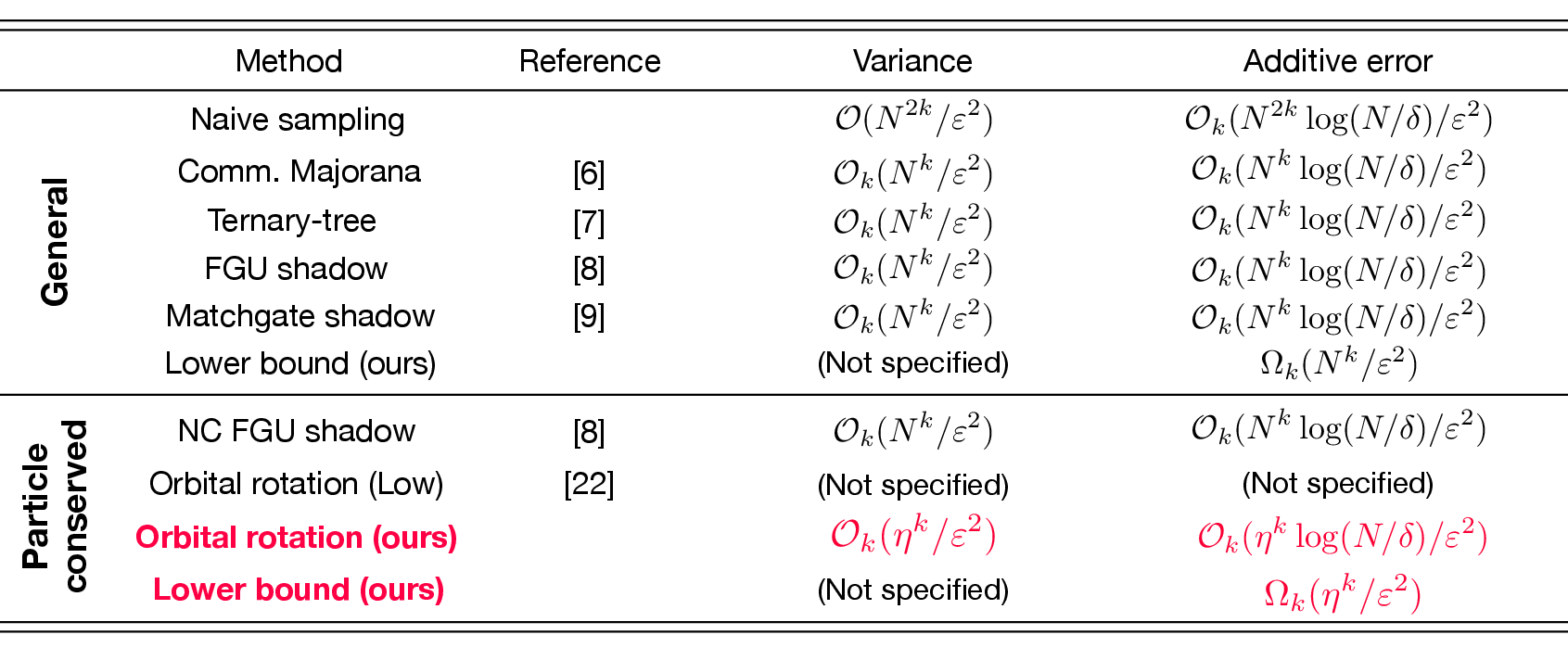
Figure 1: Sample complexity for Ok(Nk)2-RDM estimation using various protocols, comparing Ok(Nk)3-independent scaling of the orbital-rotation shadow protocol to earlier methods sensitive to the mode number.
Variance analysis is facilitated by reformulating the estimation problem in terms of Grassmannian integrals. The variance of each Ok(Nk)4-RDM estimator is cast as a bounded-degree polynomial moment over the invariant measure on Ok(Nk)5, yielding an Ok(Nk)6 upper bound and explicit closed forms for low-order cases. This approach also enables the authors to derive exact variance and covariance formulae for all Ok(Nk)7.
The information-theoretic lower bound leverages a reduction to a two-hypothesis distinguishing problem over the fixed-number sector, bounding the total variation distance via Hilbert–Schmidt norm estimates of Ok(Nk)8-RDMs. The bound applies to all possible adaptive protocols that access single copies of Ok(Nk)9, and rules out any N0-independent N1 protocols with N2 for entrywise learning.
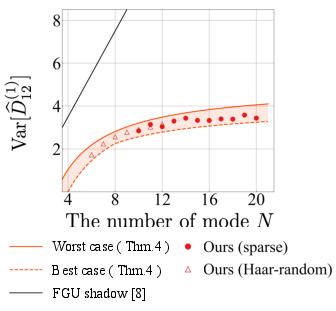
Figure 2: Empirical and theoretical variance of the orbital-rotation N3-RDM shadow estimator as a function of N4, with all curves showing variance remaining bounded as N5 grows.
Numerical Verification and Practical Cost
Numerical verification in the physically relevant case of N6 shows strong correspondence between sampled estimator fluctuations and predictions from the derived variance formulas for both Haar-typical and sparse states, for fixed N7 and variable N8.
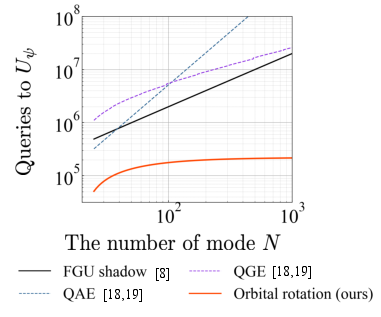
Figure 3: Query complexity for simultaneous estimation of all N9-RDM entries with fixed N0 and error, compared across protocols including FGU shadow and Heisenberg-limited oracles.
For electronic structure-type scenarios (N1, N2, N3), the protocol reduces the number of required state preparation queries by an order of magnitude compared to previously best-known methods. Notably, orbital-rotation shadows outpace even Heisenberg-limited procedures under only unitary access to state preparation.
Theoretical and Practical Implications
This work demonstrates that particle-number symmetry yields a provable and sharp collective advantage in learning all N4-body fermionic correlations—establishing, for the first time, N5-independent, particle-number-determined sample complexity that matches lower bounds from quantum information theory. As N6 increases or in electronic structure simulations, the practical resource savings for quantum hardware is significant.
On the theoretical side, the general framework, including explicit inversion, variance analysis, and information-theoretic arguments, sets a foundation for further advances in the efficient certification and learning of structured quantum systems under conserved quantities or group symmetries.
Potential further research directions include:
- Tightening the N7-dependence in constants hidden in the asymptotic bounds.
- Constructing discrete, symmetry-preserving ensembles (e.g., FGU subsets) that match the N8-independent guarantees without continuous orbital rotations, enhancing implementation viability.
- Extending these symmetry-informed learning principles to quantum state certification and more general observable sets beyond RDMs.
Conclusion
By introducing and fully characterizing the orbital-rotation shadow protocol for fermionic states under exact particle-number symmetry, this work bridges a long-standing gap between practical quantum simulation goals and information-theoretic efficiency. Both the performance analysis and exact variance evaluation confirm that particle-number conservation enables fundamentally more efficient learning for fermionic observables than previously thought possible, as further evidenced by strong cost reductions in large-scale numerical simulations.
The protocol's optimality and generality make it a strong candidate for adoption in quantum simulation pipelines, particularly as hardware and control capabilities mature to allow number-conserving orbital rotations. The general methodology—and specifically, the use of invariant measure moments on the Grassmannian for variance analysis—may inform future quantum learning protocols for systems with symmetries beyond fermionic number conservation.