- The paper introduces a real-space, linear-scaling Bethe-Salpeter method to simulate excitonic spectroscopy in disordered BN monolayers.
- It demonstrates that disorder induces asymmetric spectral broadening, systematic redshifts, and a quadratic-to-linear transition in excitonic peak behavior.
- The study reveals pronounced center-of-mass localization of exciton wavefunctions while preserving a compact electron-hole pair and strong binding energy.
Linear-Scaling Bethe-Salpeter Simulations of Excitons in Disordered Boron Nitride Layers
Introduction
This work presents a real-space, linear-scaling computational methodology for excitonic spectroscopy in atomistically-large, structurally disordered two-dimensional (2D) systems, with a focus on hexagonal boron nitride (hBN) monolayers. Standard approaches to exciton physics based on many-body perturbation theory, specifically the GW-BSE framework, face severe computational bottlenecks when translational symmetry is broken, as in the case of disordered, moiré, or large-unit-cell materials. The methodology developed addresses this by mapping the Bethe-Salpeter equation (BSE) to a sparse real-space Hamiltonian and employing the Kernel Polynomial Method (KPM) for linear-scaling evaluation of optical properties. The approach enables direct access to the effects of static disorder on excitonic spectra, center-of-mass localization, and the emergence of new optical features in supercell calculations with up to 105 orbitals.
Methodology
The formalism begins with a pz-projected tight-binding Hamiltonian for hBN, separable by sublattice, and introduces Anderson-type diagonal disorder. Using perturbative decoupling, the electronic structure is mapped to effective single-particle electron and hole Hamiltonians. The direct Coulomb interaction is modeled via the Rytova-Keldysh potential, enabling efficient evaluation of the BSE Hamiltonian in a localized basis of electron-hole pairs. A real-space cutoff, Rcut, is used to truncate pairs with large separation, ensuring linear scaling with the number of atoms in the unit cell. The optical absorption spectrum is calculated as the imaginary part of the dielectric function, avoiding explicit diagonalization via KPM.
The direct exchange term is neglected, justified by its minimal contribution compared to the direct interaction in large-gap materials. The approach is explicitly tailored to systems lacking translational invariance, allowing simulation of atomistically-resolved excitons and optical spectra under strong disorder or aperiodicity.
Optical Absorption under Disorder
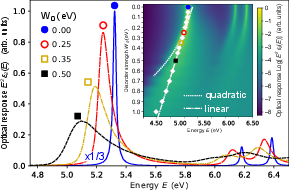
The simulated absorption spectra as a function of disorder strength W0 reveal several key features:
Exciton Density of States and Oscillator Strength Redistribution
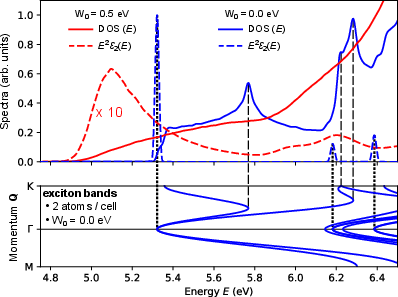
Beyond absorption spectra, the exciton density of states (DOS) and its interplay with oscillator strength are analyzed:
Exciton Wavefunction Localization
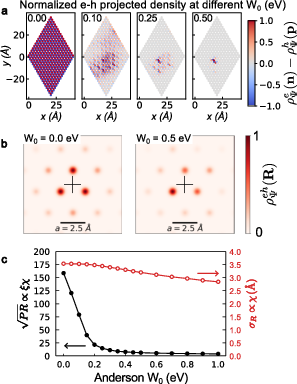
A central result pertains to the spatial localization properties of excitonic states under disorder:
Implications and Outlook
The methodology enables ab initio-informed studies of excitons in systems beyond the reach of conventional GW-BSE approaches, providing atomistic insight into disorder-driven exciton physics. The principal implications include:
- Spectral fingerprints of disorder are shown to go beyond mere peak broadening, involving activation of dark continua and qualitative reshaping of absorption lines.
- The decoupling of center-of-mass localization and electron-hole pair compactness establishes that strongly localized excitons remain robust against static potential fluctuations in terms of binding energy and radiative character.
- The quadratic-to-linear crossover in the excitonic peak redshift with disorder is a robust numerical result, offering a direct experimental observable for distinguishing weak and strong disorder regimes.
- The technique opens pathways to address new physical phenomena in moiré superlattices, quasicrystals, functionalized heterostructures, and electrically or magnetically tuned exciton systems that lack lattice periodicity (2606.30585).
The approach is also extensible to exciton diffusion simulations and could be adapted to study time-dependent or non-equilibrium phenomena in disordered 2D materials. The results suggest that, in experimentally relevant hBN monolayers, exciton localization is controlled by static disorder rather than phonons, with significant ramifications for device engineering and fundamental research.
Conclusion
This contribution establishes a linear-scaling Bethe-Salpeter framework that unlocks statistical and microscopic analysis of excitons in structurally complex, disordered, and large-unit-cell materials. By capturing both the spectral and real-space signatures of disorder, it offers a robust computational platform for probing optical and transport phenomena where excitonic effects in non-crystalline environments play a pivotal role. The work enables rigorous evaluation of the interplay between electron-electron interactions and disorder, a regime that is increasingly relevant for next-generation quantum materials and optoelectronic device architectures.