- The paper introduces CWGD, a noise measure that adapts SGD to the loss landscape geometry to mitigate over-penalization in high-curvature directions.
- It proposes a CWGD-modulated cosine schedule achieving roughly 20% lower final suboptimality than standard cosine annealing in strongly-convex quadratic scenarios.
- Efficient estimation using Hutchinson’s stochastic trace estimator enables robust curvature rescaling, paving the way for enhanced fine-tuning and adaptive learning rates.
Curvature-Weighted Gradient Diversity: Geometry-Adaptive Noise Modulation for SGD
Overview
The paper "Curvature-Weighted Gradient Diversity: A Noise Measure for Geometry-Adaptive SGD Schedules" (2606.30455) introduces Curvature-Weighted Gradient Diversity (CWGD), a theoretically justified and empirically robust noise measure tailored to the geometry of the loss landscape. CWGD is designed to enable geometry-adaptive SGD schedules by quantifying the true effective noise in optimization, particularly by compensating for over-penalization of high-curvature directions by traditional variance-based noise proxies.
The work details the definition, efficient estimation, and analytical properties of CWGD. It proves a reduction of the residual floor in asymptotic convergence bounds for mini-batch SGD when using a CWGD-modulated cosine learning rate schedule and presents consistent 20% improvements in final suboptimality over plain cosine schedules in the strongly-convex quadratic case.
Motivation and Context
Conventional noise analysis for mini-batch SGD applies a uniform scalar variance bound across all parameter directions. This approach inadequately considers that stochastic noise has a different impact depending on curvature. In directions where the objective function is steep (high curvature), SGD takes small steps due to the learning rate constraint (η≤1/L), causing noise-induced displacement to be inherently small. Nevertheless, the standard theoretical bounds do not capitalize on this, leading to suboptimal step size adaptation.
CWGD resolves this by explicitly rescaling mini-batch gradient diversity with the inverse square root of the Hessian, attenuating the contribution of high-curvature directions. Empirically, this leads to a measurement of effective noise significantly more representative of the true convergence behavior.
Definition and Theoretical Properties
CWGD is formally defined for a twice differentiable objective f with positive definite Hessian as follows:
CWGD(x,B)=B(B−1)21≤i<j≤B∑∥H(x)−1/2(gi−gj)∥2
where gi are per-sample gradients in mini-batch B. For a diagonal Hessian, this reduces to a weighted sum of per-coordinate gradient variances, scaling each variance by 1/λk.
Under isotropic noise, the expected CWGD is 2σ2tr(H−1), yielding a direct connection to the effective noise floor experienced during optimization. The theoretical improvement over standard scalar variance bounds is quantified by the factor ρ(κ)=d/(μtr(H−1)), which increases with the condition number κ.
CWGD-Modulated Cosine Scheduling and Main Results
A key contribution is the construction of the CWGD-Cosine schedule, where the step size is globally modulated by the normalized CWGD signal:
ηt=1+αrtηˉ,rt=CWGDt/CWGD0
Theoretical analysis for strongly-convex quadratics with diagonal Hessian and isotropic noise proves that this modulation strictly reduces the asymptotic residual floor by a factor f0 over standard cosine annealing, with the recommended setting f1 resulting in a two-fold reduction.
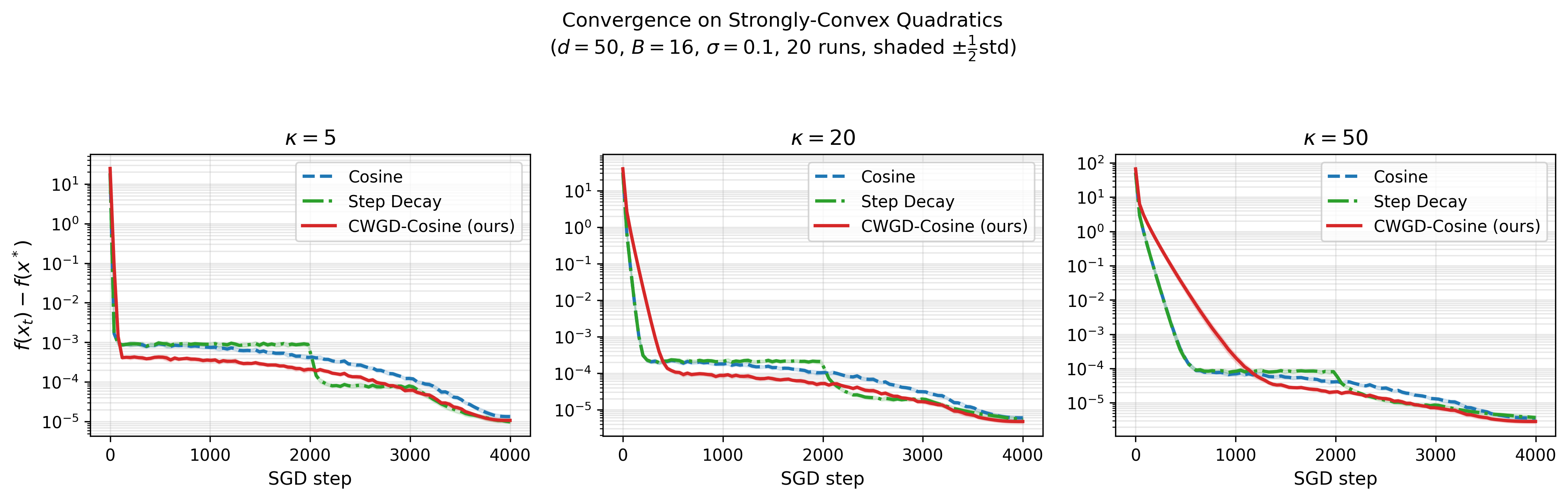
Figure 1: Convergence trajectories on synthetic quadratics for f2; CWGD-Cosine consistently accelerates convergence and lowers the residual floor compared to standard cosine and step decay schedules.
The gap between this guaranteed improvement and the theoretical optimum grows with increasing f3 but is nontrivial for moderate condition numbers (f4).
Efficient Estimation and Algorithmic Implementation
CWGD estimation leverages the Hutchinson stochastic trace estimator to obtain diagonal Hessian elements, enabling an efficient and unbiased computation of the curvature weights. Correct use requires separation of curvature and diversity estimation, as naive normalization collapses to an uninformative constant under isotropic noise.
The estimator's robustness to small off-diagonal structure is empirically validated, with relative errors below 1% under moderate non-diagonality and exactness for diagonal quadratic losses.
Empirical Evaluation
CWGD-Cosine is rigorously evaluated on synthetic strongly-convex quadratics across varying condition numbers, batch sizes, and noise structures. It consistently achieves approximately 20% lower final suboptimality than standard cosine annealing, regardless of batch size or isotropic versus aligned noise.
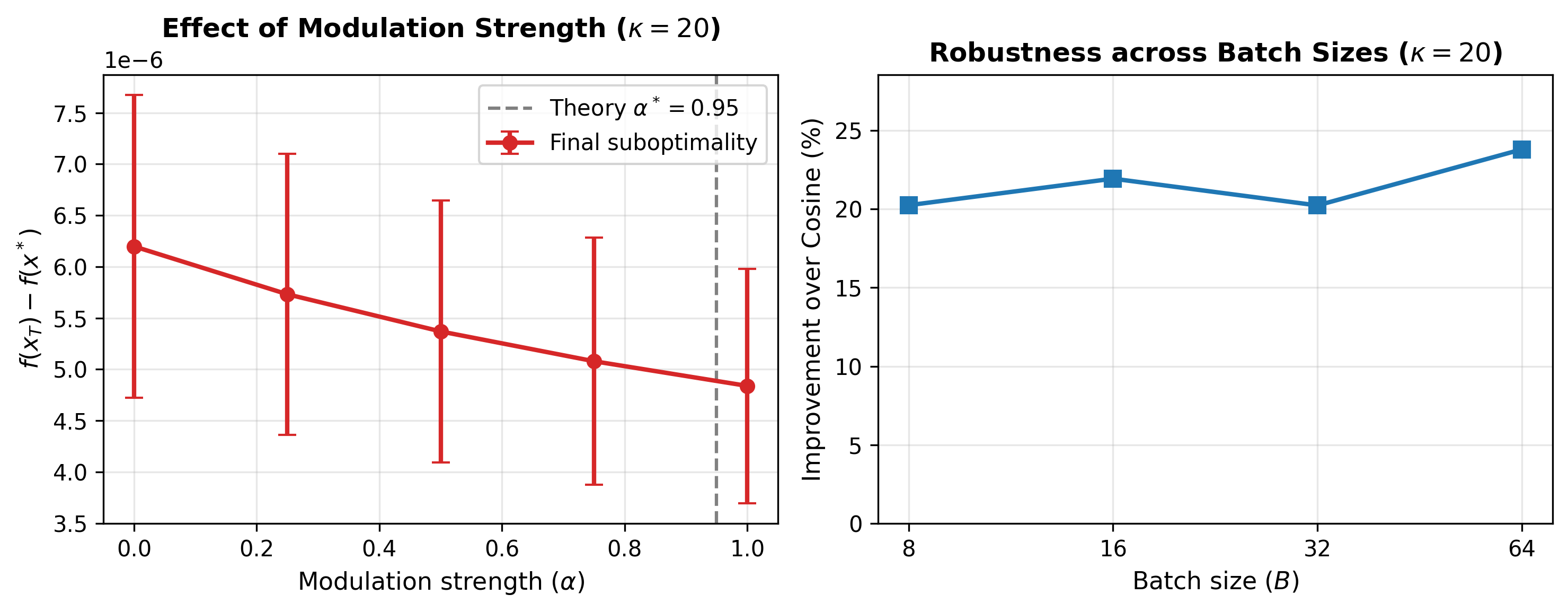
Figure 2: Left: final suboptimality monotonically decreases with increasing modulation strength f5; Right: the percentage improvement of CWGD-Cosine over Cosine remains stable across varying batch sizes.
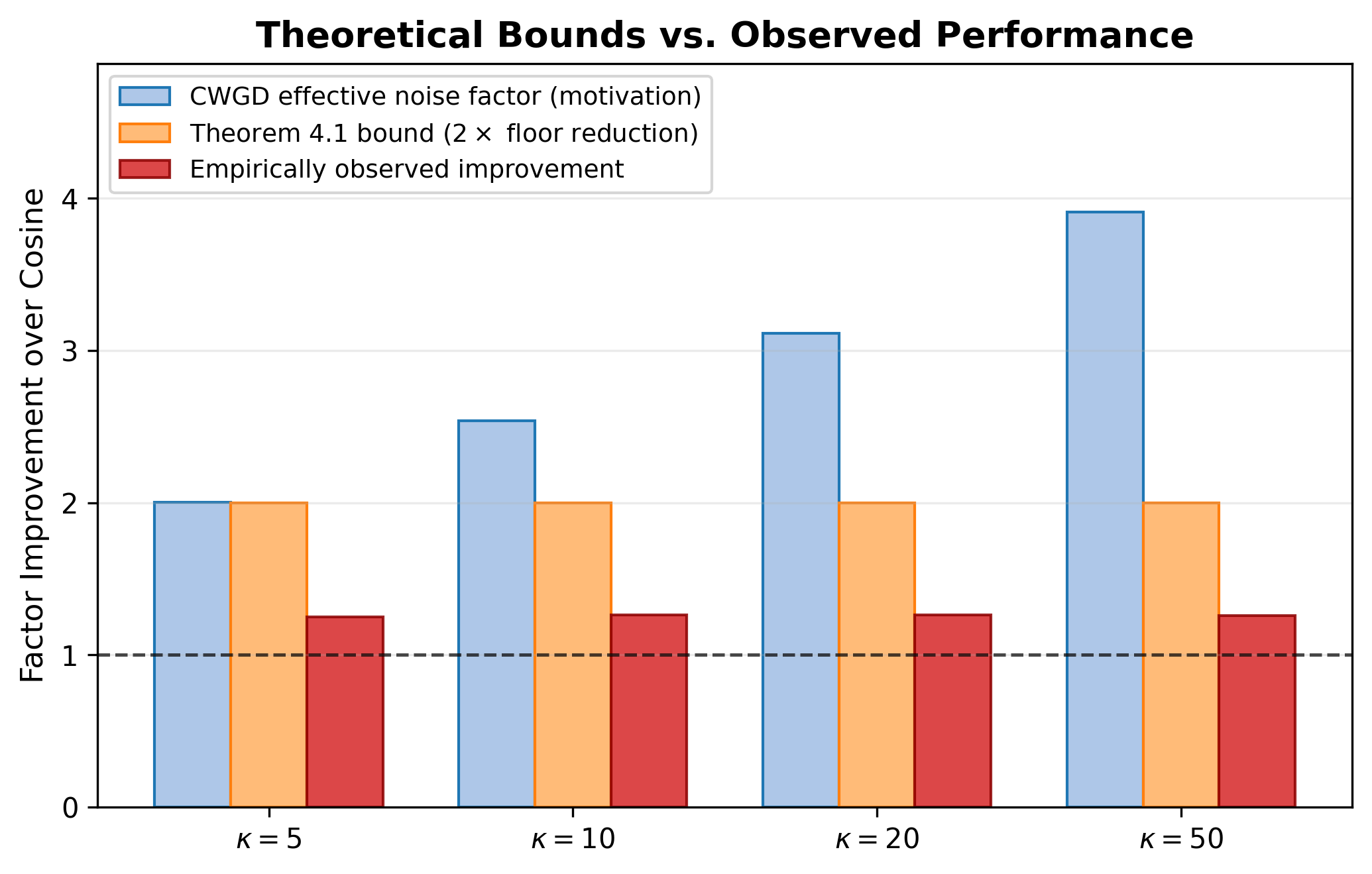
Figure 3: Theoretical improvement factor vs. empirical improvement across condition numbers; CWGD-Cosine tracks the predicted f6 reduction at f7.
In compute-normalized comparisons—where the wall-clock cost of Hessian estimation is exactly matched by additional gradient steps in the plain cosine baseline—the superiority of CWGD-Cosine persists, confirming that gains are not attributable to increased computation.
Stress testing highlights that the benefit is specific to settings where the optimizer is near the noise floor; in very ill-conditioned or nonconvex configurations, or in the presence of significant Hessian staleness, the merits of the approach are diminished.
Limitations
The main theoretical and empirical scope is restricted to strongly-convex diagonal quadratics under isotropic or moderately aligned noise. In nonconvex problems, the Hessian's rapid evolution degrades CWGD's efficacy due to the staleness of curvature estimates. Furthermore, the theory-practice gap between residual floor reduction and observed improvements is explained by transient dynamics not captured in steady-state analyses.
Key challenges for generalization involve efficient, low-bias online curvature estimation and tracking, especially for off-diagonal and dynamically shifting Hessian structures. The estimator's statistical properties in high dimensionality (f8) and large-scale neural network settings remain uncharacterized.
Implications and Future Directions
The results establish CWGD as a principled, geometry-aware noise measure capable of informing adaptive SGD schedules with provable and reproducible advantage within its regime of validity. Practically, CWGD could serve as a late-phase fine-tuning scheduler or as a diagnostic for sudden landscape shifts during optimization.
Extending CWGD's utility to nonconvex or large-scale models mandates the development of online, robust curvature proxies free of staleness and estimator degeneracy. Integrating CWGD-like mechanisms with scalable second-order or adaptive optimizers (e.g., in Adam- or Shampoo-style frameworks) presents a natural direction. Additional theoretical work is required to close the trajectory-level gap between attainable and realized noise reduction factors.
Conclusion
CWGD, together with its application in CWGD-Cosine scheduling, advances the analytical and practical understanding of how geometry and noise interact in stochastic first-order optimization. By moving beyond naive variance averaging and explicitly embedding curvature information into noise measurement and learning rate adaptation, this work sets the stage for more nuanced, data-efficient, and robust optimization strategies in convex machine learning problems. Addressing Hessian staleness and estimator generalization will be critical steps toward broader adoption and impact in deep learning contexts.