The Surprising Effectiveness of Video Diffusion Models for Hand Motion Reconstruction
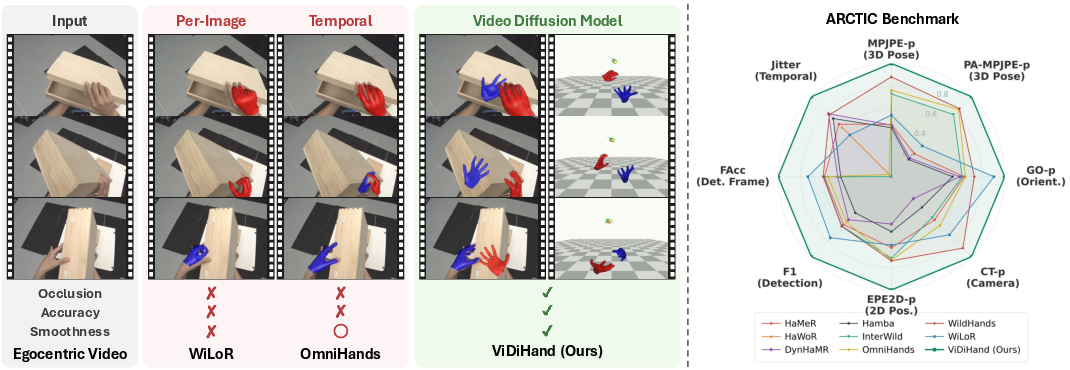
Abstract: 4D hand motion reconstruction from egocentric video is bottlenecked by clear limitations of existing methods: image-based pipelines depend on a detector that fails under heavy occlusion, while video-based methods rely on temporal modules learned only from scarce hand-pose annotations, a narrow signal insufficient to model motion dynamics, occlusion reasoning, and hand-object interaction. These capabilities, however, are exactly what video generative models must implicitly acquire when trained to synthesize coherent video at internet scale. Motivated by this, we present ViDiHand, which leverages the representations of a pretrained video diffusion model to reconstruct 4D two-hand pose. We adapt it via a hand-overlay rendering objective that specializes its features for hands while preserving its world priors. A decoder then recovers metric-scale pose from the adapted features. The whole pipeline operates directly on full frames--no detector, no infiller, and no test-time optimization. On ARCTIC, HOT3D, and HOI4D, ViDiHand substantially outperforms prior methods, establishing video diffusion models as a powerful new foundation for hand motion reconstruction and a promising route to scalable in-the-wild data collection for embodied AI. Project page: https://vidihand.github.io.

Paper Prompts
Sign up for free to create and run prompts on this paper using GPT-5.
Top Community Prompts
Explain it Like I'm 14
Overview
This paper introduces ViDiHand, a new AI system that can track both hands in 3D over time (that’s “4D”: 3D shape + time) from first‑person videos, like ones recorded with a head‑mounted camera. The big idea is to reuse the “world knowledge” inside a powerful video‑making model (a video diffusion model) to understand hand motion, even when the hands are blocked by objects (occluded) or move quickly.
What questions did the paper ask?
The authors set out to answer a few simple questions:
- Can a video‑generation model’s inner “understanding” of motion and scenes help recover hand motion better than traditional methods?
- How can we teach that model to pay special attention to hands without forgetting what it knows about the rest of the world?
- Can we turn the model’s features into accurate, smooth, real‑size 3D hand motion for both hands directly from full video frames, without relying on hand detectors or extra clean‑up steps?
- How do we measure success fairly, including when a method misses hands in hard frames?
How did they do it? (Methods explained simply)
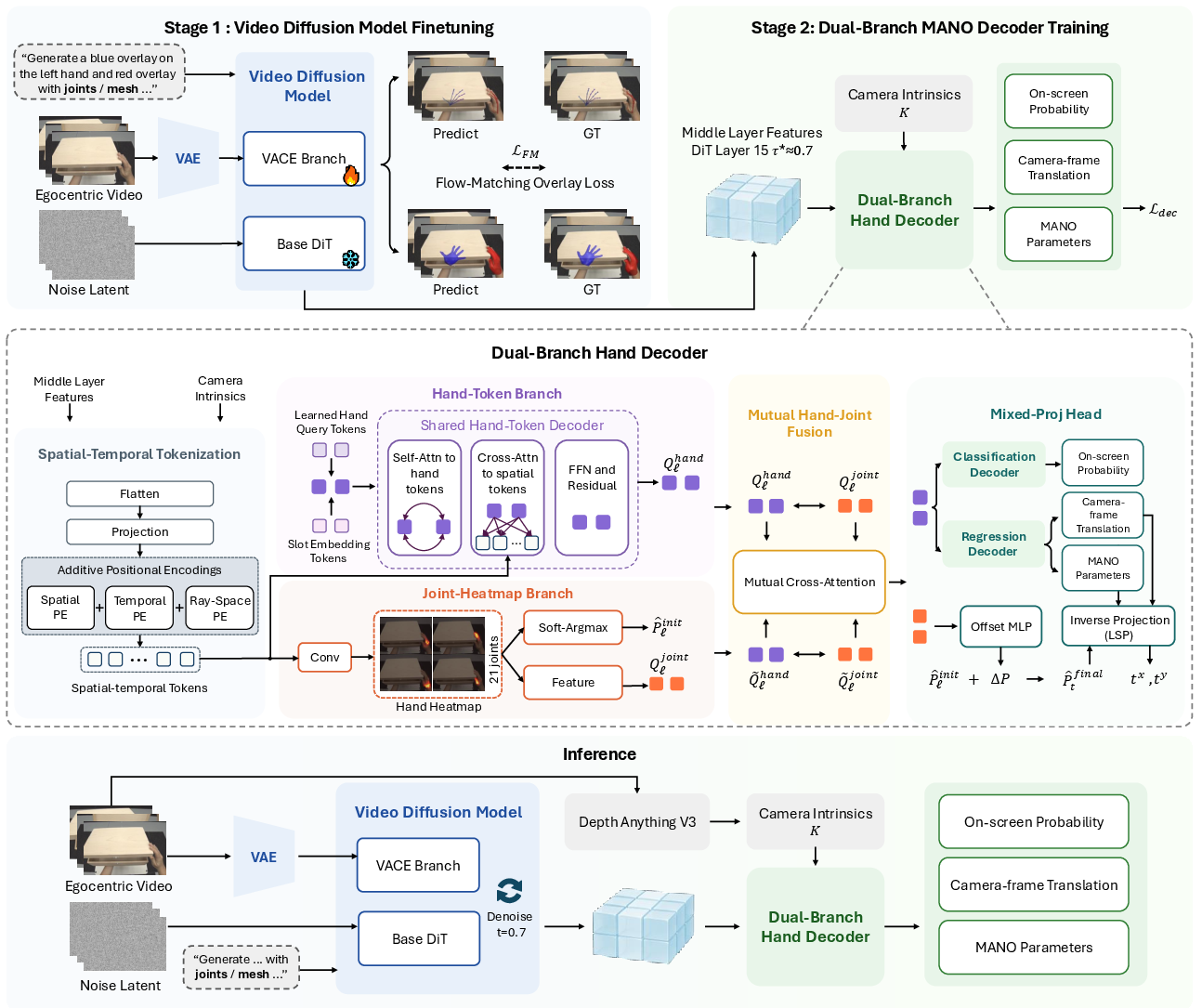
Imagine a very skilled video creator AI that has watched a huge amount of internet video. To make believable videos, it must “know” how objects move, how things look from frame to frame, and how to fill in parts you can’t see. That’s a video diffusion model. ViDiHand borrows that know‑how and points it toward hand tracking.
Here’s the approach in plain terms:
- Teach the video model to “paint” hands on videos
- The team fine‑tunes a part of a pretrained video diffusion model so it can overlay semi‑transparent hand drawings onto the original video frames, including frames where the hands are hidden behind objects or partly off‑screen.
- First, it paints simple stick‑figure joints; later, it paints full 3D hand meshes. This two‑step “overlay” training makes the model focus on hands while keeping its broad world knowledge about scenes, motion, and objects.
- Read the model’s features at the right moment
- Inside the video model, different layers and steps carry different kinds of information. The authors found that features from the middle layers and at an intermediate point in the model’s process held the best clues for hand pose and motion.
- Decode hand motion with two cooperating “specialists”
- Specialist A (whole‑hand branch): figures out the full 3D shape and angles of the hand and fingers using a standard digital hand model researchers use, called MANO.
- Specialist B (joint‑location branch): finds where each joint (wrist, knuckles, fingertips) most likely sits in the image, using “heatmaps” (think: a glow showing the most likely spot).
- The two specialists share information so the shape matches the locations and vice versa.
- Solve the camera position smartly
- To place the 3D hand at the right real‑world size and spot, the system:
- Predicts how far the hand is from the camera (depth).
- Then computes the sideways and up/down shift on the image by aligning the projected 3D joints with the 2D joint spots from the heatmaps. Think of it like sliding a transparent 3D hand overlay so the points line up with the bright spots.
- This geometric step avoids a common confusion between hand rotation and camera shift and makes the result stable and accurate.
- Train with clear goals and fair evaluation
- The training encourages correct finger angles, correct 3D placement, correct 2D joint positions, smooth motion, and proper “is this hand on screen?” signals.
- For fair testing, they use a “penalty” rule: if a method misses a hand in a frame, it doesn’t just skip that frame—it gets a penalty. This rewards methods that find hands consistently, not just in easy frames.
What did they find, and why does it matter?
Across three tough datasets—ARCTIC (lots of occlusion), HOT3D (fisheye lens, blur, tricky lighting), and HOI4D (held‑out, cross‑dataset test)—ViDiHand beat all previous methods by a wide margin.
Key takeaways:
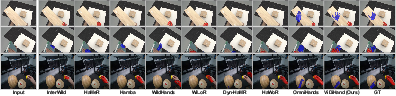
- Near‑perfect hand detection: ViDiHand almost never misses on‑screen hands, even when they’re partly or fully hidden.
- Much better accuracy: It reduced 3D and 2D errors significantly compared to strong baselines.
- Much smoother motion: Its hand trajectories are 3–4 times smoother without any special test‑time smoothing tricks. This smoothness comes from the video model’s natural sense of motion.
- Strong generalization: It worked well even on datasets it wasn’t trained on, suggesting the video model’s broad world knowledge transfers.
Why it matters:
- Reliable hand motion from first‑person video is crucial for training robots by watching humans (imitation learning). If the hands are tracked accurately and consistently, the robot learns better.
- The results suggest we can move beyond hand‑only or image‑only tricks and instead tap into the powerful priors inside large video generators to solve hard perception problems.
What could this change in the future?
This work points to a new way of doing hand (and possibly body and object) tracking: start from a powerful video‑generation model and read out the information it already knows about the world. That could:
- Make it easier to collect massive, good‑quality hand motion data “in the wild” for embodied AI (robots that learn from real videos).
- Reduce reliance on fragile hand detectors and complicated post‑processing.
- Extend naturally to tracking hands interacting with objects and full‑body motion.
Current limitations and next steps:
- Speed: It runs around 5.5 frames per second on big GPUs, so it’s great for offline annotation but not yet real‑time. The authors plan to speed it up with model distillation and faster generators.
- Data needs: One adaptation step still uses videos with known 3D hand meshes (MANO). They aim to relax this with self‑supervised training and to expand to object and whole‑body tracking.
In short, ViDiHand shows that the “imagination” of video‑making AI can be turned into strong, practical understanding of hand motion—opening a path to more robust, scalable tools for robotics and beyond.
Knowledge Gaps
Knowledge gaps, limitations, and open questions
Below is a consolidated list of concrete gaps and open questions that remain unresolved and could guide future research.
- Inference efficiency and deployment: The method runs at ~5.5 fps on 4×A100 GPUs, limiting real-time use. How to distill the video-diffusion backbone and decoder into a compact, few-step, single-GPU (or edge) model without degrading accuracy or temporal stability?
- Dependence on MANO-labeled video: Stage 1b requires video with MANO supervision. Can self-supervised or weakly supervised pretexts replace MANO labels at scale while retaining metric accuracy and articulation fidelity?
- Unknown or inaccurate camera intrinsics: The decoder relies on per-clip intrinsics (ray-space PE). How robust is performance when intrinsics are unknown, noisy, or change over time? Can self-calibration or intrinsics-agnostic formulations be developed?
- Metric-scale validity in the wild: Absolute scale is obtained via regressed depth and known intrinsics. How well does metric accuracy hold on truly “in-the-wild” videos without reliable calibration or when focal length changes (e.g., zoom, electronic stabilization)?
- World-frame trajectories: Outputs are in the camera frame; no SLAM or global camera pose estimation is used. How to couple the approach with egocentric SLAM to recover stable world-frame 4D hand trajectories suitable for robot learning and scene-level reasoning?
- Long-horizon consistency: Training and evaluation use 81-frame clips; long-term tracking and identity consistency (minutes-scale) are untested. How does the method handle long-term occlusions, hand exits/re-entries, and identity re-association?
- Multi-person and multi-hand scenarios beyond two hands: The model uses two fixed hand-slot queries and assumes a single actor. How to generalize to multiple people and more than two hands with stable identities and no false merges/splits?
- Object reconstruction and interaction reasoning: The system does not estimate object pose/shape or hand–object contact constraints. Can the diffusion features be extended to jointly reconstruct hands and manipulated objects with physically plausible contacts?
- Handling extreme occlusion and off-screen intervals: Although overlay training includes occluded frames, robustness to prolonged full occlusions and fully off-screen intervals is not quantified. Can explicit memory or persistence modules improve reappearance consistency?
- Domain shift and fairness: Robustness across skin tones, gloves, jewelry, long nails, and unusual appearances is not analyzed. Are there demographic or appearance biases inherited from the generative backbone or training data?
- Uncertainty estimation: The model outputs an on-screen probability but no calibrated per-joint or per-parameter uncertainties. Can uncertainty-aware decoding improve downstream filtering, tracking, and policy learning?
- Sensitivity to intrinsics and lens distortion: HOT3D includes fisheye, but a broader analysis of performance under different lenses, rolling-shutter effects, stabilization artifacts, and heavy distortion is missing.
- Generalization beyond egocentric views: The method focuses on egocentric video. How well do the learned priors transfer to third-person views, multi-view rigs, or moving external cameras?
- Feature usage from diffusion models: Only a single layer (L*=15) and denoising step (τ*≈0.7) are used. Would multi-layer, multi-timestep feature fusion or learned feature selection yield further gains and robustness?
- End-to-end adaptation: The decoder is trained on frozen diffusion features (after VACE adaptation). Could joint end-to-end finetuning of the backbone and decoder (with safeguards against prior collapse) improve accuracy or efficiency?
- Choice and portability of the backbone: Results are tied to Wan2.1-VACE. How portable are the gains to other video diffusion models (e.g., Sora-like, Pika, CogVideoX, Lumiere)? What are the tradeoffs across backbones in accuracy vs. compute?
- Alternative adaptation objectives: Only joint/mesh overlay pretexts are explored. Would other pretexts (e.g., flow, depth, occlusion segmentation, contact maps, masked modeling, video inpainting on hands) better specialize features for hand articulation and occlusion reasoning?
- Failure under transparent/reflective objects and heavy motion blur: Qualitative results show strong robustness, but systematic evaluation on transparent/reflective objects, specular scenes, very low light, and extreme blur is missing.
- Robustness to sparse visible joints: The in-plane translation solve relies on 2D anchor supervision. How stable is the solve when very few joints are visible or when joint detections are unreliable?
- Handedness and mirror ambiguities: Slot identity is fixed by queries without an explicit handedness classifier. How robust is handedness assignment during hand crossing, mirrored scenes, or camera flips?
- Full-body interaction: The pipeline focuses on hands; extension to arm/body pose and their coupling to hand pose is mentioned but not developed. How to jointly reconstruct full-body kinematics with consistent hand articulation?
- Downstream impact on embodied learning: The paper motivates benefits for policy learning but does not quantify improvements in imitation or RL when using ViDiHand reconstructions vs. baselines. What is the measurable gain in downstream tasks?
- Evaluation protocol standardization: The penalty protocol favors methods that maintain detections in hard frames. Community standardization and comparisons to alternative protocols (and their effects on method ranking) remain open.
- Data scaling laws: The amount and diversity of egocentric data required to reach certain accuracy/robustness targets are not studied. What are the scaling behaviors with respect to annotated vs. unannotated data for both adaptation and decoding?
- Real-time AR/VR applications: Latency and throughput are insufficient for interactive AR/VR. What architectural changes (e.g., streaming attention, token pruning, causal inference) enable interactive rates without losing accuracy?
- Reproducibility and release constraints: Dependence on large, possibly proprietary generative backbones (Wan2.1-VACE) may limit reproducibility. Are there open, lightweight alternatives that can be trained and released with comparable performance?
- Physical plausibility and self-penetration: No contact or physics constraints are enforced; interpenetrations and physically implausible poses are not analyzed. Can differentiable contact/penetration penalties or learned physics priors be integrated without optimization at test time?
Practical Applications
Immediate Applications
The following applications can be deployed now by leveraging ViDiHand’s occlusion-robust, detector-free 4D two-hand reconstruction from egocentric video. Most are best suited to offline workflows given the current throughput (≈5.5 fps on 4×A100 GPUs).
- Robotics (Industry/Academia): Offline dataset generation for imitation/policy learning from egocentric video
- Use case: Ingest head-mounted or chest-mounted worker/operator videos; reconstruct two-hand MANO poses and camera translations to supervise behavior cloning or RL for dexterous manipulation.
- Tools/workflows: “Egocentric-to-policy” pipeline (video ingestion → ViDiHand annotation → policy training via BC/RL), ROS bag converters, data governance/QA dashboards.
- Assumptions/dependencies: High compute; licensing/access to Wan2.1-VACE or equivalent video diffusion backbone; known/estimated camera intrinsics; calibration from human MANO space to target robot kinematics; privacy and consent for workplace video.
- Software/AI (Industry): Hand motion reconstruction SDK/API for content pipelines
- Use case: Provide developers with a service that outputs metric-scale MANO trajectories and per-frame camera shifts from raw egocentric clips, robust under occlusion and motion blur.
- Tools/products: Python/C++ SDK, containerized microservice, cloud batch annotation with job queues, export to
FBX/GLTF/JSON. - Assumptions/dependencies: GPU availability; model weights/usage rights; egocentric viewpoint; MANO coverage of hand shapes.
- AR/VR/Media (Industry): Animation retargeting and mocap clean-up from consumer videos
- Use case: Retarget reconstructed two-hand motion to avatars; reduce manual keyframing where hands are frequently occluded (e.g., cooking, crafting, unboxing).
- Tools/workflows: Blender/Unreal plug-ins mapping MANO joints to avatar rigs; offline batch processing; quality checks using EPE/jitter statistics.
- Assumptions/dependencies: Offline processing; camera intrinsics and lens distortion handling (e.g., fisheye in HOT3D); rig-compatibility; IP rights on footage.
- Manufacturing/Ergonomics (Industry/Policy): Task analysis and risk assessment from bodycam footage
- Use case: Quantify reach distances, joint ranges, motion smoothness (jitter), and contact patterns to flag risky hand postures during assembly or lab work.
- Tools/workflows: Analytics dashboards computing jerk/smoothness, dwell times, grip openness; compliance reports; before/after comparisons for tool redesign.
- Assumptions/dependencies: Worker consent and privacy safeguards; stable camera mounts; domain adaptation to specific environments; non-real-time insights.
- Education/Training (Industry/Academia): Skill assessment in trades and labs using egocentric recordings
- Use case: Provide feedback on hand technique (e.g., soldering, pipetting, surgical knot tying) by comparing reconstructed trajectories to expert exemplars.
- Tools/workflows: LMS integration; exemplar libraries; similarity scoring; rubrics based on MPJPE/EPE and pose archetypes.
- Assumptions/dependencies: Ground-truth exemplars and task rubrics; consistent camera placement; offline evaluation; careful interpretation to avoid overreliance on a single metric.
- Human-Computer Interaction (Academia/Industry): Occlusion-robust gesture dataset creation
- Use case: Build large, realistic datasets of egocentric hand-object interaction under occlusion to train gesture recognizers and HCI systems.
- Tools/workflows: Batch annotation of long-form UGC; automated segmenting of interaction episodes; release of anonymized motion-only datasets.
- Assumptions/dependencies: Data licensing; de-identification pipelines; MANO modeling of fine finger poses may need additional refinement for specific gestures.
- Healthcare (Industry/Academia): Preliminary remote rehab and motor function tracking from home videos
- Use case: Track range of motion and smoothness for post-stroke/orthopedic patients performing prescribed hand exercises captured by a phone or head-mounted camera.
- Tools/workflows: Clinician portal; cloud inference; session-based progress graphs (ROM/jitter); adherence alerts.
- Assumptions/dependencies: Not medical-grade without validation; IRB/compliance (HIPAA/GDPR); camera guidance for patients; systematic clinical calibration studies.
- Video Analytics and Post-production (Industry/Daily life): Hand-centric scene understanding and edits
- Use case: Detect frames with missed or hallucinated hands; splice in corrective overlays or track inserts; automate continuity checks in editing.
- Tools/workflows: NLE plug-in that surfaces detection FAcc/F1, highlights occlusion segments; batch “hand continuity” reports.
- Assumptions/dependencies: Offline pipeline; editor integration; alignment between MANO space and desired visual edits.
- Policy/Compliance (Policy/Industry): Offline audit of manual task protocols
- Use case: Verify adherence to SOPs (e.g., lab biosafety, food handling) via reconstructed hand trajectories and presence/absence detection under occlusion.
- Tools/workflows: Compliance analytics; secure review portals; incident triage with evidentiary motion traces.
- Assumptions/dependencies: Legal authority and consent; robust handling of false positives/negatives; clear governance to prevent misuse and protect workers’ privacy.
Long-Term Applications
The following applications require further research, scaling, or development, including distillation for real-time use, object/contact reconstruction, expanded self-supervision, and clinical/industrial validation.
- XR (Industry): Real-time, on-device occlusion-robust hand tracking for AR glasses and mobile
- Use case: Replace brittle detector-based pipelines in AR with a distilled ViDiHand variant that maintains identity through occlusions and complex hand-object motion.
- Tools/products: Few-step generator or feedforward distillations; NPU-optimized runtime; privacy-preserving on-device inference.
- Assumptions/dependencies: Hardware co-design; power/thermal constraints; latency targets; robust handling of diverse intrinsics and lenses.
- Robotics (Industry/Academia): Closed-loop robot assistance and teleoperation from egocentric video
- Use case: Live mapping of operator hand poses to robot grippers with occlusion resilience; policy adaptation using continuous egocentric supervision in the field.
- Tools/workflows: Real-time kinematic calibration; contact/force inference; integration with vision-language-action models for task understanding.
- Assumptions/dependencies: Low-latency inference; accurate object/contact modeling; safety certification; standardized hand-to-robot mappings.
- Hand–Object Reconstruction and Digital Twins (Industry/Academia): Joint 4D hands and manipulated objects with contact reasoning
- Use case: Build high-fidelity digital twins of assembly tasks, capturing object pose and hand contacts for simulation, training, and QA.
- Tools/workflows: Extended decoders for object meshes/poses; physics engines; contact estimation; CAD alignment.
- Assumptions/dependencies: Additional pretexts for object reconstruction; domain-specific datasets; sim2real validation.
- Healthcare (Industry/Policy): FDA-cleared motor assessment and rehabilitation monitoring
- Use case: Clinical-grade quantification of tremor amplitude, dyskinesia, or post-surgical recovery using egocentric video and validated motion metrics.
- Tools/workflows: Prospective trials; protocolized capture; clinician dashboards; integration with EHRs.
- Assumptions/dependencies: Regulatory approval; bias/generalization audits across demographics; standardized camera setups; medical liability frameworks.
- Education/Accessibility (Industry/Academia): Sign-language recognition, synthesis, and tutoring
- Use case: Use accurate 3D hand articulation to improve recognition and generation of complex signs, enabling personalized feedback and content creation.
- Tools/workflows: Multimodal datasets with linguistic annotations; avatar synthesis; interactive tutors.
- Assumptions/dependencies: Fine-grained finger articulation accuracy; language-specific datasets; cultural/linguistic validation.
- Generative Media (Industry): Interactive hand editing in video using diffusion-aware features
- Use case: “Fix my hand” editors to adjust finger posture or continuity in footage, leveraging VACE conditioning and hand-aware features.
- Tools/workflows: Professional NLE integration; keyframe constraints; safety checks to prevent misleading edits.
- Assumptions/dependencies: Advances in controllable video diffusion; ethical disclosure of edits.
- Privacy-Preserving Analytics (Policy/Industry): Federated/on-device egocentric motion analysis at scale
- Use case: Workplace or consumer analytics that never leave the device; aggregate motion statistics without transmitting raw frames.
- Tools/workflows: Federated learning; secure enclaves; differential privacy.
- Assumptions/dependencies: Efficient on-device models; policy and legal frameworks; user trust and transparency.
- Insurance/Finance (Industry/Policy): Ergonomic risk scoring and premium calibration
- Use case: Quantify manual handling risk profiles to inform underwriting and incentives for safety improvements.
- Tools/workflows: Standardized motion risk indices; audit trails; intervention assessments.
- Assumptions/dependencies: Ethical use constraints; anti-discrimination safeguards; stakeholder buy-in; robust domain generalization.
- Multi-person, Multi-agent Interaction (Academia/Industry): Beyond two hands, social and collaborative manipulation
- Use case: Extend to multi-person scenes and tool-mediated interactions to study collaboration, handovers, and crowd behaviors.
- Tools/workflows: Identity tracking across agents; role inference; task segmentation.
- Assumptions/dependencies: Scalable identities under heavy occlusion; more diverse pretraining; improved temporal identity persistence.
- Standards and Benchmarks (Policy/Academia): Governance for egocentric analytics and datasets
- Use case: Establish best-practice standards (capture protocols, consent, de-identification), robust cross-dataset benchmarks, and error-reporting norms.
- Tools/workflows: Community benchmarks with penalty-aware metrics; documentation templates; governance boards.
- Assumptions/dependencies: Multi-stakeholder coordination; funding; ongoing audits to mitigate bias and privacy risks.
Glossary
- BCE (Binary Cross-Entropy): A loss function for probabilistic classification that penalizes deviation between predicted probabilities and binary labels. "𝓛_vis is a BCE on the on-screen probability over all slots (including empty ones), suppressing hallucinated hands."
- Camera intrinsics: Parameters of a camera (e.g., focal lengths, principal point) that describe how 3D points are projected onto the image plane. "derived from the per-clip intrinsics ."
- Closed-form solve: An analytical solution that can be computed directly without iterative optimization. "a mixed-projection head splits camera translation into a regressed depth and a closed-form in-plane shift"
- Cross-frame attention: An attention mechanism that links features across video frames to enforce temporal consistency. "adds cross-frame attention on top of an image-pretrained backbone,"
- Denoising step: A timestep within diffusion inference/training that controls how much noise remains in the latent during the denoising process. "we find intermediate denoising step most suitable for this task."
- DiT (Diffusion Transformer): A transformer architecture used as the backbone in diffusion models. "the base DiT is frozen,"
- Egocentric video: First-person-view video captured from a head- or body-mounted camera. "Reconstructing 4D hand motion from egocentric video is a persistent challenge,"
- EPE-p (End-Point Error, penalty): A 2D metric measuring pixel-distance error of projected joints under the paper’s penalty protocol. "2D end-point error EPE-p in px"
- FAcc (Frame Accuracy): Detection metric: fraction of frames where all on-screen ground-truth hands are correctly matched with no hallucinations. "Detection: recall, F1, and frame accuracy FAcc, where FAcc is the fraction of frames in which all on-screen ground-truth hands are correctly matched with no hallucinated hand."
- Flow-matching loss: A training objective that aligns model predictions with the probability flow of data, often used as an alternative to score matching in diffusion. "The objective is the standard flow-matching loss;"
- Geodesic loss on SO(3): A rotation loss that measures shortest-path distances on the rotation manifold SO(3). "geodesic losses on "
- GO-p (Global Orientation error, penalty): A geodesic angular error (in degrees) for the global hand orientation under the penalty protocol. "geodesic global-orientation error GO-p in degrees"
- Jitter (temporal): A measure of temporal instability (second-order differences) of predicted motion across frames. "prediction jitter in mm/frame."
- MANO (Model of the Articulated Hand): A parametric 3D hand model used to represent pose and shape. "Monocular hand reconstruction recovers the 3D pose and shape of the hand from RGB input, commonly parameterized through the MANO~\cite{mano_sa17} model."
- Mixed-projection head: A decoding component that regresses depth while solving in-plane translation analytically to recover camera translation. "a mixed-projection head splits camera translation into a regressed depth and a closed-form in-plane shift"
- MPJPE-p (Mean Per-Joint Position Error, penalty): Average 3D joint error (mm) after root alignment, evaluated with the paper’s penalty protocol. "3D pose: MPJPE-p and PA-MPJPE-p, both in mm."
- PA-MPJPE-p (Procrustes-Aligned MPJPE, penalty): MPJPE after Procrustes alignment (rigid + scale), under the penalty protocol. "3D pose: MPJPE-p and PA-MPJPE-p, both in mm."
- Pinhole projection: The camera model mapping 3D points to 2D pixels using focal length and principal point. "the pinhole projection is linear in and decouples per coordinate,"
- Procrustes alignment: A similarity transform (rotation, translation, uniform scale) aligning two point sets to minimize squared error. "PA-MPJPE-p is Procrustes-aligned MPJPE."
- Ray-space embedding: Positional encoding based on camera ray directions (from intrinsics) to enable cross-intrinsic generalization. "The ray-space embedding lets the same decoder operate across heterogeneous camera intrinsics without \mbox{per-dataset specialization}."
- Root-translation/root-pose ambiguity: The coupling between global translation and orientation that can cause ambiguities when regressed jointly. "avoiding the root-translation/root-pose ambiguity that arises when is regressed freely alongside MANO."
- SLAM (Simultaneous Localization and Mapping): Technique to estimate camera motion and scene structure from video. "SLAM-based camera estimation,"
- Temporal upsampling: Increasing the temporal resolution of features/tokens to match the frame rate of the output video. "After temporal upsampling of the latent-frame tokens to video frames , an MLP"
- VACE: A controllable video diffusion branch/path for tasks like inpainting and editing in Wan2.1. "VACE~\cite{vace} augments Wan2.1 with a unified conditioning path that supports inpainting, editing, and reference-based synthesis,"
- Video diffusion model: A generative model that synthesizes video via iterative denoising of noisy latents. "We present ViDiHand, the first method to leverage a pretrained Video Diffusion model for 4D two-Hand motion reconstruction from egocentric video."
- Weighted least squares: An optimization that fits parameters by minimizing a weighted sum of squared residuals. "is obtained as a per-coordinate weighted least-squares fit"
- World prior: Broad visual priors about geometry, motion, and occlusion learned from large-scale video, transferable to downstream tasks. "preserving its world priors."
Collections
Sign up for free to add this paper to one or more collections.