- The paper establishes a rigorous framework using Gibbs measures on Cayley trees to model energy-based learning as a data-induced equilibrium system.
- It reveals critical phase transitions at a threshold inverse temperature (β_c), resulting in multiple Gibbs states and symmetry-broken prediction regimes.
- Numerical experiments using synthetic datasets confirm the emergence of multi-modal prediction regimes, linking empirical loss geometry to robust probabilistic inference.
Data-Driven Energy-Based Learning via Gibbs Measures on Hierarchical Structures
Introduction and Framework
This paper introduces a rigorous statistical mechanical framework for machine learning, constructing energy-based models where empirical losses serve as interaction potentials within Gibbs measures on hierarchical graphs, specifically Cayley trees. Unlike empirical risk minimization, which yields a unique optimal parameter, this approach leverages the entire loss landscape to define a probabilistic distribution over parameter configurations—each corresponding to a "learning state" of the system. This construction not only imbues the learning problem with a probabilistic structure but also admits the possibility of multiple equilibrium states, directly paralleling the notion of phases in statistical physics.
Key mathematical objects include parameter configurations σ:V→[0,1] on the vertices V of a Cayley tree, spin variables φ:V→{−1,1}, and a data-induced interaction kernel ξtu=LN(t,u), where LN is the empirical loss function derived from the training data. The associated Gibbs measure on the joint configuration space captures the equilibrium behavior of the learning system.
Gibbs Measures and Integral Compatibility Equations
The construction centers on finite-volume Gibbs distributions augmented with boundary fields, whose hierarchical compatibility ensures the existence of an infinite-volume Gibbs measure on the tree. These compatibility conditions reduce to nonlinear integral fixed-point equations for translation-invariant (TI) solutions. For Cayley trees of order k (where each node has k+1 neighbors), these equations take the form:
f(t)=D∫01ηtuf(u)du+∫01ηtu−1g(u)du,g(t)=D∫01ηtu−1f(u)du+∫01ηtug(u)du
with the kernel ηtu=exp[βLN(t,u)] and normalization D.
The spectral theory of positive compact integral operators underpins the existence and uniqueness of strictly positive solutions for these equations in the case of strictly positive loss, via the Krein–Rutman theorem.
Analytical Results: Existence, Uniqueness, and Phase Transitions
One-Dimensional and Additive Loss Cases
For V0 (the line), with strictly positive, continuous loss functions, the primary analytical result is the uniqueness of the translation-invariant Gibbs measure; the corresponding boundary law is unique and symmetric (V1). This extends to cases of separable or additive losses, where explicit formulas for the symmetric solution can be derived.
Phase Transitions and Symmetry Breaking
For higher-order trees (V2), the compatibility equations can admit multiple non-equivalent solutions, leading to distinct TI Gibbs measures. For kernels generated by non-separable empirical losses (e.g., those with a strong cross-term V3 in a quadratic form), the authors demonstrate the emergence of phase transitions at critical inverse temperature V4:
- Below V5: Only a unique TI Gibbs measure exists (symmetry preserved).
- At/above V6: Multiple TI Gibbs states coexist, including symmetry-broken phases (distinct "prediction regimes").
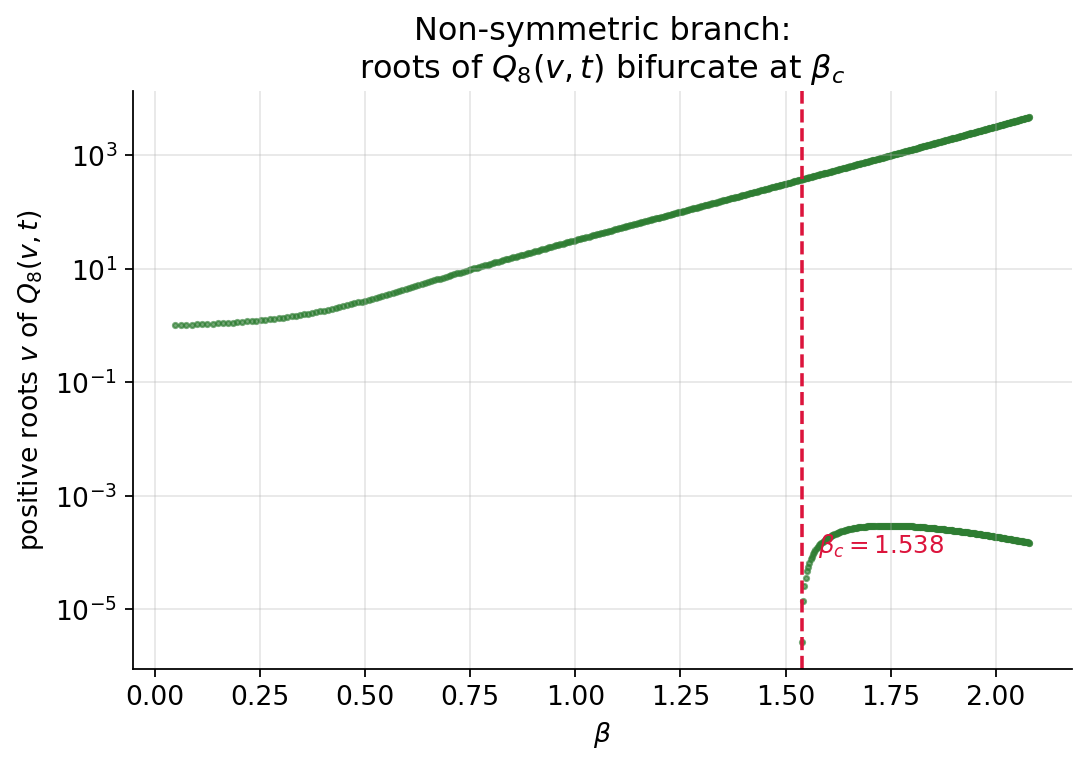
Figure 1: Positive roots V7 of the octic V8 versus V9. A second branch emerges at φ:V→{−1,1}0, reflecting the φ:V→{−1,1}1 jump in TI Gibbs states.
This critical behavior mirrors symmetry breaking and phase transitions familiar in physical spin systems and highlights the richness of energy-based learning dynamics driven by empirical data.
Probabilistic Inference and Prediction Rules
The constructed Gibbs measures are used to generate Bayesian-style predictors: for any unobserved vertex, the conditional expectation of the spin, given observed labels, yields a probabilistic rule. Notably, in regimes of non-unique Gibbs measures, prediction becomes model-dependent: the user may face multiple competing, data-induced prediction functions, reflecting the multi-modal character of the equilibrium landscape. This provides a principled framework for understanding ambiguity, uncertainty, and latent specialization in hierarchical inference.
Numerical Experiments with Non-Separable Empirical Kernels
Theoretical predictions are validated numerically using synthetic datasets. Samples from class-conditional Gaussians in φ:V→{−1,1}2 are projected onto a one-dimensional latent parameter φ:V→{−1,1}3, and a squared loss function is coupled with an affine predictor. The resulting empirical loss surface is non-separable due to a significant cross term φ:V→{−1,1}4.
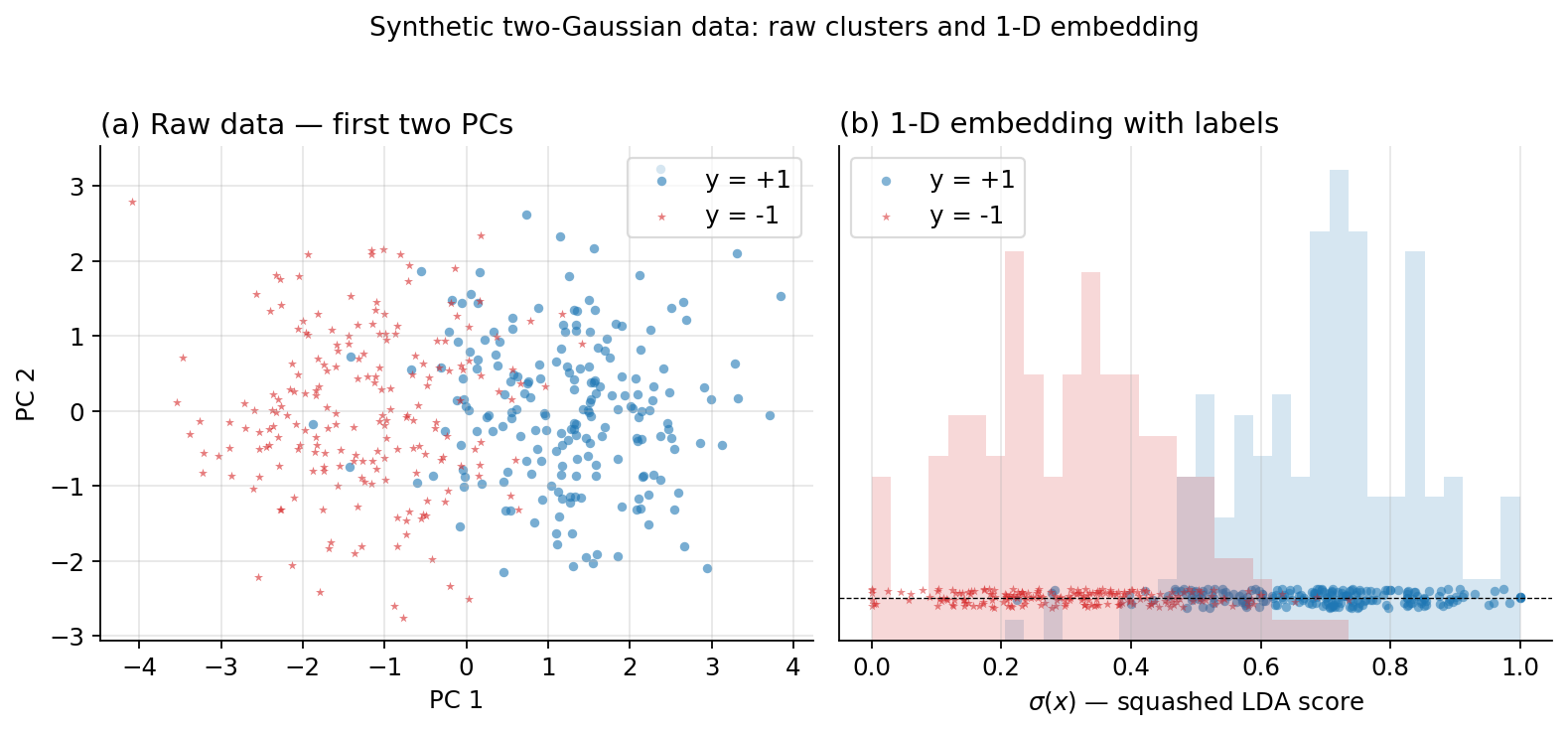
Figure 2: Synthetic two-Gaussian dataset, visualized by principal components and one-dimensional embedding φ:V→{−1,1}5. Class histograms illustrate label distributions in the latent space.
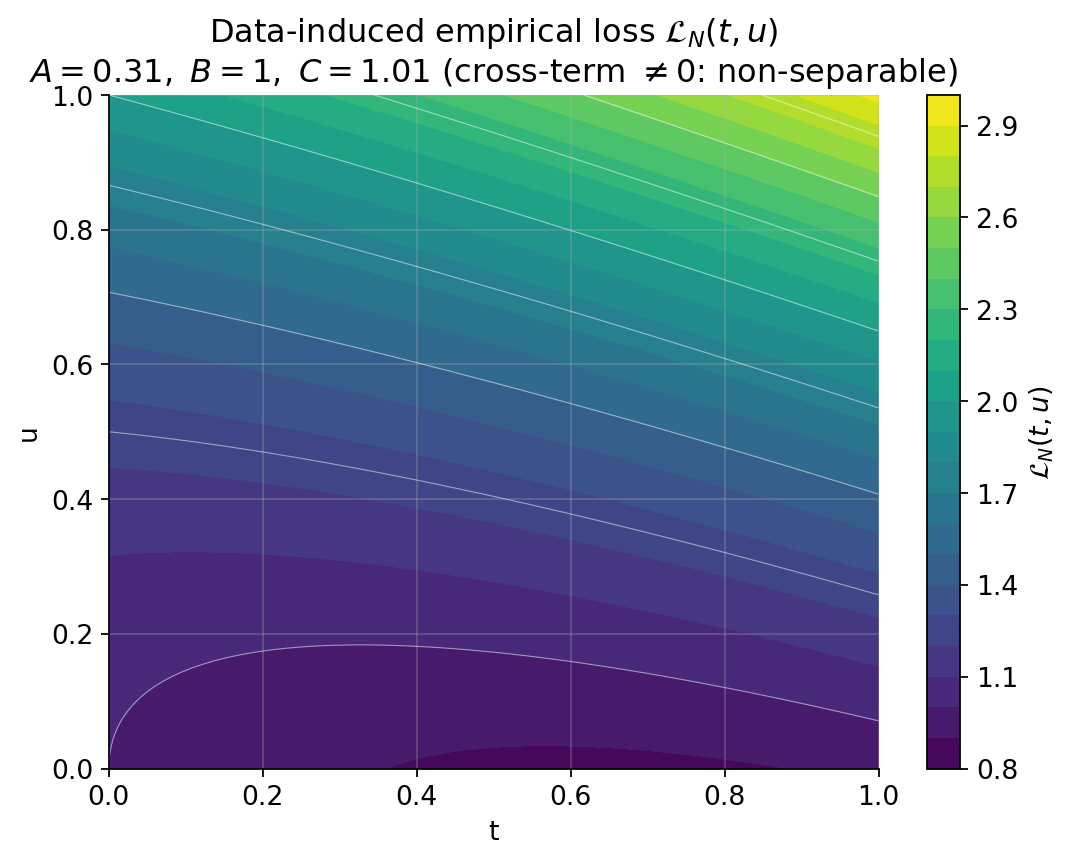
Figure 3: The empirical loss surface φ:V→{−1,1}6 is strictly positive, non-separable, and generates interacting kernels in the Gibbs measure construction.
A key observable is the number of grid-stable TI solutions as a function of φ:V→{−1,1}7. Numerical solutions using quadrature discretization and iterative algorithms recover the theoretically predicted transition from φ:V→{−1,1}8 to φ:V→{−1,1}9 equilibrium branches—i.e., the data-induced phase transition.
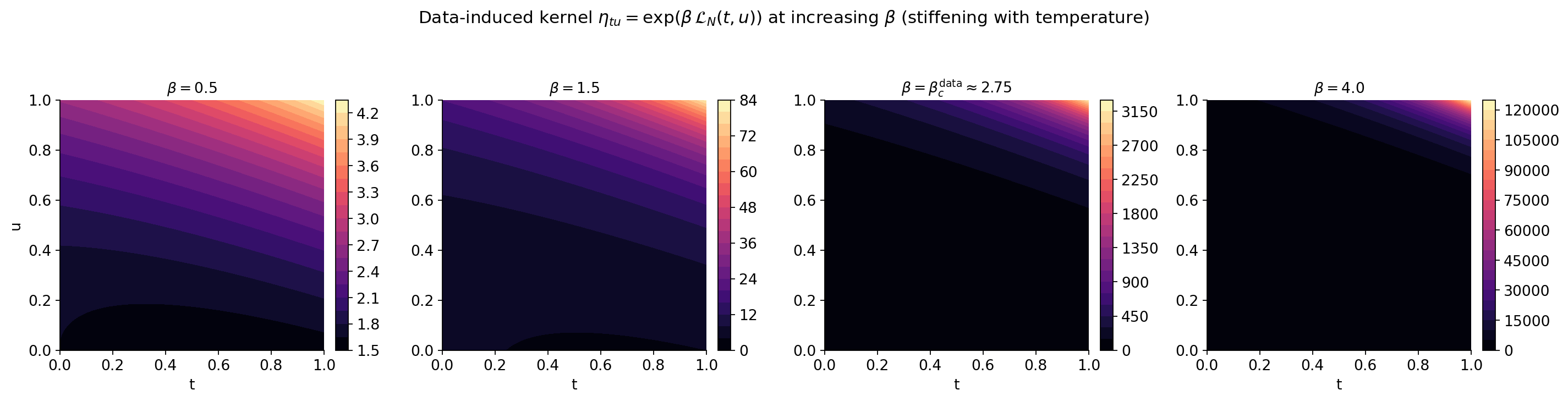
Figure 4: Data-induced kernel ξtu=LN(t,u)0 for increasing ξtu=LN(t,u)1: high-ξtu=LN(t,u)2 stiffening and sharp concentration, which increases the system's sensitivity to data structure.
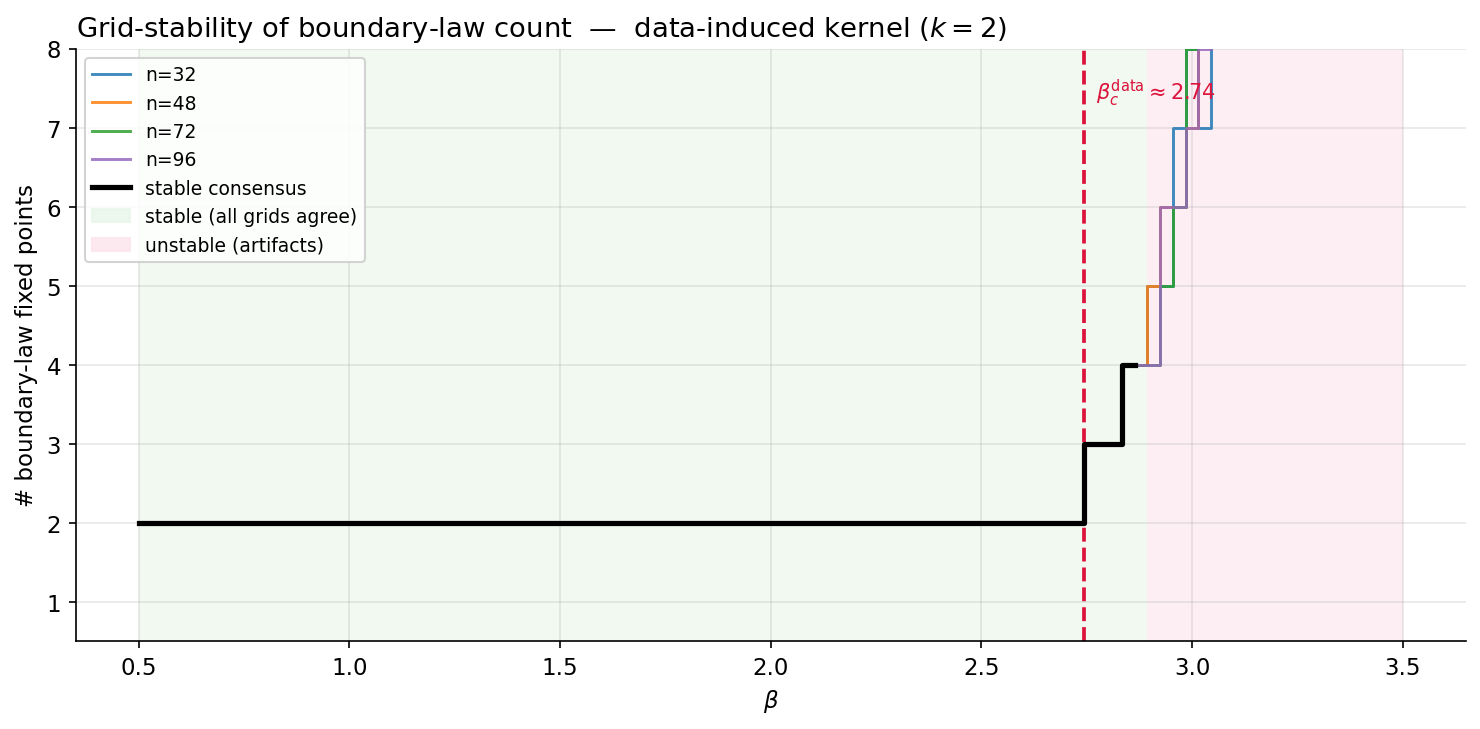
Figure 5: The number of stable TI boundary-law solutions as a function of ξtu=LN(t,u)3, evidencing the ξtu=LN(t,u)4 phase transition at critical ξtu=LN(t,u)5; for large ξtu=LN(t,u)6, additional non-physical solutions emerge due to discretization artifacts.
Implications
The theoretical and computational results provide a rigorous connection between empirical loss geometry and the probabilistic structure of complex energy-based learning systems. Practically, the approach generalizes beyond conventional empirical risk minimization—offering hierarchical inference, multi-modal equilibria, and model-induced uncertainty by construction, rather than ad hoc post-hoc Bayesianization.
Theoretically, the work advances the program of linking spectral and operator theory—especially the analysis of data-induced compact integral operators—to the phase structure and statistical inference of high-dimensional learning models.
Future Directions
Promising directions include extension to more general classes of graphs (e.g., random graphs, trees with variable degree), analysis of non-TI or boundary-induced states, connection to mean-field approximations, and exploration of stochastic training dynamics (e.g., simulated annealing or Langevin samplers) within the proposed energy-based framework. Further, these methods can inform the study of over-parameterization, double descent, and emergent multi-modal inference in deep learning by explicitly linking the geometry of the empirical loss to equilibrium statistical ensembles.
Conclusion
By reconstructing learning as inference in a data-induced equilibrium system on hierarchical structures, this work rigorously establishes the role of phase transitions, multi-modality, and probabilistic prediction rules in modern machine learning. Energy-based models grounded in statistical mechanics, when linked directly to empirical data, offer powerful new tools for analyzing the equilibrium behavior, uncertainty, and emergent phenomena of complex inference systems.