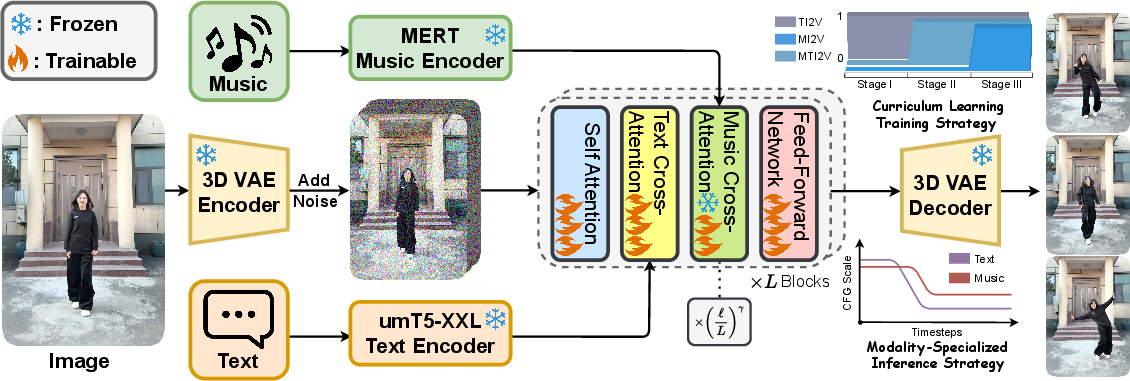
- The paper introduces a unified framework that integrates text and music conditioning to generate high-fidelity dance videos.
- It demonstrates strong performance across various modalities using a scalable dataset covering over 30 dance genres.
- The study employs curriculum learning and depth-aware specialization to enhance motion synchronization and visual fidelity.
OmniDance: Multimodal-Driven Dance Video Synthesis at Scale
Introduction
OmniDance introduces a unified framework for large-scale, multimodal dance video generation, addressing limitations in dataset availability and model design that have long constrained progress in the field. By co-integrating textual and musical conditioning within a single video diffusion model architecture, supported by a bespoke web-scale dance dataset (CIPE-Dance), OmniDance advances the state of the art in music- and text-driven video generation. The framework demonstrates robust performance under pure-text, pure-music, and combined text-music driving modalities, while maintaining strong controllability and visual fidelity.
CIPE-Dance: Data Acquisition & Annotation
The lack of comprehensive, high-quality datasets tailored to the complexity of dance video synthesis has been a persistent bottleneck. The CIPE-Dance dataset directly addresses this gap through a progressive expert-based curation pipeline, leveraging lightweight and heavyweight LLM-based filters for multi-stage video quality assessment, performer isolation, and scene stability assurance. The resulting 300k-clip corpus covers more than 30 dance genres and a vast array of environments and performer demographics.

Figure 1: Overview of the Progressive Expert-Based Data Collection Pipeline.
Annotations are automatically generated from five choreography-informed perspectives (Body Dynamics, Choreographic Content, Expressiveness, Camera Presentation, Overall Look) using multi-aspect LLMs, yielding fine-grained, semantically rich textual supervision.
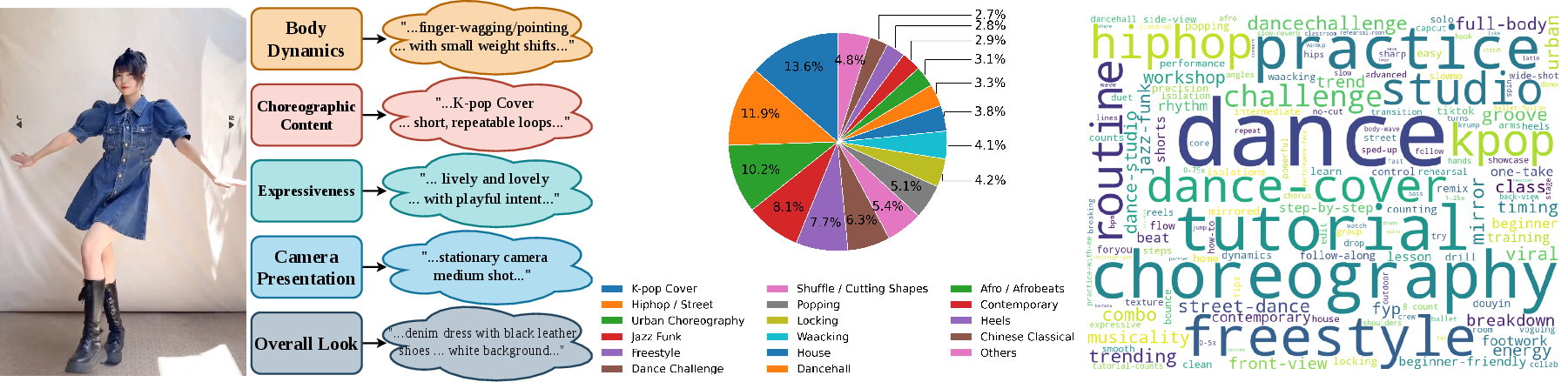
Figure 2: Dataset analysis: annotation display, genre coverage, and semantic caption statistics.
OmniDance Framework: Multimodal Integration
The core methodological contribution is a three-level co-design that injects music conditioning into a pre-trained text/image-to-video (TI2V) DiT backbone (WAN2.2-TI2V-5B), maintaining fidelity and segmentation control while unlocking music-driven choreography. OmniDance features:
Experimental Results
Extensive experiments on CIPE-Dance benchmark OmniDance against recent SOTA TI2V and MI2V baselines. OmniDance achieves the highest or near-highest scores across video quality (IQ, AQ, SC, BC, MS, TF), motion fidelity/diversity (FIDk/g, DIVk/g), and modality-alignment (BAS, OC) metrics. Notably, for MTI2V generation, the model demonstrates superior multimodal synergy, with state-of-the-art results on ID consistency, background stability, and rhythmic beat alignment, without degradation in modality-specific performance.
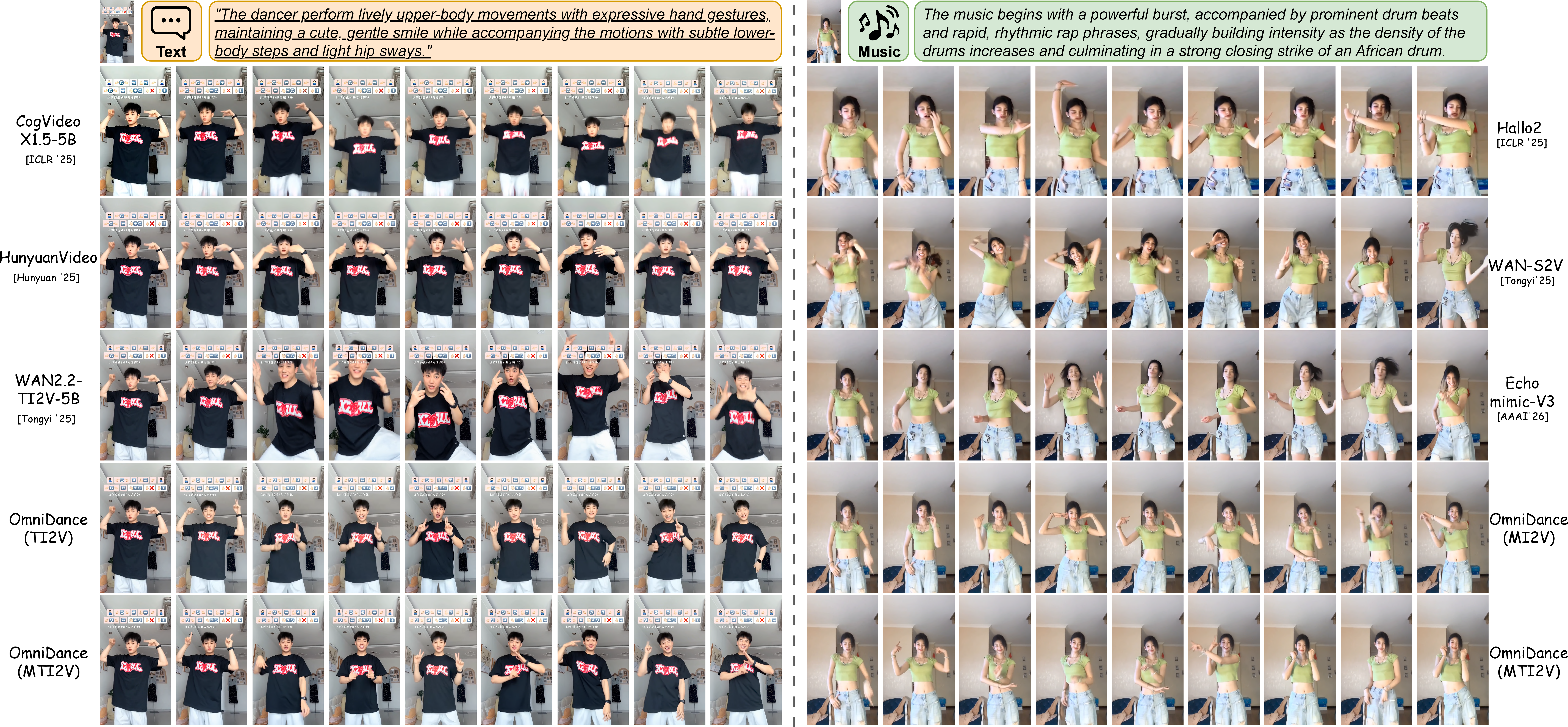
Figure 4: Comparison with SOTAs on Text-Image-to-Video (TI2V) and Music-Image-to-Video (MI2V) tasks on the CIPE-Dance dataset.
Qualitative Assessment
Generated videos via OmniDance display consistent subject identity, high-resolution visual detail, and expressive, music-synchronous choreography—capabilities that have eluded prior methods, which suffer from trade-offs between motion complexity and appearance fidelity. The music-text specialization mechanism is critical to these results; ablation shows rhythmicity and semantic alignment are severely compromised if this architectural strategy is removed or inverted.
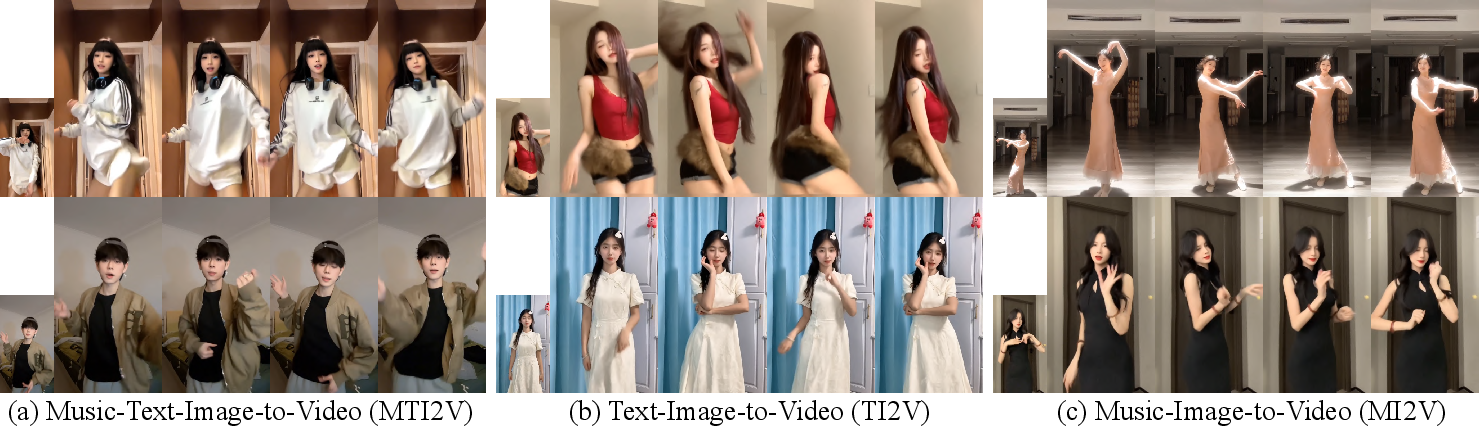
Figure 5: Example of OmniDance multimodal-driven dance video generation for various conditioning modalities.
Implications and Future Directions
OmniDance establishes a methodological blueprint for integrating temporally structured audio signals into high-capacity generative models, offering a unified solution that avoids modality-specific silos. Practically, it enables controllable dance synthesis driven by textual intent, musical features, or both, suitable for digital content creation, virtual avatar animation, and AI-art applications.
Theoretically, the findings underscore the benefits of frequency-aligned specialization in multi-branch architectures for temporal generation tasks and highlight the effectiveness of curriculum-based multimodal training. Moreover, the scalable, web-crawled data acquisition pipeline and LLM-based annotation unlock widespread accessibility to complex motion domains previously stymied by scarce supervision.
Looking forward, two primary research directions arise:
- Real-time Generation: Although current inference is not real-time, model distillation and efficient flow-matching designs (e.g., single-step generation) could bridge this gap, opening interaction-rich applications.
- Further Multimodality: Expansion to additional modalities (e.g., video–pose–music joint generation), finer-grained control, and co-creation with humans in the loop may be facilitated by the infrastructure established here.
Conclusion
OmniDance presents the first large-scale, multimodal dance video generation framework with web-scale data support and unified model design. By decoupling text and music control via depth-aware specialization, staged curriculum training, and modality-specific inference, it achieves state-of-the-art performance and robust controllability for TI2V, MI2V, and MTI2V tasks, setting a new standard for expressive, high-fidelity AI dance generation (2606.30019).