- The paper demonstrates that integrating local single-mode squeezing into pairwise fusion gates significantly increases the entangling measurement success rate of d-rail photonic qudits.
- The authors leverage structured failure outcomes by using squeezing to selectively recover diagonal-sector entangling projections in ancilla-free protocols.
- Numerical and analytic results reveal that optimal squeezing yields measurable performance gains while remaining practical under finite photon-number-resolving detection.
Squeezing-Enhanced Pairwise Fusion of Photonic Qudits
Overview and Motivation
The paper "Squeezing-enhanced Pairwise Fusion of Photonic Qudits" (2606.29432) addresses the challenge of improving the success probability of entangling measurements in high-dimensional, single-photon quantum information protocols implemented via linear optics. In particular, the study focuses on pairwise fusion gates (PFGs) for d-rail photonic qudits, exploring the use of local single-mode squeezing to actively recover part of the structured "failure" sector previously left unexploited by passive, ancilla-free architectures.
Linear-optical implementations typically lack deterministic nonlinearities, so entangling operations must rely on probabilistic interference and photon-counting measurements. While high-dimensional (d>2) photonic qudits expand the logical encoding space without increasing photon flux, success probabilities for essential joint measurements such as Bell-state projections invariably fall short of unity when restricted to passive optics and no ancillary photons. Prior work demonstrated that the failure space of the ancilla-free PFG is tightly confined: all unsuccessful outcomes correspond to the diagonal logical subspace, while all off-diagonal sectors are converted into target Bell projections with probability $1-1/d$. This paper seeks to leverage this structure, introducing squeezing as a means to selectively act on structured logical subspaces and recycle specific measurement failures.
The Squeezing-Enhanced PFG Protocol
PFGs operate by injecting two d-rail photonic qudits into a rail-wise balanced beam-splitter interferometer, followed by photon-number-resolving (PNR) detection. Each matched input mode pair is mixed and subsequently measured. For passive PFGs, a successful outcome directly corresponds to observing odd-photon-number parity patterns in the output, signifying projection onto specific off-diagonal logical Bell states.
The modification introduced in this work is a uniform single-mode squeezing operation applied independently to each of the $2d$ output modes prior to PNR detection. This structure is depicted schematically below.
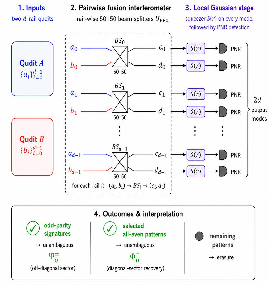
Figure 1: Schematic of the local squeezing-enhanced PFG. Two d-rail photonic qudits are interfered via rail-wise balanced beam splitters, each followed by local squeezing, then PNR detection. Odd-parity outputs continue to herald off-diagonal Bell projections, while selected all-even outcomes herald diagonal-sector projections.
The squeezing operation preserves photon-number parity, thus maintaining the integrity of odd-parity signatures associated with off-diagonal Bell projections. Critically, it reshapes the probability amplitudes in the all-even (diagonal) sector, enabling certain new detection patterns—characterized by well-defined rail imbalance vectors—to herald diagonal-sector entangling projections, substantially increasing the overall gate success probability.
POVM Structure and Success Criterion
In the logical subspace, the action of squeezing followed by photon counting induces a structured Positive Operator-Valued Measure (POVM). The analysis in the paper provides an explicit characterization of which detection patterns contribute to successful fusion. The key result is a rigorous imbalance-vector criterion: an all-even photon-number pattern is accepted as a successful diagonal Bell projection if and only if its imbalance vector (composed of half the difference of photon numbers detected in the output ports of each rail) has exactly two nonzero components, equal in magnitude. This selectivity ensures that multi-rail and nonmaximal projections are rigorously excluded from the resource count.
Mathematically, this yields a compact, exact expression for the total probability Pfid(d,r) of successful PFG operation (both off-diagonal and squeezing-enhanced diagonal contributions) for arbitrary d and squeezing strength r, involving special functions (complete elliptic integrals). It is shown that the optimal squeezing is finite, and analytic scaling relations are provided for both small and large d.
The squeezing-enhanced protocol achieves notable improvement over passive PFGs across all investigated dimensions. For instance, at d>20, the average success probability increases from d>21 to d>22; for d>23, from d>24 to d>25. These improvements are achieved solely by augmenting the local output operations, requiring no ancillary photons or modification to the logical encoding.
The optimal squeezing decreases with increasing d>26, asymptotically scaling as d>27. In the large-d>28 limit, a finite fraction d>29 of the diagonal sector can be recovered, yielding an absolute gain that decays as $1-1/d$0.
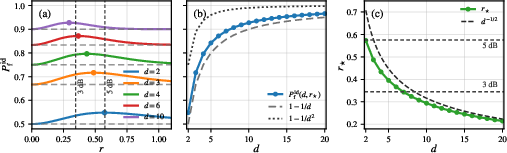
Figure 2: (a) Success probability $1-1/d$1 versus squeezing $1-1/d$2 for various $1-1/d$3, with passive benchmarks shown as dashed lines. (b) Optimized success probability compared to passive and ancilla-assisted benchmarks. (c) Optimal squeezing parameter $1-1/d$4 versus $1-1/d$5, with asymptotic scaling indicated.
Impact of Finite PNR Resolution
Realistic implementations invariably involve detectors with finite dynamic range. The paper extends the theoretical analysis to account for a saturation threshold $1-1/d$6, wherein detection events above $1-1/d$7 photons are lumped together and treated as erasures. The analysis confirms that the squeezing-induced advantage persists with practical PNR capabilities; for instance, with $1-1/d$8 (resolving up to six photons), the certified lossless success probabilities for $1-1/d$9 and d0 remain at d1 and d2, respectively.
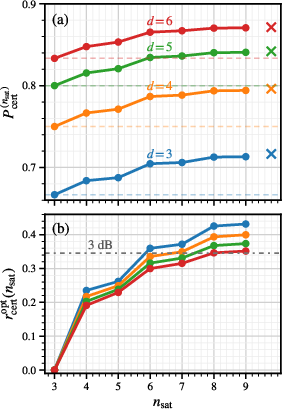
Figure 3: Optimized certified success probability d3 versus detector threshold d4 for d5. Horizontal dashed lines are passive benchmarks; rightmost crosses denote the ideal-PNR limits. Steps correspond to the inclusion of additional photon number bins in the parity window.
Theoretical and Practical Implications
The main contribution is a rigorous demonstration that active Gaussian operations—specifically, local single-mode squeezing—can be strategically employed to recycle a nontrivial, structured subset of linear-optical measurement "failures" in high-dimensional entangling gates. The proof incorporates exact POVM analysis, yielding closed-form analytic expressions and asymptotic optimality characterization. Unlike "blind" probabilistic improvements, the method operates on a strongly constrained, well-understood subspace of failures, avoiding the pitfalls of overcounting nonorthogonal projections.
The implication is twofold:
- Theory: The study reveals how active Gaussian operations can enhance measurement-based photonic protocols by reshaping logical POVM sectors, suggesting further exploration of more general local Gaussian processing, passive multimode mixing, and hybrid squeezing-ancilla constructions for optimal exploitation of structured logical failure spaces.
- Experiment: The protocol is implementable with currently understood technology, requiring phase-stable, uniform squeezing on each PFG output mode and increased (but still feasible) PNR dynamic range. The persistent improvement under finite resolution validates practical applicability, particularly for mid-scale d6 relevant to near-term photonic quantum networks.
Future Directions
Open technical directions include optimizing over nonuniform squeezing and passive local mixing, exploiting higher-order superpositions in the diagonal sector, and analyzing hybrid gates with both squeezing and ancilla. Additionally, extending the framework to model losses, detector inefficiency, mode mismatch, and experimental noise is essential for reliable benchmarking and scaling. More broadly, the central methodology—selectively enhancing logical subspaces of structured measurement failures—offers a template for analogous developments in other quantum information processing architectures where failure POVMs occupy identifiable subspaces.
Conclusion
This work establishes that local single-mode squeezing can provide a systematic, quantitative increase in the success probability of ancilla-free PFGs for d7-rail photonic qudits, with exact analytical characterization. The approach leverages the structure of the logical failure sector, offering a resource-efficient route to improving photonic entangling protocols. The results motivate expanded exploration of Gaussian engineering within measurement-based quantum information, with direct implications for scalable fault-tolerant photonic architectures and quantum network engineering.