- The paper rigorously isolates and quantifies the geometry-induced error of the dipole diffusion model using closed-form optical thickness laws.
- It validates the error analysis by comparing the dipole model against finite-slab solutions and Monte Carlo benchmarks, achieving error reductions below 1%.
- The grid-free Walk-on-Spheres estimator is introduced to deliver geometry-exact diffusion rendering across arbitrarily thin and curved translucent materials.
Authoritative Summary: Dipole Diffusion Error in Thin Geometry — Optical Thickness Laws for Grid-Free Subsurface Scattering
Motivation and Problem Scope
Subsurface scattering is fundamental in rendering translucent materials, with the classical dipole diffusion model serving as a core approximation for multiply-scattered light in semi-infinite slabs. However, the dipole’s radial profile assumption imposes a strong and systematic geometric bias: it does not account for thin or highly curved features, resulting in substantial over-glow and visually distorted appearance for these regions. This paper rigorously isolates and quantifies the geometry-induced error of the dipole model, derives closed-form optical thickness laws governing that error, and proposes a grid-free stochastic estimator for geometry-exact diffusion rendering and analysis.
Optical Thickness Laws Governing Dipole Error
The dipole model inherently neglects the presence of a second boundary in thin objects, presuming infinite material beneath the surface. The authors explicitly compare the dipole profile to the finite-slab multipole solution under identical diffusion regimes and boundary assumptions, isolating the geometry error. The diffuse albedo discrepancy is shown to be dominated by a material-independent exponential, Ce−2τ, where optical thickness τ=T/ℓd is the thickness normalized by the diffusion length. The prefactor C is material-dependent but logarithmically weak across typical translucent media.
This exponential sets crossover regimes in practical rendering: the dipole severely over-predicts the albedo by tens of percent until τ≳2, with the precise threshold varying slightly between materials. Thin features lose energy via transmission through their back face, which the dipole ignores. The analytical prediction holds across diverse media and is validated numerically via brute-force volumetric path tracing.
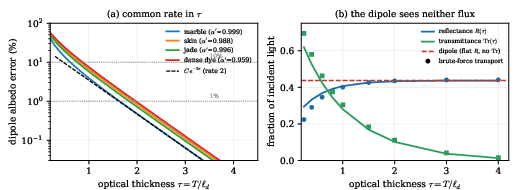
Figure 1: The dipole’s diffuse-albedo error against the closed-form finite-thickness solution under varying optical thickness, displaying universal rate −2 and weak material dependence.
Transmitted flux through thin slabs follows a single-pass exponential decay, e−τ, and accounts for back-lit appearance, as demonstrated in rendered examples. Both reflectance and transmittance closed forms align closely with Monte Carlo photon transport benchmarks, confirming their physical validity.
Geometry-Exact Grid-Free Diffusion Estimation
Addressing general geometry outside the planar slab requires a solver that is not constrained by interior meshing nor tangent half-space approximations. Leveraging grid-free Monte Carlo approaches, the paper introduces a Walk-on-Spheres estimator for the screened-Poisson diffusion equation directly over arbitrary signed-distance domains. This estimator is unbiased, converges as O(N−1/2), and reproduces closed-form references with maximum relative error below 1%. Its sole geometric requirement is a signed-distance function, making it versatile across analytic and production assets.
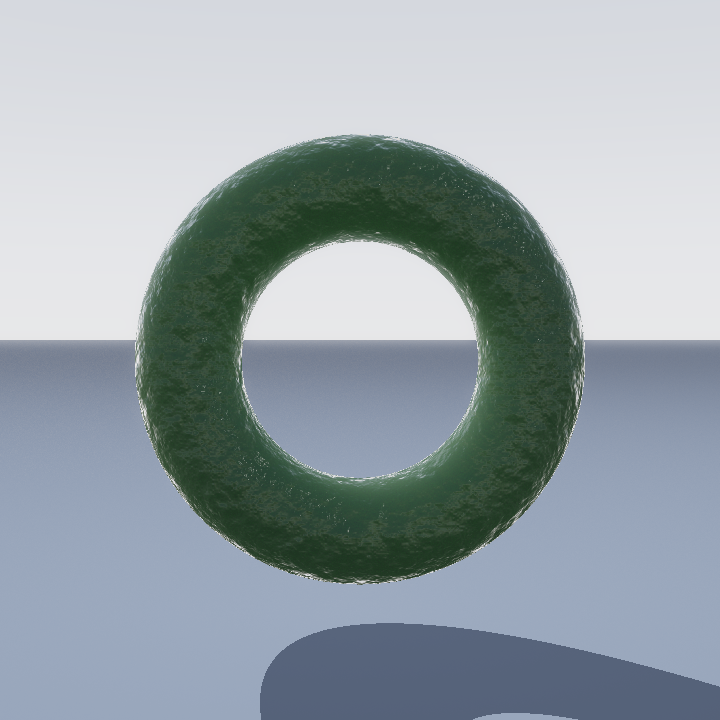
Figure 2: A back-lit jade ring rendered with the grid-free diffusion estimator, capturing true thin feature transmission.
Comparison with independent backward path tracing validates the estimator's accuracy in thick and thin regimes, highlighting its reduction of geometry-induced error in back-lit and transmit-dominant regions. However, in front-lit or sharply curved cases, remaining error is attributed to diffusion model limitations, not solver bias.
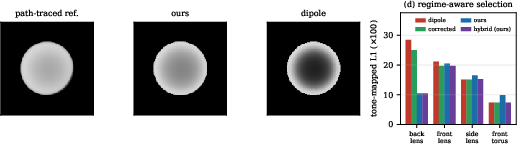
Figure 3: Path-traced reference validation demonstrates improved accuracy for the grid-free estimator in transmission regimes, with residual dominated by model, not solver, error.
Practical Predictors, Corrections, and Regime Dispatch
The closed-form slab law enables practical per-pixel error prediction using local shape diameter (thickness over diffusion length), suitable for thin feature heuristics in production pipelines. The predictor not only ranks pixels by expected error but also prescribes an albedo correction factor κ(τ) universally across materials. This correction significantly reduces dipole over-glow, although remaining spatial error is curvature-driven.
Pixels flagged by high predicted error can be dispatched to the grid-free estimator, tracing a cost-accuracy frontier unattainable by profiles alone.
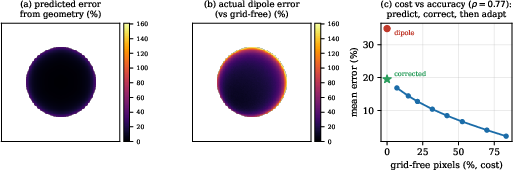
Figure 4: Thickness-based prediction, correction, and dispatch: per-pixel error is predicted, corrected, and high-error regions are routed to the grid-free solver for cost-efficient accuracy.
A single radial profile cannot represent spatially-varying coefficients or internal inclusions. The grid-free diffusion estimator extends naturally to variable media using null-scattering majorants, maintaining accuracy within manufactured benchmarks even under coefficient ratios as high as 2×. Internal inclusions cast observable shadows in the diffuse fluence, captured only by geometry-aware methods.
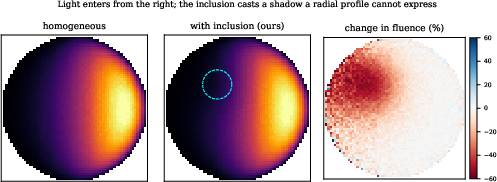
Figure 5: Fluence in spatially varying media, with a denser inclusion casting a measurable shadow inaccessible to single-profile models.
Further, the differentiable nature of the estimator supports inverse problems such as grid-free diffuse optical tomography. Recovery of low-dimensional absorbers is demonstrated via efficient gradient descent, with sensitivity decay quantitatively matched to theoretical Born kernel expectations.
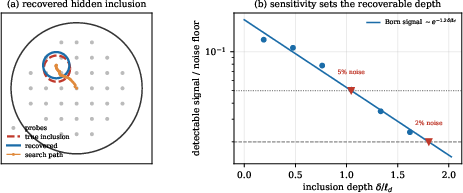
Figure 6: Inverse recovery of an absorbing inclusion and sensitivity decay with depth, quantifying recoverable resolution limits.
Theoretical Analysis: Curvature and Boundary Effects
Regression analysis over diverse geometry reveals that while optical thickness sets the dominant exponential decay in dipole error, boundary curvature dramatically modulates the prefactor. The operator τ=T/ℓd0 shows error grows with mean curvature τ=T/ℓd1 at fixed thickness. The form τ=T/ℓd2 quantifies the coupling, with τ=T/ℓd3 entering via the prefactor, especially in non-flat regions.
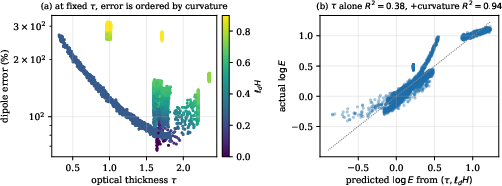
Figure 7: Error decomposition over six shapes, highlighting curvature-dependent prefactors in the exponential slab law.
The estimator is fully general within the diffusion approximation, supporting Dirichlet and Robin boundary conditions, spatially-varying coefficients, and direct integration with single scattering corrections.
Results, Limitations, and Implications
The results are supported by comprehensive closed-form, path-traced, and manufactured solution benchmarks. The grid-free estimator offers geometry-exact rendering within the diffusion regime, matching closed forms and validated references across thickness and heterogeneity. However, in optically thin or highly curved regions, the diffusion approximation itself diverges from true transport, and remaining errors owing to model limitations persist.
Pairing fast profile estimators with regime-aware dispatch of grid-free solvers to error-prone regions yields minimal mean error, a practical approach for production rendering. The mathematical results highlight that the primary geometric control in thin features is optical distance to a second surface, not raw thickness.
Implications span practical rendering—enabling confident shading of thin assets, targeted correction, and rapid geometry-exact preview—as well as theoretical understanding of error structure and recovery limits in optical tomography. Future developments could focus on extending the grid-free estimator for coupled scattering-transport models, deploying efficient regime-aware hybrids, and automating error prediction and correction in complex scenes.
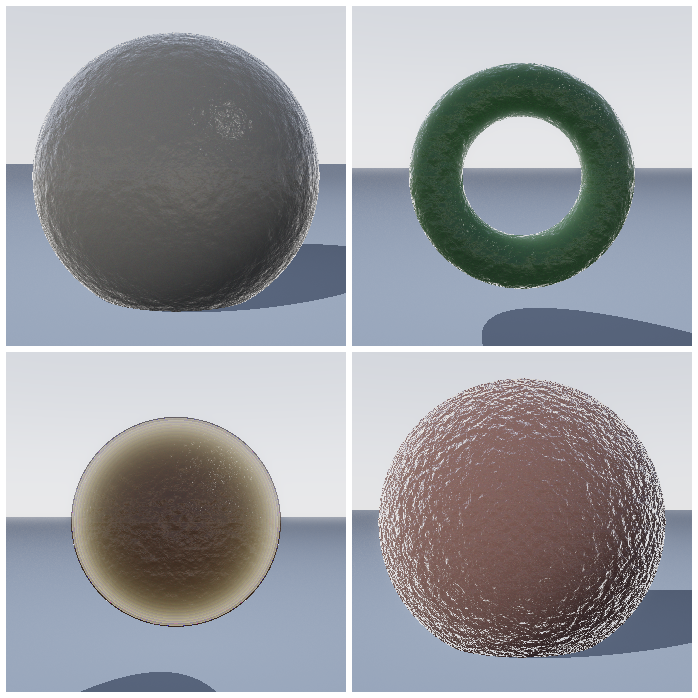
Figure 8: Full appearance rendering of diverse translucent materials under environment lighting, combining grid-free diffusion with microfacet dielectric surface models.
Conclusion
This paper establishes the optical thickness law as the fundamental scalar governing geometric error in dipole diffusion models for thin and curved translucent features. Through closed-form derivations, Monte Carlo path tracing validation, and introduction of a geometry-exact, grid-free diffusion solver, it quantifies, predicts, and corrects persistent dipole over-glow and supports accurate rendering and analysis across homogeneous and heterogeneous domains. The work underscores the need for geometry-aware approaches in subsurface rendering and analysis, providing rigorous theoretical bounds, practical correction curves, and versatile numerical tools for future research and deployment.
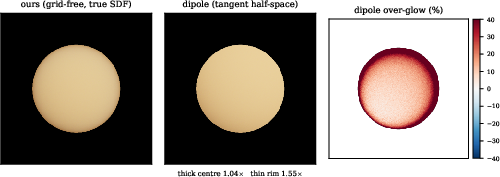
Figure 9: Comparison of grid-free estimator and dipole profile rendering, with spatial error concentrated at thin rim regions, confirming structured dipole over-glow.