- The paper introduces a residual-guided neural dictionary learning framework that integrates ResDMD residuals with conditioning regularization for reliable Koopman spectral approximation.
- The methodology is validated on systems like the pendulum, harmonic oscillator, and Duffing oscillator, demonstrating significant improvements in forecast error and numerical conditioning over traditional approaches.
- The approach is also applied to sea-surface temperature dynamics, where it enhances residual loss metrics and enables robust extraction of Koopman modes critical for climate forecasting.
Residual-Guided Dictionary Learning for Spectrally Accurate Koopman Approximation
Introduction and Motivation
Koopman operator theory enables the study of nonlinear dynamical systems via an infinite-dimensional linear operator acting on observables. Recent thrusts in data-driven dynamical modeling, most notably EDMD and its extensions, have elevated spectral analysis for systems where no analytic model exists. However, spectra computed from finite-dimensional approximations (commonly via fixed dictionaries such as polynomials, Fourier, Hermite, or kernels) are notoriously unreliable: observed eigenvalues and eigenfunctions often suffer from spectral pollution, lacking correspondence to the true Koopman spectrum. Persistent questions remain on the reliability and trustworthiness of learned Koopman spectral objects—particularly the crucial links between expressive dictionary function classes, their numerical conditioning, and their spectral fidelity.
This work tackles these challenges by making spectral reliability the core objective of neural dictionary learning. Instead of training dictionaries purely for predictive fidelity, the authors build their objective around Residual Dynamic Mode Decomposition (ResDMD) residuals—operator-level, a posteriori errors which certify whether computed eigenpairs genuinely correspond to Koopman spectral components. To counteract numerical instability endemic to over-expressive or redundant dictionaries, the loss is augmented with explicit regularization on the condition number of the lifted data matrix. Thus, the proposed approach enforces both low-residual spectral certificates and robust conditioning, yielding neural dictionaries whose numerically computed spectra are both expressive and trustworthy.
Theoretical and Algorithmic Framework
The foundation of this approach is a rigorous integration of Koopman operator theory with modern neural dictionary learning and certified spectral diagnostics:
- Koopman Operator Setup: The evolution operator KF acts on observables via composition with the system dynamics F. For numerics, it is compressed via projection onto a finite dictionary DN.
- ResDMD Residuals: Unlike standard EDMD, ResDMD computes not just eigenvalues of the projected operator, but also the residual for each eigenpair, converging (as data grows) to the true operator-level residual. Thus, low-residual eigenpairs are credible spectral candidates, while high-residual pairs are identified as pollution.
- Neural Dictionary Parameterization: Each dictionary element is a separately parameterized shallow ReLU network, initialized independently. Neural architectures are chosen for flexibility but require careful regularization to avoid redundancy and ill-conditioning.
- Joint Loss Function:
L(X;Θ)=N1j=1∑Nrj(Θ)2+αReLU(logκ0κ(Θ))
Here rj(Θ) denotes the ResDMD residual for the jth eigenpair with current parameters Θ, and κ(Θ) is the condition number of the (weighted) lifted data matrix. The loss directly enforces the simultaneous minimization of spectral residuals and control of numerical instability.
- Optimization Scheme: Mini-batch AdamW is employed, with early stopping and held-out validation to prevent overfitting and select ridge/Tikhonov regularization.
Empirical Evaluation on Benchmarks
The methodology is evaluated across three canonical dynamical systems and a high-dimensional, noisy real-world climate dataset. For each, training dynamics and post-training diagnostics are quantitatively assessed using training/test loss, condition number, and spectral forecast error.
Pendulum System
On the nonlinear undamped pendulum, the learned neural dictionary demonstrates a sharp reduction in both spectral residuals and forecast error relative to traditional Fourier–Hermite dictionaries, even while sustaining a much lower (and controlled) condition number. The spectral pseudospectra post-training show significantly reduced pollution and tight inclusion on the unit circle, indicating robust recovery of the expected unitary Koopman structure.
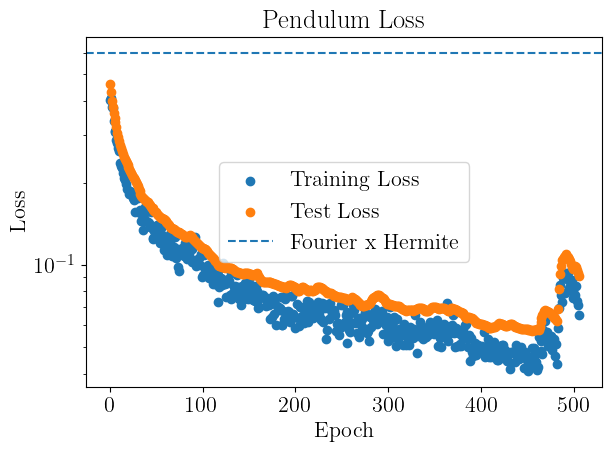
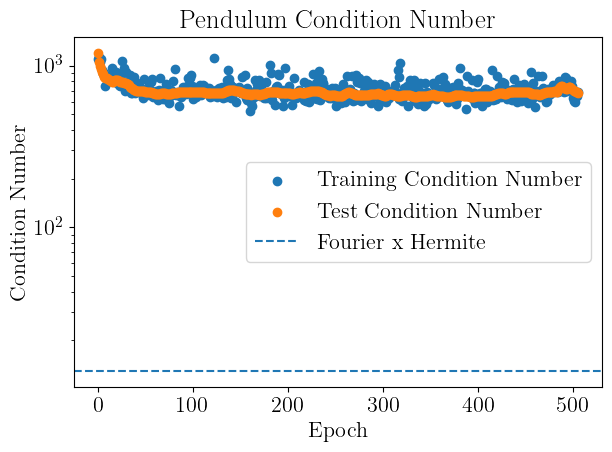
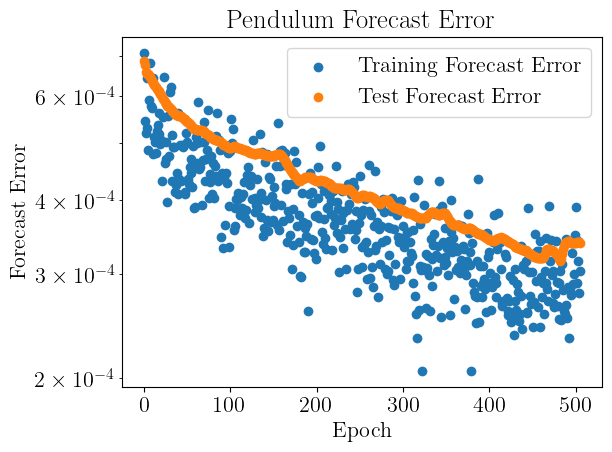
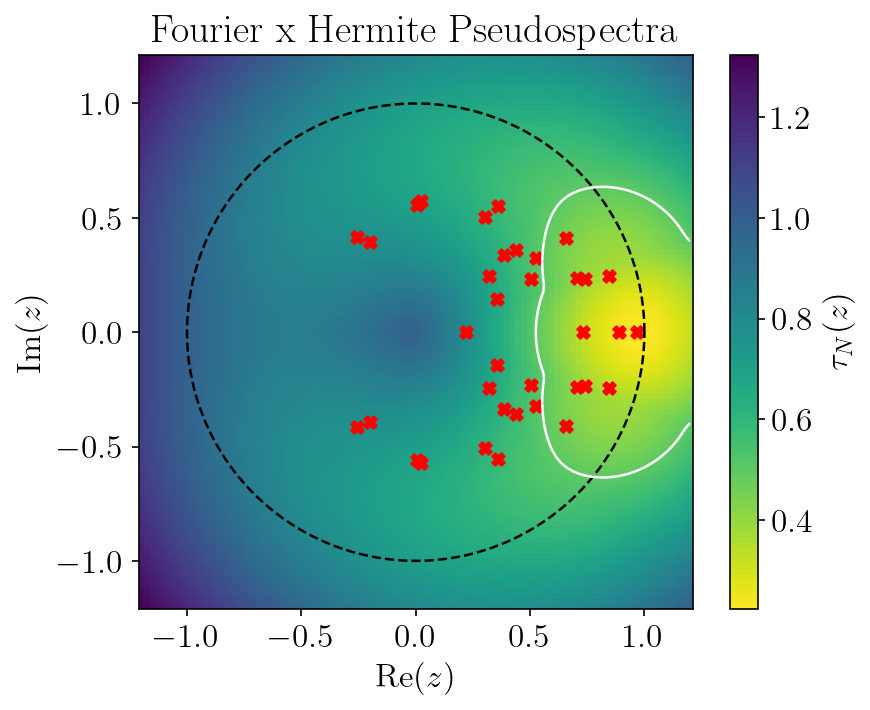
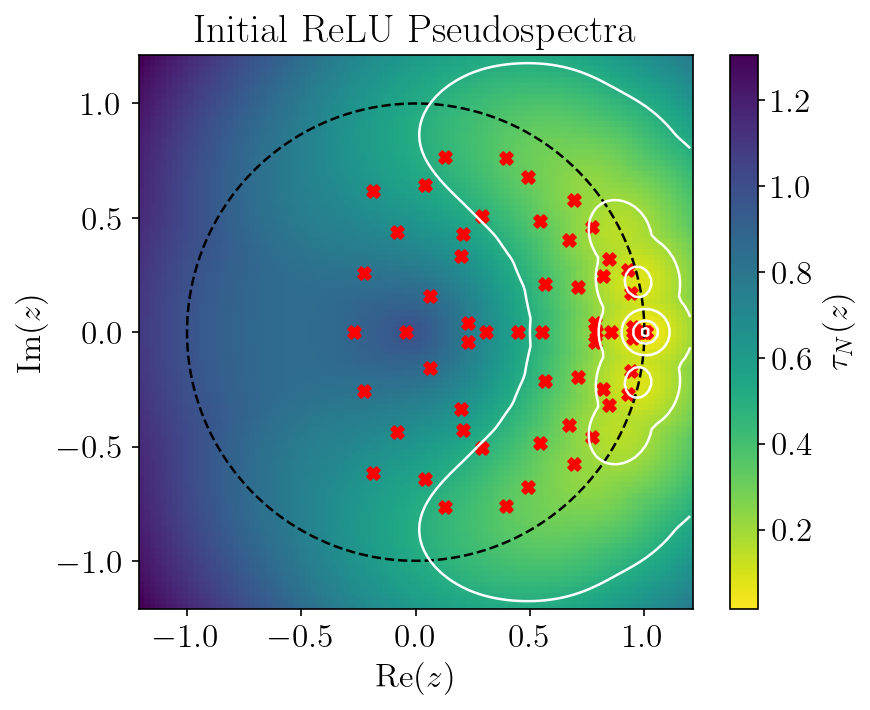
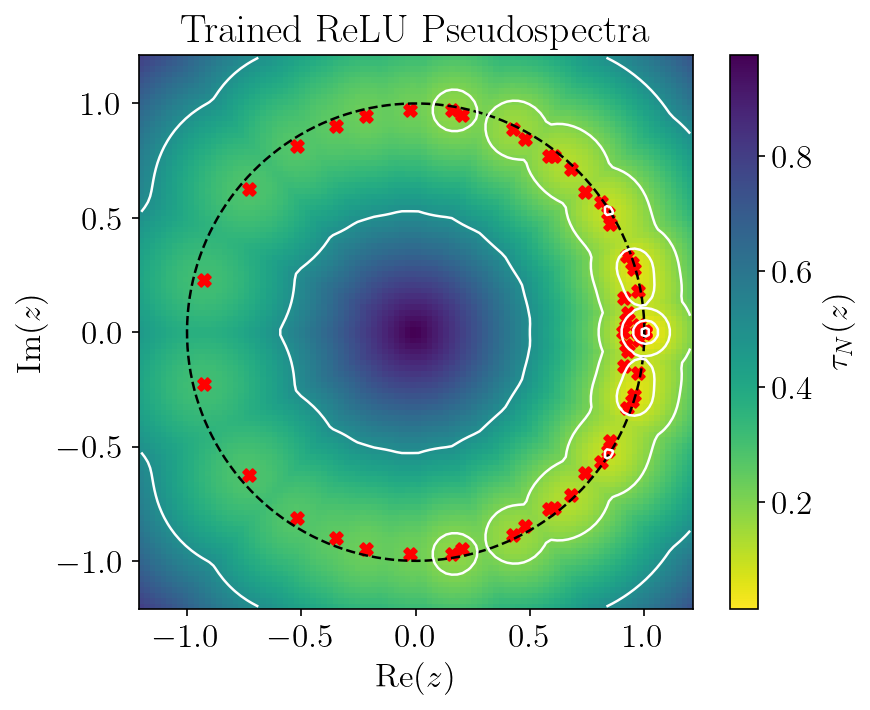
Figure 1: Pendulum training diagnostics, demonstrating convergence of loss, improved conditioning, and substantial reduction in forecast error for the neural dictionary relative to Fourier–Hermite benchmarks.
Undamped Harmonic Oscillator
The approach yields a well-conditioned dictionary (mean κ≈258 versus >106 for Hermite), nearly order-of-magnitude improvements in forecast error, and strong match between computed and expected spectral structure on the unit circle. The ResDMD pseudospectra reveal that the neural dictionary, post-training, resolves additional genuine modes and eliminates spurious spectral pollution.
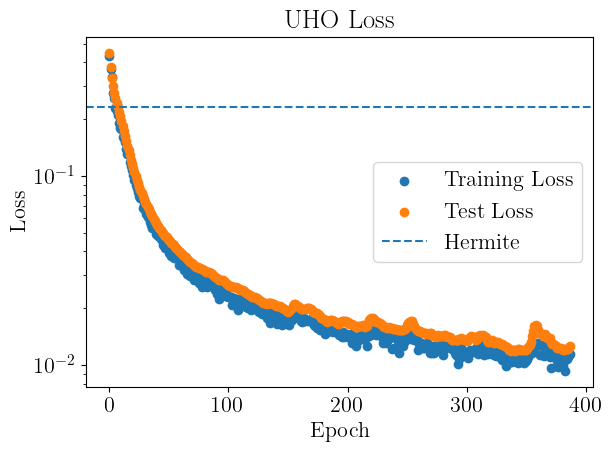
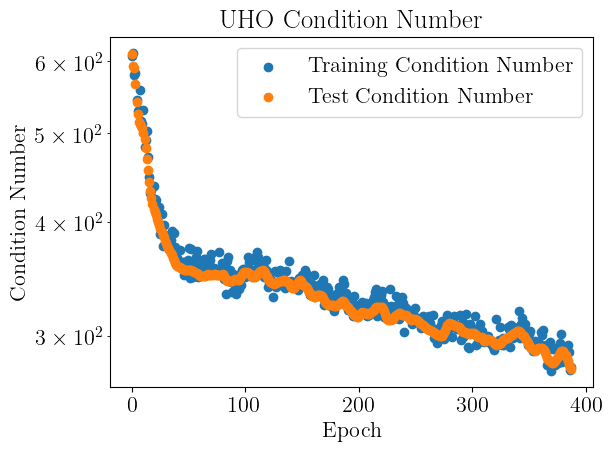
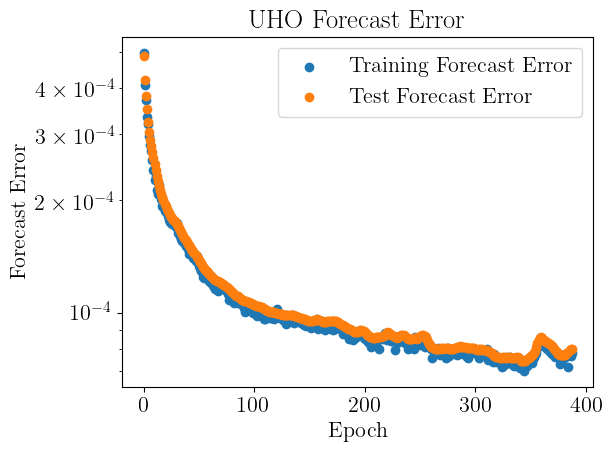
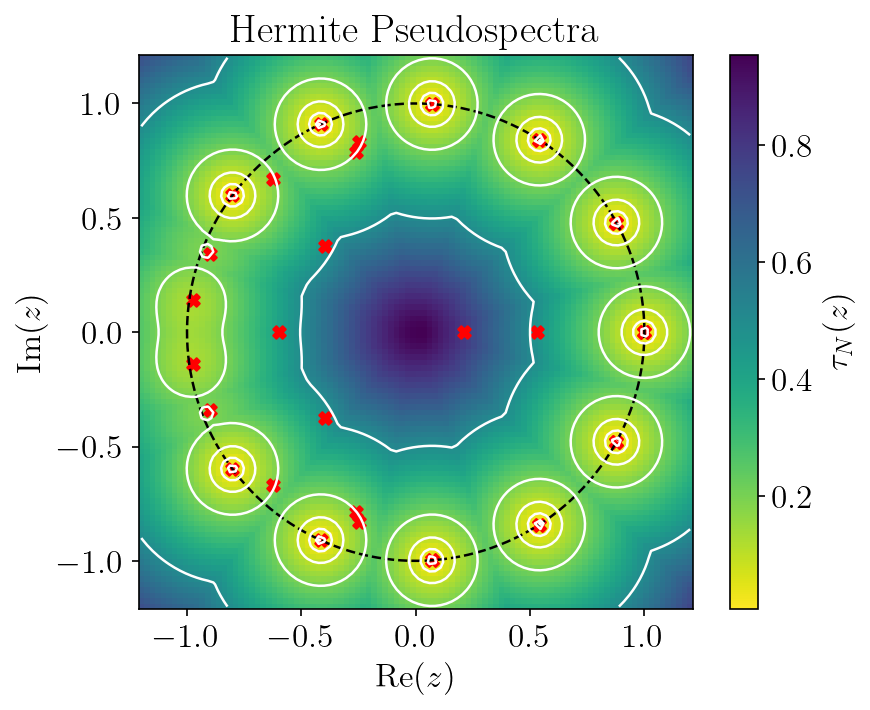
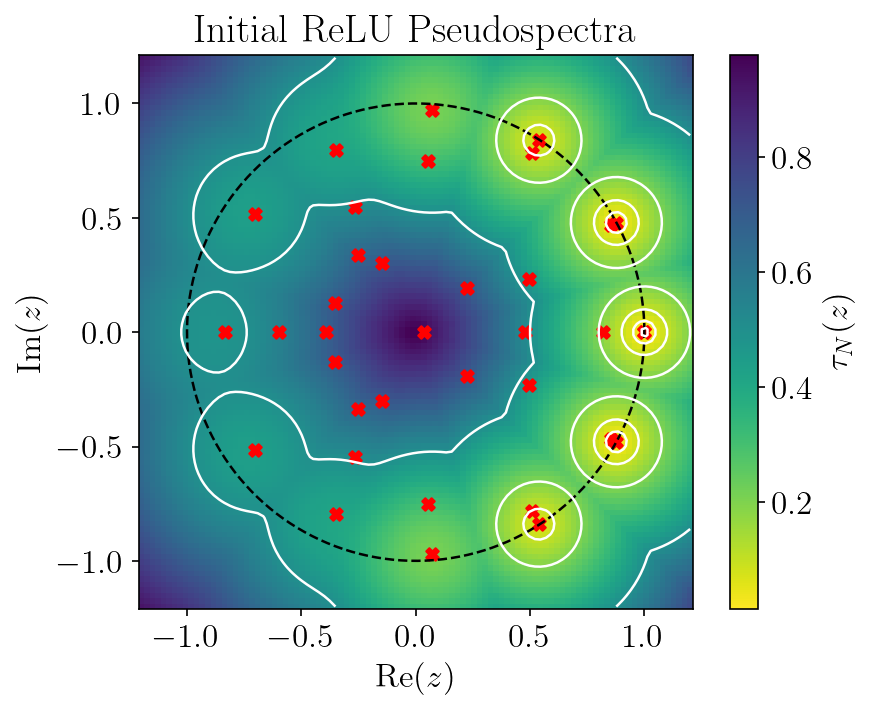
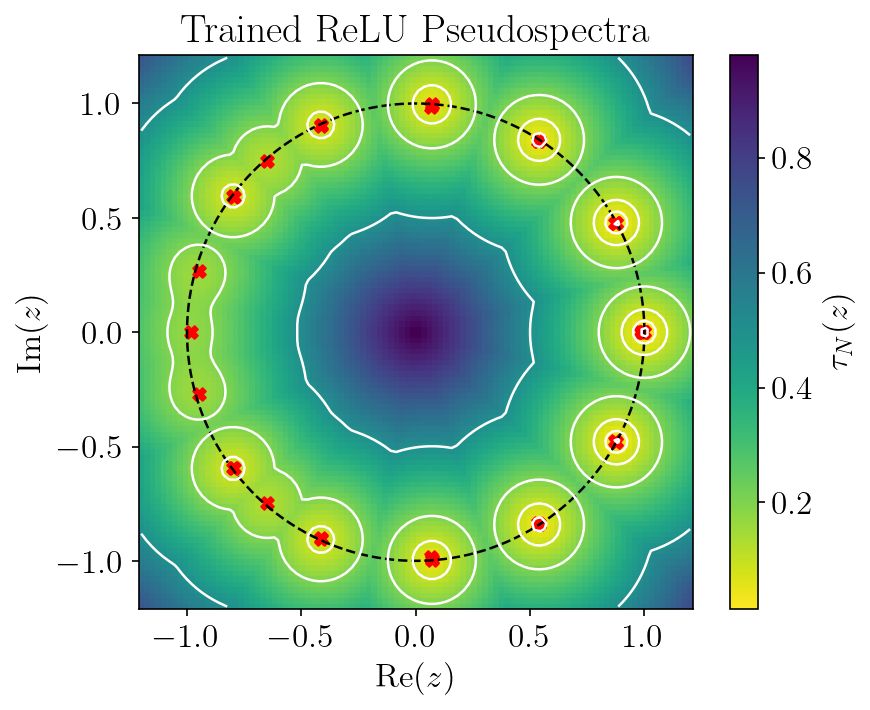
Figure 2: Undamped harmonic oscillator diagnostics: strong loss reduction, stable conditioning, and order-of-magnitude better forecast error with the trained neural dictionary.
Duffing Oscillator
For the dissipative Duffing oscillator, Chebyshev benchmark dictionaries suffer from large condition numbers (median F0) and significant spectral pollution; post-training, the neural dictionary achieves a mean F1 of F2 and a forecast error improved by nearly an order of magnitude. The residual pseudospectra tighten around genuine dynamical features and suppress spurious eigenvalues in the disk.
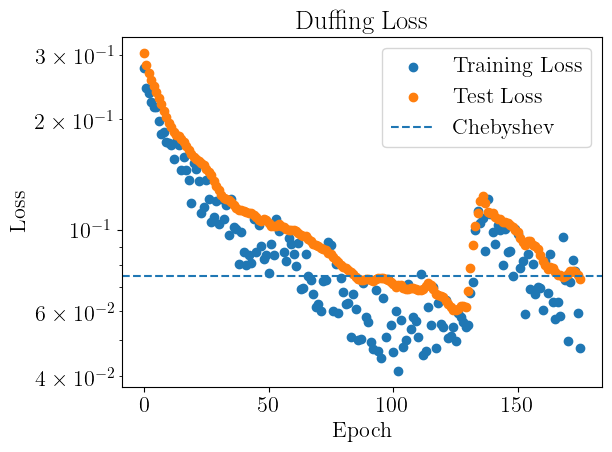
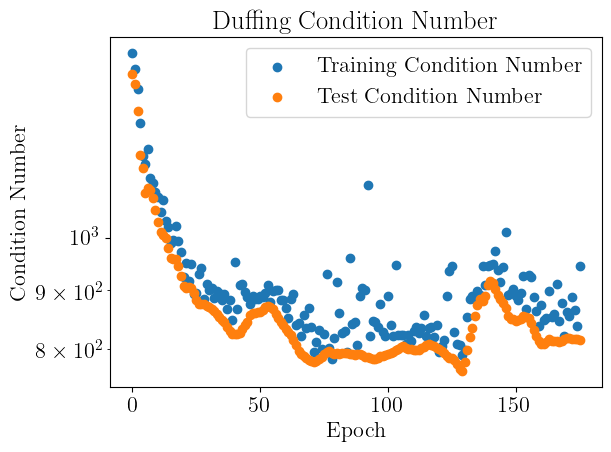
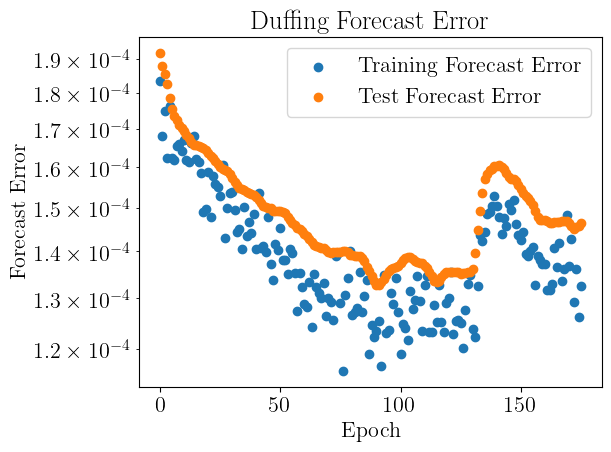
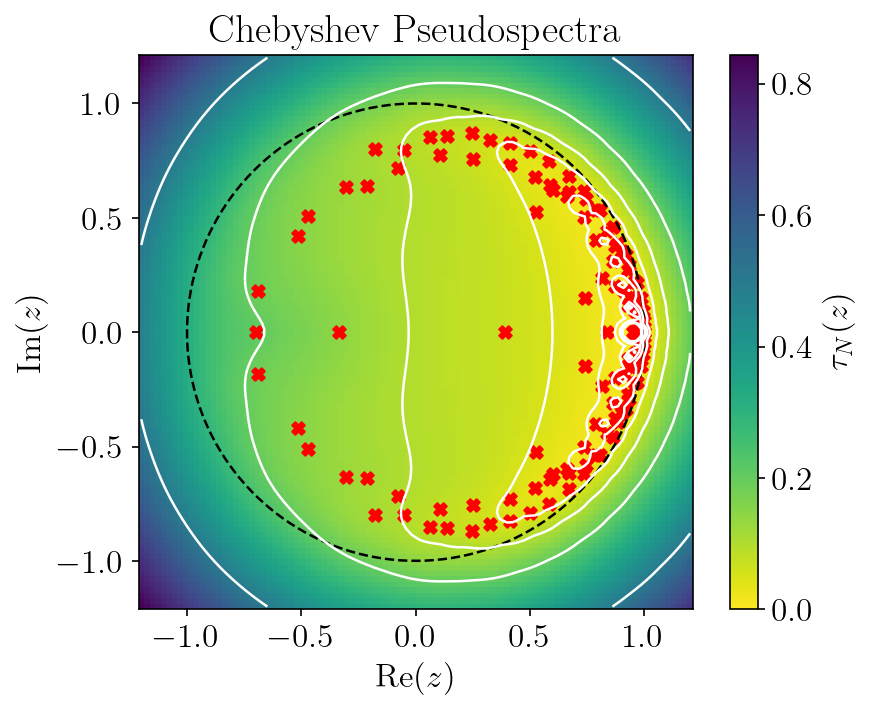
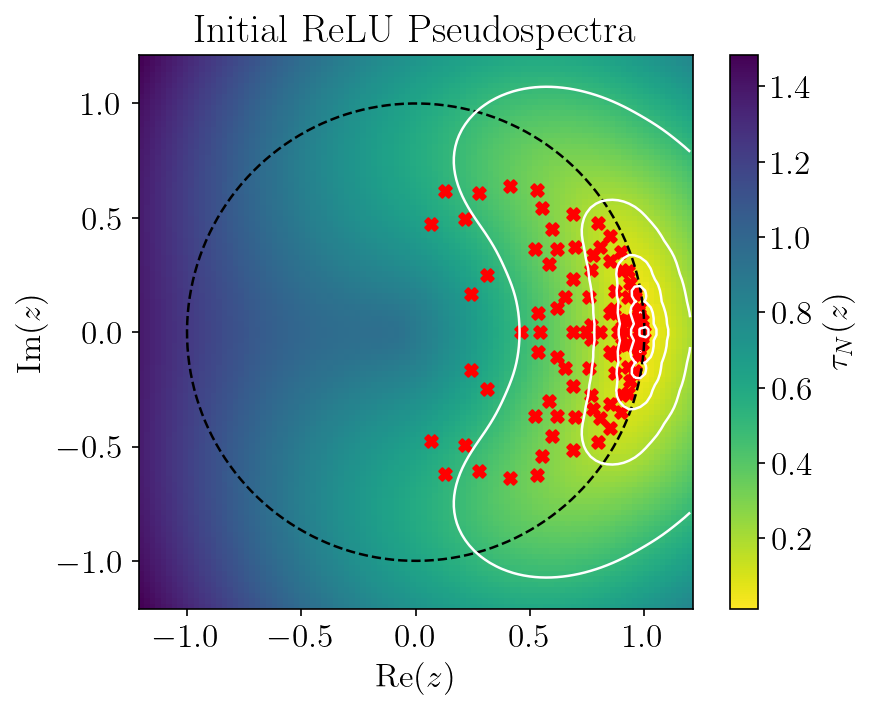
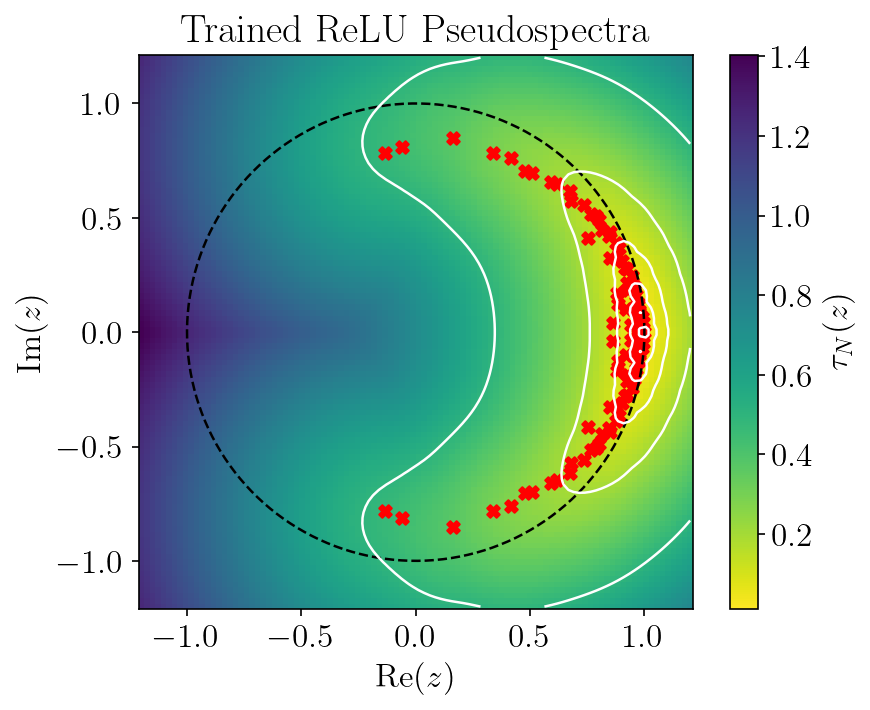
Figure 3: Duffing oscillator diagnostics: superior spectral residual minimization and forecast error lowering via the residual-guided neural dictionary.
Real-World Application: Sea-Surface Temperature (SST) Dynamics
To assess practical utility in high-dimensional, noisy, partially observed systems, the authors apply their method to monthly tropical Pacific sea-surface temperature data, preprocessed with PCA for dimensionality reduction. For both 5- and 10-dimensional state truncations, the neural dictionaries consistently outperform quadratic polynomial benchmarks across residual loss, conditioning, and one-step forecast error—progressing from mean errors of F3 (polynomial) to F4 (neural, F5) and F6 to F7 (F8). The approach also produces Koopman modes with substantial amplitude in the Niño 3.4 region (an area critical for ENSO prediction) and with substantially smaller associated residuals.
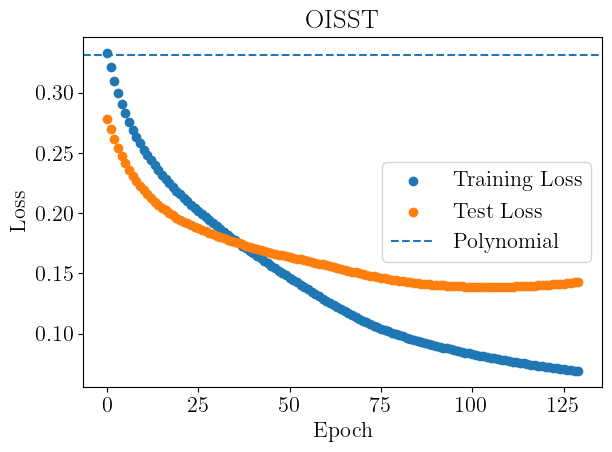
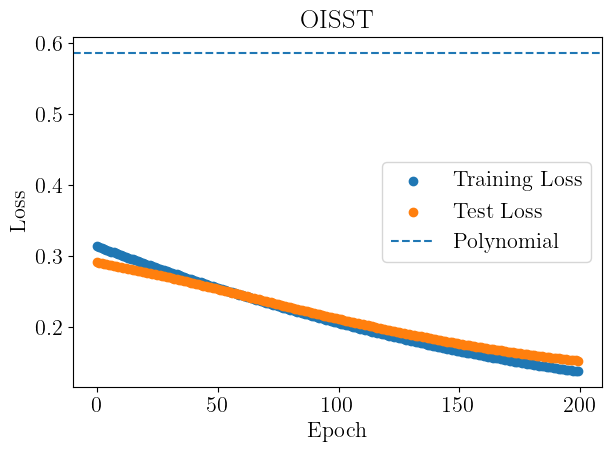
Figure 4: Loss curves for SST forecasting with F9 and DN0, showing consistent reduction with the trained neural dictionaries against polynomial reference.
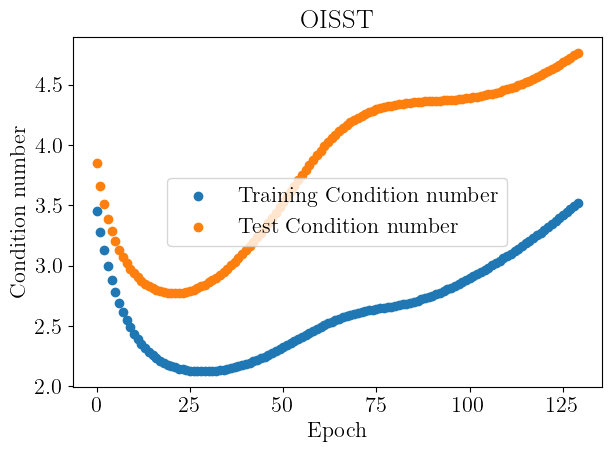
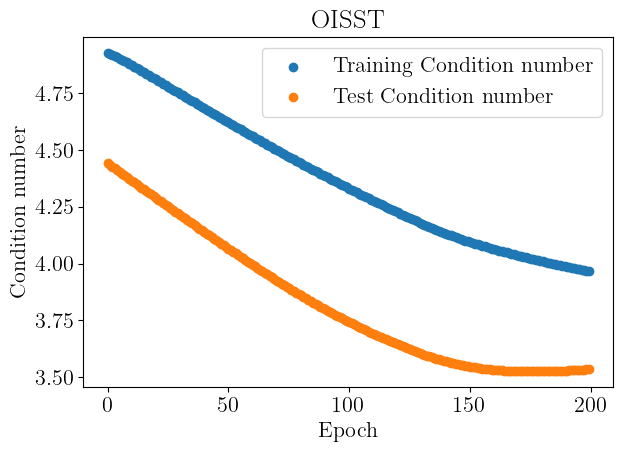
Figure 5: Condition number evolution during SST neural dictionary training for DN1 and DN2.
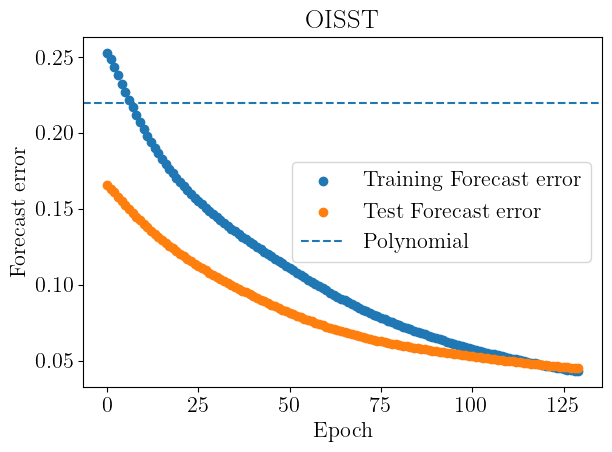
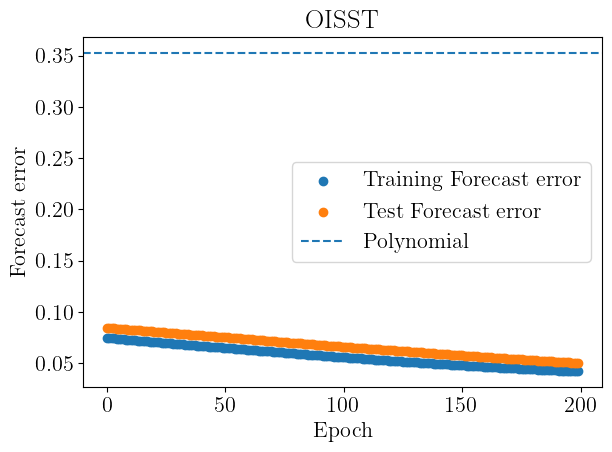
Figure 6: One-step forecast error curves for SST data, with significantly improved performance from trained dictionaries.
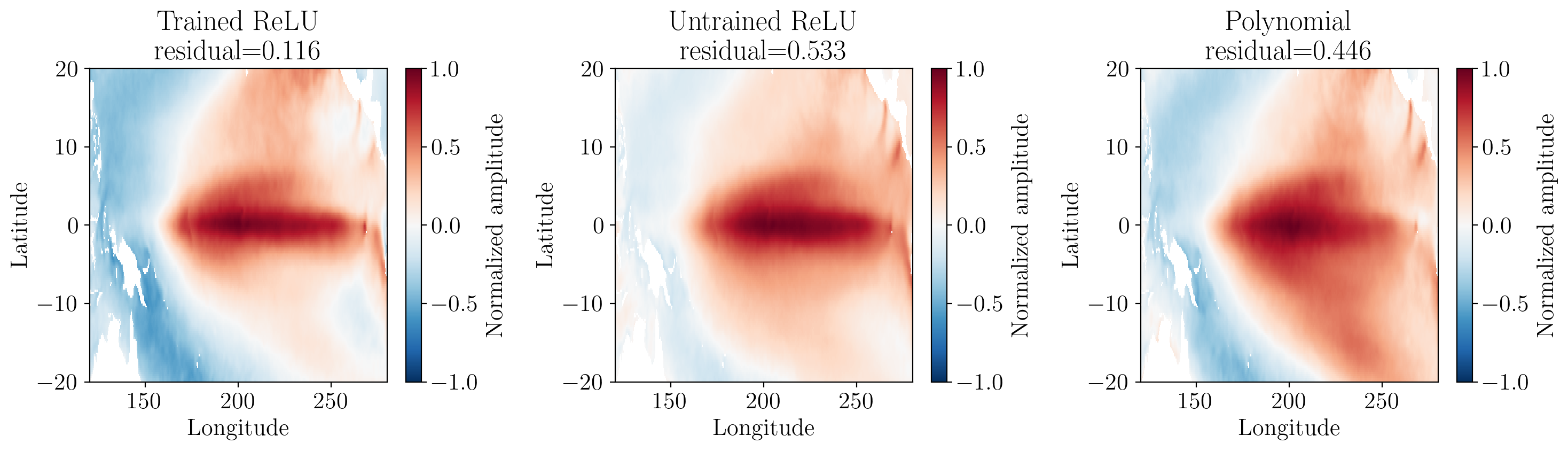
Figure 7: Koopman mode with maximal amplitude in Niño 3.4 region, post-training, exhibiting strong residual reduction compared to pretraining and benchmark polynomial dictionaries.
Implications, Limitations, and Future Directions
The principal implication of this work is a rigorous shift in neural Koopman operator learning: spectral trustworthiness, assessed through operator-level residuals and stabilized through conditioning regularization, can and should be built directly into the learning process. This approach enables the computation of Koopman eigenvalues and modes that are robust, numerically stable, and can be meaningfully associated with the infinite-dimensional spectrum, even when starting from highly flexible neural dictionaries with little prior structural knowledge.
The method’s negligible sensitivity to hyperparameters and moderate computational cost substantiate its practicality for dynamical modeling in scientific and engineering contexts. Remaining limitations include reliance on sufficiently rich snapshot data and sensitivity to dictionary size relative to data—further work could explore adaptive dictionary sizing and extensions to continuous spectra and nonstationary or stochastic dynamics.
Theoretical advances could include extensions to continuous-time Koopman generator approximation, assessment in infinite dictionary limits, and integration with model discovery frameworks that simultaneously learn both operators and governing equations.
Conclusion
This study establishes residual-guided neural dictionary learning with conditioning penalties as a robust and principled paradigm for data-driven Koopman approximation, shifting focus from mere prediction to spectral fidelity. The approach yields spectrally disciplined neural dictionaries that minimize spectral pollution, ensure numerical stability, and produce Koopman objects with certified operator-level trust. This aligns data-driven dynamical modeling with rigorous operator-theoretic standards, paving the way for more reliable discovery and analysis of complex systems.
Citation: "Residual-Guided Dictionary Learning for Spectrally Accurate Koopman Approximation" (2606.29083)