- The paper introduces PACR, a novel differentiable framework that post-processes DCOPF solutions to achieve AC-feasible dispatches.
- It employs smooth surrogates and offline supervised learning to optimize active and reactive power adjustments, reducing errors by up to 34% and cost differences by 80%.
- Empirical evaluations demonstrate improved feasibility, faster convergence, and scalability on large-scale systems with up to 9,241 buses.
Parameter-Optimized AC Power Flow Restoration for AC Feasible DCOPF Dispatch
Introduction and Motivation
The DC optimal power flow (DCOPF) formulation remains the de facto standard in power system operations and market clearing due to its convexity and scalability, especially for time-critical and large-scale problems. However, DCOPF dispatches systematically violate nonlinear AC power flow (ACPF) constraints, specifically regarding voltage and reactive power limits, even when augmented with loss compensation techniques [baker2021solutions]. Bridging the gap between computationally efficient DCOPF and physically accurate ACPF remains a critical challenge in power system optimization.
This paper introduces a differentiable framework—PACR (Parameter-Optimized AC Restoration)—for post-processing DCOPF solutions to achieve AC feasibility. It exploits smooth parameterizations of both active and reactive power adjustments, allowing offline training of restoration parameters via supervised learning. The PACR pipeline provides a structured, efficient, and AC-feasible mapping for DCOPF dispatches, improving on prior work by enabling gradient-based optimization and robust implementation on both standard and large-scale test systems.
PACR Pipeline: Parameterization and Differentiability
The PACR restoration approach replaces conventional discrete or rule-based AC feasibility corrections with two key, parameterized modules: (1) distributed slack allocation for active power mismatch, and (2) smooth PV/PQ generator switching for reactive power and voltage regulation. Both modules feature tunable, differentiable surrogate functions—softplus for generator headroom, softmax for participation factors, and sigmoid curves for PV/PQ control—all designed to be optimized offline for best AC restoration performance.
The restoration pipeline can be depicted as follows:
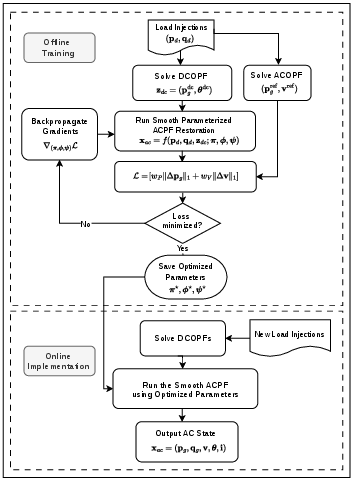
Figure 2: Flowchart of the algorithm, illustrating the offline training and online implementation of the DCOPF→ACPF pipeline.
Inputs (load and generation setpoints) are passed through DCOPF; the computed dispatch is then fed to a parameterized ACPF routine implementing the aforementioned smooth controls. Offline, the restoration parameters are optimized via supervised gradients using ACOPF solutions as references, leveraging the implicit function theorem to differentiate through the fixed-point solution of the AC equations.
The key differentiable surrogates are visualized as discrete-to-smooth transitions for headroom, participation, and PV/PQ control:
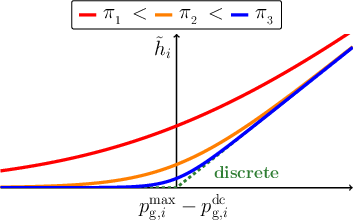
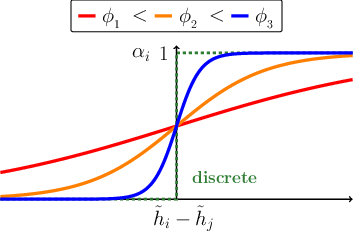
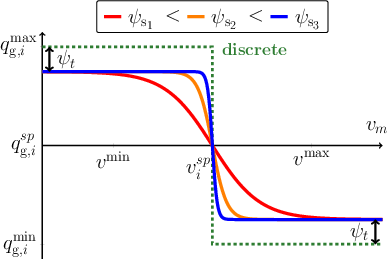
Figure 4: Discrete vs. smooth surrogates for distributed slack headroom, participation factors, and generator PV/PQ regulation; smoothness parameters are optimized for AC feasibility and numerical stability.
By embedding these smooth controls into the Newton-Raphson solution of the AC system, PACR enables efficient joint optimization of participation factors and voltage setpoints to minimize deviations from ACOPF ground truth. This design sidesteps convergence issues endemic to discrete PV/PQ switching while supporting direct deployment in both smooth and legacy discrete systems.
Learning and Optimization Algorithm
The PACR method implements supervised offline training of its internal parameters—specifically, the participation softmax temperature and per-generator PV voltage setpoints—using setpoint-ACOPF pairs over large scenario datasets. The learning objective is a weighted sum of generator dispatch error and voltage profile error relative to ACOPF references, regularized to avoid ill-conditioned parameters. Gradients for all parameters are computed via implicit differentiation through the Newton-converged ACPF fixed point.
This full pipeline is summarized in the following workflow:
Figure 3: The PACR algorithmic workflow: DCOPF generates initial dispatch; smooth, parameterized ACPF restoration maps it to a feasible solution; restoration parameters are optimized offline against ACOPF via supervised learning.
Once trained, optimized parameters are frozen and used directly in operational AC restoration, ensuring computational efficiency and repeatability.
Empirical Evaluation and Numerical Results
PACR was evaluated across benchmark IEEE, ACTIVSg, and PEGASE systems of up to 9,241 buses, with rigorous scenario perturbations (30,000 total cases). The smooth pipeline and its discrete logic counterpart (using trained parameters) were systematically compared to baseline single-slack and untrained initialization:
- Feasibility: The optimized smooth pipeline (DCACSSopt) eliminates all active and reactive power violations and drastically reduces voltage and line constraint violations across test cases, outperforming the discrete version especially on the largest systems.
- Dispatch Consistency: On the PEGASE 9,241-bus system, cost difference (relative to ACOPF) is reduced by 80% and mean absolute error (MAE) by up to 34% compared to single-slack baseline.
- Computational Performance: The optimized smooth restoration achieves up to 75% reduction in solve time relative to ACOPF, and 36–49% faster than the discrete restoration using the same trained parameters.
Iteration count distributions further illustrate the improved convergence behavior of the smooth approach:
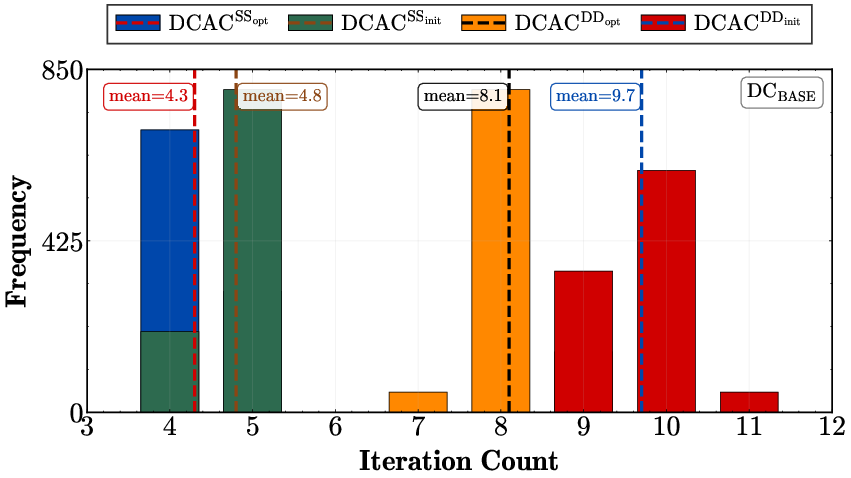
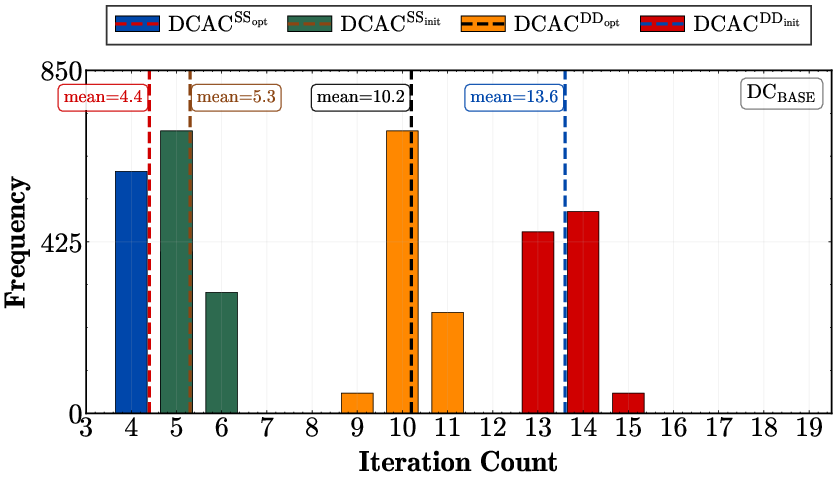
Figure 1: Iteration count for pegase_1354 on 1,000 samples, showing the concentration of the smooth (blue) pipeline at low iteration counts compared to discrete (orange/red).
Empirical CDFs for generator active power error emphasize that the smooth pipeline not only improves mean error but substantially reduces the worst-case restoration error:
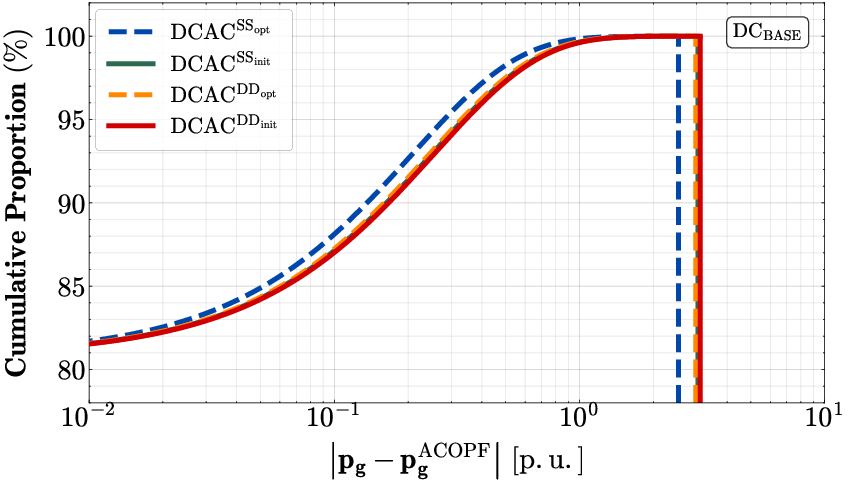
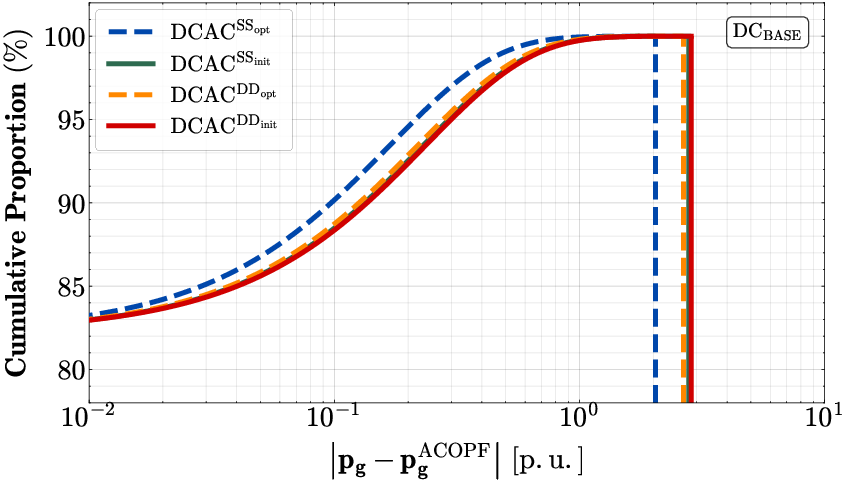
Figure 5: Cumulative plot of active power error for pegase_2869, showing the superior right-tail behavior of the optimized smooth pipeline.
Crucially, the learned parameters transfer with minimal degradation to traditional discrete AC restoration frameworks, enhancing legacy implementations without requiring fundamental code changes.
Implications and Future Directions
The PACR framework establishes a new standard for AC-feasible post-processing of DCOPF solutions, combining robust feasibility, optimality tracking, and scalability. By achieving differentiability throughout the pipeline, the approach opens the door to direct integration with larger differentiable optimization workflows, meta-learning schemes, and real-time end-to-end market tools.
The practical impact is significant for operators seeking fast, reliable, and AC-consistent dispatch under uncertainty and high renewable penetration—contexts where full ACOPF solutions are prohibitively expensive or unreliable. Theoretically, the work provides a blueprint for embedding smooth surrogate controls into classical power flow, extending to other discrete corrective devices (e.g., transformer taps, shunts) and to co-optimized market models [taheri2024optimizing].
Potential future developments include:
- End-to-end pipeline optimization where both DCOPF and restoration parameters are trained jointly for AC constraint satisfaction.
- Extension to hybrid stochastic-deterministic and reinforcement learning paradigms for resilient grid control under uncertainty.
- Incorporation of additional grid controls such as discrete shunts, tap changers, and voltage-VAR support for more exhaustive AC feasibility.
Conclusion
PACR presents a parameterized, differentiable AC feasibility restoration framework for DCOPF dispatches, outperforming discrete and ad hoc correction methods in constraint satisfaction, tracking error, and computational cost. Smooth surrogates for distributed slack and PV/PQ switching, paired with supervised offline training, yield scalable and transferable parameterizations. This approach is poised to facilitate next-generation market and operational platforms that demand both tractability and physical realism (2606.29011).

