- The paper introduces SEAR, a dual-process framework that integrates deliberate planning with intuitive execution to robustly address complex, coupled image degradations.
- The methodology employs hierarchical P-MCTS and self-evolving episodic memory to optimize tool sequencing and reduce planning overhead while enhancing restoration quality.
- The agentic approach yields practical scalability and theoretical insights into balancing exploration and exploitation for long-horizon, open-ended decision-making in image restoration.
Self-Evolving Agentic Image Restoration via Dual-Process Planning and Execution
Introduction and Motivation
The persistent challenge in image restoration (IR) arises from the complex, coupled degradations that are typical in real-world conditions. Classical All-in-One (AiO) restoration frameworks, while successful on isolated distortions, lack adaptability and often fail on unseen or intricate degradation combinations. Static application of toolchains (such as denoising or deblurring) is insufficient due to the sensitivity of restoration outcomes to the ordering of operations—greedy or myopic strategies can lead to irreversible information loss (Figure 1).
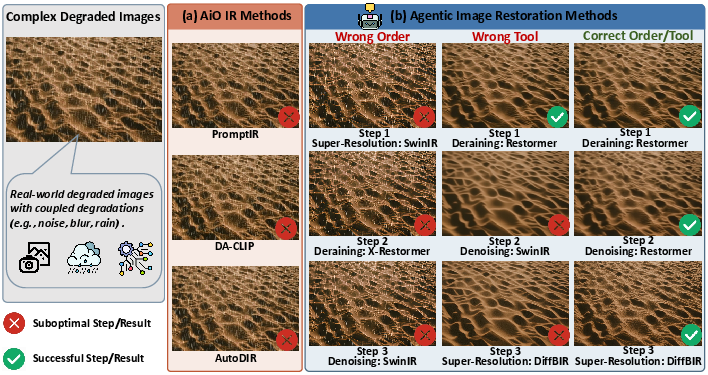
Figure 1: Static AiO models and greedy execution strategies are highly sensitive to decision sequences and can result in irreversible degradation or over-smoothing.
Recent agentic IR frameworks, leveraging LLMs for restoration tool planning, address some flexibility but still suffer from two major deficiencies: excessive reliance on greedy policy search, which yields suboptimal or locally optimal trajectories; and underuse of prior experience, exhibiting what is termed "episodic amnesia," wherein agents do not reuse previously discovered high-reward trajectories for similar scenarios. This results in repeated cold-start explorations and inefficiency, especially in long-horizon and high-dimensional restoration tasks (Figure 2).
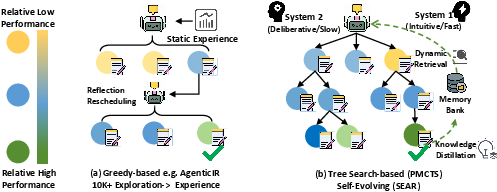
Figure 2: Myopic (greedy) decision strategies yield suboptimal local choices, while SEAR's dual-process approach enables globally optimized restoration plans.
The SEAR Framework: Architectural Overview
SEAR (Self-Evolving Agentic Image Restoration) addresses these gaps by modeling restoration as a long-horizon sequential decision-making problem. The architecture is explicitly dual-process, inspired by the dual-process theory from cognitive science: a fast, memory-driven Intuitive Executor (System 1) and a slow, reasoning-intensive Deliberate Planner (System 2), with a self-evolving episodic memory as the bridge (Figure 3).
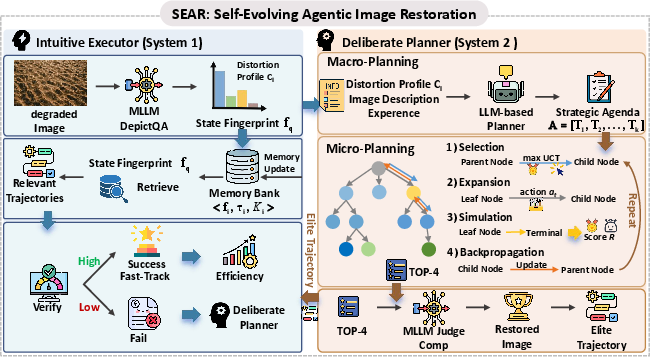
Figure 3: SEAR’s dual-process design progressively distills search-based plans into episodic memory for future rapid execution, shifting from compute-intensive planning to memory-guided inference.
The Intuitive Executor retrieves previously distilled, high-potential restoration trajectories using degradation-aware state fingerprints, allowing for efficient, memory-driven inference when applicable. The Deliberate Planner, invoked for novel or uncertain cases, employs a hierarchical Pruning-Aware Monte Carlo Tree Search (P-MCTS), guided by an LLM for macro task scheduling (agenda generation) and an MLLM-based perceptual reward ensemble for robust search guidance.
Methodological Contributions
Restoration is formulated as a trajectory τ through a space of ordered tool applications (actions) over the input image. Critically, the reward R(IH) for a restoration trajectory is no-reference and hybrid, combining aesthetics (HPSv2) and multiple NR-IQA metrics (e.g., NIQE, MANIQA, MUSIQ, CLIP-IQA), with the final perceptual quality judged by a tournament among candidate solutions using an MLLM.
Self-Evolving Memory and State Abstraction
The episodic memory M contains tuples of degradation fingerprints, associated tool trajectories, and reward statistics. The state fingerprint is a semantic abstraction derived via an MLLM-based degradation diagnosis, quantized over a taxonomy of primitive distortions and intensities, ensuring robust, content-invariant and efficient keying for trajectory retrieval.
During inference, the Intuitive Executor retrieves and executes the high-potential trajectory if its expected reward passes a reliability gating threshold; otherwise, the agent falls back to deliberate planning. As new P-MCTS plans yield high rewards, they are incorporated, pruned, and distilled into M—enabling a continual shift from deliberation to amortized, memory-guided execution as experience accumulates (Figure 4).
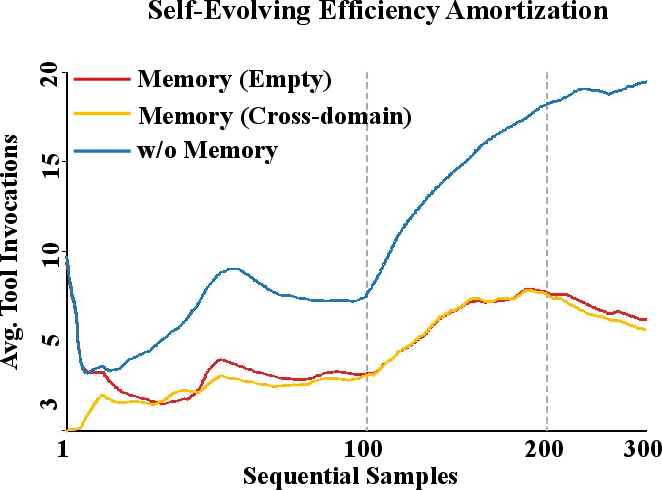
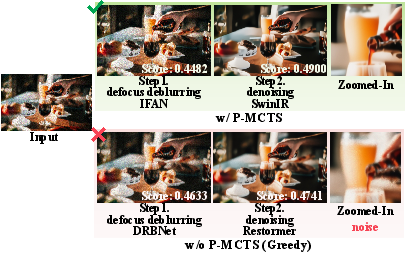
Figure 4: The agent’s memory self-evolves over deployment, accelerating trajectory retrieval and shrinking planning overhead as more situations are encountered.
Hierarchical Planning via P-MCTS
The Deliberate Planner operates hierarchically: macro-planning via LLM-generated agendas limits search breadth, while micro-planning via P-MCTS enables rollouts over constrained action sets at each stage, balancing exploration (via UCT) and exploitation. Pruning, caching, and tournament-based perceptual selection (top-4 candidates judged by MLLM) ensure that planning avoids adversarial reward exploitation and maintains alignment with human perception (Figure 5).
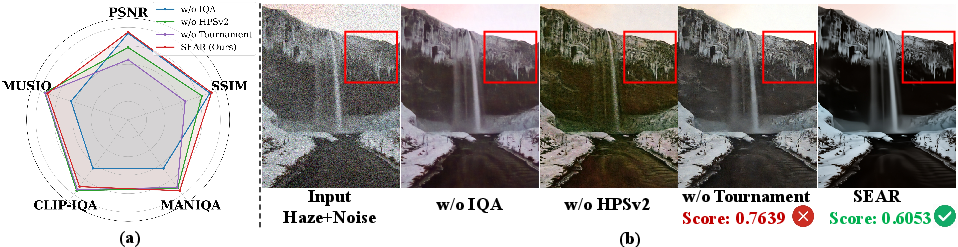
Figure 5: Ablation of reward design highlights the importance of combining perceptual and aesthetic calibrations to prevent metric exploitation and preserve visual quality.
Empirical Validation
SEAR outperforms AiO and previous agentic baselines on synthetic and real-world benchmarks in both reference-based (PSNR, SSIM) and no-reference (LPIPS, MANIQA, CLIP-IQA, MUSIQ) metrics. Gains are strongest in regimes involving challenging, unseen degradation combinations, confirming the effectiveness of global trajectory optimization and adaptive experience reuse.
Visual comparisons show that SEAR better preserves fine textures and structural details relative to over-smoothing and residual artifact issues common in competitors (Figures 4–5).
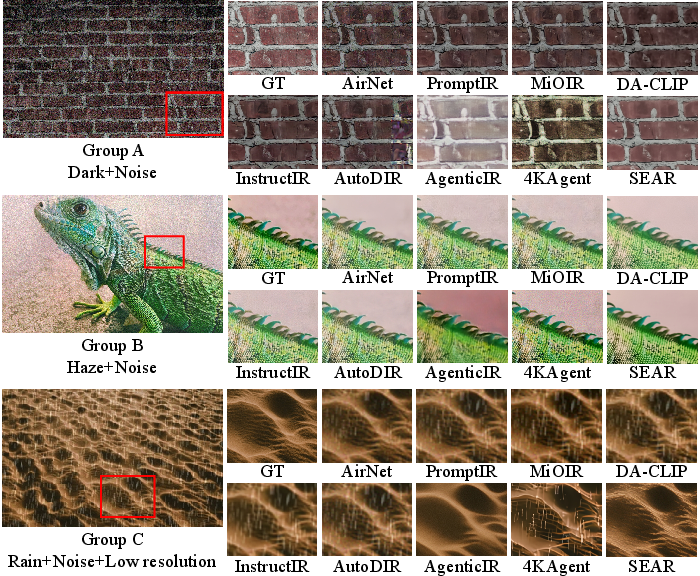
Figure 6: SEAR demonstrates strong qualitative recovery in synthetic data across diverse mixed-degradation scenarios.
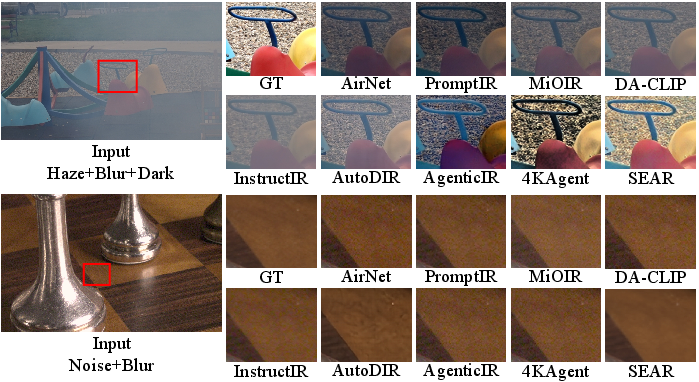
Figure 7: On real-world images, SEAR restores natural textures and avoids artifacts that persist in static or greedily planned outputs.
Ablation and Memory Routing
Ablation studies confirm the necessity of each architectural component:
- Removing memory doubles tool calls per image, indicating the efficiency of amortized planning.
- Disabling P-MCTS (replacing with greedy heuristics) yields a large PSNR drop, underscoring the need for long-horizon trajectory optimization.
- Removing macro-task decomposition or semantic fingerprinting severely degrades both quality and efficiency.
Routing statistics indicate that SEAR routes a high proportion of cases through memory-accelerated execution, especially as experience accumulates, with the reliability gate ensuring that retrieval shortcuts do not compromise quality.
Robustness and Sensitivity
Hyperparameter sensitivity analysis reveals that SEAR’s performance is robust across a reasonable range of planning, gating, and memory parameters. The hybrid reward and MLLM-based tournament effectively prevent metric exploitation, as shown by both quantitative and perceptual analyses.
Practical and Theoretical Implications
SEAR advances the paradigm of adaptive, agentic image restoration by demonstrating (1) the criticality of long-horizon, global planning over greedy or purely heuristic baselines and (2) the viability of self-evolving episodic memory for amortizing planning cost in sequential, complex decision spaces. This framework generalizes beyond image restoration, offering a template for agentic reasoning in other vision and multimodal domains where task complexity and input diversity preclude one-size-fits-all or static models.
In practical terms, the ability to distill and reuse restoration strategies across similar cases can yield significant scalability benefits in real-world deployments, reducing latency and compute as the agent accumulates experience.
Theoretically, the work exemplifies a viable pathway for embedding dual-process cognitive architectures into AI agents, synthesizing deliberative planning and fast, expert retrieval mechanisms, and sets a benchmark for balancing exploration, exploitation, and continual adaptation in open-ended environments.
Conclusion
SEAR represents a rigorous dual-process agentic framework for real-world image restoration, marrying deliberate, long-horizon planning via hierarchical P-MCTS with intuition-driven execution via a self-evolving episodic memory. This architecture achieves robust, perceptually aligned restoration with increasing efficiency as it operates, pointing toward self-improving, scalable AI agents in vision. Future extensions may involve expanding the repertoire of restoration tools, refining state representations, or generalizing dual-process, self-evolving agents to other complex decision-making tasks in AI.

