- The paper establishes that semiclassical vacuum decay rates are identical in GR, TEGR, and STEGR due to the cancellation of boundary terms.
- It employs an O(4)-symmetric bounce formalism to compute tunneling exponents for Minkowski-to-AdS transitions, yielding precise lifetime estimates.
- The analysis reinforces that the classical equivalence of different gravitational formulations extends to quantum processes, informing constraints on modified gravity theories.
Vacuum Stability in the Geometric Trinity of Gravity: Classical and Quantum Equivalence
Introduction and Motivation
The analysis of vacuum stability, particularly the calculation of false vacuum decay rates, yields crucial constraints on particle physics beyond the Standard Model (BSM) and is deeply intertwined with gravitational dynamics. While gravitational effects on tunneling have traditionally been computed within the standard Riemannian framework of General Relativity (GR), the existence of multiple classically equivalent geometrical formulations—namely the Geometric Trinity of Gravity (GR, the Teleparallel Equivalent of GR [TEGR], and the Symmetric Teleparallel Equivalent of GR [STEGR])—prompts an investigation into whether such equivalence is preserved in quantum processes such as vacuum decay.
This work systematically addresses whether semiclassical tunneling rates, as determined by the bounce action in false vacuum decay, are invariant under the choice of gravitational formulation in Minkowski to AdS transitions, using the O(4)-symmetric bounce formalism. The analysis is carried out for GR, TEGR, and STEGR, utilizing the respective torsion, non-metricity, and curvature-based representations, and includes explicit computations of the relevant boundary terms.
Theoretical Framework: Geometric Trinity and Vacuum Stability
The Geometric Trinity of Gravity encapsulates three formulations:
- GR: Curvature-based, with dynamics determined by the Ricci scalar;
- TEGR: Torsion-based, utilizing tetrads and a flat, metric-compatible connection;
- STEGR: Non-metricity-based, with a flat and torsionless but non-metric connection.
All share the feature that their respective dynamical Lagrangians differ only by total derivative (boundary) terms, guaranteeing equivalence of classical field equations and solutions.
Vacuum decay in this context is analyzed semiclassically, using the method of Euclidean bounces. The scalar potential V(ϕ) with a local (false) and global (true) minimum is central to the analysis. The role of gravity is to modify the equations of motion for the bounce, altering the decay rate exponent through backreaction effects.
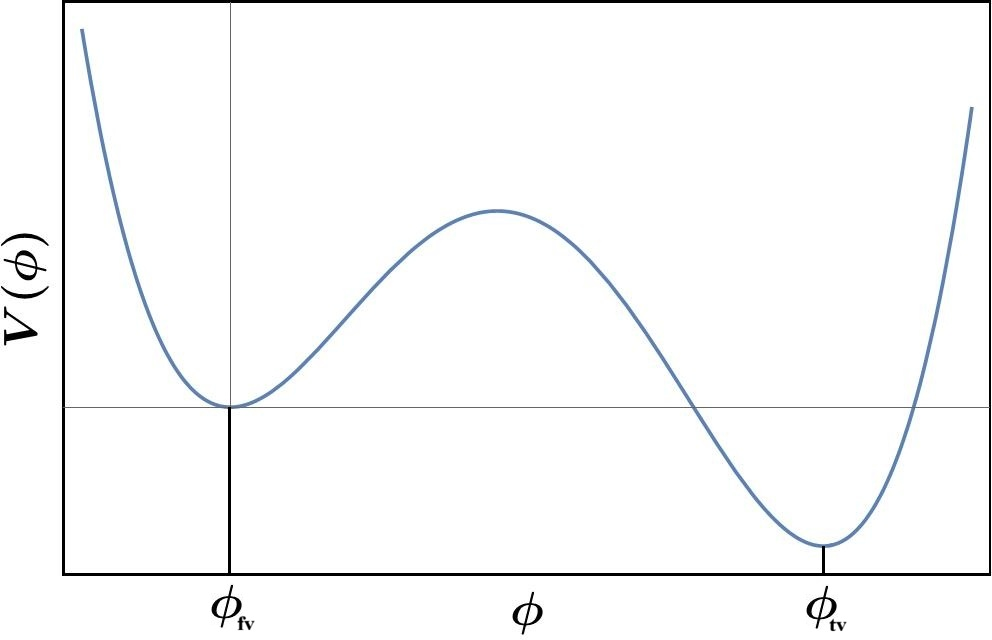
Figure 1: Sketch of the scalar potential V(ϕ), with ϕfv denoting the false vacuum (Minkowski) and ϕtv the AdS true vacuum.
The decay rate per unit volume, in leading semiclassical approximation, is
Γ/V∼De−B,B=Sbounce−Sfv
where B is the tunneling exponent.
Standard General Relativity (GR)
Within GR, the bounce profile is determined by coupled scalar field and gravitational equations in an O(4)-symmetric Euclidean background. The analytical structure and numerical procedure for obtaining bounce solutions and the associated actions are standard, including the necessity of the Gibbons-Hawking-York (GHY) boundary term for a well-posed Dirichlet variational principle.
TEGR
TEGR replaces curvature with torsion, employing tetrads and a flat, metric-compatible affine connection (Weitzenböck connection). The tetrad formalism is used, and the torsion scalar T takes the place of the Ricci scalar in the action. The field equations match those of GR, up to a boundary term involving the divergence of the torsion vector.
STEGR
STEGR relies on non-metricity, with a flat and torsionless affine connection but non-vanishing non-metricity tensor Qαμν. The Lagrangian is constructed from quadratic invariants of non-metricity. Flatness and torsionlessness are imposed, and the dynamics follow from the variation of the non-metricity scalar. Again, the field equations coincide with those of GR, up to a total divergence involving traces of non-metricity.
Boundary Terms and Quantum Equivalence
For both TEGR and STEGR, the central technical issue is whether the divergence (boundary) terms introduced in going from curvature to torsion or non-metricity formulations can contribute to the tunneling exponent V(ϕ)0, and thus to observable vacuum decay rates.
The analysis demonstrates that:
- The boundary terms in the actions, when evaluated on the bounce and false vacuum configurations, either vanish at V(ϕ)1 or cancel between the two configurations as V(ϕ)2.
- The semiclassical tunneling exponent is therefore invariant:
V(ϕ)3
for Minkowski-to-AdS transitions in the V(ϕ)4-symmetric bounce scenario.
Asymptotic and Numerical Results
The work provides explicit expressions for connections, superpotentials, torsion vectors, and non-metricity traces in V(ϕ)5-symmetric configurations for both TEGR and STEGR. The asymptotic behavior of bounce solutions is analyzed, demonstrating the cancellation or vanishing of boundary contributions.
Strong numerical lifetime estimates for the electroweak vacuum are reported, both without gravity (V(ϕ)6) and including gravitational corrections (V(ϕ)7), confirming earlier results in the literature. These values show the tunnelings are exponentially suppressed, with effectively stable vacua over cosmological timescales.
Implications and Outlook
Bold claim: The observed semiclassical quantum equivalence among GR, TEGR, and STEGR is not merely a restatement of classical equivalence, but a non-trivial statement about quantum processes in distinct, albeit classically equivalent, geometrical frameworks. This supports the claim that for all matter couplings and tunneling processes reducible (via field redefinition and boundary subtraction) to the standard bounce scenario, the Geometric Trinity yields identical physical predictions at the semiclassical level.
This result has significant theoretical implications:
- It supports the predictive consistency of semiclassical calculations in any of the trinity representations, assuming the dynamical equivalence remains valid.
- It constrains scenarios where boundary terms or quantum gravity corrections could spoil such equivalence, notably in extended metric-affine, V(ϕ)8, V(ϕ)9, or V(ϕ)0 theories.
- It highlights the importance and subtlety of boundary terms in quantum tunneling problems in gravitational backgrounds.
Future work can explore:
- Whether quantum (loop-level) corrections or coupling to hypermomentum in truly dynamical affine-connection theories could lead to observable departures from this equivalence.
- How non-linear generalizations of the trinity (such as V(ϕ)1 or V(ϕ)2) alter decay rates and whether remnants of the boundary-term argument persist.
- Hamiltonian (canonical) approaches to tunneling in non-Riemannian geometries, which may shed light on possible inequivalences at a more fundamental level.
Conclusion
This analysis establishes that semiclassical vacuum decay rates, as encoded in the tunneling exponent V(ϕ)3, are invariant under the choice of GR, TEGR, or STEGR gravitational frameworks for Minkowski-to-AdS transitions with V(ϕ)4 symmetry. The explicit evaluation of boundary terms confirms their non-contribution in these scenarios, providing a concrete test case for the quantum-level robustness of the Geometric Trinity. The results reinforce the deep interplay between geometry and quantum field dynamics and mark an important consistency check for future studies in quantum gravity and metric-affine theories.

