- The paper demonstrates that spontaneous symmetry breaking in a pre-geometric gauge theory yields effective metric-affine actions representing curvature (GR), torsion (TEGR), and non-metricity (STEGR).
- It constructs explicit mappings between pre-geometric fields and standard gravitational variables, clarifying the gauge-fixing required to manifest the geometric trinity.
- The framework unifies distinct gravitational formulations and suggests novel high-energy insights that could impact quantum gravity research.
The Pre-geometric Origin of the Geometric Trinity of Gravity
Introduction
The paper addresses a foundational aspect of gravity: the emergence of the so-called "geometric trinity"—curvature, torsion, and non-metricity—as effective descriptions within the metric-affine paradigm, proposing their deeper origin in pre-geometric gauge theory. The authors demonstrate that all three avatars of gravity—General Relativity (GR), its teleparallel equivalent (TEGR), and the symmetric teleparallel equivalent (STEGR)—can be understood as effective low-energy limits of a pre-geometric phase, itself described via spontaneous symmetry breaking (SSB) in a gauge-theoretic framework with a Higgs-like field. They establish explicit mappings between the pre-geometric action and the standard metric-affine actions, elucidating the gauge-fixing that yields the familiar geometric trinity.
Pre-geometric and Metric-affine Gravity
Metric-affine gravity, formulated in the Palatini approach, treats the metric gμν and the affine connection Γμνλ as independent dynamical variables, with the possibility of nonzero curvature R, torsion Tμνλ, and non-metricity Qλμν. Conventionally, these geometric structures are realized via the Levi-Civita, Weitzenböck, or coincident connections, underlying GR, TEGR, and STEGR, respectively.
By contrast, pre-geometric gravity postulates no prior metric structure; it is formulated as a gauge theory for the (anti-)de Sitter or general linear group, built upon a differentiable manifold with a gauge potential and a Higgs-like field. The effective metric and gravitational dynamics emerge only after SSB, when the Higgs-like field acquires a vacuum expectation value, breaking the gauge group to the Lorentz or GL(4) subgroup.
Emergence of the Geometric Trinity from Pre-geometry
A principal result demonstrated is that the process of SSB generically yields the field content and dynamics of metric-affine gravity, with curvature, torsion, and non-metricity emerging depending on the gauge fixing and group structure imposed in the unbroken phase.
The authors detail a precise "pre-geometric dictionary" relating pre-geometric structures (built from the gauge potential and the Higgs field) to the metric, tetrads, and affine/spin connections arising after SSB. For example, the components of the gauge field AμAB with internal index along the broken direction correspond to tetrads, while those within the residual symmetry become the spin connection. The identification is formalized for both the Einstein–Hilbert and more general invariant structures, including the torsion and non-metricity scalars, by appropriate gauge fixing and construction of pre-geometric Lagrangians.
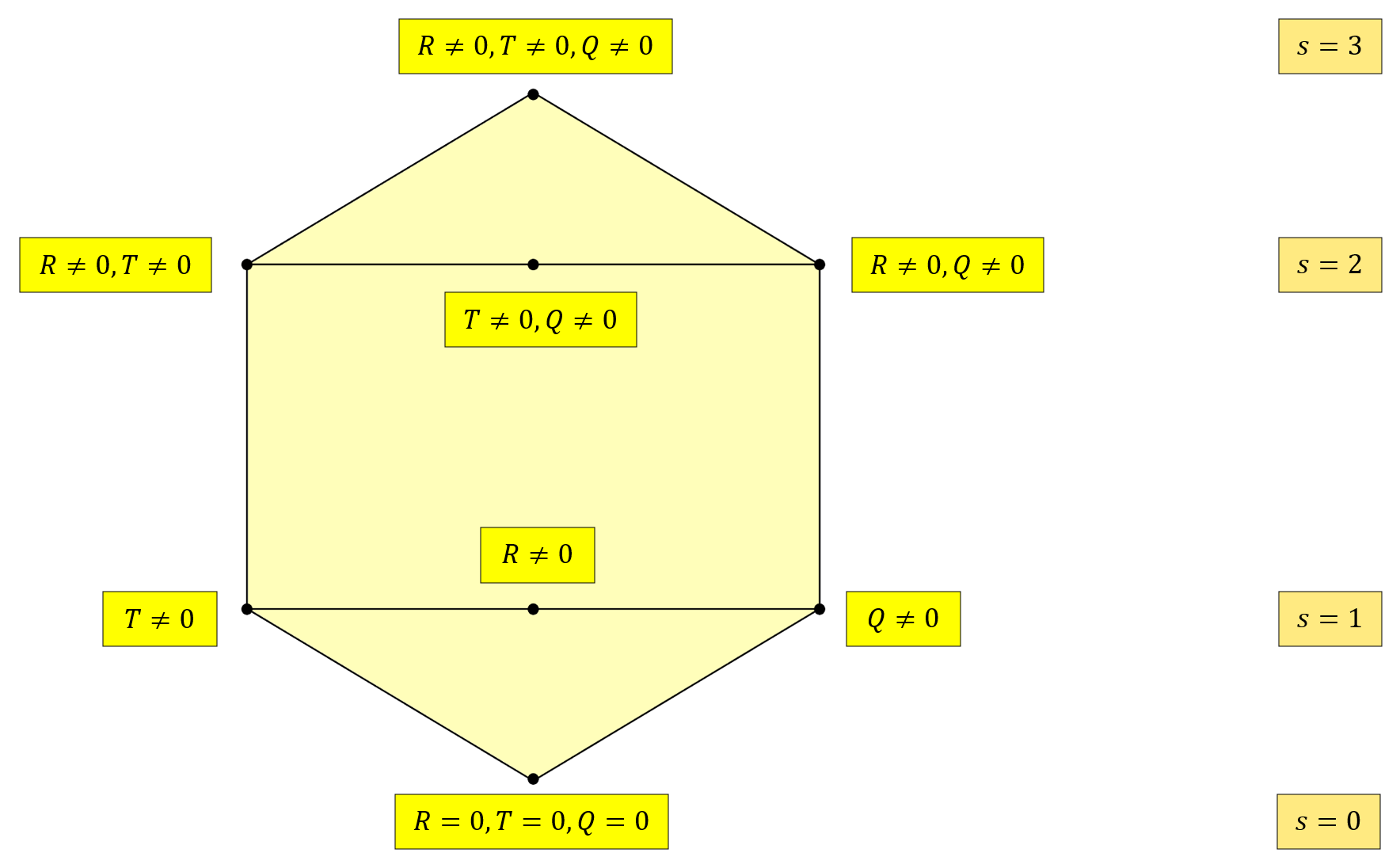
Figure 1: The octet of gravity—a diagrammatic classification of metric-affine theories based on the number s of nonzero geometric invariants (R, T, Γμνλ0). The geometric trinity corresponds to Γμνλ1.
In the case of non-metricity, which requires a non-Lorentzian, generally Γμνλ2 spin connection, the unbroken phase must be endowed with the higher Γμνλ3 symmetry, subsequently reduced to Γμνλ4 by SSB. The pre-geometric action includes the Higgs mechanism as an essential ingredient, and additional gauge-fixing ensures the absence of spurious degrees of freedom from the enlarged group.
Construction of Pre-geometric Actions
The paper systematically builds pre-geometric analogs for the gravitational actions corresponding to the trinity of gravity:
- Curvature-based (GR): The pre-geometric Wilczek Lagrangian, possibly augmented to eliminate the cosmological constant, produces the Einstein–Hilbert action under SSB. The Planck mass and cosmological constant emerge dynamically from the VEV and coupling constants.
- Torsion-based (TEGR): Suitable scalar invariants constructed in the pre-geometric phase, via antisymmetrized double covariant derivatives of the Higgs field, yield the torsion scalar Γμνλ5 after symmetry breaking.
- Non-metricity-based (STEGR): By generalizing the pre-geometric gauge potential to Γμνλ6 and imposing the required gauge conditions, the construction gives the non-metricity scalar Γμνλ7.
The approach is fully generalizable. For any Γμνλ8 theory, one can define an associated pre-geometric action, which flows to the corresponding metric-affine theory in the broken phase, as dictated by the form of the scalar invariants in the pre-geometric sector.
Gauge Choices and Physical Implications
The correspondence between gauge choices for the affine connection in the metric-affine setting and gauge-fixing conditions in the pre-geometric theory is explicitly developed. For instance, the Levi-Civita, Weitzenböck, and coincident gauges correspond to specific configurations of the gauge potential in the pre-geometric phase, realized by targeted gauge-fixing aligned with the spontaneous breaking.
The framework demonstrates that metric-affine gravity with any combination of curvature, torsion, or non-metricity (as illustrated by the "octet" in Figure 1) can be unified as emergent phenomena within pre-geometric gauge theory. This synthesis points toward a broader perspective in quantum gravity, wherein the low-energy geometric notions are secondary to pre-geometric, gauge-theoretic origins.
Theoretical and Phenomenological Implications
Theoretically, the pre-geometric scenario recasts gravity as a gauge-Higgs phenomenon, demoting the metric to a derived concept. The unification and mutual equivalence of the trinity indicate that differences between curvature, torsion, and non-metricity are not fundamental, but mere facets of the emergent metric-affine geometry.
Phenomenologically, the framework introduces additional degrees of freedom, specifically those associated with the Higgs-like field, which are inert at low energy but potentially significant near the Planck scale. The emergent view suggests that observable deviations from GR, particularly in the UV/early universe regime, may serve as tests of the underlying pre-geometric scenario. Moreover, the approach circumvents Ostrogradsky instabilities, as the pre-geometric actions—by construction—avoid higher-derivative pathologies.
Future directions include a detailed Hamiltonian analysis to ascertain constraint structure and the true dynamical content; the extension to quantum corrections and the viability of resolutions to the cosmological constant problem; and explorations of coupling to Standard Model matter within the pre-geometric scheme.
Conclusion
The work rigorously establishes that any metric-affine theory of gravity—classified by its nonzero curvature, torsion, and non-metricity—can be interpreted as an emergent low-energy phase of a pre-geometric gauge theory. Spacetime geometry itself is revealed as a dynamical consequence of SSB in a gauge-Higgs system, with the geometric trinity arising from different gauge choices and group reductions. This comprehensive correspondence not only unifies the trinity but generalizes to all Γμνλ9-type theories, advocating for a genuinely pre-geometric, gauge-theoretic foundation for gravitational physics.

