A3M: Adaptive, Adversarial and Multi-Objective Learning for Strategic Bidding in Repeated Auctions
Published 27 Jun 2026 in cs.CL and cs.LG | (2606.28943v1)
Abstract: Learning to bid in repeated multi-unit auctions with bandit feedback poses a fundamental challenge. Existing methods often rely on rigid explore-then-exploit schedules, assume stationary adversaries, and optimize solely for bidder utility, thereby limiting adaptability and strategic robustness. To address these limitations, we introduce the A3M framework, which integrates adaptive deep reinforcement learning (DRL), explicit adversarial reasoning, and principled multi-objective reward design for online auction strategy optimization. A3M employs an actor-critic DRL backbone to dynamically balance exploration and exploitation, an opponent model for fictitious play against non-stationary adversaries, and a composite reward function to jointly maximize utility, auctioneer revenue, and fairness. We provide the first comprehensive empirical evaluation of this integrated approach against established baselines in both discriminatory and uniform price auctions. Results show that A3M reduces final regret by 30--40\% in standard settings, maintains robust performance against adversarial strategy shifts, scales favorably with the number of units $K$, and enables tunable multi-objective trade-offs. An extensive ablation study confirms the necessity of each core component. Our work establishes A3M as a powerful and flexible framework for learning in complex auction environments.
The paper presents the A3M framework that integrates adaptive deep reinforcement learning, adversarial modeling, and multi-objective optimization for strategic bidding.
It demonstrates significant regret reductions of 30-40% over baselines and shows sublinear scaling with auction size in both stochastic and adversarial settings.
Empirical evaluations and ablation studies confirm A3M’s robustness, rapid convergence, and practical viability across diverse auction formats and non-stationary environments.
Adaptive, Adversarial, and Multi-Objective Bidding in Repeated Multi-Unit Auctions: A Critical Synthesis of the A3M Framework
Problem Formulation and Motivation
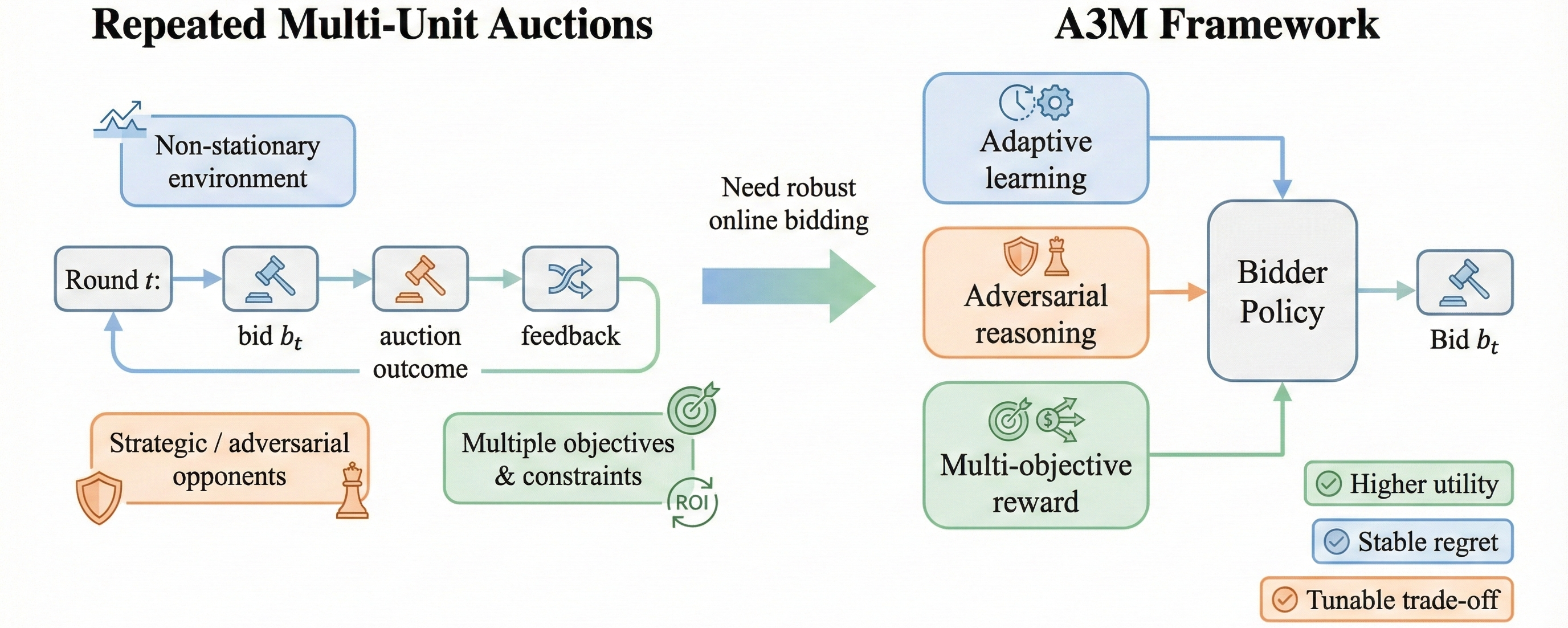
Strategic bidding in repeated multi-unit auctions is central to modern market design, with applications spanning electricity markets, government securities, and digital advertising. The bandit feedback setting, in which bidders observe allocations and payment but not full opponent bids, introduces fundamental statistical and strategic challenges, especially under non-stationary and adversarial environments. Standard approaches—rigid explore-then-commit policies and single-objective utility maximization—fail to address non-stationarity, strategic adaptation, and practical objectives beyond bidder utility.
Figure 1: Motivation—repeated auctions involve non-stationarity, adversarial opponents, and multiple competing objectives, necessitating an adaptive, adversarial-aware, and multi-objective framework.
The A3M Framework: Architecture and Core Components
The A3M (Adaptive, Adversarial, Multi-objective) framework is introduced to address these gaps by synergizing adaptive deep reinforcement learning (DRL), explicit adversarial modeling, and multi-objective optimization in a cohesive architecture.
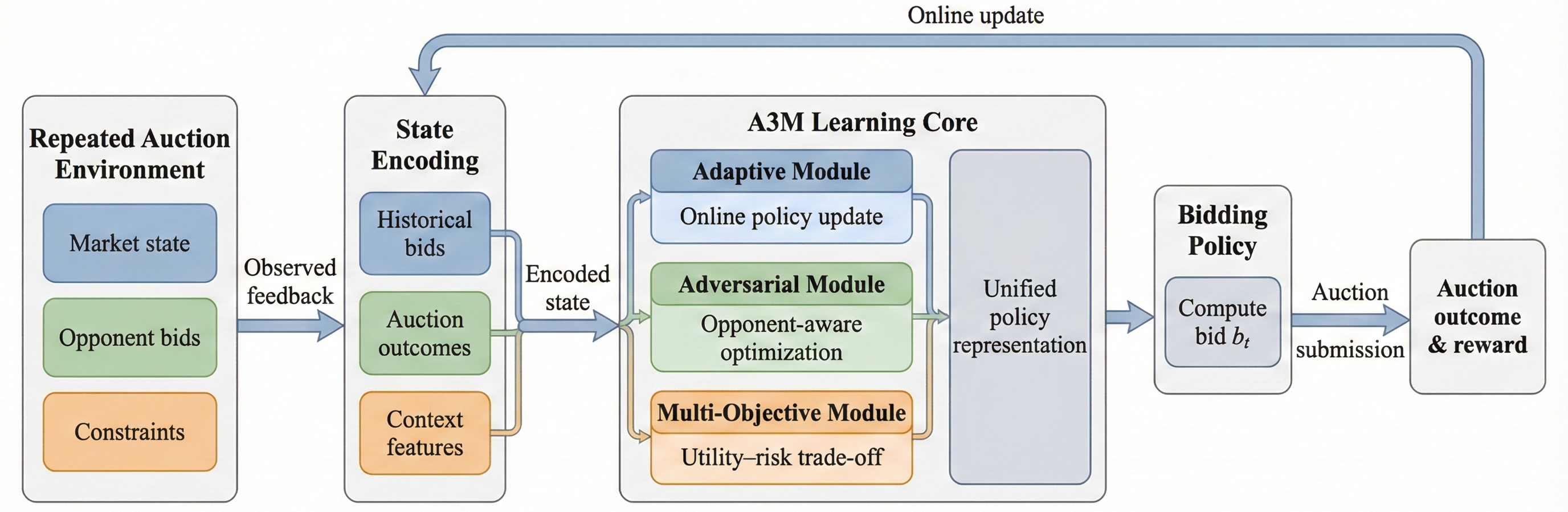
A3M reformulates the bidding policy as a structured neural function ϕ over item indices, with parameters ψt computed by an actor network conditioned on auction state history. This structure encodes monotonicity and promotes interpretability. The framework maintains an explicit opponent model Pϕ parameterized by a latent state zt, supporting real-time fictitious play and dynamic best-response adaptation. Multi-objective reward design replaces classic utility with a composite reward R(b,β;λ), weighted by λ to balance bidder utility, auctioneer revenue, and fairness regularization.
Figure 2: Overview of the A3M architecture—auction states are encoded and processed to perform adaptive learning, adversarial reasoning, and multi-objective optimization.
Learning is conducted through an actor-critic RL backbone, leveraging continuous updates informed by both the value function (critic) and opponent model (for adversarial awareness). The policy is updated via stochastic policy gradient, leveraging advantage estimation over multi-objective reward signals and normalized for improved stability.
Theoretical Insights and Regret Analysis
A key contribution is a rigorous contextualization of regret rates across auction formats and feedback regimes. The work provides proofs that, under adversarial and stochastic settings:
Both discriminatory and uniform auctions achieve tight minimax regret rates of Θ~(T2/3) under bandit feedback.
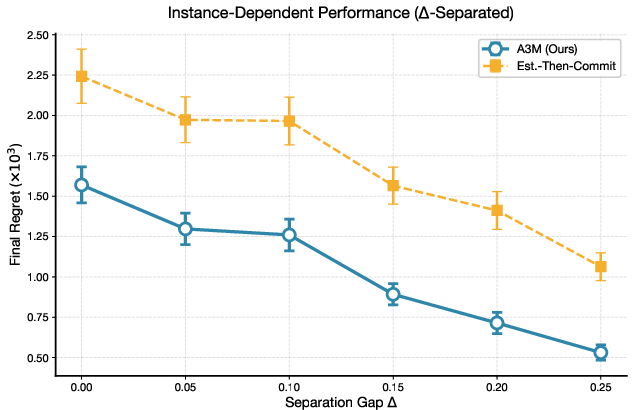
For structured adversaries (e.g., i.i.d. bids or Δ-separated distributions), uniform auctions allow O~(T) regret—contrasting with discriminatory auctions, which remain lower-bounded by Ω(T2/3).
A3M’s continuous adaptive learning, strategic opponent modeling, and policy flexibility yield lower regret both in worst-case and instance-dependent settings, outperforming phase-based and non-adaptive baselines. The analysis is further extended to establish sublinear regret guarantees in the i.i.d. adversarial regime and characterize circumstances under which uniform auctions are strictly easier to learn.
Figure 3: Instance-dependent regret—A3M achieves stronger performance than baseline as separation gap ψt0 increases in adversary distributions.
Empirical Evaluation
A3M is empirically benchmarked against state-of-the-art baselines across a series of auction scenarios:
Standard Stochastic and Adversarial Environments
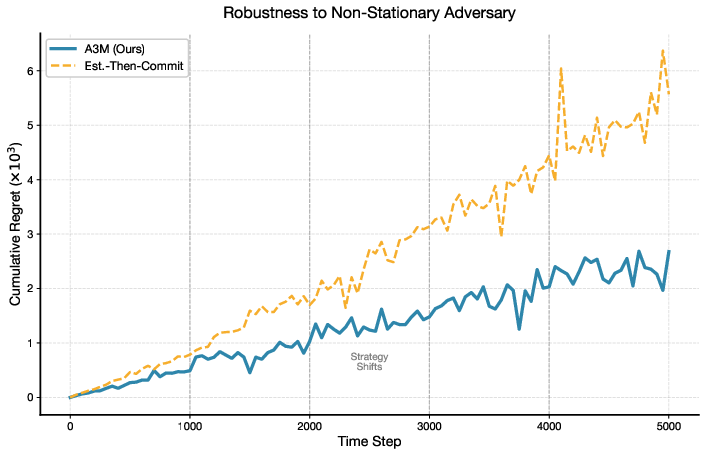
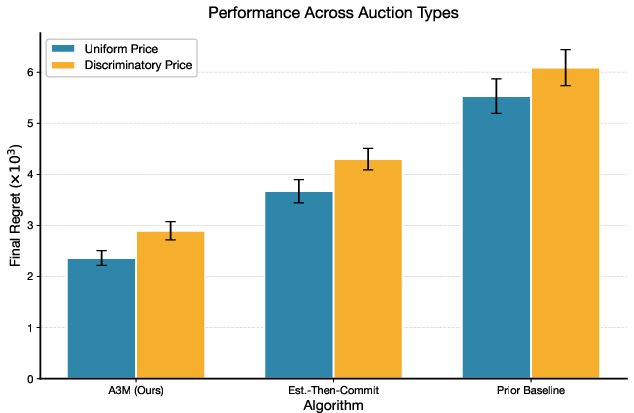
In standard stochastic settings for ψt1, ψt2, A3M demonstrably reduces final regret by 30-40% compared to prior methods. Under adversarial regime switches, explicit opponent modeling allows A3M to swiftly adapt to new strategies, drastically lowering accumulated regret, in stark contrast to fixed-schedule baselines.
Scalability and Multi-Objective Optimization
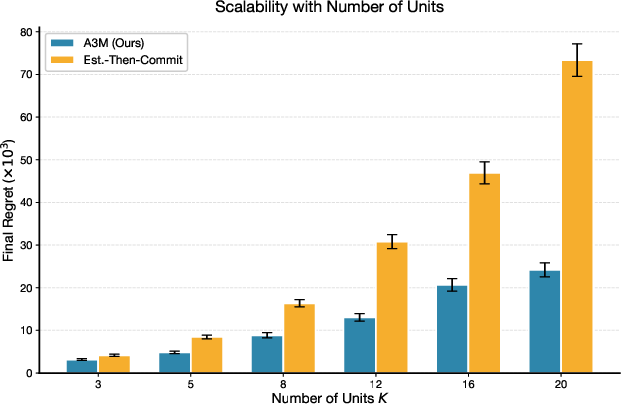
A3M’s structured policy representation yields favorable scaling with auction size ψt3, substantially tempering regret growth relative to phase-based alternatives.
Figure 4: Scalability—A3M’s regret growth is significantly sublinear in ψt4, outperforming the baseline.
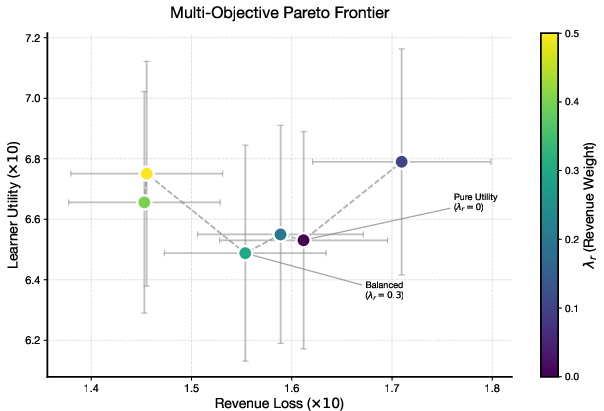
Tuning the reward vector ψt5 enables precise control over utility and auctioneer revenue, supporting application-aligned mechanism objectives. A3M’s ability to traverse the utility-revenue Pareto frontier is empirically visualized.
Figure 5: Multi-objective trade-off—a range of ψt6 configurations allow for fine-grained negotiation between learner utility and auctioneer revenue loss.
Component Ablation
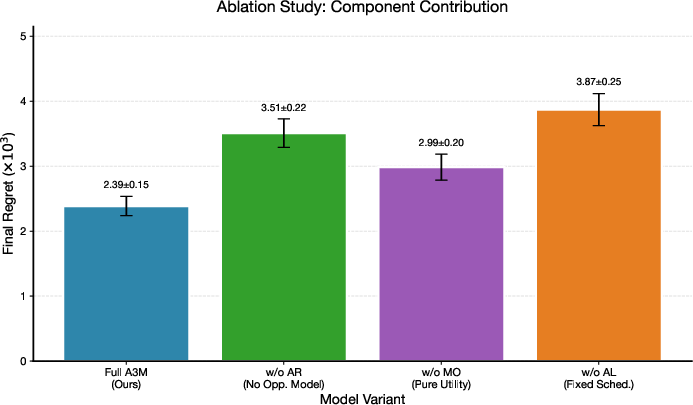
Ablation studies validate the necessity and contribution of three core modules:
Adaptive RL is critical for instance-adaptive performance and flexible exploitation-exploration tradeoff;
Adversarial Reasoning ensures robustness under strategy shifts;
Figure 6: Ablation study—removal of each component induces marked regret increases, confirming their mutual indispensability in A3M.
Convergence and Robustness
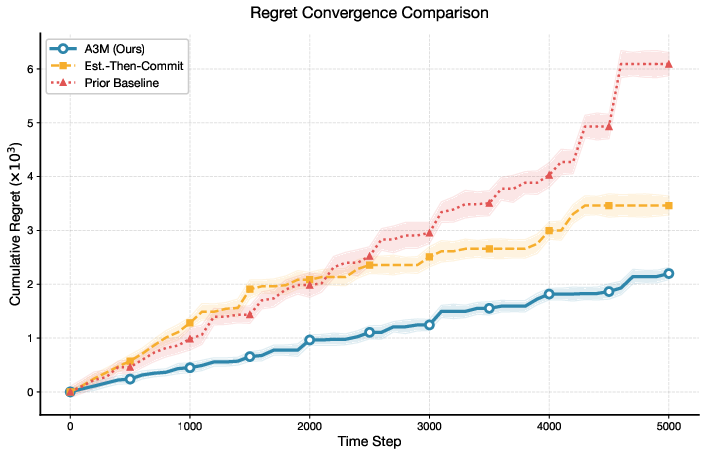
Notably, A3M achieves smoother and faster regret convergence than baselines, with empirical trajectories demonstrating both rapid adaptation and lower variance.
Figure 7: Regret trajectories—A3M displays faster convergence and adaptability versus baselines.
A3M is robust to hyperparameter variations (learning rate, discount, buffer size), non-stationary opponent regimes, and is agnostic to auction type, consistently outperforming in both discriminatory and uniform settings.
Figure 8: Robustness—A3M rapidly recovers from adversarial regime shifts, while baselines accumulate persistent regret.
Figure 9: Auction-type comparison—A3M exceeds the performance of baselines in both uniform-price and discriminatory-price formats.
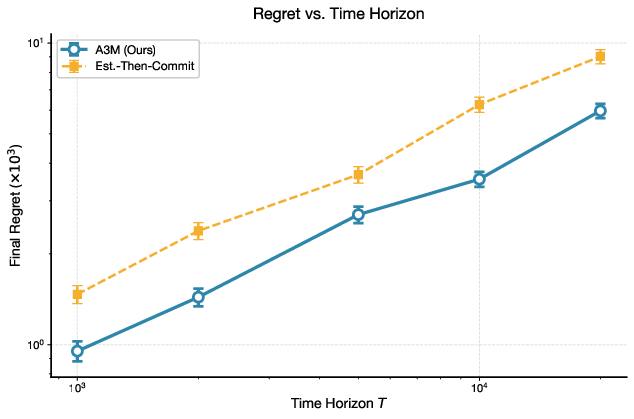
Figure 10: Time horizon scaling—final regret is consistently sublinear in ψt7, with A3M maintaining a lower curve across all horizons.
Implications and Future Research Trajectories
A3M’s integrated design addresses pressing challenges in adaptive bidding, adversarial robustness, and application-aligned objective optimization. The framework’s success in practical, noisy, and adversarial settings demonstrates the viability of DRL-based approaches for real-world auction design and dynamic market interaction, providing a modular solution for a wide variety of mechanism design environments.
On the theoretical side, the completion of lower-bound scaling results and the demonstration of instance-dependent performance open up new avenues in auction learning theory, particularly regarding the optimal use of feedback richness in mechanism design.
From a practical AI standpoint, the explicit separation—and integration—of learning, adaptation, and design objectives prescribes a template for multi-agent systems in adversarial domains, suggesting direct analogues in resource allocation, pricing, and collaborative control under uncertainty.
Future work should extend theoretical guarantees for the composite objective, generalize the A3M paradigm to richer mechanism design landscapes (e.g., combinatorial auctions, endogenous information revelation), and explore fine-grained interpretability and human-in-the-loop control within adaptive multi-objective frameworks.
Conclusion
A3M advances the field of online auction strategy learning by providing a rigorous, empirically validated, and practically flexible architecture for strategic bidding under uncertainty. Through its integration of deep RL, adversarial modeling, and multi-objective reward optimization, it establishes new standards for adaptability, robustness, and mechanism alignment in repeated auction environments (2606.28943).