- The paper introduces a projection-based methodology using a pinhole camera model to integrate thermal and mechanical measurements on curved surfaces.
- The method employs radial basis functions for spatial and temporal interpolation, enabling computation of temperature gradients and rates.
- Experimental validation on polymer and metal specimens confirms the technique's robustness for thermo-mechanical coupling under varied loading conditions.
Projection-Based Coupling of Infrared Thermography and Stereocorrelation-Based Digital Image Correlation
Introduction
This work presents a projection-based methodology for fusing full-field thermal and mechanical measurements in solid mechanics, focusing on the integration of infrared thermography (IRT) and stereocorrelation-based digital image correlation (DIC) (2606.28905). Conventional approaches for combining DIC and IRT face substantial challenges, especially when dealing with non-planar geometries, due to the inherent disparity between Lagrangian 3D material point tracking and Eulerian 2D temperature field acquisition. The paper introduces an external, camera-model-driven approach leveraging the pinhole camera model to synchronize temperature and mechanical data at the material point level. Additionally, the framework is extended with global interpolation in both spatial and temporal domains using radial basis functions (RBFs), enabling the computation of in-plane temperature gradients and temperature rates on arbitrarily curved surfaces.
Methodological Framework
Camera Model Projection and Calibration
The core of the coupling protocol is the utilization of the pinhole camera model as a mapping between object (DIC-acquired) points and IR image coordinates. The transformation matrix M∈R3×4 encapsulates both intrinsic and extrinsic camera parameters and is calibrated via direct linear transformation (DLT).
The calibration requires only a single image of a 3D reference object containing visible markers for both the visible-light and IR systems, streamlining procedure logistics and decoupling the need for synchronized device or code bases. This simplicity stands in contrast to hybrid multiview schemes, which either require access to camera inner loops or rely on image-level digital signal correlation.
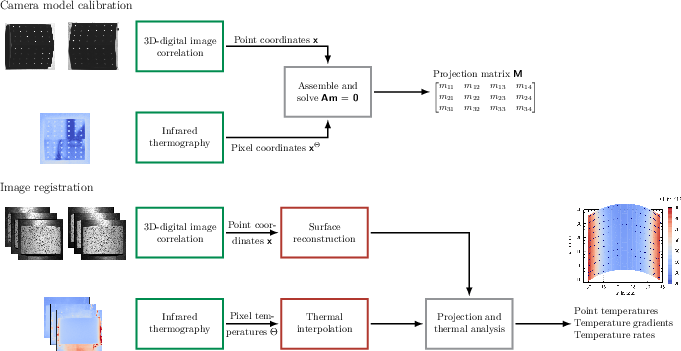
Figure 1: Overview of the projection and interpolation workflow for coupling stereocorrelation-based DIC and IRT, including camera model calibration and the projection of Lagrangian coordinates into the IR image plane.
Interpolation and Differential Data Analysis
The approach extends beyond simple pointwise remapping. By combining DIC-based 3D point coordinates with projected IR temperatures, the methodology allows comprehensive spatial and temporal interpolation using RBFs. This enables:
- Continuous reconstruction of complex curved surfaces from discrete point data.
- Computation of surface temperature gradients and temperature rates, which are unattainable from IR data alone.
The RBF framework is applied in both domains: surface interpolation exploits RBFs with monomial supplements for geometric fidelity, while pixel temperature fields are interpolated over the image plane, also allowing for temporal interpolation. Differentiable interpolation in the combined spatial–temporal domain is pivotal for robust evaluation of gradients and rates.
Experimental Validation
The efficacy and versatility of the approach are validated through two case studies:
Thermal Analysis on a Curved Polymer Half-Shell
A cylindrical polymer half-shell is subjected to controlled heating. The DIC system captures the 3D geometry, while the IR system records temperature evolution. The coupled projection and interpolation pipeline regenerates the temperature field on the material surface, enabling gradient and rate calculation.
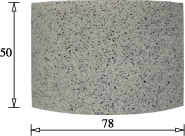
Figure 2: Geometry of the additively manufactured polymer half-shell specimen.
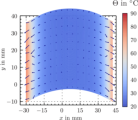
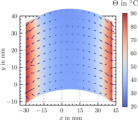
Figure 3: Temperature field and in-plane temperature gradient at t=180 s for the half-shell specimen.
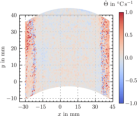
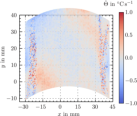
Figure 4: Temperature rate at t=180 s for the half-shell; field heterogeneity primarily reflects IR imaging noise for low-conductivity polymers.
Key findings underscore the restriction posed by low thermal conductivity materials on temperature rate quantification, with spatial noise dominating temporal derivatives; this motivates future RBF regression (smoothing) to suppress measurement noise.
Thermomechanical Coupling: Tube under Tension-Torsion
A second experiment on a zinc die-casting alloy tube under simultaneous tension-torsion demonstrates the approach under coupled mechanical and thermal loading, where strain, temperature, gradients, and rates are all quantifiable.
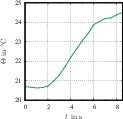
Figure 5: Temporal evolution of surface temperature at a representative material point in the tube experiment.
Due to the specimen's higher thermal conductivity, temperature rates are robustly extractable and track mechanical dissipation during loading and unloading phases.
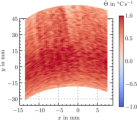
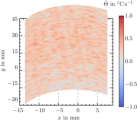
Figure 6: In-plane temperature gradient and rate on the curved tube surface at t=4 s, illustrating coupling with mechanical loading.
Implications and Future Directions
The fully external, modular projection-based protocol described is system-agnostic and well-suited for adoption in a broad range of experimental solid mechanics applications. By facilitating assignment of IR-derived temperatures to Lagrangian material points, the approach enables model calibration, validation, and data-driven discovery for both isotropic and anisotropic materials under complex loading, especially where standard hybrid image-level correlation is impractical or unavailable.
The paper advocates several research directions: rigorous propagation of measurement uncertainty through the projection and interpolation chain, targeted regression-based smoothing to manage temporal and spatial noise, and the design of experiments to maximize heterogeneity in thermo-mechanical fields—supporting parameter identification and model discrimination for advanced constitutive models.
Conclusion
This study introduces a projection-based coupling framework linking stereocorrelation DIC and IRT for full-field thermo-mechanical analysis, with a demonstrably straightforward calibration and data postprocessing chain. Leveraging RBF-based global interpolation, the method supports advanced differential analyses unavailable with either technique alone, notably in computing temperature gradients and rates on curved surfaces. Its modularity and extensibility provide a robust foundation for future experimental mechanics and data-driven model identification workflows in solid and structural mechanics.