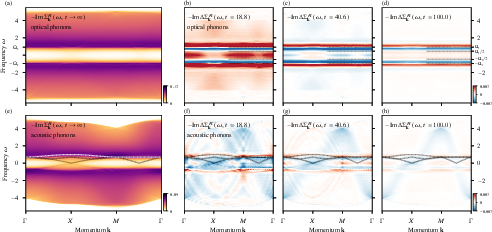
- The paper introduces a QTT-NEGF method to simulate nonequilibrium electron-phonon interactions with full momentum resolution.
- It identifies distinct relaxation bottlenecks, including main and reduced phonon windows, arising from energy and momentum conservation laws.
- The study highlights how momentum-dependent charge susceptibility and acoustic phonon dispersion critically impact thermalization dynamics in correlated solids.
Nonequilibrium Electron-Phonon Dynamics: Momentum-Resolved Relaxation Pathways and Bottlenecks
Introduction and Motivation
Understanding nonequilibrium dynamics in correlated solids, particularly the interplay between electrons and phonons, remains a significant challenge in condensed matter theory. While previous studies have elucidated important aspects using nonequilibrium Green’s function (NEGF) techniques, they frequently relied on approximations such as local self-energies and dispersionless (optical) phonons due to computational constraints. This restriction has limited the exploration of momentum-dependent effects, especially in the context of dispersive (acoustic) phonons, which are crucial for a realistic description of thermalization and relaxation phenomena following strong optical excitation.
The present work introduces large-scale, fully momentum-resolved NEGF simulations leveraging quantics-tensor-train (QTT) compression to overcome prohibitive memory demands. This enables the systematic study of relaxation dynamics in electron-phonon systems with arbitrary phonon dispersion across lattices up to 256×256 sites. The focus is on delineating the hierarchy of relaxation bottlenecks, their generalization beyond the conventional "phonon-window" picture, and the distinct impact of phonon dispersion on thermalization pathways.
Model and Methodology
The study considers a half-filled electron-phonon system on a 2D square lattice governed by a Fröhlich-type Hamiltonian with momentum-dependent electron and phonon operators and tunable phonon dispersion:
- Optical phonons: dispersionless, Ωq=Ω0
- Acoustic phonons: Ωq∼∣q∣ for small ∣q∣
- Intermediate regime: Interpolation between the two
Electron-phonon coupling satisfies appropriate scaling for both limiting cases. The system is excited via a sudden quench of the coupling strength from zero to g, setting the system out of equilibrium. The dynamics are treated within the renormalized Migdal approximation, providing fully self-consistent feedback between electrons and phonons.
The critical methodological advance is the use of QTT compression for two-time Green’s functions, which drastically reduces the memory footprint and enables high momentum and time resolution. This is achieved by representing functions as tensor trains in a quantized (binary) grid, with faithful and controllable truncation tolerances. All diagrammatic NEGF operations, including convolutions and Dyson equation solutions, are implemented purely in QTT form, eliminating the need to decompress large objects.
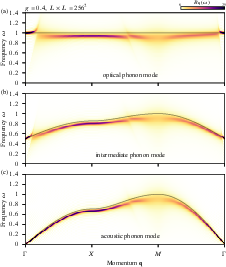
Figure 1: Bare and renormalized equilibrium phonon dispersions, Ωq (lines) and spectral maps Bq(ω), for optical, intermediate, and acoustic regimes.
Hierarchies of Thermalization Bottlenecks
Optical Phonon Case
After an abrupt electron-phonon coupling quench, rapid redistribution of the electronic population is followed by the emergence of persistent nonthermal distributions, particularly within well-defined momentum windows. The central observations are:
Nonthermal features are evident in both the electron occupation and the time-dependent self-energy. Scattering rate suppression and enhancement occur at characteristic energies, tracking the bottleneck and the reduced window boundaries. The long-time self-energy becomes nearly momentum-independent for optical phonons, aligning with previous observations supporting the validity of local (DMFT-like) self-energies for Holstein-type scenarios at moderate couplings.
Phonon Thermalization and Charge Correlation
Phonon relaxation is not homogeneous in momentum space—modes corresponding to weak charge responses (insignificant particle-hole pairing at a given momentum) display markedly slower return to equilibrium occupation. This is attributed to the direct imprint of the charge susceptibility structure on the renormalized phonon propagator, as both share analytic properties in the Migdal-level theory:
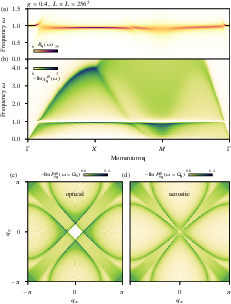
Figure 3: (a) Renormalized optical phonon spectral function Ωq=Ω03; (b) corresponding retarded charge susceptibility Ωq=Ω04; (c,d) Imaginary part of the bare particle-hole polarization at optical and acoustic phonon energies, respectively.
Regions with small charge susceptibility act as "thermalization traps", slowing the absorption or emission of phonons and thus leading to persistent nonthermal phonon populations at specific momenta. This phenomenon constitutes a second, distinct thermalization bottleneck.
Acoustic Phonon Case
Contrary to naive expectation, the presence of low-energy (near-gapless) acoustic phonons does not eliminate nonthermal bottlenecks. Instead:
- Persistence of the energy window: The bottleneck energy window obtains a pronounced momentum dependence, with its boundaries determined by the structure of simultaneous energy and momentum conservation. The boundaries are tracked accurately by analytic expressions derived from imposing both conservation laws in electron-phonon scattering.
- Population asymmetry and directional scattering: Unlike the optical case, a pronounced asymmetry appears between regions hosting excess and deficit populations; directional scattering, dictated by the band structure and phonon dispersion, enables efficient relaxation in some sectors but leaves other momentum regions (especially low-momentum phonons near Ωq=Ω05) underpopulated.
- Low-Ωq=Ω06 bottleneck: The electron-phonon matrix elements vanish as Ωq=Ω07, and the final thermalized state requires large occupation of these modes, leading to a persistent deficit at low Ωq=Ω08. The inability to efficiently populate low-energy phonons retards overall energy redistribution, coupling the fate of electron and phonon thermalization.
- Momentum-resolved phonon relaxation: The structures found in the equilibrium charge response are again mirrored in nonthermal distributions and the relaxation rates of phonon modes in the nonequilibrium regime.
Implications and Theoretical Perspective
This work demonstrates that even in the presence of full, dispersive phonon spectra, thermalization in coupled electron-phonon systems can be substantially delayed by phase space effects, momentum- and energy-space selection rules, and collective features in the charge and phonon responses. The identification of reduced as well as main phonon windows, and the explicit characterization of momentum-resolved relaxation traps, constitutes a significant advance over traditional models like the two-temperature paradigm, highlighting the necessity of energy- and momentum-resolved theoretical frameworks.
The QTT-NEGF formalism enables simulations at unprecedented scale and accuracy for nonequilibrium many-body systems, overcoming the historical barrier of prohibitive memory scaling. Its explicit momentum and time resolution brings numerically unbiased reference data for a range of phenomena previously only qualitatively understood or inaccessible.
From a practical standpoint:
- Experimental relevance: The computed momentum-resolved electron occupations and their relaxation trajectories have direct analogs in time-resolved ARPES, providing avenues for benchmarking and interpreting ultrafast experiments. The predicted reduced windows and persistent phonon mode populations could be directly probed by pump-probe spectroscopy or ultrafast electron diffraction.
- Benchmarking and extensions: The QTT-NEGF approach can provide benchmarks for kinetic theories, enable the study of the interplay between electron-phonon and electron-electron (e.g., Hubbard-type) interactions, or be incorporated as a reference for parameterizing effective models in more complex, realistic material simulations.
- Algorithmic future: Further optimization of tensor-train representations, as well as their extension to include multiple phonon branches, complex unit cells, or first-principles dispersions, is feasible and can generalize the approach to a wide array of materials and interactions.
Conclusion
Large-scale, momentum-resolved QTT-NEGF simulations reveal a nuanced hierarchy of relaxation bottlenecks in nonequilibrium electron-phonon systems, controlled by phonon dispersion, mutual electron-phonon feedback, and the structure of charge and phonon susceptibilities. These results refine and expand upon the established phonon-window paradigm, revealing reduced windows, spatially separated excess and deficit populations, and the critical role of phase space in defining slow relaxation channels. The methodology paves the way for direct, quantitative simulations of time-resolved phenomena in correlated electron-phonon systems and sets the stage for future theoretical and experimental exploration of nonequilibrium material science.