- The paper introduces a comprehensive analytic treatment of electron energy relaxation via two-phonon scattering, demonstrating the breakdown of the classical diffusion model.
- It derives explicit ERR scaling laws across distinct temperature regimes, including cubic, quadratic, and linear dependences in doped SrTiO₃ systems.
- The study offers actionable formulas and insights for interpreting ultrafast spectroscopy in quantum paraelectrics and related correlated materials.
Energy Relaxation Due to Two-Phonon Scattering of Electrons: Breakdown of the Energy Diffusion Model
Introduction
This work provides a comprehensive analytic treatment of electron energy relaxation rates (ERR) due to two-phonon (2TO) scattering in degenerate electron systems, highlighting parameter regimes for which the classical energy diffusion model fails. Focusing on systems such as doped SrTiO3 (STO) with t2g band structure and mutual Fermi surface orthogonality, the analysis spans deformation potential scattering (single acoustic phonon) and Frohlich-type polar coupling (simultaneous 2TO phonon emission or absorption). Both isotropic and highly anisotropic electron dispersions are considered, with particular attention to the temperature scaling of ERR across different regimes.
Theoretical Framework and Scattering Matrix Elements
The electron-phonon collision integrals are derived within a semiclassical Boltzmann framework and the two-temperature approximation. For the deformation potential case, the coupling is standard, with a T3 scaling for ERR in the low-temperature (Bloch–Grueneisen, BG) regime and a T−1 scaling in the high-temperature (equipartition) regime. For 2TO phonon polar (Frohlich) coupling, the matrix elements governing electron-lattice energy exchange are computed using Fermi's Golden Rule including direct and exchange diagrams. The formalism accounts for angular dependence and multi-band t2g structure in anisotropic scenarios.
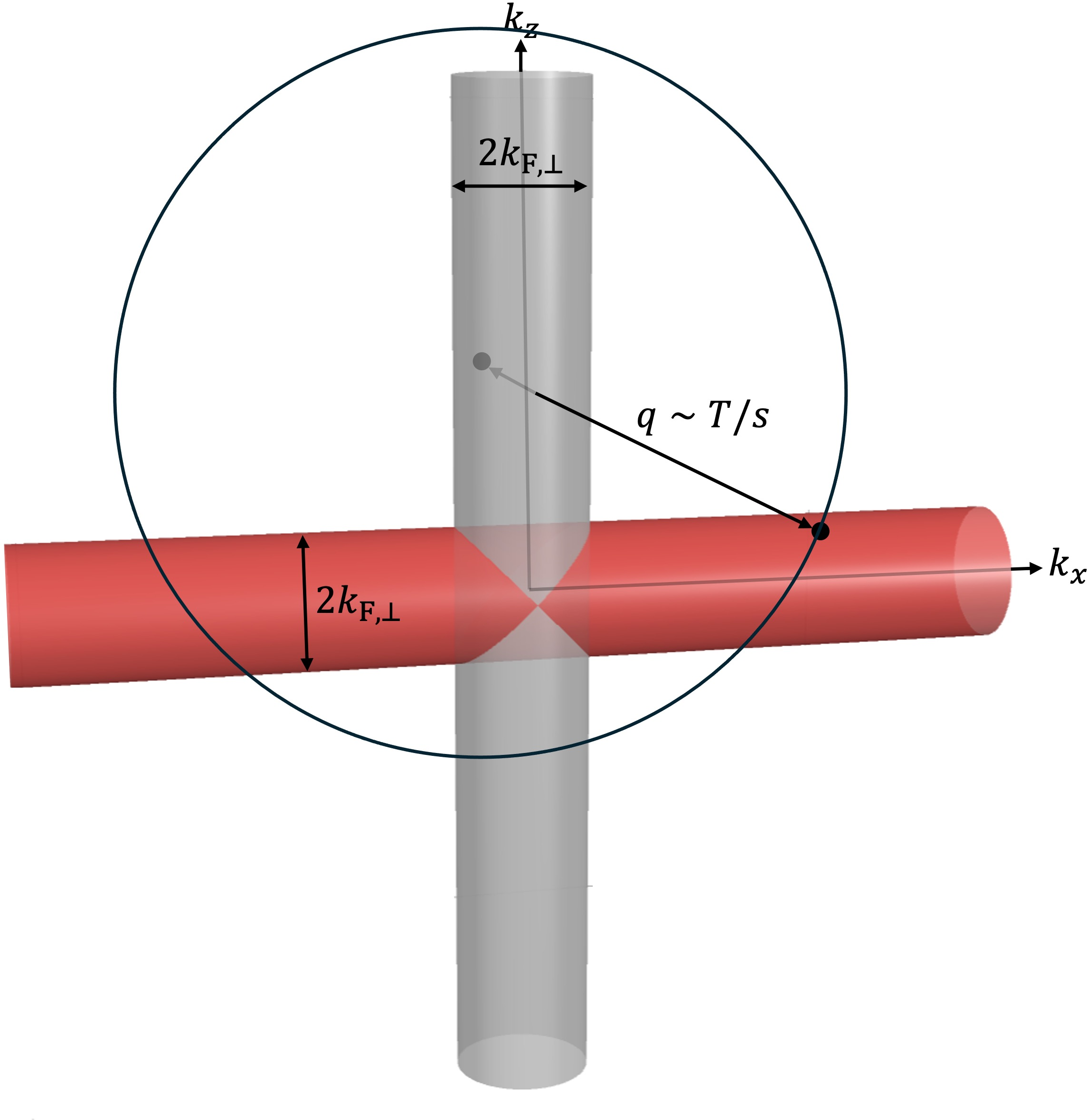
Figure 1: Intervalley electron scattering pathways for a t2g system, relevant for anisotropic energy relaxation analysis.
Energy Relaxation Regimes: Temperature Scaling
Single Acoustic Phonon Scattering
ERR for acoustic phonons follows established scaling laws. In the BG regime (T≪TBG), the cubic scaling 1/τE∼T3 is obtained. In the equipartition regime (T≫TBG), 1/τE∼T−1. For anisotropic (t2g0) Fermi surfaces, an intermediate regime (t2g1) appears, with t2g2 scaling. These regimes are distinguished precisely via integration over appropriate Fermi surface cross sections and detailed kinematic constraints.
Two-Phonon (2TO) Scattering
For two-phonon processes, the ESS is not universal and strongly depends on the phonon gap t2g3. With nearly gapless soft TO phonons (t2g4), in the BG regime, t2g5 is preserved. For t2g6, the scaling crosses over to t2g7. For large phonon gap (t2g8) or t2g9, ERR is exponentially suppressed.
A distinctive feature is the intermediate scaling (T30) in systems with highly anisotropic Fermi surfaces and T31. This intermediate regime is particularly relevant for multi-band perovskite oxides.
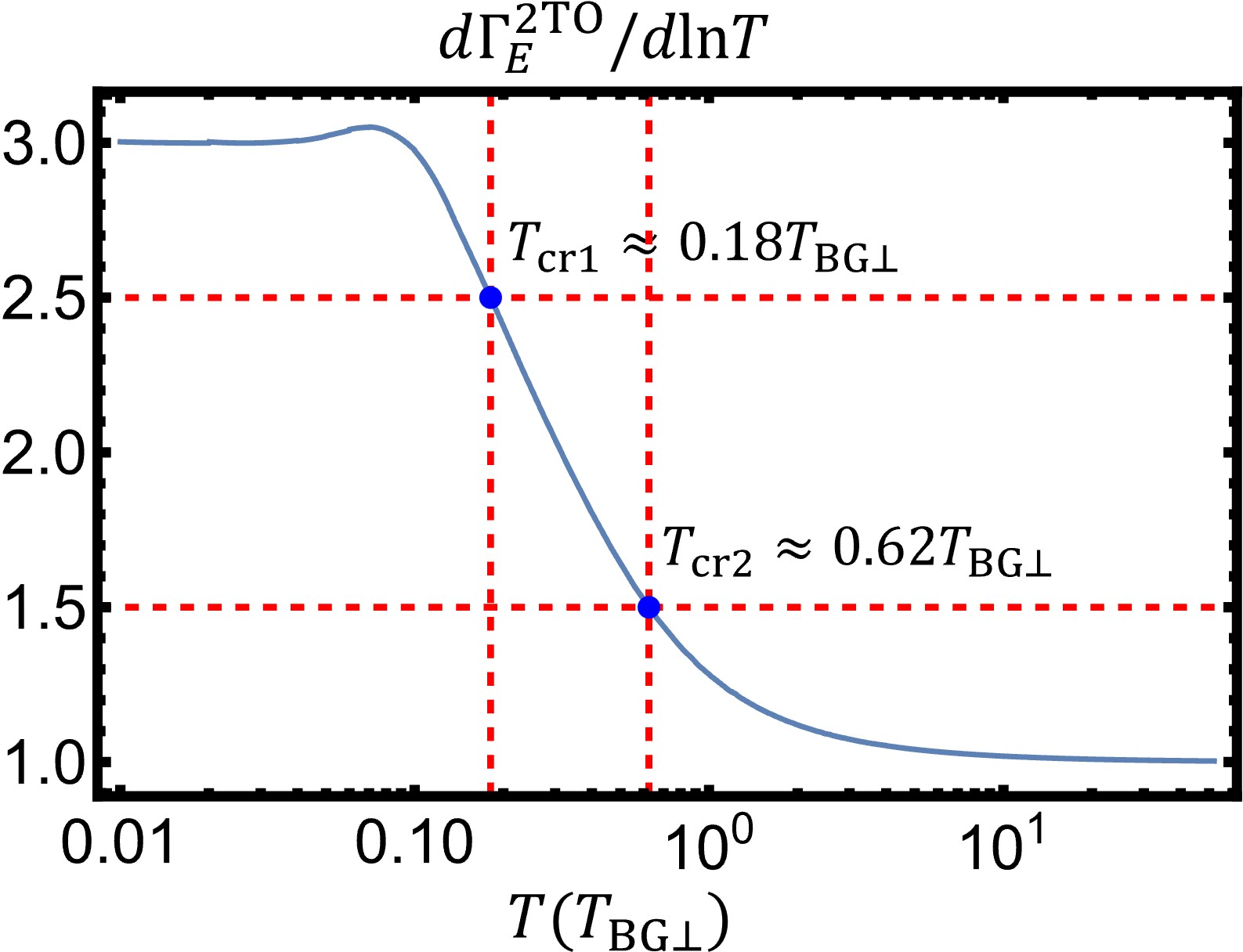
Figure 2: Scaling exponent T32 in ERR for isotropic systems, with the crossover temperature T33 defined by T34 (from numerical solution of the coefficient functions in analytic ERR formulae).
Figure 3: T35 for a representative anisotropy T36; two distinct crossover temperatures define transitions between cubic, quadratic, and linear ERR scaling regimes.
Breakdown of the Diffusive Energy Relaxation Model
The analysis highlights that, unlike single-phonon scattering, 2TO energy relaxation does not obey the standard energy diffusion (random walk in energy space) picture in the high-temperature regime. Rather, relaxation is dominated by rare events with large energy transfer, even though momentum transfer remains kinematically small. This leads to a parametric enhancement of the ERR over conventional diffusion predictions: T37, with T38 the single-particle (scattering) time, and T39 the temperature.
This breakdown is especially evident in the high-temperature (equipartition) regime for soft TO phonons, where the leading contribution comes from double emission/absorption events with large energy transfer but small total momentum transfer.
Numerical and Analytical Quantitative Results
The work presents analytic formulas for the ERR in all regimes, with closed-form expressions for the scaling functions in asymptotic limits. The crossover temperatures between scaling regimes are determined both analytically and numerically via the temperature derivative of the log ERR (i.e., effective exponent T−10). For typical STO parameters, the crossovers between T−11 scaling occur at temperatures set by the geometric mean of Bloch–Grueneisen scales and the degree of Fermi surface anisotropy.
Practical and Theoretical Implications
These results are highly relevant for interpreting energy relaxation and ultrafast optics experiments in quantum paraelectrics, perovskite oxides, and other systems near quantum criticality, where soft mode behavior and strong electron-phonon coupling via multi-phonon processes become dominant. The breakdown of the diffusion picture in energy relaxation also has implications for the modeling and understanding of nonequilibrium carrier dynamics in a broad class of correlated quantum materials.
The pronounced sensitivity of ERR to Fermi surface geometry, phonon spectra, and temperature regime provides a guiding principle for material and experimental design in studies of electron-lattice interactions. The theory is directly connected to recent pump-probe and THz spectroscopy experiments, which have begun to probe these nontrivial relaxation regimes (Kumar et al., 27 Jan 2025).
Future Directions
Building on the analytic foundation detailed here, promising directions include explicit inclusion of quantum critical fluctuations (extending beyond Boltzmann transport), exploration of higher-order phonon processes, and more refined inclusion of band and lattice symmetries. Given the increasing availability of ultrafast probing techniques and the emergence of materials with soft optical modes, further experimental-theoretical synergy in mapping out nonequilibrium relaxation regimes is expected.
Conclusion
This paper rigorously establishes the temperature scaling of the electron energy relaxation rate under single and two-phonon electron-phonon coupling—including for highly anisotropic multi-valley systems—and demonstrates explicit breakdown of the classical energy diffusion model for 2TO processes. The results clarify the fundamental limits of lattice-mediated energy relaxation, with broad applicability to quantum paraelectrics and beyond, and define clear criteria for interpreting experimental signatures across various relaxation regimes.