- The paper establishes a strict monotonic relationship between the signal envelope’s coefficient of variation and the Rician K-factor, enabling channel-adaptive feature modulation.
- It introduces the EAFM neural architecture with a dual-branch design and FiLM layers, achieving higher SEI accuracy under out-of-distribution channel conditions.
- The integration of a Mahalanobis-distance based fingerprint library robustly identifies unknown attackers while maintaining compact feature distributions.
Envelope-Guided Adaptive Feature Modulation for Cross-Channel Specific Emitter Identification and Verification
Introduction and Motivation
Specific Emitter Identification (SEI) and Verification (SEV) exploit device-dependent radio-frequency fingerprints (RFFs) for physical-layer device authentication. The practical deployment of SEI and SEV in wireless systems such as UAV communications and IIoT is fundamentally challenged by distributional shifts between training and testing channels—primarily due to changes in the Rician K-factor, which models the relative power of line-of-sight and multipath components. This work addresses the loss in SEI/SEV performance under such channel-induced domain shifts.
The authors provide a theoretical result establishing that the coefficient of variation (CV) of the received signal envelope is strictly monotonic with respect to the Rician K-factor. Leveraging this, they propose an envelope-guided adaptive feature modulation (EAFM) neural architecture, which is extended with a Mahalanobis-distance (MD)-based fingerprint library (EAFM-MD) for robust SEV against unknown transmitters.
Theoretical Foundation: Envelope Statistics and Channel Conditioning
A key theoretical contribution is the proof that the normalized envelope's CV decreases strictly as Rician K increases. Hence, envelope statistics provide a principled, measurable indicator of channel conditions, which can then guide adaptive feature correction in neural discriminators.
EAFM Model Architecture
The EAFM identifier leverages a dual-branch neural design:
- The main branch processes IQ-domain input for device-oriented feature extraction.
- The auxiliary branch processes the normalized envelope and extracts channel-conditioning features.
- FiLM (Feature-wise Linear Modulation) layers are employed to modulate main-branch features using auxiliary-branch outputs. This modulates device fingerprints dynamically based on channel state, attenuating feature drift under OOD channel conditions.
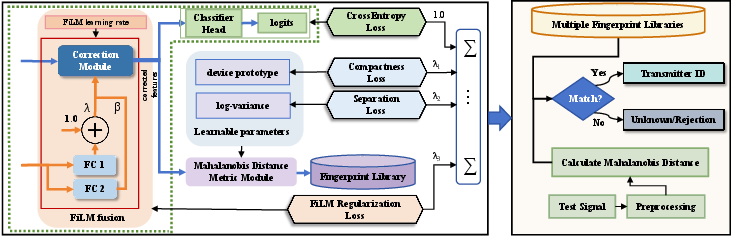
Figure 2: EAFM identifier architecture with fingerprint library for SEV, using per-device centroids, inverse covariance, and Mahalanobis distances.
This design is operationalized through a composition of three modules: dual-branch feature extractors, a FiLM correction module, and an identity classifier. The training objective uses cross-entropy loss, with differentiated learning rates for backbone and modulation parameters.
Mahalanobis Fingerprint Library and SEV Extension
For SEV, the EAFM-MD verifier replaces the softmax output with a fingerprint library. Each device is represented by a statistical prototype (mean and covariance) in the FiLM-corrected feature space. During verification, the Mahalanobis distance between a query and each device centroid is computed; if no distance falls below device-specific thresholds (obtained from empirical distributions), the input is rejected as an unknown device.
This architecture retains the closed-set discriminative power of the EAFM while enabling detection of OOD (spoofing) transmitters without exposure to attack samples during training. The metric-learning objective combines cross-entropy (identification), feature compactness, centroid separation, and FiLM regularization terms.
Empirical Results
Comprehensive experiments over synthetic UAV channel data with varied Rician K factors—some outside of those encountered in training—demonstrate that the EAFM identifier yields higher SEI accuracy and retention rate under OOD fading conditions compared to both non-modulated baselines and domain-adversarial/generalization methods.
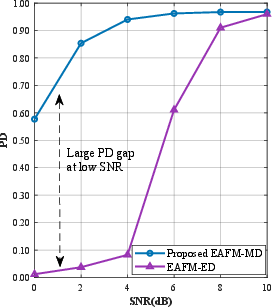
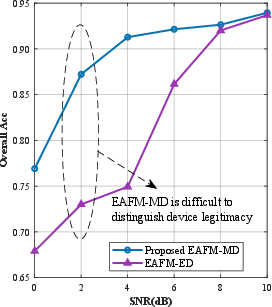
Figure 4: Probability of Detection (PD) and Overall Accuracy comparison across SNR for EAFM-MD and Euclidean-distance (ED) verifiers.
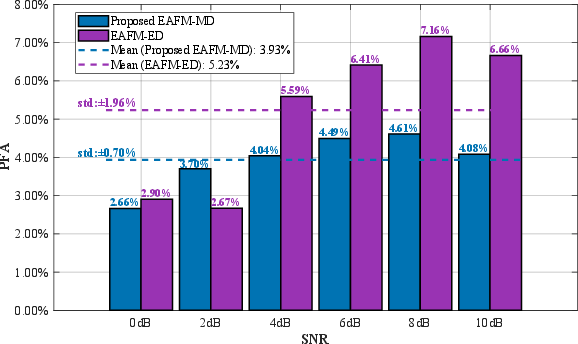
Figure 6: PFA comparison (mean and variance) for EAFM-MD and EAFM-ED, showing lower false alarm rates for the proposed method.
SEV with Unknown Attackers
The EAFM-MD verifier yields marked gains in detection probability (PD) and accuracy compared to both Euclidean distance baselines and models that omit envelope-guided feature modulation. At low SNR, the Mahalanobis-based verifier achieves a PD of 57.7% vs. 1.2% for the Euclidean baseline; at higher SNRs, the advantages persist though reduce in scale.
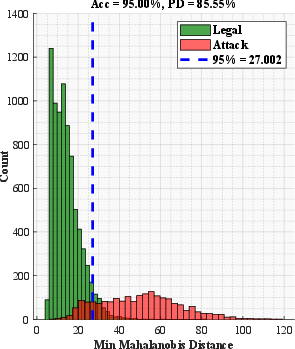
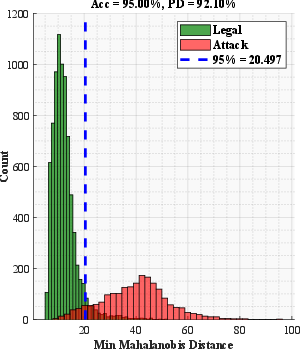
Figure 1: Out-of-distribution (OOD) detection performance—histogram of minimum Mahalanobis distances for baseline and EAFM-MD verifiers under challenging channel fade, showing tighter decision boundaries for EAFM-MD.
Channel-Robust OOD SEV
Evaluation under conditions combining OOD channels and unseen transmitters indicates that the EAFM-MD verifier achieves the highest accuracy and lowest false alarm rates. The Mahalanobis thresholding, informed by envelope statistics, produces more compact and well-separated feature distributions for legitimate devices, as shown by confusion matrices and OOD detection histograms.
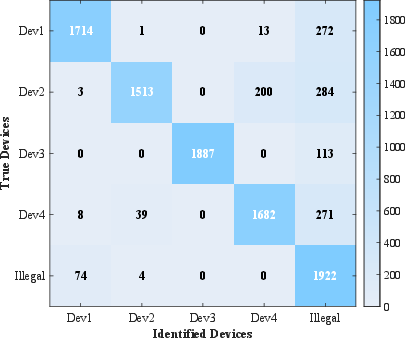
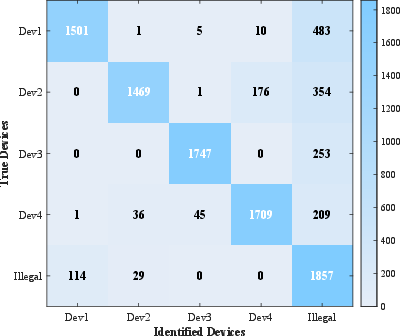
Figure 9: Confusion matrices for EAFM-MD and baseline under challenging OOD conditions, reflecting lower misclassification rates and superior attacker detection from EAFM-MD.
Implications and Future Directions
This paper demonstrates that explicitly quantifying and conditioning on measured channel statistics (envelope-based CV) can provide robust invariance to domain shifts in wireless SEI/SEV tasks. The proposed EAFM and EAFM-MD architectures systematically improve both in-domain accuracy and OOD generalization, especially in regimes with high channel variability or unknown spoofing threats. The use of Mahalanobis-fingerprint libraries further allows verification without requiring samples of all possible attackers during training.
Practical implications are significant for wireless security in dynamic or adversarial environments such as UAV swarms or distributed IoT deployments. The proposed methods require only legitimate signals for training, thus improving the scalability and deployability of SEI/SEV solutions.
Potential future work includes adaptation to more complicated channel models, online updating of device fingerprints, extension to massive-MIMO or multi-modal authentication, or integrating model-driven priors and uncertainty quantification for adversarial robustness.
Conclusion
The authors have established a principled framework for device identification and verification under cross-channel distribution shifts by integrating envelope-guided feature modulation and Mahalanobis-based fingerprinting. Theoretical analysis and comprehensive empirical benchmarks confirm superior robustness and attacker detection. These results motivate further research on physically-informed, channel-robust machine learning architectures for wireless security and authentication, especially in open, variable, or adversarial environments.