- The paper introduces a novel framework decomposing boundary vorticity into rigid-rotation and spin modes with explicit enstrophy characterization.
- It employs differential-geometric methods to integrate surface curvature and kinematics into the analysis of vorticity production.
- The findings enhance flow diagnostics and control by clarifying vortex generation mechanisms on moving and deforming boundaries.
The paper "The intrinsic decomposition of vorticity dynamics on an arbitrarily moving and deforming boundary" (2606.28763) presents a comprehensive, differential-geometric framework for analyzing the generation, decomposition, and transport of vorticity at boundaries in compressible Newtonian fluids. This theory unifies and extends previous paradigms for boundary vorticity dynamics, rigorously accounting for both boundary kinematics and surface geometry, and introduces novel insights into the elementary vorticity modes — the rigid-rotation and spin components — and their enstrophy (squared vorticity) constituents.
Motivation and Background
Vorticity production at boundaries is a cornerstone of fluid mechanics, underpinning phenomena ranging from boundary-layer formation to coherent structure genesis in turbulent flows. The boundary vorticity flux (BVF), initially introduced by Lighthill, quantifies this process. However, the non-uniqueness of the vorticity current tensor yields two primary, physically significant BVF definitions:
- The Lighthill-Panton-Wu (LPW) interpretation based on direct wall-normal vorticity gradients,
- The Lyman-Huggins (LH) interpretation utilizing the curl of vorticity.
Both have identical global surface integrals but differ locally, especially at complex, deforming boundaries. Recent observations have also revealed that vorticity itself can be decomposed into rigid-rotation (swirling) and spin (shear) modes, necessitating a decomposition theory that tracks these elementary modes and their boundary sources.
Mathematical Foundation: Surface Geometry and Operators
The authors develop a rigorous apparatus of surface differential geometry and coordinate-invariant operators suitable for arbitrarily moving and deforming surfaces. They define a family of surfaces in a local neighborhood via a normal extension map parameterized by the surface coordinates and the normal offset.
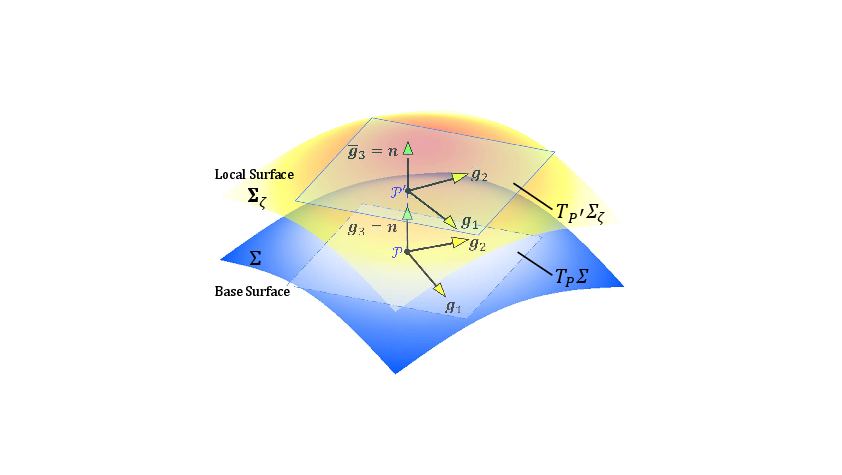
Figure 1: Schematic of the base surface Σ and a local surface extension Σζ, showing the tangent and normal vectors.
The treatment introduces surface metric G, curvature tensor K, and its conjugate K^, as well as surface-gradients, Laplace-Beltrami operators, and the surface Levi-Civita connection, allowing for fully covariant formulations of kinematic and dynamic quantities.
Decomposition of Velocity Gradient and Vorticity Modes
Within this geometric framework, the velocity gradient tensor A admits a symmetric-antisymmetric decomposition, which, together with surface projection, yields the following vorticity decomposition on a surface Σ:
- Rigid-rotation mode (R): Associated with the effective angular motion of the material surface normal.
- Spin mode (S): Relates to surface shear (relative vorticity minus total rotation).
- Wall-normal vorticity (ωn): Vorticity projected onto the surface normal.
This decomposition extends to enstrophy (the squared magnitude of vorticity), unpacking it into sums and cross-terms of the above modes. The approach provides explicit relations between these modes and fundamental surface quantities such as skin friction, curvature, and surface pressure gradients.
Boundary Vorticity Flux: LPW and LH Interpretations
The LPW and LH interpretations of the boundary vorticity flux arise from different forms of the viscous vorticity current tensor:
- LPW: Σζ0 (normal vorticity gradient),
- LH: Σζ1 (curl of vorticity projected tangentially).
A key observation is that while both have the same net flux through a closed boundary, they differ locally, especially in the presence of three-dimensional effects (e.g., non-trivial curvature, boundary deformation).
Full Intrinsic Decomposition
The authors present compact, fully intrinsic expressions for all constituent BVF and Boundary Enstrophy Flux (BEF) terms, reflecting contributions from:
- Surface pressure gradients,
- Tangential acceleration and external force,
- Surface curvature and its coupling with tangential and normal vorticity,
- Surface divergence of vorticity fields.
In their decomposition, all source terms are reduced to bilinear or quadratic couplings between vorticity components and surface curvature tensors, using the conjugate curvature tensor pair Σζ2. This compactification is achieved regardless of the local kinematic complexity of the boundary.
Explicit Expressions
For example, under the LPW definition:
Σζ3
where Σζ4 indicates the surface gradient, Σζ5 the curvature-vorticity coupling, and ellipses denote additional divergence terms.
In differential geometric terms, all terms involving surface deformation, surface-normal flow, and arbitrary movement are consistently absorbed by the surface tensors introduced.
Decomposition of Boundary Enstrophy Flux
The theory applies similar decomposition schemes to the boundary enstrophy flux (BEF), with analogous distinctions between LPW and LH forms. For both, the enstrophy creation rate due to different vorticity modes and their geometric interactions can be explicitly quantified, enabling tracking of rigid-rotation vs. shear-layer energy injection at the boundary.
Numerous terms — in both BVF and BEF — exhibit strong dependences on mean (Σζ6) and Gaussian (Σζ7) curvature, particularly through cross-terms such as Σζ8 and similar contractions.
Implications for Flow Diagnostics and Control
The decomposition theory enables unambiguous identification of the origin of various vorticity and enstrophy fluxes at boundaries, including their localization to surface features with strong curvature or dynamic deformation. Practically, these results have substantial implications:
- Experimental and computational diagnostics: Direct application to wall-resolved simulations and measurements (e.g., luminescent oil-film or pressure-sensitive paints) for reconstructing near-wall vortical structures and their energy budgets.
- Flow control strategies: By pinpointing the geometric and kinematic mechanisms of vorticity production, rational boundary manipulation (e.g., adaptive surface morphing or dynamic actuation) can be better targeted for turbulent drag reduction, vortex suppression, or aeroacoustic noise mitigation.
- Theoretical fluid mechanics: The approach generalizes classical boundary-layer theory, capturing three-dimensional effects and explicitly connecting vorticity generation to intrinsic geometric and kinematic features of moving and deforming surfaces.
Numerical and Analytical Results
While the paper is mainly theoretical, it emphasizes the generality of the formulation for arbitrary compressible Newtonian flows, including those with moving, flexible, or even oscillatory walls. The decomposition structure is preserved even under nontrivial surface motions or non-standard coordinate mappings.
Strong claims are made regarding the completeness of the boundary source identifications for all vorticity and enstrophy constituents, and the ability of the conjugate curvature tensor pair to unify a wide range of geometric effects into algebraically tractable forms.
Contrasts and Connections
The formalism enables direct comparison between the LPW and LH perspectives. For example, while both describe the same total vorticity flux, the LH form is more naturally associated with vortex reconnection and free-surface phenomena, and the LPW form is appropriate for formulating Neumann boundary conditions in adjoint and stochastic Lagrangian formulations.
Under special cases (e.g., stationary, rigid boundaries), the full theory collapses to classical forms, such as the original Lighthill flux balance, but the generalization unveils subtle new effects in more complex settings.
Conclusion
This work establishes a rigorous, differential-geometric theory for decomposing boundary vorticity and enstrophy dynamics into physically interpretable, curvature-coupled elementary modes at arbitrary, potentially deforming, boundaries. The compact algebraic representation of geometric and kinematic couplings enables both broad theoretical insight and direct application to wall modeling, diagnostics, and control in complex flows. Future directions could include systematic numerical validation for flexible/moving walls, integration into LES/RANS wall models, and extension to non-Newtonian or multiphase flows.
Key Visual
Figure 1: Schematic of the base surface Σζ9, neighborhood extension, tangent spaces, and local geometry, supporting the intrinsic surface tensor decomposition framework.