- The paper presents a differential-geometric framework that decomposes the boundary vorticity flux into four intrinsic modes for detailed analysis.
- It experimentally validates the methodology using global luminoscent oil film measurements on a NASA FAITH hill model to match theoretical predictions.
- The study elucidates the roles of geometry and pressure gradients in wall vorticity production, providing insights for turbulence diagnostics and control.
Theoretical Advances in Boundary Vorticity Dynamics
The study establishes a differential-geometric framework for the decomposition of the boundary vorticity flux (BVF) on stationary solid walls in three-dimensional viscous flows. Building upon the formalization by Lighthill and the generalization to 3D and deformable interfaces by Wu, the work addresses the canonical measurement of vorticity creation rate at boundaries, a foundational mechanism underlying coherent structure formation and wall-bounded turbulence.
Central to the approach is a quadruple decomposition of the BVF, such that the BVF splits into four intrinsic components, each quantifying the boundary creation rates of fundamental vorticity modes—tangential rigid-rotation, tangential spin, wall-normal rigid-rotation, and wall-normal spin—over an arbitrarily curved, stationary surface. The decomposition is constructed via a rigorous differential-geometric treatment of surface and near-wall flow, introducing explicit coordinate-free expressions for all constituent terms.
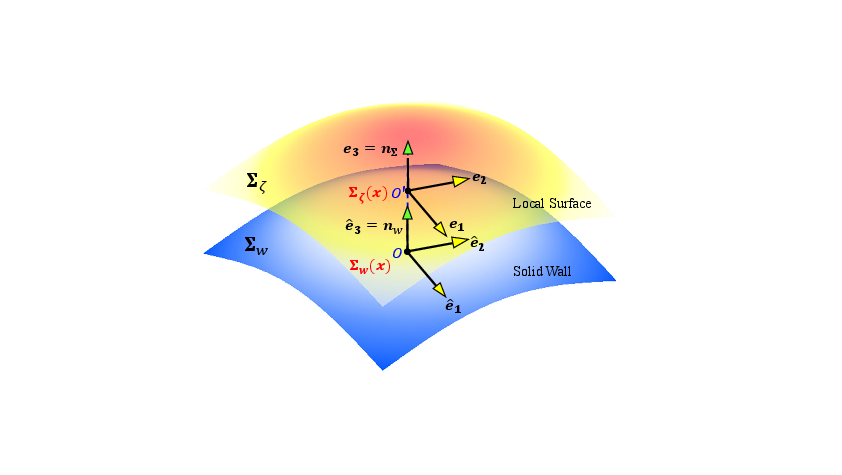
Figure 1: Schematic of the local surface, with intrinsic and extrinsic geometric attributes underpinning the decomposition of near-wall vorticity dynamics.
Mathematical Decomposition and Interpretation
The decomposition proceeds by:
- Decomposing the tangential vorticity ωπ into surface-element-based rigid-rotation (RΣ) and spin (SΣ) modes.
- Decomposing wall-normal vorticity ωn via a streamline-based (orbital) approach, yielding RL and SL.
The BVF vector is then split as:
σ=σπR+σπS+σnR+σnS.
- σπR: Tangential rigid-rotation flux—arises from curvature-vorticity coupling and local surface dilatation gradients.
- σπS: Tangential spin flux—receives contributions from both surface pressure gradient (Lyman flux) and geometry-vorticity coupling.
- σnR, RΣ0: Wall-normal rigid-rotation/spin fluxes—extracted via projected gradients along streamlines and skin-friction lines, encoding the solenoidal constraint and dynamical kinematics.
Key findings include the result that the curvature-induced terms (RΣ1) contribute to both tangential vorticity modes, while the Lyman (surface pressure gradient) term exclusively drives boundary spin production.
Experimental Validation: Flow Over a Hill Model
The theoretical apparatus is experimentally validated using global luminoscent oil film (GLOF) measurements of skin friction and surface pressure for low-speed flow over a NASA FAITH hill model. High-resolution skin-friction vectors and reconstructed surface pressures provide input for the quadruple BVF analysis.
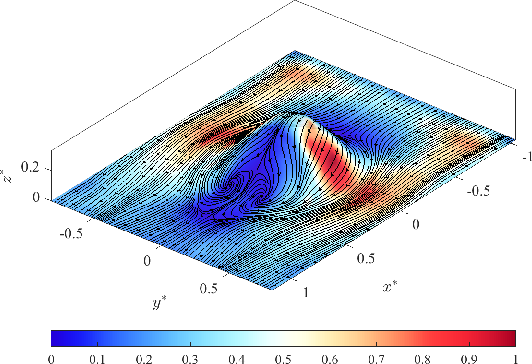
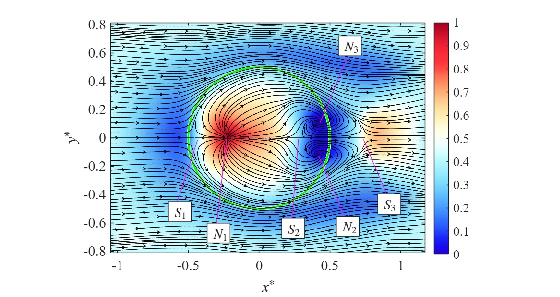
Figure 2: Skin-friction lines (RΣ2-lines) superimposed on the normalized modulus of the skin-friction vector, illustrating near-wall flow topology.
The experimental system resolves all elementary singularities (nodes, saddles) in the skin-friction field, which are consistent with the Poincaré index theorem for surface flows. Distinct surface regions (crest, flanks, leeward side) present pronounced variations in both the magnitude and topology of the decomposed BVF components.
Spatial Structure of the Decomposed BVF Components
The spatial distribution of each BVF mode is mapped and interpreted:
- RΣ3 and RΣ4 attain maxima at regions of high curvature and strong vorticity magnitude (crests/flanks).
- RΣ5 dominates the tangential spin mode and exceeds RΣ6 by approximately 1.7 orders of magnitude, particularly at high Reynolds number limits—consistent with classical boundary layer asymptotics.
- The wall-normal components, RΣ7 and RΣ8, feature strong localization near regions of large geodesic curvature and vorticity gradients (spiraling nodes, separation/reattachment lines).
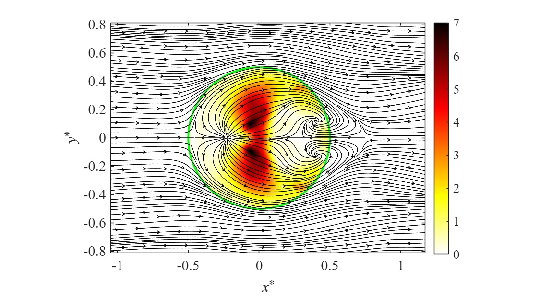
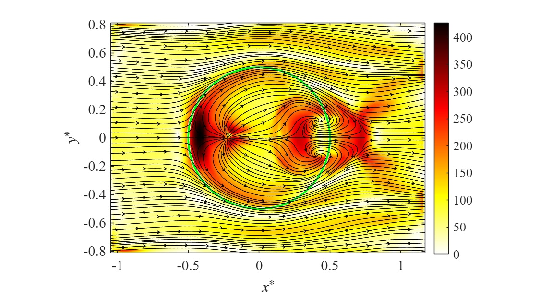
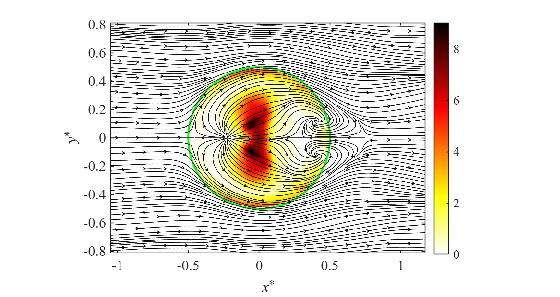
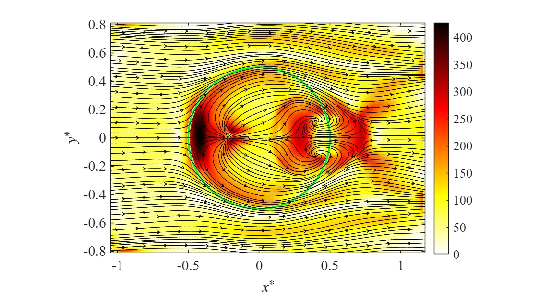
Figure 3: Skin-friction lines overlaid on RΣ9. Rigid-rotation mode creation rates are enhanced at high-curvature sites.
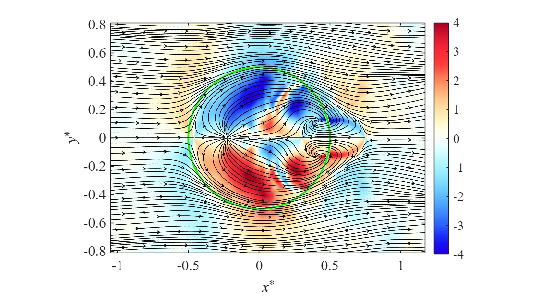
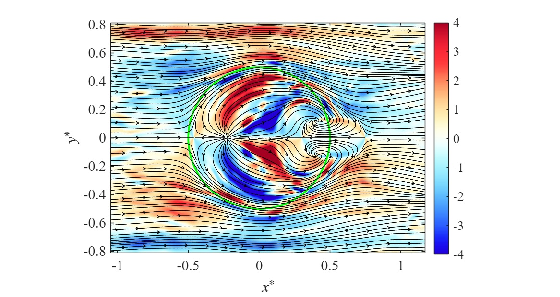
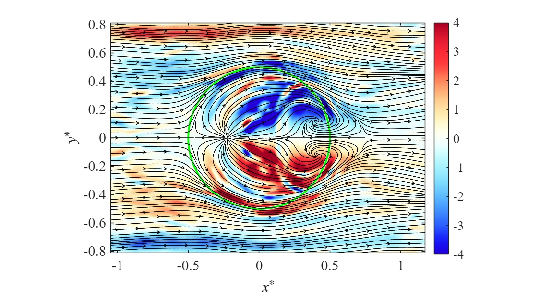
Figure 4: Skin-friction lines with wall-normal rigid-rotation flux SΣ0. Wall-normal creation rates peak at flanks and nodes with strong streamline curvature.
The quadruple decomposition reveals how vorticity production at the wall—via geometry, pressure gradients, and kinematic constraints—segregates into constituent dynamical mechanisms with clear physical and mathematical signatures.
Implications and Future Directions
The formalization and experimental validation of the quadruple BVF decomposition significantly extends the toolkit for analyzing near-wall vorticity dynamics. Practical implications encompass:
- Global diagnostics of coherent structure footprints from wall measurements.
- Isolation of geometry-vorticity and pressure-driven contributions to boundary-layer vorticity production.
- Improved mechanistic interpretation of skin friction and enstrophy flux signatures for wall-bounded turbulence, separation, and flow-induced noise prediction.
Theoretically, the framework generalizes to time-dependent, moving, and deformable boundaries, interfacial flows, and supports further development of turbulence modeling strategies grounded in surface vorticity transport. Anticipated future work includes applications in unsteady flow control, flow-structure interaction on flexible boundaries, and integration with advanced surface sensing methodologies.
Conclusion
This work provides a comprehensive differential-geometric decomposition of the boundary vorticity flux into four elementary dynamics modes, with direct experimental validation on a canonical complex geometry. The quadruple splitting enables precise identification of generation mechanisms for each vorticity mode at the boundary, bridges theoretical results to experimentally measurable quantities, and lays the foundation for refined understanding and control of near-wall flow phenomena in three-dimensional configurations.