- The paper introduces a continuous-time, reduced-form liquidation model that integrates shareholder dividend strategies with financial stability considerations via zone-dependent controls.
- It establishes that a barrier dividend strategy, calibrated using surplus-dependent liquidation risks, is optimal despite non-concave value regions.
- Numerical analysis reveals that a combined buffer and regulation regime uniquely enhances both shareholder value and expected survival.
Executive Summary and Motivation
This paper introduces a general continuous-time, reduced-form framework to study the interplay between shareholder value maximization and financial stability for a firm subject to formal liquidation risk. The principal innovation is the introduction of a surplus-dependent liquidation hazard rate alongside regulatory constraints on dividends, partitioning the firm's state space into three distinct operating zones: distress, regulated, and unregulated. This enables explicit evaluation of modern interventions such as restructuring "buffers below insolvency" and dividend bans near regulatory minima, mechanisms that are ubiquitous in real-world insolvency management and prudential regulation but are ill-captured by the classical, hard-barrier ruin models.
The research frames the dividend optimization problem as a singular stochastic control task over a general diffusion process, allowing for zone-dependent drift, volatility, and liquidation intensity. It derives both the explicit form for the optimal payout strategy and the shareholder value function, and provides tractable numerical methods for comparing regulatory designs. The key result is the demonstration that neither buffer-only nor regulation-only designs systematically improve both value and stability, but their combination can achieve a strict Pareto improvement over traditional immediate liquidation at insolvency.
Modeling Framework and Mathematical Structure
The surplus process RtD is controlled with admissible dividend strategies and admits zone-dependent drift and volatility:
dRtD=μ(Rt−D)dt+σ(Rt−D)dWt−dDt
Three thresholds a0<ad≤as define four operational regions:
- Immediate liquidation at a0.
- Distress (a0,ad): Firm can operate but faces surplus-dependent liquidation at rate ω(x).
- Regulated [ad,as): No dividend distributions permitted.
- Unregulated [as,∞): Full dividend discretion.
The optimal control problem is to maximize the present value of dividends until liquidation, with the expected survival time as the proxy for financial stability.
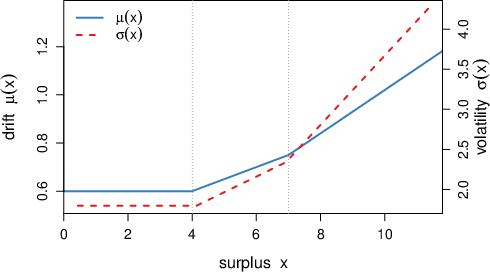
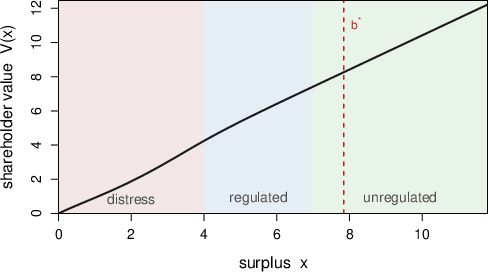
Figure 2: Zone-dependent drift and volatility profiles (left) and the value function V(x) across zones, with the optimal dividend barrier b∗ (right).
Main Theoretical Contributions
1. Barrier Optimality and Control Solution
The paper rigorously establishes that, under mild regularity and transversality conditions, the optimal policy is a barrier dividend strategy: pay out surplus above a computed threshold dRtD=μ(Rt−D)dt+σ(Rt−D)dWt−dDt0. The value function dRtD=μ(Rt−D)dt+σ(Rt−D)dWt−dDt1 and expected survival dRtD=μ(Rt−D)dt+σ(Rt−D)dWt−dDt2 are constructed as solutions to linear ODE systems pieced together according to the firm's zone, with explicit matching at interfaces.
Many of the technical challenges stem from coupling the singular control at the dividend barrier with discontinuities at the regulatory and distress boundaries—complications absent in both classic dividend and credit-risk models.
2. Non-Concavity of Shareholder Value
A significant analytical result is the breakdown of concavity for the value function dRtD=μ(Rt−D)dt+σ(Rt−D)dWt−dDt3 below the regulatory dividend threshold dRtD=μ(Rt−D)dt+σ(Rt−D)dWt−dDt4 when state-dependent liquidation intensity is present. This contrasts sharply with classical models, where dRtD=μ(Rt−D)dt+σ(Rt−D)dWt−dDt5 is always concave. The combination of dividend suspension and stochastic, surplus-dependent liquidation risk induces regions where the marginal value of surplus increases, especially deep in distress.
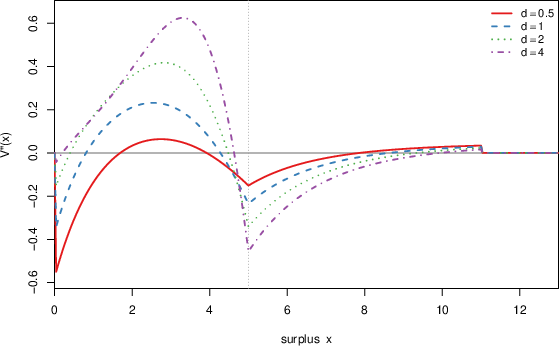
Figure 1: The value function's second derivative dRtD=μ(Rt−D)dt+σ(Rt−D)dWt−dDt6 exhibits convexity inside the distress region at high liquidation intensities—an effect absent in classic models.
3. Regulatory Design and Numerical Results
The central economic message emerges through a series of quantitative design experiments, contrasting four regimes:
- Traditional: Immediate liquidation at insolvency (hard barrier).
- Buffer-only: Distress zone below the traditional threshold, allowing continued operation at a cost of liquidation risk.
- Regulation-only: A no-dividend band above the insolvency threshold (softening the payout policy with no additional buffer).
- Combined: Both a buffer and a regulatory band.
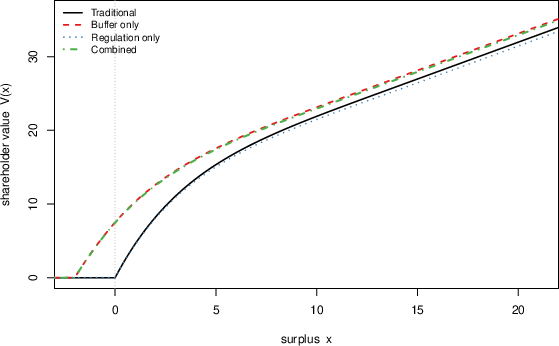
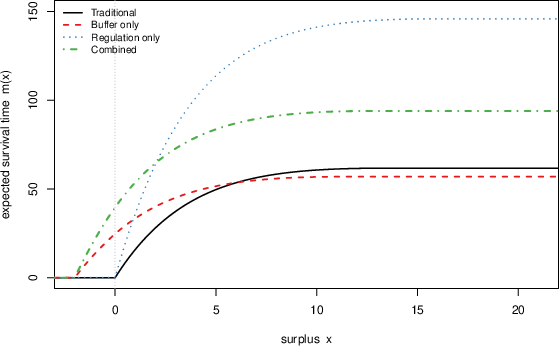
Figure 5: Shareholder value dRtD=μ(Rt−D)dt+σ(Rt−D)dWt−dDt7 (left) and expected survival dRtD=μ(Rt−D)dt+σ(Rt−D)dWt−dDt8 (right) for the four policy designs, highlighting that only the combined policy achieves improvements in both metrics over the traditional approach.
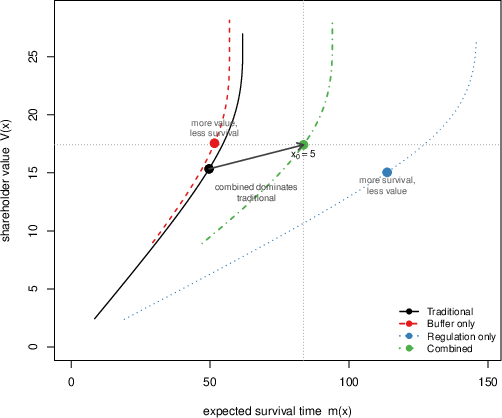
Figure 3: The value-survival trade-off traced as a function of initial surplus dRtD=μ(Rt−D)dt+σ(Rt−D)dWt−dDt9, with the combined design achieving strict Pareto dominance (upper right) over the traditional regime.
Key numerical insights include:
- Buffer-only regimes increase shareholder value but may reduce survival for well-capitalized firms due to earlier payouts and leaner capitalization.
- Regulation-only regimes increase survival but always reduce shareholder value.
- Combined regimes can achieve simultaneous improvement in both objectives, with the buffer region offsetting the value destruction imposed by strict dividend regulation above insolvency.
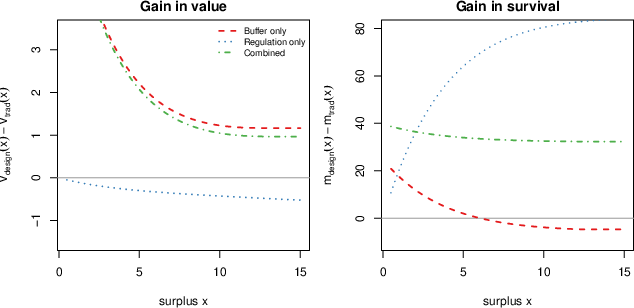
Figure 4: Gains in a0<ad≤as0 and a0<ad≤as1 over the traditional model. The combined design uniquely avoids negative regions in both axes.
4. Sensitivity and Robustness
The paper demonstrates, through parametric sweeps, that tightening the regulatory band produces a monotonic trade-off of value for stability, and that increasing the intensity of liquidation risk within the buffer region has predictable, but modest, adverse effects on both value and survival. Notably, use of non-increasing (state-dependent) hazard rates, as opposed to constant intensities common in the previous literature, provides superior value-stability profiles.
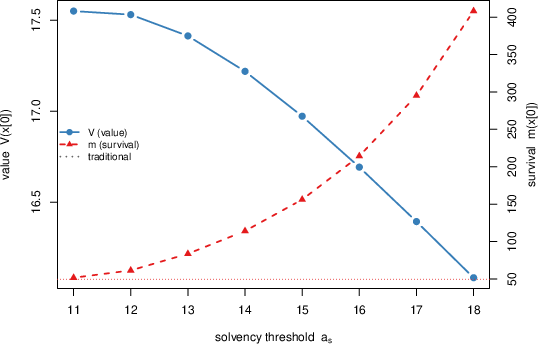
Figure 6: Shareholder value and expected survival as a function of the regulatory threshold a0<ad≤as2, demonstrating the smooth value-stability trade-off.
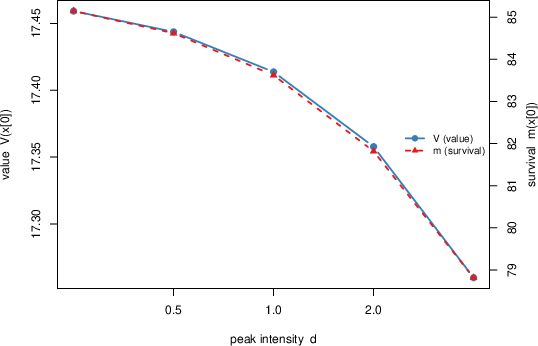
Figure 7: The effect of liquidation intensity parameter a0<ad≤as3 on value and survival; higher intensity reduces both, but the binding nature of the regulatory band limits sensitivity.
Empirical Simulation and Scenario Analysis
A Monte Carlo study further quantifies the full distributional impact of policy choices on time to liquidation and realized dividends, using common random numbers for exact scenario pairing:
- The combined regime sharply reduces the probability of early liquidation and the right-tail skew of the survival distribution, while maintaining dividend payments similar to buffer-only designs.
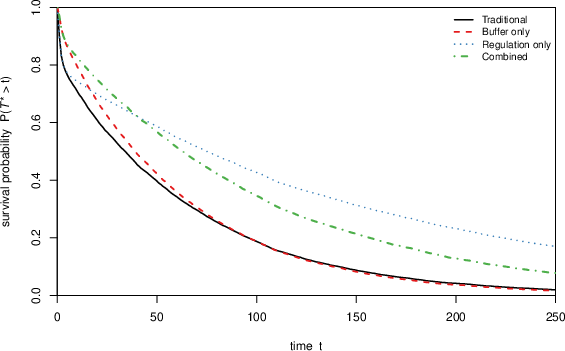
Figure 8: Empirical survival functions a0<ad≤as4 across regimes, confirming the combined design's dominance.
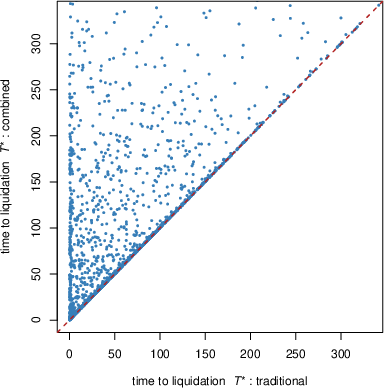
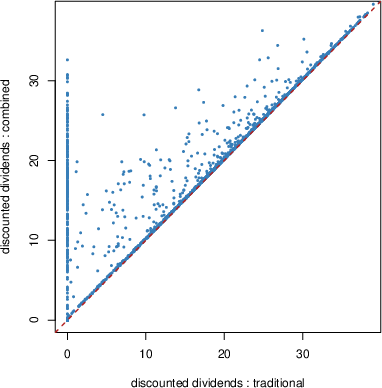
Figure 9: Scenario-by-scenario comparison of combined design (vs. traditional) on survival time (left) and realized dividends (right); almost all scenarios see longer survival under the combined regime with negligible loss in payout.
Practical Implications and Theoretical Extensions
Regulatory and design levers are highly consequential: policy effectiveness is not simply a function of the presence of buffers or restrictions, but of their calibration and interplay. Buffer-only approaches favor shareholder extraction but can be destabilizing; regulation-only mechanisms, common in insurance/banking capital protocols, stabilize at nontrivial value cost. Only careful, combined calibration can reliably achieve the dual mandate of financial stability and shareholder value preservation.
The tractable control-theoretic formulation and explicit solution logic enable comparison and sensitivity analysis of alternative regulatory strategies. This is directly applicable to stress-testing, capital planning, or the design of resolution regimes in corporate finance, insurance, and banking.
Theoretically, the framework is broad and flexible: extensions to incorporate endogenous hazard dynamics, Parisian ruin, explicit capital injections, transaction cost frictions, or stakeholder bargaining (game-theoretic liquidation) are natural and provide an agenda for subsequent methodological development.
Conclusion
This research systematically demonstrates that optimizing both shareholder value and financial stability requires careful, joint calibration of liquidation buffers and payout regulation. The canonical reduced-form model of surplus-dependent liquidation intensity embedded in a general diffusion context, with explicit regulatory zones, provides not only a rich and realistic basis for financial regulation analysis but also a tractable, computationally effective toolkit for comparing policy interventions.
The central technical advance is the explicit solution and verification for a singular stochastic control problem with region-dependent dynamics and state-dependent default risk. The qualitative finding that the value function need not be globally concave below the regulatory threshold has implications for shareholder incentives, capital allocation, and the design of prudential constraints.
This framework provides a practical methodology for stress testing and regulatory design, and suggests that effective prudential regimes must leverage the complementary interactions between payout restrictions and graduated resolution buffers to robustly enhance both value and stability.
Reference:
"Balancing Shareholder Value and Financial Stability under a Reduced-Form Liquidation Model" (2606.28706)

