- The paper establishes a clear dichotomy in optimal dividend strategies, identifying conditions when capital injections are or are not optimal.
- It develops a unified Markovian representation to derive explicit threshold characterizations for dividend payouts and injection regimes.
- Numerical experiments confirm threshold monotonicity and near-linear convergence of AC strategies to singular controls under extreme parameter values.
A Simple Approach to the Løkka-Zervos Dichotomy for Absolutely Continuous Dividend Strategies
This work provides a rigorous analysis of the stochastic control problem involving optimal dividend distribution under a Brownian risk model, where dividend payment rates are restricted to be absolutely continuous (AC) and bounded by an affine function of the surplus, while capital injections remain permitted but are not mandatory. The model further incorporates a penalty at ruin, synthesizing the trade-off between dividend maximization and loss minimization due to either ruin or costly capital injections. The surplus process is formulated as an arithmetic Brownian motion subject to controlled dividend outflows and possible singular capital inflows.
The main optimization problem investigates the value function
V(x)=π∈ΠsupEx[∫0τπe−qt(ℓtπdt−βdGtπ)−Pe−qτπ],
where admissible strategies consist of AC dividends with rates obeying 0≤ℓtπ≤KXtπ+S, K,S>0, and Gπ a non-decreasing (possibly singular) capital injection process. The parameters q, β, and P govern, respectively, the discount factor, injection cost, and penalty at ruin. The central novelty lies in explicitly handling the dichotomy emerging from the interplay between the cost of ruin and the cost of capital injections, producing distinct regimes for optimal control.
The Løkka-Zervos Dichotomy and Sub-Problems
The Løkka-Zervos dichotomy describes two mutually exclusive optimal regimes:
- When capital injection is too costly, it is optimal never to inject: dividends are paid at maximal admissible rate above a threshold, and ruin is allowed.
- When capital injection is not prohibitively expensive or the penalty for ruin is high, it is optimal to inject capital at the boundary (i.e., keep the process above zero) while paying dividends at the maximal admissible rate above a threshold.
Mathematically, this dichotomy is encoded through two sub-problems:
- No-injection (de Finetti) Problem: Optimization with Πd (no capital injection, Gπ≡0), optimizing dividends up to the first ruin.
- Bail-out Problem: Optimization with Πc (forced positivity, 0≤ℓtπ≤KXtπ+S0 via singular injections), optimizing dividends under continuous survival.
Both value functions 0≤ℓtπ≤KXtπ+S1 and 0≤ℓtπ≤KXtπ+S2 have semi-explicit representations and threshold characterizations obtained as solutions of nonlinear equations involving the problem parameters.
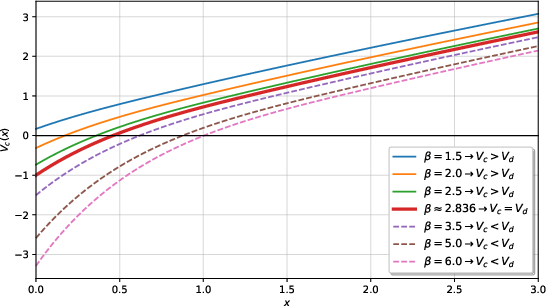
Figure 1: 0≤ℓtπ≤KXtπ+S3 for different 0≤ℓtπ≤KXtπ+S4 in the regime where parameters are favorable, showing transitions in the optimal regime as injection cost varies.
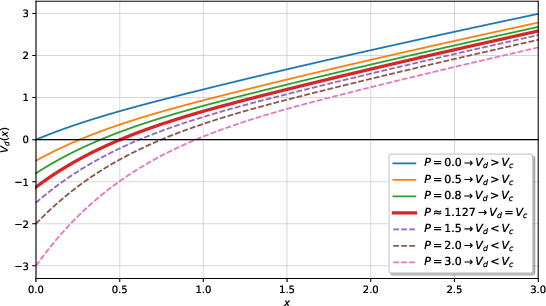
Figure 2: 0≤ℓtπ≤KXtπ+S5 for different penalty values 0≤ℓtπ≤KXtπ+S6, illustrating the regime switch as the penalty at ruin increases.
Unified Representation and Analytical Structure
A notable contribution of the paper is the unified Markovian representation for both sub-problems:
0≤ℓtπ≤KXtπ+S7
where 0≤ℓtπ≤KXtπ+S8 is the expected discounted dividends until threshold exit and 0≤ℓtπ≤KXtπ+S9 is the discounted probability of hitting zero before crossing the barrier at K,S>00. This structural form exposes a duality between injection and penalty costs, enabling threshold monotonicity results:
- The threshold for pure dividends K,S>01 increases in the penalty at ruin K,S>02.
- The threshold for bail-out K,S>03 increases in the injection cost K,S>04.
These thresholds fundamentally dictate the control boundaries for dividend flow and capital injection under the AC affine-constrained regime.
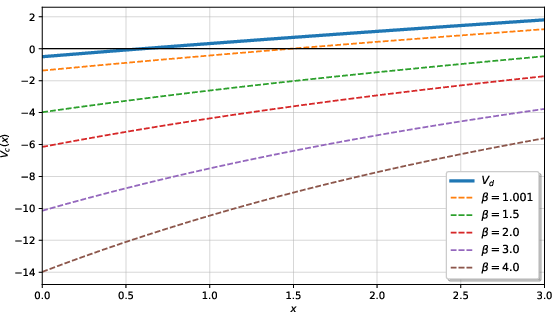
Figure 3: K,S>05 for different K,S>06 under unfavorable parameters (high risk or low drift), confirming the strict optimality of liquidation strategies.
Main Results and Numerical Sensitivity Analysis
The main theorems provide necessary and sufficient conditions on parameters K,S>07 that partition the parameter space into regions dictating which regime—inject-or-not—in the dichotomy is optimal. The explicit threshold crossing points are given by solutions to nonlinear equations reflecting the interplay between K,S>08 and K,S>09, which may be formulated using either parameter for the dichotomy criterion.
Notably, if parameters render the company inviable (e.g., high volatility, low drift, or unfavorable cost structure), liquidation is optimal: maximal dividends at all times until ruin, without capital injections.
A series of detailed numerical experiments highlight:
- The regime transition in Gπ0 and Gπ1 as Gπ2 increases or Gπ3 increases.
- The ability to recover the singular control (Løkka-Zervos barrier) regime by sending Gπ4 or Gπ5 large, despite the AC constraint.
- Monotonicity and near linearity in optimal threshold dependence on Gπ6, suggesting "regularization" of singular control strategies by the affine-bound setting.
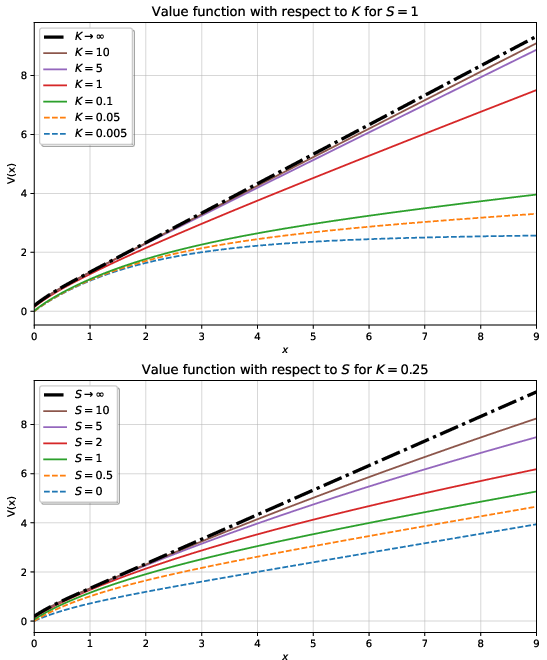
Figure 4: Value function versus Gπ7 or Gπ8 with Gπ9, comparing AC-affine and singular strategies.
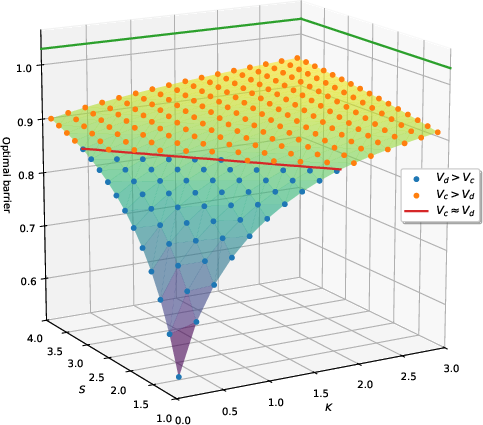
Figure 5: Optimal threshold behavior as functions of q0 and q1 (with q2), displaying both regime boundaries and convergence to singular barrier values.
Implications and Future Outlook
The explicit, elementary approach extends the Løkka-Zervos dichotomy to a broader class of controls, clarifies the dependence of optimal policies on the affine bound and cost parameters, and establishes a unifying structural representation valuable for both analytic and numerical study. The results bear practical implications for risk and dividend management in finance and insurance, especially for regulatory or operational regimes enforcing smoother dividend distribution constraints.
Future theoretical developments may further generalize these results to Lévy-driven models, non-affine or state-dependent dividend bounds, or deeper characterization of the financial interpretations for duality between injection and penalty costs. Algorithmic improvements building on this framework could yield efficient real-time policies for dividend management in practice.
Conclusion
This study rigorously demonstrates that, under AC affine-dividend constraints and penalties at ruin, the Løkka-Zervos dichotomy persists with explicit, tractable structure. The behavior of the optimal policy—inject or not—can be determined by critical relations among model parameters, and affine bounds are sufficient to nearly emulate singular-optimal controls in the large parameter regime. The dual role of the penalty and injection cost in governing regime transitions enhances understanding and tractability for a broad class of stochastic control problems in finance and insurance.

