- The paper demonstrates that graviton bremsstrahlung in scalar leptoquark decays can generate a high-frequency stochastic gravitational wave background consistent with SU(5) GUT constraints.
- It employs a full Boltzmann analysis to trace leptoquark thermal evolution and maintain equilibrium until freeze-out, validating benchmarks with masses up to 10^15 GeV.
- The study highlights detection prospects via resonant cavity experiments, offering actionable insights for probing GUT-scale phenomena through high-frequency gravitational waves.
Gravitational Waves from Graviton Bremsstrahlung in Scalar Leptoquark Decays
Introduction
This work presents a detailed study of the stochastic gravitational wave background (SGWB) generated via graviton bremsstrahlung in the decays of scalar leptoquarks, utilizing the SU(5) Grand Unified Theory (GUT) as a concrete framework. Scalar leptoquarks, being colored scalar bosons that couple simultaneously to leptons and quarks, naturally arise in unified models, but are stringently constrained to superheavy masses by limits on proton decay. Their quantum-gravitational decay processes in the early universe thus become viable sources of a high-frequency SGWB, potentially accessible to novel gravitational wave (GW) detection technologies operating in the MHz–GHz regime.
Scalar Leptoquark Framework and SU(5) GUT Embedding
The scalar leptoquark sector is based on the minimal SU(5) GUT, with Higgs multiplets in the 5H and 45H representations responsible for both electroweak symmetry breaking and fermion mass generation. The color triplet components (Δa) of the 5H multiplet are identified as the leptoquark states of interest. Because their baryon and lepton number violating Yukawa couplings also mediate proton decay, their masses are tightly constrained: even with arbitrary flavor structures, typical masses must satisfy mΔ≳1013 GeV to evade current bounds.
The relevant proton decay channels (e.g., p→e+π0, p→K+νˉ) are exhaustively analyzed, taking into account full CKM and PMNS mixing, running masses and couplings at the GUT scale, and a comprehensive random parameter scan. The strongest limit arises from p→K+νˉ, robustly excluding scalar leptoquark masses below ∼1013 GeV.
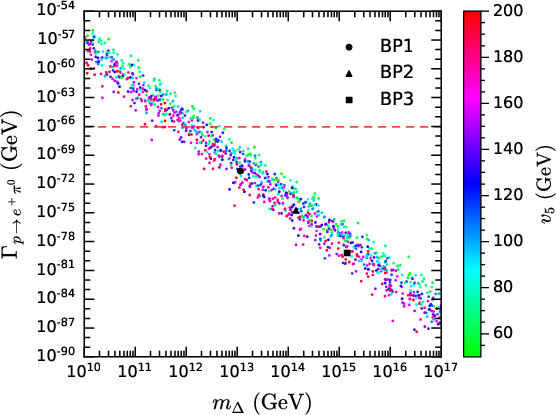
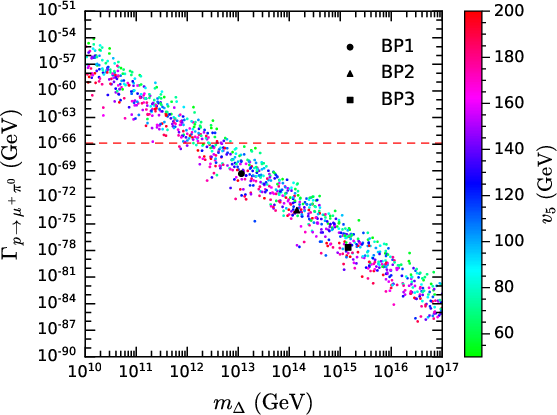
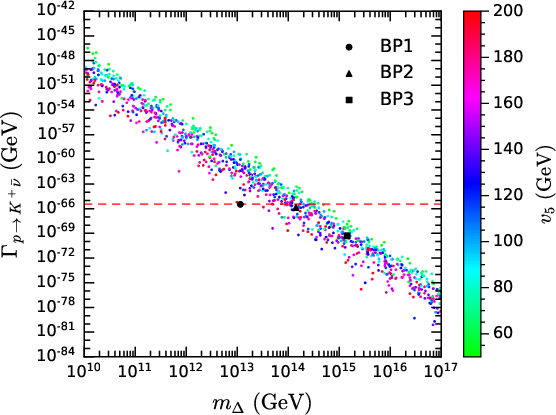
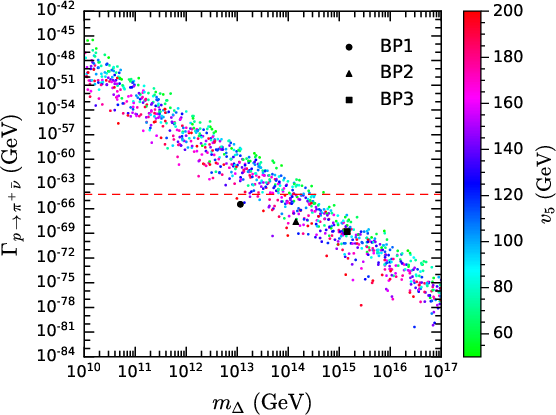
Figure 1: Partial widths for proton decay channels p→e+π0 (a), 45H0 (b), 45H1 (c), and 45H2 (d), with experimental limits (red dashed) and three benchmark points indicated.
Thermal Evolution and Boltzmann Analysis
To compute the GW signal from graviton bremsstrahlung, the evolution of the scalar leptoquark number density in the early universe is obtained by numerically solving the full Boltzmann equation, including all relevant annihilation, coannihilation, and decay processes. The implementation incorporates tree-level matrix elements for both two-body decays and 45H3 (co)annihilations, with all couplings evolved to the appropriate high scale.
Annihilation and decay rates remain well above the Hubble expansion rate down to temperatures 45H4, guaranteeing equilibrium until thermal freeze-out. Benchmark scenarios with 45H5, 45H6, and 45H7 GeV are studied in detail, with all chosen points consistent with proton decay constraints.


Figure 2: Feynman diagrams for two-body decays of the scalar leptoquarks 45H8.
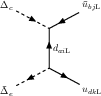
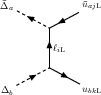
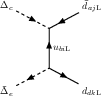
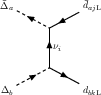


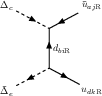
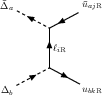
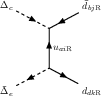

Figure 3: Feynman diagrams for 45H9 annihilation processes of scalar leptoquarks via Yukawa couplings.
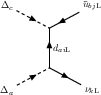
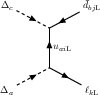
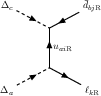
Figure 4: Feynman diagrams for Δa0 coannihilation processes of scalar leptoquarks via Yukawa couplings.
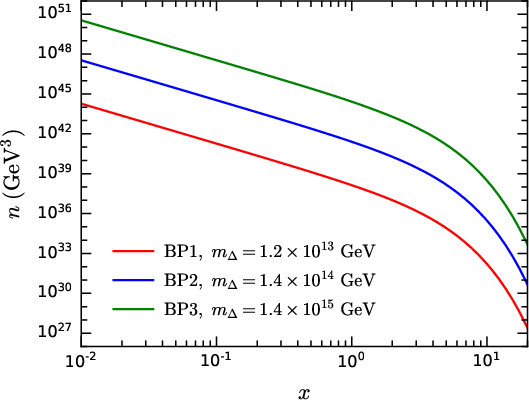
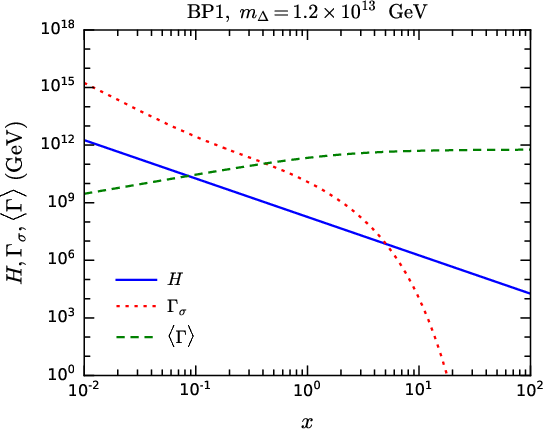
Figure 5: Evolution of (a) total leptoquark number density for three benchmarks, and (b) Hubble rate versus total annihilation/coannihilation and decay rates for BP1.
Graviton bremsstrahlung arises in all two-body decays of the scalar leptoquarks, suppressed by Δa1 but partially compensated by the superheavy nature of Δa2. The rate is analytically derived from the linearized Einstein-Hilbert Lagrangian coupled to matter, yielding explicit energy-differential decay rates for all decay channels as a function of the graviton energy.
The cosmological SGWB spectrum is then determined via convolution of these rates with the leptoquark number density history and cosmological redshift. The resulting present-day SGWB is expressed as Δa3, accounting for expansion history, changing relativistic degrees of freedom, and all relevant cosmological parameters.
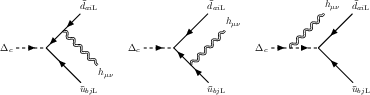
Figure 6: Feynman diagrams for the graviton bremsstrahlung process Δa4.
Results: SGWB Frequency and Detection Prospects
The predicted GW spectra originating from leptoquark bremsstrahlung exhibit sharply peaked profiles in the high-frequency regime: cutoff frequencies are set by Δa5 and reach up to several hundred GHz for the largest considered benchmark. The SGWB spectral energy density reaches its maximum at frequencies Δa6–Δa7 GHz depending on Δa8, with integrated amplitudes sensitive to both the leptoquark mass and the specifics of the Yukawa sector.
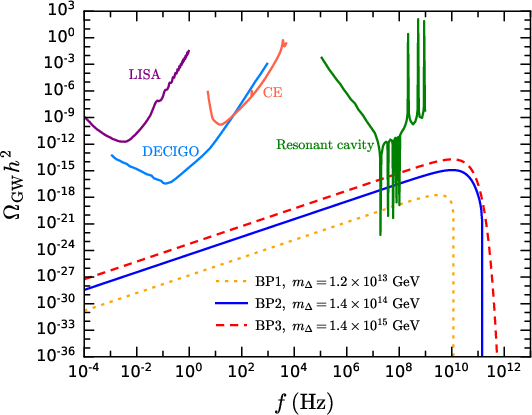
Figure 7: SGWB spectra from graviton bremsstrahlung in scalar leptoquark decays for three benchmarks, with sensitivities of CE, LISA, DECIGO, and resonant cavity experiments overlaid.
A key result is that, although inaccessible to ground-based interferometers such as LIGO, a portion of the predicted SGWB falls within the reach of proposed high-frequency GW resonant cavity detectors leveraging the inverse Gertsenshtein effect, sensitive in the Δa9 MHz to several GHz range. These results provide compelling motivation for the development and commissioning of high-frequency GW detection methods, which could offer unique access to GUT-scale physics and early-universe quantum gravity processes.
Implications and Future Directions
The calculations demonstrate that the SGWB from graviton bremsstrahlung in scalar leptoquark decays serves as a robust probe of the superheavy sector characteristic of GUT scenarios. Detection of such a signal would furnish evidence not only for the existence of new GUT-scale states but also direct signatures of quantum gravitational processes in the early universe. From a theoretical standpoint, the approach connects flavor structure, baryon/lepton number violation, and cosmological phenomena in a single, testable framework.
Future developments may involve:
- Extending the analysis to nonscalar or vector leptoquark representations and alternative GUT embeddings.
- Considering the interplay of graviton bremsstrahlung with other GW sources (e.g., first-order phase transitions, cosmic strings) for the structuring of the full high-frequency SGWB.
- Refinements in integrating quantum gravity corrections and the impact of nonminimal gravitational couplings.
- Detailed experimental studies for the optimization and deployment of MHz–GHz GW detectors.
Conclusion
This work systematically computes the stochastic gravitational wave background induced by graviton bremsstrahlung in the decays of scalar leptoquarks mandated by SU(5) grand unification. With rigorous treatment of flavor physics, thermal history, quantum gravity corrections, and experimental constraints, the study establishes that superheavy leptoquarks can source an observable high-frequency SGWB, forming a new window into early-universe physics and GUT-scale phenomena. The results underscore the phenomenological importance of high-frequency GW experiments in probing scenarios otherwise inaccessible to both current colliders and traditional low-frequency GW observatories.